 Add to Preferred Sources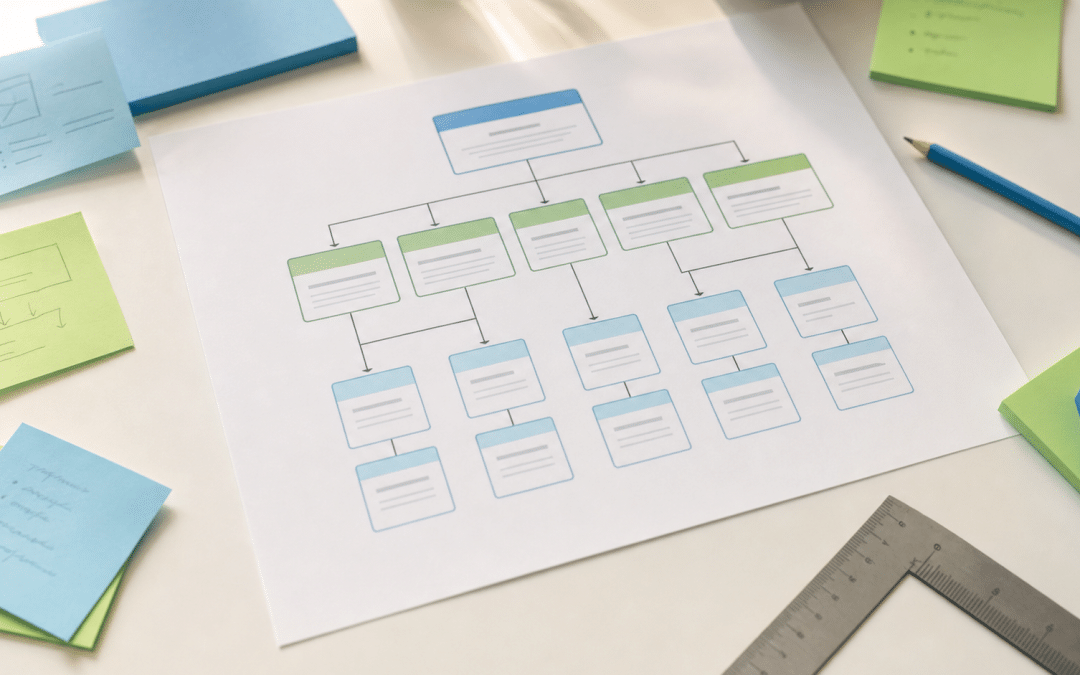
An seo information architecture guide for South African websites begins with a question you can answer in thirty seconds: open your homepage and count how many clicks it takes to reach your most important service or product page. If the answer is four or more, the SEO practitioner consensus — based on crawl-frequency and link-equity analyses — is that the page is receiving less crawl attention than shallower pages. Proper SEO in South Africa is built on a foundation of site structure long before a single piece of content is written, published, or promoted.
Information architecture — the way pages are named, grouped, and connected — controls how efficiently search engines crawl your content, how link equity flows to your key pages, and how clearly Google can map your topical authority. Your internal linking strategy operates on top of this structure; the hierarchy underneath determines whether those links carry weight or circulate through an unmapped maze.
Most South African sites under 100 pages need a flat structure. Growing ecommerce stores need category depth. Content-heavy publishers need the full pillar-cluster model. This seo information architecture guide tells you which one applies to you and how to build it correctly.
Quick Answer
An SEO information architecture guide covers how to organise a website's pages into a hierarchy Google can crawl efficiently: key pages within two to three clicks of the homepage, clean URLs that reflect content hierarchy, topic clusters where every cluster page links back to a central pillar, and XML sitemaps that signal your priorities.
The right model depends on your site size — flat for small service sites, category-depth for ecommerce, pillar-cluster for large content publishers. Google's Googlebot fetches only the first 2MB of any HTML page, so structural decisions also have a direct technical impact on what gets crawled at all.
In This Guide
What Is SEO Information Architecture?
How Site Hierarchy Affects Google Crawling
URL Patterns That Help Search Engines Find Your Pages
Building Topic Clusters Around Your Core Services
Is Your Site Structure Holding Back Your Rankings?
Share your site URL and we will map the structural issues blocking your organic growth — at no cost, with no commitment.
Get a Free Structure ReviewWhat Is an SEO Information Architecture Guide?
SEO information architecture is the practice of organising a website's pages into a logical hierarchy that helps search engines crawl, index, and rank content — and helps users find what they need without friction. Think of it as website information architecture applied specifically to organic search: how you structure the site shapes how authority flows, how crawlers navigate, and how Google maps your topical expertise.
A practical seo information architecture guide must address three layers together: the page hierarchy (which pages sit under which parent categories), the URL structure (how page addresses reflect that hierarchy), and the internal link network (how pages connect to distribute authority and signal topical relevance). Fixing only URLs without fixing the link network leaves the job half done.
Architecture decisions compound over time. A poorly planned site built at 20 pages becomes a structural liability at 200 and a genuine crawl problem at 2,000. Getting the foundation right — or rebuilding it deliberately before you scale content — is among the highest-leverage technical decisions a South African site owner can make. When businesses ask about information architecture for websites at scale, this compounding effect is the core argument: technical SEO for South African websites starts with structure, and optimising individual pages on top of a broken hierarchy is slow, expensive work.
The Three-Layer Framework
Every site architecture decision touches one of three things: the hierarchy (what lives where), the URL pattern (how addresses represent the hierarchy), and the link network (how pages connect). Fix all three together. Patching only one layer rarely moves rankings.
How Site Hierarchy Affects Google Crawling
Site hierarchy determines how deeply Googlebot must travel to reach every page. Practitioners consistently treat depth as a proxy for crawl priority, based on analyses of how crawl frequency and link equity flow through real sites — the working model is that pages reachable in fewer clicks receive more attention and accumulate authority more efficiently than those buried behind five or six navigation steps. As a practitioner working rule of thumb, important pages should sit within three clicks of the homepage; pillar pages should ideally sit within two.
The table below maps SA site types to the appropriate hierarchy model. The decision changes based on your page count because the structural cost of a deep hierarchy is negligible at 20 pages and significant at 5,000.
| Site Type | Approximate Page Count | Recommended Architecture | Maximum Depth |
|---|---|---|---|
| Service / professional site | Under 100 pages | Flat: homepage → service pages → supporting posts (no subcategories needed) | 2–3 clicks |
| Ecommerce store (WooCommerce / Shopify) | 100–5,000 pages | Category depth: homepage → collection → subcategory → product (3 levels max) | 3–4 clicks |
| Content-heavy publisher | 5,000+ pages | Pillar-cluster: hub pages → topic clusters → supporting posts, with XML sitemap segmentation | 3 clicks from pillar |
Most South African businesses running on WordPress default to a /%category%/%postname%/ permalink structure that adds one unnecessary level to every post. A retail site using category → subcategory → post can push product articles four or five clicks deep before any deliberate IA planning has taken place. That structure should be flattened or reorganised before content investment accelerates.
Crawl budget context: Google's crawl budget guidance states that most sites do not need crawl budget optimisation — it becomes a meaningful concern primarily above 10,000 pages with rapid daily content changes. For smaller SA sites, hierarchy matters mainly for link equity distribution and user navigation, not raw crawl frequency.
URL Patterns That Help Search Engines Find Your Pages
A well-formed URL tells both users and search engines what a page covers before it is clicked — descriptive, hyphenated slugs that reflect site hierarchy are the mechanism by which URL structure actively supports crawling and indexing. This is where any seo information architecture guide — or a broader site structure SEO guide — must be specific, because it is also where SA sites make the most recoverable mistakes. Google's own SEO Starter Guide recommends descriptive URLs with meaningful words that reflect content hierarchy; the inverse — random identifiers, parameter-heavy dynamic URLs, or unnecessary subdirectories — adds noise that slows down discovery and complicates indexing.
Practical rules for SA sites:
- Use hyphens between words, always lowercase. Underscores and spaces are tokenised differently; hyphens are the standard Google reads cleanly.
- Reflect hierarchy logically but don't over-nest. /services/seo/ is correct; /services/digital-marketing/seo/on-page/technical/ is burying the page. Cap URL depth at three to four path segments for pages that need to rank.
- Group related pages in directories. Google notes this helps it learn how frequently content in each section changes — useful for news sections, product catalogues, or blog clusters that update at different rates.
- Keep slugs short and keyword-bearing. Drop filler words (a, the, for, in) from slugs while keeping the primary keyword intact.
- Never change URLs without redirects. URL migrations without 301 redirects lose the accumulated authority of every inbound link pointing at the old address.
Avoid: /digital-marketing/seo-services/on-page-seo/technical-seo/south-africa/guide-2026/ — six levels, duplicate concept words, date in URL means it ages out of relevance
Use: /technical-seo-south-africa/ — one level, keyword-bearing, permanent, no date dependency
Building Topic Clusters Around Your Core Services
Topic clusters are the dominant architectural pattern for content-heavy SA sites in 2026 because they solve two problems at once: they signal topical authority to search engines, and they keep important hub pages within a shallow click depth for crawlers and users alike. The model works as a hub-and-spoke where a central pillar page covers a broad topic comprehensively, and cluster pages go deep on specific subtopics — each linking back to the pillar.
For a South African SEO agency, the pillar might be a broad SEO guide for South Africa. The cluster pages cover subtopics: how long SEO takes, how to build topical authority, how to fix keyword cannibalisation, how to improve crawlability. Every cluster page links back to the pillar using anchor text that includes the pillar's target keyword. The pillar links out to each cluster page. This bidirectional link network is what creates the hub-and-spoke topology that search engines use to identify the site's subject expertise.
The Cluster Rule That Most Sites Miss
Cluster pages that do not link back to the pillar are wasted link equity. The internal link from cluster to pillar is what consolidates authority at the hub — without it, you have a group of loosely related posts, not a cluster.
Three cluster-building principles for SA sites:
- One pillar per topic, not per product line. A pillar on "ecommerce marketing" and a pillar on "email marketing for ecommerce" are not two pillars — they overlap and cannibalise. Define pillar boundaries by search intent, not by your service menu.
- Cluster pages must earn their existence. A cluster on "what is SEO" that answers a question already covered in the pillar is duplication. Each cluster post should answer a distinct question the pillar introduces but doesn't fully resolve.
- Anchor text discipline matters. Cluster-to-pillar links should use the pillar's focus keyword as anchor text. Cluster-to-cluster links should use the target's keyword. Generic anchor text ("click here," "read more") distributes no topical signal.
The 2MB HTML Cap Every SA Developer Should Know
Googlebot fetches only the first 2MB of any HTML page — content beyond that cutoff is silently truncated before indexing, with no error surfaced to the site owner. (Google Search Central Blog, March 2026.) It does not reject pages over 2MB — it simply stops reading at the cutoff and passes the truncated HTML to indexing systems as if it were the complete document. If you suspect heavy pages or a tangled structure are holding your site back, our founder-led SEO services start with a free audit before any restructuring is agreed.
For most SA sites, this is invisible. A clean WordPress page with minimal inline scripts lands well under 500KB of HTML. The problem appears in specific patterns common in the South African market:
- Bloated WordPress themes that inline large blocks of CSS and JavaScript directly in the HTML rather than loading them as external files
- WooCommerce product pages with dozens of variations, large schema markup blocks, and product attribute tables rendered inline
- Page builder exports (Elementor, WPBakery, Divi) that serialize layout data as inline HTML attributes
The fix follows directly from the constraint: move heavy CSS and JavaScript to external files (Googlebot fetches those separately under their own limits), and place critical elements — meta tags, title, canonical link, and essential structured data — high in the document, well before the potential 2MB cutoff. Improving website indexation often starts with reducing the inline payload size.
Check your HTML weight: In Chrome DevTools, open the Network tab and filter by Doc type. Load your most content-heavy page (product pages, long-form posts). The "Size" column for the HTML document shows transferred size. If it approaches or exceeds 1MB of raw HTML before compression, audit what is being inlined.
Not Sure Where Your Site's Structural Debt Is Hiding?
Tell us what you're trying to rank for and we will run a crawl-depth and indexation check — and show you what is blocking your pages from getting indexed consistently.
Request an Indexation CheckDiagnosing Structural Problems on Your Website
Structural problems on a website show up in specific, measurable symptoms before they show up in lost rankings. Identifying the symptom type tells you which layer of the architecture needs attention.
| Symptom | Likely Architectural Cause | Where to Look First |
|---|---|---|
| Good pages stuck in "Discovered — currently not indexed" in Search Console | Pages are too deep or not internally linked from any indexed page | Click depth report (Screaming Frog); internal link count per page |
| Keyword cannibalisation across multiple URLs | Two pages targeting the same query with no hierarchy signal between them | Search Console Performance tab filtered by query; cannibalisation guide |
| Orphan pages with no traffic or rankings | Pages with no inbound internal links — invisible to crawlers unless in a sitemap | Orphan page audit; sitemap vs. crawl comparison |
| Cluster posts ranking better than the pillar for the pillar's own target keyword | Cluster pages have stronger internal link profiles than the pillar itself | Internal link count per page; anchor text distribution |
| Slow crawl rate despite fresh content | Bloated HTML, large pages with many internal links, excessive redirect chains | Server log analysis; HTML document size in DevTools |
Think of this as your SEO site architecture guide for triage: start with a crawl (Screaming Frog's free tier covers a few hundred pages and is sufficient for most SA SME sites), map click depth for all pages, then cross-reference against Search Console's Index Coverage report. Prioritising your SEO fixes by impact means addressing orphan pages and cannibalisation before worrying about marginal on-page tweaks. Structure issues block everything else.
The Fastest Structural Win on Most SA Sites
Add internal links from your homepage and top-traffic posts to your most important pages that currently have no inbound internal links. A page with zero internal links is effectively invisible to crawlers who are not reading your sitemap — even if it has external backlinks. This single step moves pages from "Discovered — currently not indexed" to actively crawled faster than any other fix.
Ready to Turn Your Site Structure Into a Rankings Asset?
We'll assess your current architecture and show you the three highest-impact fixes for your organic visibility — no obligation, response within 24 hours.
Get Your Architecture AssessmentWhy South African Businesses Choose Growth Pulse Media
Dirk van Greuning built and scaled a large South African ecommerce operation before founding Growth Pulse Media — which means every structural recommendation in our South African SEO engagements comes from someone who has run the campaigns, paid for the crawl waste, and watched cannibalised keyword sets fight each other in rankings. The problems in this guide are not theoretical.
We work on a limited client load, with all strategy and implementation handled in-house by senior operators — no juniors on accounts, no templated audits. When we review a site's information architecture, we are reading your crawl log and Search Console data together, not running a checklist tool and generating a PDF report. SA businesses choosing an SEO partner are often choosing between fast volume and slow precision — we build for precision because that is what produces compounding organic growth rather than single-keyword wins that plateau.
Our work covers WooCommerce and Shopify store architecture, WordPress content site restructuring, pillar-cluster design for B2B and professional service sites, and the technical implementation that gets structural changes to actually land in rankings. If you want to understand what your specific site's architecture problem is before committing to anything, the free structure review is the right starting point.
Who This Is NOT For
Sites with fewer than ten pages. A brochure site with a homepage, services page, about, and contact has no meaningful architecture problem. A flat structure is already the right answer. Spending time on pillar-cluster planning at this scale is premature.
Businesses planning a full rebuild in the next three months. If your site is being redesigned and relaunched, the right time to implement information architecture is during the build — not as a retrofit on the old site. Architecture work on a site headed for demolition serves no one.
Operations running entirely on paid acquisition. If your business runs exclusively on Google Ads and Meta Ads with no organic traffic objective, site architecture work has no near-term return. Organic structure investment makes sense when organic search is a channel you are actively building or protecting.
Teams that cannot commit to implementation. A structural audit delivers nothing without implementation. If your development queue is backlogged for six months and URL migrations, internal link updates, or permalink restructuring cannot be scheduled, the audit creates false confidence. Structure issues require execution, not documentation.
Frequently Asked Questions
How many clicks should every page be from the homepage?
As a working rule of thumb used across the SEO practitioner community, important pages should be reachable within three clicks of the homepage; pillar pages ideally within two. This is not a Google policy statement — it is a structural heuristic based on how crawl frequency and link equity distribution correlate with click depth in large-scale crawl analyses. Deeper pages are not impossible to rank, but they require proportionally more internal linking support to receive crawl attention equivalent to shallow pages.
Should I include keywords in my URL structure?
Yes, but without forcing it. A URL like /seo-south-africa/ is descriptive and keyword-bearing because that is what the page covers — not because someone inserted a keyword for its own sake. The Google SEO Starter Guide recommends using meaningful words in URLs that reflect content hierarchy. Keep slugs short, use hyphens, and include the primary keyword if it fits naturally — but do not include dates in post slugs, as they create unnecessary maintenance burden when content is updated.
What is the difference between site structure and information architecture?
In practice, the terms are used interchangeably in SEO contexts, but information architecture is the broader discipline that covers the conceptual organisation of content (taxonomy, categorisation, labelling), while site structure refers to the technical implementation of that organisation as URL paths, navigation menus, and internal links. For SEO purposes, both matter: the conceptual model determines which pages exist and how they relate, and the technical structure determines how well search engines can map and traverse those relationships.
How do I fix poor information architecture without losing rankings?
The key is separating changes that require URL migrations (which risk losing accumulated authority) from changes that only require internal link updates (which carry no such risk). Adding internal links, fixing orphan pages, and restructuring navigation menus can be done without changing URLs — do those first. URL migrations, if necessary, require comprehensive 301 redirect mapping before launch. Prioritise SEO fixes in this order: internal linking first, then redirects only where URLs genuinely need to change.
Does site architecture affect how pages rank on mobile?
Indirectly, yes. Google confirmed that mobile-first indexing is its primary approach — it predominantly uses the mobile version of a page's content for indexing and ranking. A site with deep, complex navigation that is difficult to traverse on mobile signals a poor user experience to ranking systems. More directly, architecture decisions affect page load time — pages carrying large inline HTML payloads load slowly on mobile data connections, which affects both Core Web Vitals scores and the effective crawl depth that resource-constrained mobile crawlers cover on each visit.
What tools do SA site owners use to audit information architecture?
For small to medium SA sites, Screaming Frog's free tier (up to 500 URLs) maps click depth, internal link counts, and orphan pages in one crawl. Google Search Console's Index Coverage report shows which pages are not being indexed and often reveals structural causes. Chrome DevTools' Network tab exposes HTML document size — useful for the 2MB crawl limit check described above. For larger sites with thousands of pages, Ahrefs' Site Audit or Semrush's Site Audit tool provide click-depth visualisations and internal link analysis at scale.
Build a Site Structure That Compounds Over Time
Growth Pulse Media works with South African businesses to design and implement information architecture that scales — clean URL hierarchies, pillar-cluster content models, internal linking systems, and technical structure that holds up as you add content. All work is executed in-house by senior operators with direct SA ecommerce and B2B experience. No obligation — we'll get back to you within 24 hours.
Talk to Us About Your Site Structure