
 Add to Preferred Sources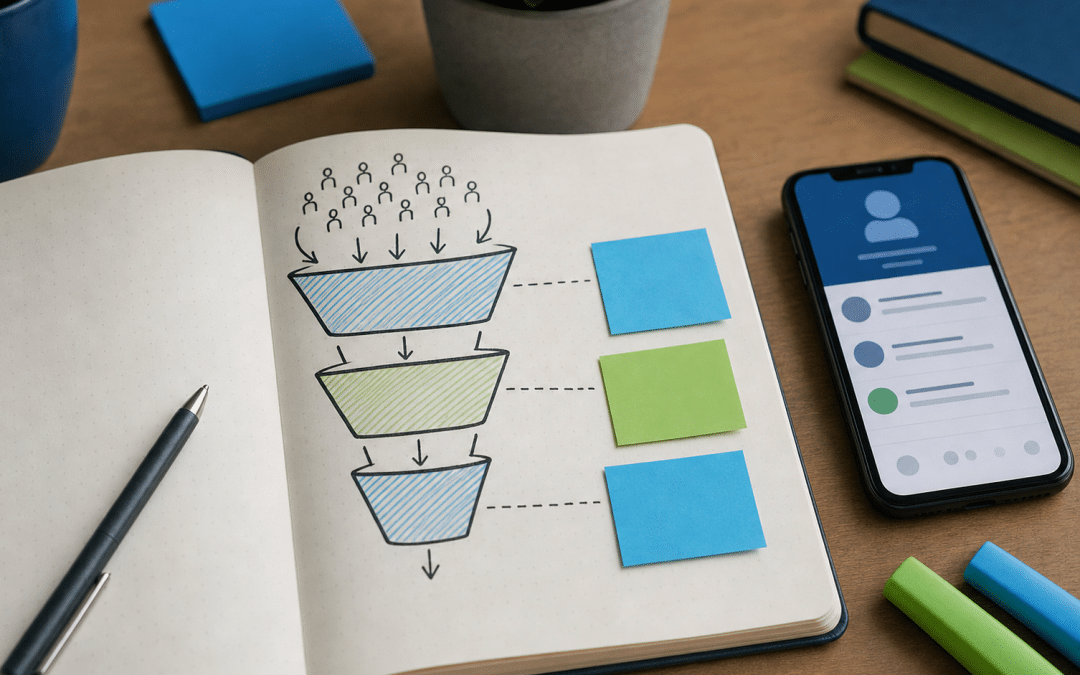
A marketing funnel is the system that moves a prospective client from first discovering your business through to a signed agreement — in measurable, repeatable stages. A B2B marketing funnel South Africa operators can rely on requires the same structure wherever you are based — but the channels, costs and compliance requirements are locally specific. Our full B2B lead generation guide for South Africa covers the broader acquisition engine; this post maps the funnel itself — stage by stage — with the channels, tactics and benchmarks that apply to SA operators in 2026.
Three realities make building a funnel in South Africa different from the global playbook. Industry data compiled by dadsgrowthlab.com, citing Gartner research, indicates that B2B buyers spend just 17% of their total purchase journey in direct contact with potential vendors — the rest of that time goes to independent research, internal alignment and evaluation without any sales involvement. South Africa has 17.0 million LinkedIn members (DataReportal 2026), giving B2B brands genuine professional-network reach at the top of the funnel. And POPIA section 69 requires consent — or the existing-customer exception under s69(3) — before you send electronic direct marketing, which shapes how you can legally progress a contact from awareness to close.
What follows covers what happens at each stage, which SA channels fit where, what the benchmarks look like, and how to measure whether your pipeline is working.
Quick Answer
A marketing funnel describes the path a prospect follows from first discovering your brand (awareness), through evaluating their options (consideration), to making a purchase decision (decision). In a South African B2B context, the funnel typically spans months, involves multiple decision-makers, and depends on content and nurture touchpoints that build trust before any sales conversation begins. The three-stage structure — top, middle, and bottom of funnel — each require different channels, different goals and different success metrics.
Jump to a Section
Losing leads somewhere between first click and first call?
Share your current enquiry flow and we will show you exactly where prospects are dropping out of your pipeline.
Get a Free Flow ReviewWhat a Marketing Funnel Actually Does
A marketing funnel is the structured system that organises your acquisition activity by buyer stage — so every tactic serves a specific purpose rather than running on channel logic alone.
A sound marketing funnel strategy starts by matching each stage to the right channel — then measuring conversion at each handoff. The three stages are:
- Top of funnel (ToFU) — Awareness. Your buyer has a problem but may not yet know your business exists. The goal is to appear in front of the right audience before they build a shortlist.
- Middle of funnel (MoFU) — Consideration. Your buyer is actively evaluating solutions. The goal is to educate, build trust, and capture enough data — with proper consent — to sustain the relationship.
- Bottom of funnel (BoFU) — Decision. Your buyer is comparing final options. The goal is to validate their choice, address remaining objections, and close.
| Stage | Primary goal | Typical SA channels |
|---|---|---|
| Awareness (ToFU) | Get found; build brand recognition | SEO content, LinkedIn organic, Google Ads, Meta Ads |
| Consideration (MoFU) | Educate; demonstrate expertise; capture consent | Email nurture, gated content, LinkedIn InMail, webinars, WhatsApp |
| Decision (BoFU) | Validate; reduce purchase risk; convert | Demos, proposals, case studies, account-based outreach |
Key Point
The marketing funnel stages South Africa B2B teams navigate follow the same awareness-consideration-decision logic — but the channels that carry weight at each stage, and the POPIA requirements that apply when you capture data, are specific to this market. Understanding both is what separates a funnel that works from one that is just activity.
How SA B2B Buyers Research Before Engaging
B2B buyers in South Africa — like their counterparts globally — have largely taken control of the buying process, completing most of their evaluation before speaking to a sales team.
Research aggregated by dadsgrowthlab.com, citing Gartner, indicates that buyers spend just 17% of their total purchase journey in direct contact with potential vendors. The rest is split across independent research, internal alignment sessions and evaluation against competitors. According to sourced industry benchmarks aggregated by dadsgrowthlab.com, 81% of buyers choose a preferred vendor before making first sales contact — which means the funnel must do most of its trust-building work in the pre-contact phase.
The buying committee compounds this challenge. Complex B2B purchases typically involve 6 to 10 decision-makers (Gartner, cited by dadsgrowthlab.com), each with different evaluation criteria. The procurement lead assesses cost and compliance; the technical evaluator assesses fit and integration; the executive assesses ROI and strategic risk. A pipeline that only speaks to one of these roles will stall when the deal goes to committee.
Sector sales cycles in South Africa — particularly across professional services, construction, manufacturing and logistics — frequently run six to twelve months. That duration requires sustained nurture across the full period, not a single follow-up email after the first enquiry. Global benchmark data suggests the average B2B deal involves approximately 27 touchpoints before a purchase decision is made.
For platform-specific tactics using LinkedIn lead generation in South Africa, the audience reach is significant: with 17.0 million SA members (DataReportal 2026), LinkedIn gives B2B brands access to professional decision-makers at scale.
Key Point
If your acquisition activity stops after a prospect's first website visit, you are losing most of your pipeline to businesses that stay in contact through the research phase. Sustained, value-first nurture is the differentiator — not more volume at the top.
Awareness Stage: Getting Found in the Right Places
The awareness stage is where your ideal buyer first encounters your business — and in SA B2B, the highest-value awareness comes from professional networks and search, not broad-reach display.
SEO and content. Ranking for the problems your buyers search for — not just your product names — is the most sustainable ToFU channel. A logistics manager searching "SA cold chain compliance checklist" should find your expert content before they know your brand. Content built around buyer problems, not product features, drives qualified organic traffic.
LinkedIn organic. South Africa's 17.0 million LinkedIn members (DataReportal 2026) give consistent thought leadership content — published under named professionals, not just branded pages — genuine reach into target sectors before those buyers enter an active buying cycle. LinkedIn's B2B lead generation resource cites that 75% of prospective buyers say thought leadership helps them determine which vendors to shortlist — reinforcing why consistent expert content drives pipeline, not just awareness.
Google Ads (search intent). Capturing in-market searches — buyers already looking for a solution category — is efficient ToFU spend for B2B. Category terms ("HR software South Africa," "fleet management solution Gauteng") attract more specific in-market intent than broad keywords — they match buyers who already know the category they are looking for, rather than those still exploring general topics.
Meta Ads for audience building. While Meta is lower-precision for B2B than LinkedIn, it remains an effective channel for ToFU brand awareness at a lower cost per impression, particularly for building retargeting pools ahead of MoFU outreach.
At the awareness stage, your goal is reach and relevance — not data capture. You are not asking for contact details yet, which means no consent obligations arise at this stage.
Consideration Stage: Turning Interest Into Enquiries
The consideration stage is where a prospect moves from being aware of your brand to actively evaluating you — and the businesses that win here are those that answer specific buyer questions before they have to be asked in a meeting.
Gated content and lead magnets. A practical guide, industry report, or calculation tool behind a form is the standard mechanism for capturing contact details at MoFU. POPIA provides several lawful bases for processing personal information. For a marketing opt-in form where consent is the basis being relied on, section 69 requires that the consent language explicitly covers downstream electronic direct marketing. The analysis changes if another lawful basis applies. See our guide on POPIA-compliant lead generation for the full legal detail.
Email nurture sequences. Once you have a consent-valid email address, a structured nurture sequence keeps your brand in front of the prospect across the six-to-twelve months their buying cycle spans. The goal of each email is to be the most useful resource they open that week, not to push for a meeting. Our lead nurturing strategy guide covers the sequence architecture in detail.
LinkedIn InMail and retargeting. LinkedIn allows targeting of users who have visited your site or engaged with your content, with personalised outreach. LinkedIn's own platform data cites that 89% of B2B marketers use it for lead generation. For direct outreach, appointment setting in South Africa — whether through LinkedIn or phone — requires a clear value proposition and a tight ICP definition.
Webinars and educational sessions. An online session focused on a problem your buyers care about qualifies prospects better than almost any form — the people who register and attend are actively signalling evaluation intent. A marketing funnel South Africa B2B teams run effectively typically includes at least one high-value MoFU asset — a practical guide, a webinar, or a diagnostic tool — to improve the quality of contacts entering the CRM.
WhatsApp for relationship-stage contacts. Once a prospect has engaged enough to share their number, WhatsApp conversations can accelerate trust significantly — but only when initiated with consent and used as a relationship channel, not a broadcast list.
MQL-to-SQL Benchmark
The global benchmark for MQL-to-SQL conversion sits at approximately 13% (sourced industry benchmarks, dadsgrowthlab.com). If your rate is well below this, the issue is usually the quality of your qualification criteria, not a shortage of leads at the top.
Key Point
The consideration stage is not about selling — it is about being the most useful resource your buyer encounters while they are doing their own research. Research aggregated by dadsgrowthlab.com (citing FocusVision/Highspot 2023) finds that B2B buyers consume an average of around 13 pieces of content before making first contact with sales. Position early and stay visible.
Decision Stage: Converting Prospects Into Clients
At the decision stage, your prospect has made the internal case for buying a solution — they are now deciding whether to buy from you or from a competitor who has also been nurturing them.
Demonstrations and proof of concept. A live demo tailored to the prospect's specific context — not a generic walkthrough of features — addresses the residual objections of the full buying committee. The objective is to make the decision feel low-risk, not to restate the value proposition.
Case studies and reference clients. B2B buyers rely heavily on social proof from comparable businesses. A documented case study showing outcomes in a comparable SA context is more persuasive at BoFU than any awareness-stage advertising. The reference call with a current client carries even more weight for high-value contracts.
Account-based outreach for high-value targets. For contracts above a certain threshold, account-based marketing in South Africa — coordinating outreach across channels, content, and direct contact to a single target company — is the appropriate BoFU approach. It is resource-intensive but highly effective when the contract size justifies it.
Proposals and commercial clarity. A slow or unclear proposal process kills deals that your pipeline earned. Marketing's role at BoFU is to ensure the prospect arrives proposal-ready — already convinced on fit and trust — so the proposal becomes confirmation, not persuasion.
Opportunity-to-Close Benchmark
The global benchmark for opportunity-to-close conversion is approximately 21% (sourced industry benchmarks, dadsgrowthlab.com). If your rate is lower, the issue is usually late-stage trust, proposal quality, or misalignment within the buying committee — not a sales volume problem.
Pipeline Metrics That Tell the Truth
Measuring conversion at every stage of your pipeline is the only way to identify the constraint — and fix that constraint rather than adding more budget at the top and hoping the problem resolves itself.
| Stage metric | Definition | Global benchmark |
|---|---|---|
| Visitor-to-lead rate | % of website visitors who submit a form or gated content request | ~2.4% |
| MQL-to-SQL rate | % of marketing-qualified leads accepted as sales-qualified | ~13% |
| SQL-to-Opportunity rate | % of sales-qualified leads that become active opportunities | ~36% |
| Opportunity-to-Close rate | % of active opportunities that convert to paying clients | ~21% |
| End-to-end lead-to-client | Combined conversion from first contact to signed agreement | 3–5% |
Source: Sourced industry benchmarks, dadsgrowthlab.com/research/b2b-buyer-journey-statistics. These are global reference figures — not SA-specific targets.
SA B2B pipelines frequently see lower visitor-to-lead rates early in their content journey (before organic authority builds), and higher close rates when prospects are properly qualified before reaching the sales team. Use these benchmarks as reference points for directional diagnosis, not as pass/fail targets.
Track each stage metric monthly in your CRM and in GA4. As a working rule of thumb, compare rolling periods of roughly 90 days rather than week-on-week — B2B pipelines move slowly, and short windows produce noise rather than signal. For a full list of what to track and how, our guide to B2B lead generation KPIs in South Africa covers the metrics that matter at each stage.
Key Point
If you can only track one metric right now, track your MQL-to-SQL rate. It sits at the handoff between your acquisition activity and your sales team — a poor rate there tells you either your leads are poorly qualified or your sales team's criteria are too strict. Either way, fixing it unlocks the whole pipeline.
Not sure if your pipeline volumes are where they should be?
Tell us your current stage — new leads, established pipeline, or scaling — and we will assess whether the numbers make sense and what the fastest path to improvement looks like.
Book a Pipeline AssessmentWhy South African B2B Businesses Choose Growth Pulse Media
Growth Pulse Media was built by someone who ran campaigns, paid the invoices, and closed deals — not by someone who studied how to do it. Dirk van Greuning scaled a South African ecommerce business before founding the agency, which shapes how GPM approaches B2B pipeline strategy: lead generation is evaluated by its contribution to closed revenue, not by MQL volume or click-through rates.
On the B2B lead generation side, the work spans the full funnel — LinkedIn content and InMail, Google Ads for in-market demand capture, email nurture sequences built on POPIA-compliant consent flows, and CRM pipeline tracking using platforms including HubSpot and ActiveCampaign. All work is executed in-house by senior team members, with a deliberately limited client load to ensure each pipeline gets genuine attention rather than templated delivery.
For SA operators running B2B pipelines in professional services, IT, construction, manufacturing or logistics, the brief looks the same: longer sales cycles, multiple stakeholders, and a buying process that runs mostly without you. The solution is a funnel built for that reality — not a global template applied without adjustment.
Who This Is NOT For
Businesses expecting results in weeks
B2B funnels run on sales cycles that frequently span six to twelve months. If your timeline expectation is two to four weeks to revenue, this approach is not the right fit — and any agency that promises otherwise is not being straight with you.
Companies without a sales team to handle qualified leads
A well-functioning funnel generates sales-ready opportunities — but converting those opportunities requires a structured sales process and available headcount. If your business is not yet set up to handle incoming qualified enquiries, fix that first.
High-volume B2C operations
The three-stage B2B funnel with its extended nurture sequences, buying committees and proposal processes is designed for considered purchases. High-volume direct-to-consumer businesses need a different acquisition model — the B2B funnel applied to B2C creates friction where there should be speed.
Teams not ready to measure pipeline consistently
A funnel you cannot measure cannot be improved. If your business is not yet tracking leads by source and stage in a CRM, the optimisation work that makes funnels compound over time is not possible. The infrastructure matters as much as the tactics.
Ready to see exactly where your funnel is leaking?
Book a free funnel audit and we will map where your SA pipeline is strong, where it is weak, and what to fix first.
Get a Free Funnel AuditFrequently Asked Questions
What are the three stages of a marketing funnel?
The three stages are awareness (top of funnel), consideration (middle of funnel), and decision (bottom of funnel). At awareness, the goal is to be discovered by the right audience before they build a shortlist. At consideration, the goal is to educate and nurture prospects through their evaluation, building enough trust to keep the relationship moving. At decision, the goal is to convert a well-qualified prospect into a paying client using demos, case studies and clear commercial terms — with different channels and metrics at each stage.
How many touchpoints does it take to convert a B2B lead?
Industry benchmark data suggests the average B2B deal involves approximately 27 touchpoints before a purchase decision, distributed across channels and over time (sourced benchmarks, dadsgrowthlab.com). Most of these occur without any sales involvement — which is why content, email nurture and LinkedIn presence matter so much in the pre-contact phase. In South Africa's longer-cycle sectors, the number of touchpoints required is typically at the higher end of this range.
What is a good MQL-to-SQL conversion rate for a B2B business?
The global benchmark for MQL-to-SQL conversion sits at approximately 13%. This represents the share of marketing-qualified leads that a sales team accepts as sales-qualified — meaning they meet the criteria for direct outreach or a meeting. If your rate is significantly below this, the most common causes are loose qualification criteria at the MQL stage, misalignment between marketing and sales on what a qualified lead looks like, or leads entering the pipeline from poorly targeted ToFU channels.
How does POPIA affect my B2B marketing funnel?
POPIA section 69 requires consent — or the existing-customer exception under s69(3) — before you send electronic direct marketing to a natural person. In a B2B funnel context, this means your consent language must be clear on gated content forms, email opt-ins, and any other point where you capture contact details for subsequent outreach. Business context does not automatically exempt you — the test turns on the recipient, not the nature of your product. See our full guide on POPIA-compliant lead generation for the legal detail.
How long should a B2B marketing funnel take in South Africa?
In most SA B2B sectors, a realistic time from first ToFU exposure to a signed agreement is six to twelve months for complex or high-value purchases. The funnel's job is not to shorten this cycle artificially — it is to keep your business positively positioned across that entire duration, so that when the prospect is ready to decide, you are the obvious choice.
Build a B2B Pipeline That Keeps Working
Growth Pulse Media designs and operates B2B marketing funnels for South African businesses — from LinkedIn content and Google Ads at ToFU, through POPIA-compliant email nurture at MoFU, to CRM-tracked opportunity management at BoFU. All work is executed by senior team members using platforms including HubSpot, ActiveCampaign and LinkedIn Campaign Manager. No obligation — we'll get back to you within 24 hours.
Talk to a B2B Funnel Specialist