
 Add to Preferred Sources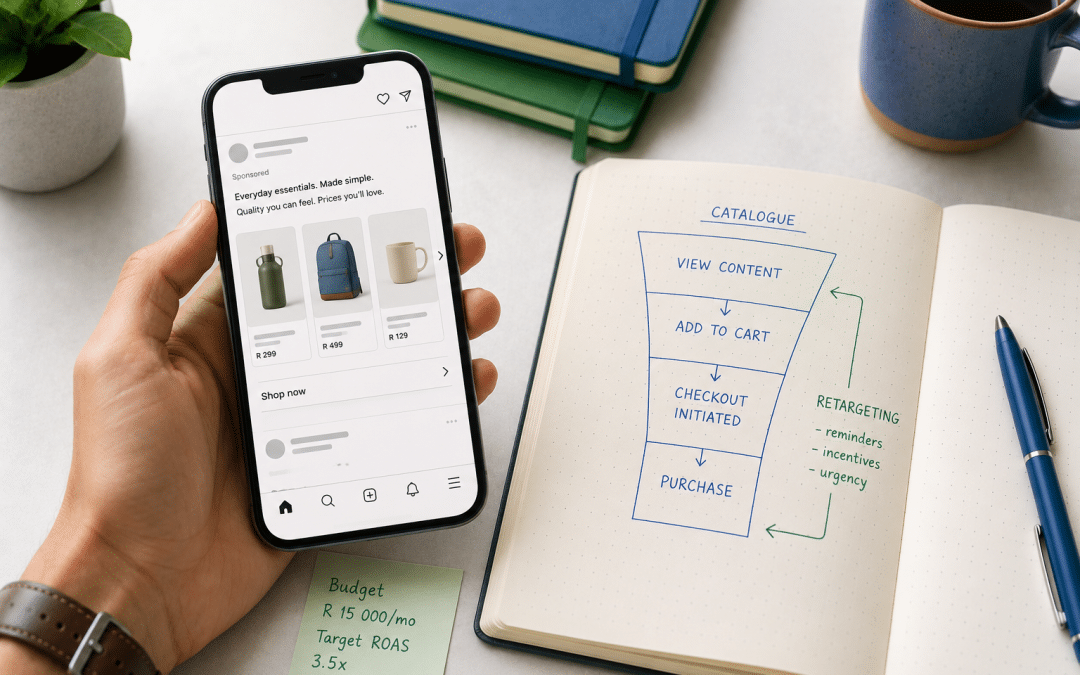
Running facebook ads for ecommerce in South Africa works differently from advertising a service, because the engine is your product catalogue, not a single clever creative. Connect your store's product feed to Meta and the system can show each shopper the items they are most likely to buy, then chase the ones who browsed but did not check out.
For an SA online store, that catalogue-driven approach — paired with clean tracking and a sensible funnel — is what turns paid social from an expense into a revenue line.
This guide sits within our Meta Ads South Africa guide and covers the store-specific playbook. It deliberately bridges into the wider Shopify South Africa and ecommerce work, because advertising an online store well depends on the store itself being set up to convert. Here the focus is the channel: how paid social actually sells products for an SA store.
Quick Answer
Facebook ads for ecommerce run on your product catalogue. You connect your store's feed to Meta — directly or through a Shopify integration — and the platform generates personalised product campaigns (called Advantage+ Catalog Ads, formerly Dynamic Product Ads) that show online shoppers items matched to their browsing and interests. This catalogue engine, not one-off creative, is what makes paid social scale across a large range of products.
Three things decide whether it works for an SA store. The catalogue and tracking must be clean, because the system can only sell what it can see and match. The funnel must move shoppers from discovery to checkout to re-engagement. And you must judge results on return, not on cheap clicks. Get those right and it becomes the most scalable sales channel most SA stores have.
Running store ads but seeing clicks that never convert to sales? The catalogue or funnel setup is usually why.
Get a Free Store Ads ReviewWhat Makes Advertising a Store Different
The defining feature of facebook ads for ecommerce is the product catalogue — a feed of every item you sell, with prices, images, and descriptions, connected to Meta through Commerce Manager or a Shopify integration.
Once it is linked, the platform can build catalogue campaigns that automatically show different products to different people based on what each shopper has browsed or bought. You are not designing one creative; you are letting the system assemble thousands from your feed.
This is why advertising a store scales in a way service advertising cannot. A plumber promotes one service with one message; an SA store with 500 products needs the system to match the right item to the right shopper at the right moment, and the catalogue makes that possible.
It also means the quality of your feed — accurate titles, clean images, correct prices in Rand — directly shapes performance, because the campaigns are built from it.
Your Product Feed Is the Real Creative
On a store campaign, the catalogue feed does most of the work a creative team would do elsewhere. If product titles are vague, images inconsistent, or prices wrong, every automatically-generated creative inherits those flaws. An SA store that treats its feed as an afterthought is quietly capping the performance of every catalogue campaign it runs.
Before scaling spend, get the feed right: clear titles, clean consistent imagery, accurate Rand pricing, and complete product data. A well-structured catalogue gives the system a strong base to build from and match against; a messy one starves it. The feed is not back-office admin — on a store campaign it is the single biggest creative lever you control.
The Campaign Types an SA Store Uses
Facebook ads for ecommerce typically lean on a small set of campaign types working together rather than one. Catalogue ads — Meta's Advantage+ Catalog Ads, once known as Dynamic Product Ads — are the workhorse, showing personalised products across Facebook and Instagram. Advantage+ Shopping Campaigns add automation on top, consolidating prospecting and re-engagement into one AI-driven structure suited to stores with solid data. For stores ready to run catalogue campaigns with outside help, our Meta ads service for ecommerce manages Facebook and Instagram ads around return on ad spend, starting with a free audit.
The third pillar is re-engagement, showing warm shoppers the exact products they viewed or abandoned. These are not competing choices; they are layers. The automated specifics of the Shopping campaign type are covered in our Advantage+ Shopping guide, and the warm-audience mechanics in our Meta retargeting guide. An SA store usually runs a blend, weighted by where its data and budget are strongest.
| Campaign Layer | Role in an SA Store's Account |
|---|---|
| Catalogue ads (Advantage+ Catalog) | Personalised product campaigns across the funnel — the workhorse |
| Advantage+ Shopping | Automated prospecting + re-engagement for stores with data |
| Retargeting | Warm shoppers who viewed or abandoned specific products |
| Cold prospecting | New-audience reach where warm pools are too small alone |
Not sure which campaign mix suits your store's data, catalogue, and budget right now?
Get a Free Campaign Mix PlanLayers, Not Choices: Run the Mix Together
SA stores often treat catalogue campaigns, automation, and re-engagement as an either-or decision, picking one and ignoring the rest. They are layers of one system: automation and catalogue campaigns find new buyers, re-engagement closes the ones who hesitated. Running only a single layer leaves obvious revenue uncaptured at whichever stage you skipped.
The right blend shifts with your store's data and budget — a store with rich purchase history can lean harder on automation, while a newer one builds with more manual control first. What does not change is that the layers feed each other, so an SA store should think in terms of a working mix rather than hunting for the one campaign type that wins alone.
The Store Funnel: Discovery to Checkout to Return
The mistake that wastes the most budget on facebook ads for ecommerce is pointing everything at one stage of the journey. A healthy SA store account moves shoppers through a funnel: discovery, where catalogue campaigns and automated campaigns introduce products to new audiences; consideration, where browsers who showed interest get nudged; and re-engagement, where the system chases cart abandoners and recent viewers with the exact items they left behind.
Each stage needs its own message and budget logic. Spending only on cold discovery means paying to create interest and then letting it leak away unconverted. Spending only on re-engagement means quickly exhausting a small warm pool with nothing replenishing it. The art is balancing the stages so demand created at the top is captured at the bottom, with budget flowing to whichever stage is currently the constraint.
Balance the Funnel, Don't Crowd One Stage
SA stores commonly over-invest in re-engagement because its numbers look brilliant — warm shoppers convert cheaply, so the temptation is to pour budget there. But re-engagement only converts demand that discovery created; starve the top and the warm pool dries up within weeks. The impressive re-engagement numbers quietly collapse because nothing is feeding them.
Treat the funnel as a system, not a league table of which campaign has the best return in isolation. Discovery looks expensive because it does the hard work of creating demand; re-engagement looks cheap because it harvests it. An SA store needs both, balanced, with budget moving to the stage currently holding back the whole machine. Judge the account, not the individual campaign.
Tracking and Return: The Non-Negotiables
Every catalogue match and re-engagement audience in a store advertising setup is built on tracking data, which makes clean measurement the foundation rather than a finishing touch. The pixel and server-side Conversions API tell Meta which products were viewed, added, and bought — and privacy controls now block a large share of browser-only signal, so stores running the pixel alone feed the system an incomplete picture. Our Pixel and Conversions API guide covers fixing this.
The second non-negotiable is judging the account on return, not on cheap clicks or a flattering cost-per-click. A store's purpose is profitable sales, so return on ad spend, measured honestly against real revenue and your margins, is the number that matters. Our Meta ads ROAS guide covers setting targets from your break-even. Cheap traffic that never buys is the most expensive outcome a store can chase.
| Before (one-off creative, clicks) | After (catalogue + funnel + return) |
|---|---|
| Single boosted post, no catalogue | Clean product feed connected — catalogue campaigns at scale |
| All budget on cold discovery | Balanced discovery-to-re-engagement funnel — demand captured |
| Pixel-only, missing events | Server-side tracking added — system sees real sales |
| Judged on cost per click | Judged on return vs margin — profitable spend visible |
How Growth Pulse Media Approaches Store Advertising
Most SA agencies running store campaigns boost a few posts, point all the spend at cold audiences, and report clicks — never connecting a clean catalogue, never building the funnel, never measuring against margin. The honest approach starts with the store itself: a clean product feed, server-side tracking, and a funnel that moves shoppers from discovery to checkout to return, all judged on profitable sales rather than vanity traffic.
Dirk built and scaled an SA ecommerce business on paid social, where the catalogue, the funnel, and the return number were managed as one system and a campaign that did not move real revenue was killed regardless of how its clicks looked. That operator habit means store advertising is treated as a revenue engine tied to the store's own conversion health, not a traffic tap left running on a boosted post.
SA stores wanting paid social built on a clean catalogue, a real funnel, and honest return can use our ecommerce marketing service, covering feed setup, campaign architecture, tracking, and return-led measurement. We pair it with the full Meta Ads South Africa framework and the wider ecommerce marketing guide so the channel sits inside a complete store strategy.
Who Store Advertising Is NOT For
Paid social is not the right first move for every SA online store. Here is who should approach it with caution.
Stores with a messy or missing catalogue: Because the campaigns are built from your product feed, a store with no catalogue or a chaotic one cannot run the format that makes paid social scale. An SA store with vague titles, wrong prices, or no feed at all should fix that first. Advertising a broken catalogue just amplifies the mess across thousands of auto-generated ads.
Stores that don't convert their own traffic: If your store's product pages and checkout lose most visitors who do arrive, paid social pours money into a leaking bucket. An SA store with a poor conversion rate should fix the store before scaling spend, because advertising only sends more people to a page that already fails them. Sort the store, then drive traffic to it.
Single-product or tiny-range stores: The catalogue engine's advantage is matching many products to many shoppers. A store selling one item or a handful gains less from dynamic catalogue campaigns and may do better with standard creative campaigns. An SA store with a very small range should weigh whether the catalogue machinery suits it or whether simpler ads fit better.
Stores unwilling to fix tracking: Since catalogue matching and re-engagement depend on pixel and server-side data, an SA store unwilling to set up proper tracking will get tiny audiences and blind optimisation. The system cannot match or re-engage shoppers it never recorded. A store that will not invest in clean measurement should not expect the format to perform.
Want an honest read on whether your store and catalogue are ready to advertise profitably?
Get a Free Store Readiness SessionThe discipline that ties this together is treating the store, the catalogue, and the funnel as one system that paid social plugs into — not a tap you switch on over a weak foundation. Per Shopify's own guide to dynamic catalogue ads, these formats personalise products to each shopper from your feed automatically.
That is exactly why a clean catalogue and connected store matter so much. The automation rewards a well-built foundation and exposes a weak one.
For an SA store in 2026, the path is clear: connect a clean product catalogue, run a balanced funnel of catalogue campaigns, automation, and re-engagement, build it all on server-side tracking, and judge every Rand on return against your margins. Done that way, paid social becomes the most scalable sales channel an online store has. Done as boosted posts pointed at cold audiences, it stays an expense that never quite explains itself.
Frequently Asked Questions
How do Facebook ads work for an ecommerce store in South Africa?
They run on your product catalogue. You connect your store's feed to Meta — directly or via a Shopify integration — and the platform generates personalised product campaigns (Advantage+ Catalog Ads, formerly Dynamic Product Ads) showing shoppers items matched to their browsing. This catalogue engine, plus clean tracking and a discovery-to-re-engagement funnel, is what makes paid social scale across many products for an SA store.
What do I need to start advertising my store on Facebook?
A product catalogue connected to Meta through Commerce Manager or a Shopify integration, a Meta Business account, and a connected pixel plus Conversions API for tracking. Without a clean catalogue and tracking, the catalogue campaigns that make store advertising scale cannot run properly. Get the feed and measurement right before scaling spend — they are the foundation everything else depends on.
What are Advantage+ Catalog Ads?
They are Meta's personalised product campaigns, formerly called Dynamic Product Ads, that automatically show different items from your catalogue to different shoppers based on browsing and interest. Instead of building one ad per product, you connect your feed and the system generates and matches them at scale. They tend to convert higher than generic product campaigns, which lifts an SA store's return.
How much should an SA store spend on Facebook ads?
There is no fixed figure — spend should be set by your margins and the return you need to profit, not an arbitrary budget. Start with enough to gather conversion data, judge the account on return against your break-even, and scale the stages that prove profitable. Spending too little to exit the learning phase starves the system; chasing cheap clicks wastes whatever you spend.
Should an SA store use Advantage+ Shopping or manual campaigns?
It depends on data. Advantage+ Shopping suits stores with established conversion volume, a connected catalogue, and clean tracking, automating prospecting and re-engagement. Newer stores with little data often do better building conversion history with more manual control first. Many SA stores run both, letting performance against real return decide the budget split rather than platform loyalty.
Why do my store's Facebook ads get clicks but no sales?
Usually one of three causes: a messy catalogue producing poor creative, a store that does not convert the traffic it receives, or tracking so incomplete the system optimises blindly. Clicks without sales point to a foundation problem, not a campaign problem. Fix the catalogue, the store's conversion rate, and the tracking before blaming the campaigns themselves.
Want Store Ads Built on a Clean Catalogue and Real Return?
Growth Pulse Media builds Facebook and Instagram advertising for SA online stores around a clean product feed, a balanced funnel, server-side tracking, and honest return measurement against your margins. Real operator experience scaling an SA ecommerce business on paid social, treating the catalogue and funnel as one revenue system. No obligation — we will get back to you within 24 hours with an honest read on whether your store is ready to advertise profitably.
Get Your Free Store Ads Strategy Call