
 Add to Preferred Sources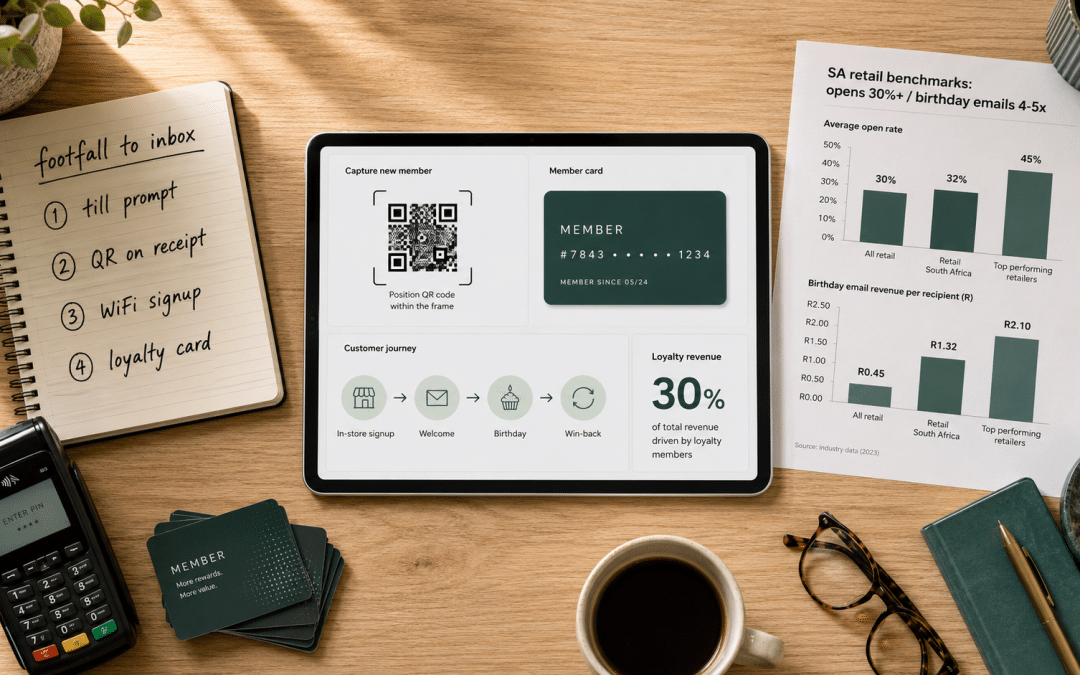
Email marketing for retail South Africa turns walk-in shoppers into a repeat-purchase database — capturing footfall at the till, rewarding loyalty across store and screen, and bringing customers back with birthday, replenishment, and win-back sends. For bricks-and-mortar retailers it is the highest-ROI retention channel in our email marketing South Africa guide. Below: in-store capture, loyalty integration, and the flows that drive return visits. For online-only stores, our ecommerce email guide fits better.
Quick Answer
Email marketing for retail South Africa turns anonymous footfall into a named database: capture at the till and via loyalty signup, then run birthday, replenishment, VIP, and win-back flows that pull shoppers back in. The retail difference is the physical-to-inbox bridge: an in-person buyer is invisible until captured. Expect 30%+ opens and strong repeat-purchase lift, since 85% of shoppers now say in-store loyalty matters. Treating a shop like an online store is the mistake.
Wondering how many of your daily walk-ins you could be turning into repeat customers? Let's map it.
Get a Free Footfall Capture PlanEmail Marketing for Retail South Africa: The Physical-to-Inbox Bridge
The defining challenge for a physical SA retailer is that footfall is anonymous — a customer buys, leaves, and is unreachable unless you capture them at the moment of purchase. Solving that capture problem is what separates a shop's email from every other kind.
| Capture Point | How It Works | Best For |
|---|---|---|
| Till prompt | Staff ask for email at checkout | Every transaction; highest volume |
| Loyalty signup | Card or app tied to email and phone | Repeat shoppers; richest data |
| QR on receipt | Scan to join for a first-purchase perk | Self-service, staff-light capture |
| In-store WiFi | Email in exchange for connection | Cafés, larger-format stores |
| Competition / draw | Entry in exchange for opt-in | Events, launches, seasonal peaks |
The prize for solving capture is retention, and the data on why is stark. According to LoyaltyLion's 2026 research, 85% of shoppers now say in-store loyalty access is important, and loyalty-linked email is consistently the top-performing send each day. A shopper you can reach is a shopper you can bring back — and bringing them back costs a fraction of finding a new one.
Why Retail Email Is Not Ecommerce Email
The two look similar and behave differently — a physical retailer's programme is built around return visits and loyalty, not cart recovery and online checkout. Treating a shop like an online store is the commonest, costliest mistake.
The capture problem is inverted
An online store captures email automatically at checkout; a physical shop captures nothing unless it deliberately asks. That single difference reshapes the whole programme — for a physical retailer, list growth is an in-store operational discipline (staff prompts, loyalty signup, receipt QR) rather than a website widget. The list is built at the till, not the landing page.
The goal is a return visit, not a checkout
Ecommerce email drives an immediate online purchase; a shop's email drives a future in-store visit. The call-to-action is "come in this weekend", "your points expire soon", "new stock in your size is in" — not "buy now online". Success is measured in return footfall and repeat spend, which means tying email back to till data wherever possible. Our ecommerce guide covers the online-checkout side.
Omnichannel is the winning shape
The strongest SA retailers are not choosing between shop and screen — they are joining them. A loyalty programme that works identically in-store and online, email that reflects both purchase histories, and offers redeemable either way is what modern shoppers expect. Omnichannel retailers retain dramatically more customers than single-channel ones, because the customer experiences one brand, not two disconnected ones.
The Capture-First Insight
For a physical SA retailer, the entire programme rises or falls on one operational habit: capturing email at the point of sale, every time, without fail. A brilliant flow strategy sending to a list of 200 walk-ins captured by accident will always lose to a simple one sending to 5,000 captured on purpose. Fix the till-prompt discipline first, incentivise staff to ask, and the list — the actual asset — starts compounding from day one.
The Flows That Bring Retail Shoppers Back
The return-visit flows differ from ecommerce's cart-focused ones — they are built around loyalty, milestones, and re-engagement. Build these first, triggered automatically off purchase and signup data.
Welcome and first-visit reward. The moment a shopper joins, thank them and give a reason to come back soon — a discount on their next in-store visit, redeemable at the till. This converts a one-time walk-in into a second visit, which is the hardest and most valuable step in retail retention.
Birthday and milestone. The single highest-performing send in the shop's arsenal. Birthday emails achieve dramatically higher transaction rates than any other type because they are personal and timely. A birthday voucher redeemable in-store is a proven footfall driver — capture the birth month at signup and this flow runs itself.
Replenishment and repeat-cycle. For retailers selling consumables — beauty, pet, food, wellness — a reminder timed to the natural repurchase cycle brings the shopper back exactly when they are running low. Timed to the buying cycle rather than a generic calendar, it feels helpful, not pushy.
VIP and loyalty tier. Your best customers deserve different treatment — early access to sales, exclusive in-store events, tier progress updates. Loyalty communications are the top-performing emails each day precisely because members chose them. Our automation guide covers building these as evergreen flows.
Win-back. A shopper who has not visited in 90-180 days gets a re-engagement sequence with a reason to return. Win-back works here because the relationship already exists — you are reminding a known customer, not chasing a stranger. Our re-engagement guide covers the sequence in depth.
The generic-blast trap: A retailer that captures emails then sends the same "20% off everything" blast to the whole list every week trains shoppers to wait for discounts and erodes margin. Personalised, milestone-triggered sends outperform blanket promotions decisively — relevance, not frequency, is what brings feet back through the door without teaching everyone to hold out for a sale.
Want the birthday, replenishment, and win-back flows built for your store?
Get a Free Flow BlueprintWhat It Costs SA Retailers
Programme costs scale with list size and programme complexity, and the loyalty layer often sits alongside. The ranges below reflect what SA retailers pay in 2026.
| Programme Level | Indicative Cost | Best For |
|---|---|---|
| Starter (flows + capture) | R4,500 – R9,000 / month | Single-store retailers, core flows |
| Growth (loyalty-integrated) | R9,000 – R18,000 / month | Multi-store, loyalty tie-in, segmentation |
| Omnichannel | R18,000 – R32,000 / month | Store-plus-online, unified customer data |
| Email platform (Klaviyo/Omnisend) | R350 – R4,000+ / month | Paid separately; scales with list |
The return justifies the spend because retention is so much cheaper than acquisition. Bringing a captured shopper back through a birthday or replenishment send costs cents; winning a brand-new customer through paid advertising costs many rands. The SA benchmark guide covers the revenue side in detail, and loyalty-integrated retailers routinely see a large share of total revenue flow through their programme.
The Retention-Economics Insight
The whole financial case rests on one asymmetry: reaching a customer you already have costs a fraction of finding one you do not. Every walk-in captured at the till is a customer you can bring back for the price of a send, for years. A retailer who treats capture as central turns the shop's daily footfall into a compounding asset — while one relying on acquisition alone pays full price for every sale, forever.
Consent and the SA Retail Reality
In-store capture carries the same POPIA obligations as any other channel, and the till is where it is easiest to get wrong. A customer handing over an email at checkout must be giving genuine consent to marketing — not just an address for a receipt — so staff scripts and signup forms need to make the opt-in explicit.
Practically, that means a clear line at the till or on the loyalty form stating that joining means receiving marketing email, an actively-chosen opt-in rather than an assumption, and a record of when and how consent was given. A loyalty programme makes this cleaner, because signing up is itself an explicit, logged act of consent. Our POPIA compliance guide covers the record-keeping in full.
The SA retail context adds one more consideration: many shoppers are cautious with data, so the value exchange must be obvious. "Join and get 10% off today, plus a birthday treat" earns the opt-in honestly; a bare "can I have your email" often does not. Lead with the benefit and the capture rate climbs while the consent stays clean.
Before and After: What a Real Programme Changes
The table below reflects the typical trajectory for a single-location SA retailer moving from no capture to a structured, loyalty-integrated programme over six months. Figures are indicative composites from SA benchmark ranges.
| Metric | Before (no capture) | After (structured programme) |
|---|---|---|
| Reachable customer list | Near zero | Growing 100-400 / month |
| Repeat-visit rate | Unmeasured, low | Materially higher, tracked |
| Birthday / milestone revenue | R0 | Consistent monthly footfall driver |
| Share of revenue from known customers | Untracked | 20-35% and rising |
| Cost to bring a customer back | Full acquisition price | Cents per send |
Measurement and Reporting Discipline
Strong email marketing for retail South Africa programmes report on capture and return, not opens alone. Track weekly list-capture rate at the till, repeat-visit rate for captured versus uncaptured customers, redemption of in-store offers sent by email, and share of revenue from known customers. That capture rate is the leading indicator — everything downstream depends on how many walk-ins become reachable.
Tie email to till data wherever the point-of-sale system allows. The prize is closing the loop: knowing that a birthday email sent Tuesday drove a redemption in-store Saturday. Even partial matching — loyalty-card scans at the till linked to email sends — turns a guessing game into a measured one, and reveals which flows actually move footfall versus which just fill inboxes.
On tooling, an email platform that integrates with your point-of-sale or loyalty system beats a disconnected one, because the whole value is the physical-to-inbox link. Review quarterly: is capture rate holding at the till, are the milestone flows still driving redemptions, and is the known-customer share of revenue climbing? Those three answers tell you whether the programme is compounding. The SA strategy guide covers how this feeds the wider plan.
The Growth Pulse Media Difference
Growth Pulse Media is run by an operator, not an account team. Before founding the agency, Dirk built and scaled a large SA retail and ecommerce business — capturing customers, running loyalty, and bringing shoppers back through email on Klaviyo and Omnisend — so this playbook comes from turning real footfall into real repeat revenue, not from theory.
All work is done in-house with a deliberately limited client load. No offshore outsourcing, no junior hand-offs, and reporting built on capture rate, repeat visits, and revenue from known customers — never opens dressed up as retention.
If you would rather have this built for you, our managed inbox revenue service runs the full retail system — in-store capture design, loyalty-integrated flows, POPIA-compliant consent at the till, and reporting that ties email back to footfall.
Who This Is NOT For
An honest disqualifier list saves both sides time. A shop email programme is the wrong priority right now if any of the following describes you:
You are an online-only store. Your capture happens automatically at checkout and your flows revolve around cart recovery. The ecommerce guide fits you better; the physical-to-inbox focus is built for a different problem.
Your staff will not ask for email at the till. Capture is an in-store operational habit before it is a marketing channel. If the till-prompt discipline cannot be established, the list never grows and the programme has nothing to run on.
You only want to blast weekly discounts. Blanket promotions train shoppers to wait for sales and erode margin. If milestone-triggered relevance is not the plan, this channel will quietly teach your customers to buy only when everything is on special.
Not sure whether your store is set up to capture and keep customers? We'll take an honest look.
Request a Free Retail Readiness ReviewFrequently Asked Questions
How does email marketing work for a physical retail store?
It turns anonymous footfall into a reachable database. You capture customer email at the till, via loyalty signup, receipt QR, or in-store WiFi, then run automated flows — welcome, birthday, replenishment, VIP, and win-back — that bring shoppers back into store. Unlike an online store, the goal is a return visit rather than an online checkout, and the whole programme depends on disciplined in-store capture.
How do I collect customer emails in a physical shop?
The highest-volume method is a staff prompt at checkout, ideally tied to a first-purchase incentive. Loyalty signup gives the richest data, receipt QR codes enable self-service capture, and in-store WiFi works for cafés and larger formats. Lead with a clear benefit — a discount today plus a birthday treat — and pair it with explicit POPIA consent, and the capture rate climbs while staying compliant.
How is retail email different from ecommerce email?
Ecommerce captures email automatically at online checkout and focuses on cart recovery; physical retail captures nothing unless staff ask, and focuses on driving return visits. Retail flows revolve around loyalty, birthdays, and replenishment rather than abandoned carts, and success is measured in return footfall and repeat spend. Omnichannel retailers that unify both experiences retain significantly more customers than single-channel ones.
What email flows work best for SA retailers?
Welcome with a first-visit reward, birthday and milestone (the highest-performing retail send by transaction rate), replenishment timed to the repurchase cycle, VIP and loyalty-tier communications, and win-back for shoppers who have lapsed 90-180 days. Each is triggered automatically off purchase and signup data, and each drives a return visit rather than an online sale. Milestone-triggered sends decisively outperform generic weekly discount blasts.
How much does retail email marketing cost in South Africa?
Starter programmes with core flows and capture run R4,500-R9,000 monthly. Loyalty-integrated growth programmes for multi-store retailers run R9,000-R18,000. Full omnichannel programmes unifying store and online data run R18,000-R32,000. The email platform (Klaviyo or Omnisend) is additional, from R350 to R4,000+ monthly. The return justifies it because retaining a captured customer costs a fraction of acquiring a new one.
Is collecting emails in-store POPIA compliant?
Yes, with explicit consent. A customer handing over an email at the till must be genuinely consenting to marketing, not just providing a receipt address, so till scripts and signup forms must make the opt-in clear. Keep a record of when and how consent was given. A loyalty programme makes this cleaner, since joining is itself an explicit, logged act of consent to receive communications.
Worried in-store capture will slow down your queue or annoy customers? Done well, a one-line till prompt with a real benefit takes seconds and shoppers welcome it — we'll show you the script.
Get Your Free Retail Retention Plan for Your SA Store
Growth Pulse Media builds email programmes for South African retailers — in-store capture systems your staff will actually use, loyalty-integrated birthday and replenishment flows, POPIA-compliant consent at the till, and reporting that ties email sends back to real footfall on Klaviyo or Omnisend. Built by an operator who turned shop footfall into repeat revenue while scaling an SA retail business.
No obligation — we will get back to you within 24 hours.
Request Your Free Retention Plan →