
 Add to Preferred Sources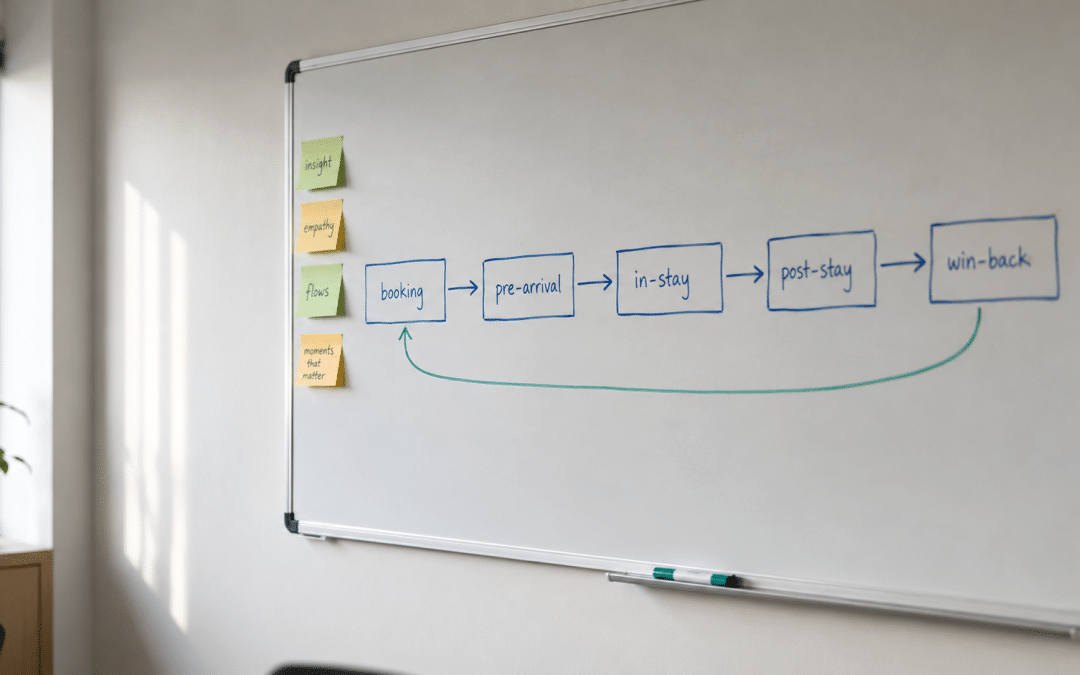
Email marketing for hotels is the only channel that turns a guest an online travel agent sent you once into a guest who books you directly for the next ten years. The platform fundamentals in our email marketing South Africa guide apply here — this page is about the guest lifecycle and the consent rules that govern it.
The economics make the case on their own. A booking that arrives through a platform carries a commission every single time. A booking that arrives because a past guest opened an email carries almost nothing, and the guest costs you nothing to reach again.
What stops most properties is not strategy. It is that the guest list was never captured lawfully in the first place, which makes the whole programme unusable — a problem our guide to POPIA email compliance covers in general terms and this page covers for accommodation specifically.
Quick Answer
Email marketing for hotels in South Africa works by converting platform-acquired guests into direct repeat bookings, avoiding online travel agent commissions that range from 10% to 25% of reservation value. The guest email must be captured by the property at booking or check-in with an opt-out offered, because POPIA section 69 requires consent or a qualifying existing-customer relationship. Realistic monthly cost runs from R4,000 for a single guesthouse to R20,000 or more for a group.
Are your repeat guests booking direct — or paying a platform to send them back to you?
Get a Free Guest Email QuoteThe Guest a Platform Sent You Is Not Yet Your Customer
A booking that arrives through an online travel agent is a rental, not an acquisition, because the platform keeps the relationship and charges you again next time. Reporting on the South African Competition Commission settlement put Booking.com fees at 10% to 25%, averaging 15%, varying by property type, location and cancellation policy.
That settlement changed something else that matters more for email than the commission itself. Price parity terms were removed from South African contracts, including the narrow version that stopped a property offering a lower rate on its own website than on the platform.
Read that carefully, because it is a local advantage most properties have not acted on. In this market a hotel may now legitimately make its direct rate the best rate — and an email to a past guest is the cheapest place in the business to say so.
What this looks like when it goes wrong: a Ballito guesthouse exports its guest list from the platform extranet and sends a summer special. Half the addresses are platform-issued aliases that bounce or forward nowhere useful. Nobody on the list ever agreed to hear from the property, and the send earns complaints instead of bookings.
What this looks like when it goes right: the same property collects the guest's real address on its own check-in form, with a single tick for stay offers and news. Six months later a shoulder-season email goes to people who chose to hear from it, at a direct rate the property is now free to set below the platform price.
Key Takeaway
An online travel agent booking costs commission on every reservation it sends, while a repeat guest reached by email costs nothing to contact. Following the South African Competition Commission settlement, price parity terms were removed from local Booking.com contracts — so a property here may set its direct rate below the platform rate, which turns a past-guest email list into a genuine commercial asset.
Email Marketing for Hotels: The Consent Moment Is Check-In
A property's lawful guest list is built at booking and check-in, not exported from a platform, because South African law sets specific conditions on marketing to people you have transacted with. Section 69(3) permits electronic marketing to existing customers where the details were obtained in the context of a sale, the marketing covers your own similar products or services, and an opt-out was offered at collection and in every message since.
Each condition has a practical translation for accommodation. Details obtained in the context of a sale means your own booking or check-in form, not a third party's data feed. Similar products means stays, packages and on-site offers, not an affiliate's car hire deal.
The opt-out condition is the one properties fail most often. It has to be offered at the moment you collect the address, not only in the footer of the emails that follow. One line on the check-in form, worded plainly, is the whole compliance step.
The enforcement risk is no longer theoretical. The Information Regulator issued an enforcement notice against a consultancy for unlawful direct marketing under section 69, carrying the prospect of a fine of up to R10 million or imprisonment of up to ten years for non-compliance, and a national opt-out registry followed under amended Consumer Protection Act regulations in 2026.
Key Takeaway
POPIA section 69(3) allows a property to email past guests without separate consent only if three conditions hold: the address was obtained in the context of the booking, the marketing covers the property's own similar offerings, and an opt-out was given both at collection and in every message. A guest list exported from a platform extranet meets none of them.
The Sequences That Earn a Second Stay
A hotel email programme is built from five automated sequences that run off the reservation system, not from a monthly newsletter somebody has to write. Each one is triggered by something the guest does, which is what makes the programme work without adding to anyone's workload.
Pre-arrival comes first: confirmation, directions, check-in times, and the upsells that actually convert at that moment — airport transfer, early check-in, a dinner reservation. This is the sequence that lifts the value of a booking you have already won.
In-stay and post-stay carry the relationship. A short mid-stay message catches problems while you can still fix them rather than reading about them in a review. A post-stay message thanks the guest, asks for the review, and makes the first direct-rate offer while the visit is fresh.
Then the two that produce revenue months later. A win-back sequence reaches guests approaching their anniversary of a stay, and a seasonal sequence works the calendar. Segmentation is what keeps these from feeling generic — a Gauteng family who came for a coastal December is a different audience from a Cape Town couple who came midweek in June.
Origin market deserves its own split. A domestic guest driving from Gauteng books on a different lead time and responds to different offers than an international visitor planning months ahead through an agent, and a list that treats them identically underperforms on both. Ask one question at check-in — where the guest travelled from — and the segmentation writes itself.
The South African calendar gives the seasonal sequence real structure. School holiday windows, the long-weekend clusters, Easter, and the December migration from the inland provinces to the coast are all predictable months ahead. A property that emails into those windows early is competing before the platforms start bidding.
Want to know which of those five sequences your property is missing?
Get a Free Sequence RecommendationWhat It Costs: Programme Tiers by Property Size
A South African property running a proper guest email programme realistically needs R4,000 a month at the floor and R20,000 or more for a group, plus the platform subscription. The ranges below are what GPM scopes accommodation accounts at — our own pricing rather than a market survey.
| Tier | Monthly cost | What you get | Best for |
|---|---|---|---|
| Single property | R4,000 – R8,000 | Consent-compliant capture at booking and check-in, pre-arrival and post-stay sequences, one seasonal campaign a month, deliverability setup | A guesthouse or single small hotel |
| Full lifecycle | R8,000 – R15,000 | All five sequences, segmentation by origin market and stay type, upsell flows, review requests, reservation system integration | Properties with a returning guest base and a direct booking engine |
| Group or portfolio | R15,000 – R20,000+ | Programme per property with a shared brand layer, cross-property win-back, revenue attribution by channel, seasonal planning across regions | Groups running inland and coastal properties on opposite seasons |
What moves a property up the range is list size, how many sequences run, and whether the reservation system can pass booking data to the email platform. Where it cannot, expect manual export work in the first months — that integration gap is the most common reason a quote comes in higher than expected.
Deliverability is the other cost line worth naming upfront. Authentication records set up properly before the first send are the difference between a list that reaches inboxes and one that quietly lands in spam, and retrofitting that after a bad send takes longer than doing it at the start.
Measure the programme against revenue from direct repeat bookings, not open rates. A property knows its average room rate and its commission percentage; multiply a direct booking by that saved commission and add the room revenue, and the value of the programme becomes arithmetic. Our South African email benchmarks give you the engagement baselines to sanity-check performance alongside it.
Key Takeaway
Judge a hotel email programme on direct repeat booking revenue rather than open rates. Every direct booking carries both the room revenue and the commission the property did not pay, which means a single recovered guest per month can cover the cost of the entire programme at most South African room rates.
The Bottom Line
Email marketing for hotels pays because accommodation has something most businesses do not: a guest who already stayed, already knows the product, and can be reached for nothing. Capture the address lawfully at check-in, run the five sequences off the reservation system, use the direct rate the parity ruling now allows, and measure the channel on repeat revenue rather than engagement.
Here is the shape of change a properly built programme is designed to produce. These figures are an illustrative scenario, not a promise — actual movement depends on your list, your rates and your season.
| Metric | Before | After | Change |
|---|---|---|---|
| Monthly direct bookings from email | 3 | 19 | +533% |
| Commission paid per month | R41,000 | R28,500 | -30% |
| Guests on a consented list | 140 | 1,180 | +743% |
The GPM Difference
A channel whose whole value depends on a lawful list needs someone who reads the regulator's conditions before designing the capture form.
Growth Pulse Media is run by an operator, not an account manager. Dirk van Greuning built and scaled South African ecommerce businesses before founding GPM, which is why the advice here is costed in Rands, tested against the South African market, and measured in pipeline rather than impressions.
If you want Email Marketing handled by someone who has carried the same numbers you are carrying, that is the work we do.
Who This Is NOT For
You have fewer than 200 active subscribers or under 500 monthly sessions. Automated flows are triggered by behaviour; without list size or traffic there is not enough volume to justify the platform cost.
Your only guest addresses came from a platform extranet. Those contacts were not obtained in the context of a sale by you, and many are platform-issued aliases. Start capturing addresses at check-in and the list becomes usable within a season — but the old export does not.
You have no direct booking engine. If the email drives a guest to a page where they cannot actually book, the programme sends them back to the platform you were trying to avoid, and pays commission on the booking your own email generated.
Nobody can add one line to the check-in process. The consent tick is the foundation of everything here. If front desk procedure cannot change, the lawful list never gets built and there is nothing for a programme to run on.
Want an honest read on whether your existing guest list can lawfully be emailed at all?
Request a Guest List AuditFrequently Asked Questions
How much does email marketing for hotels cost in South Africa?
GPM scopes accommodation programmes from R4,000 to R8,000 a month for a single property, R8,000 to R15,000 for a full lifecycle programme, and R15,000 or more for a group. The platform subscription sits on top. The drivers are list size, how many sequences run, and whether your reservation system integrates.
Can I email guests who booked through Booking.com or Airbnb?
Not from the platform's contact details alone. POPIA section 69 requires consent or a qualifying existing-customer relationship where you obtained the address in the context of a sale and offered an opt-out at that point. Capture the guest's own address on your booking or check-in form, with an opt-out line, and the relationship becomes yours.
How do I choose an email agency for a guesthouse or hotel?
Ask how they will build consent capture into your check-in process, whether they can integrate your reservation system, and what they measure past open rates. An agency proposing to import a platform export without asking where the addresses came from has not read section 69.
Which email sequences should a property run first?
Pre-arrival and post-stay, in that order. Pre-arrival lifts the value of a booking you already hold through transfers, early check-in and dining. Post-stay captures the review and makes the first direct-rate offer while the visit is recent. Win-back and seasonal sequences follow once the list has depth.
Can a South African property offer a lower rate on its own website?
Yes. Following the Competition Commission settlement, Booking.com removed wide and narrow price parity terms from its contracts with South African accommodation providers, so properties here are no longer contractually required to match platform pricing on their own site. Confirm your own current contract terms before advertising a differential.
What should a hotel track as a conversion?
Track direct bookings attributed to email, and value each one as room revenue plus the commission you did not pay. Open and click rates tell you whether the sending is healthy; they do not tell you whether the programme is earning, and the two numbers can move in opposite directions.
Most South African property owners we speak to know roughly what they pay in commission each month and have never once had a plan for reducing it. That is the conversation we would rather start with.
Get a Guest Email Programme Built Around Direct Bookings
Book a short consultation and we'll go through your check-in process, your reservation system and your current commission bill — then give you a scoped plan with a straight Rand answer. No obligation, and we reply within 24 hours.
Book a Free Consultation