
 Add to Preferred Sources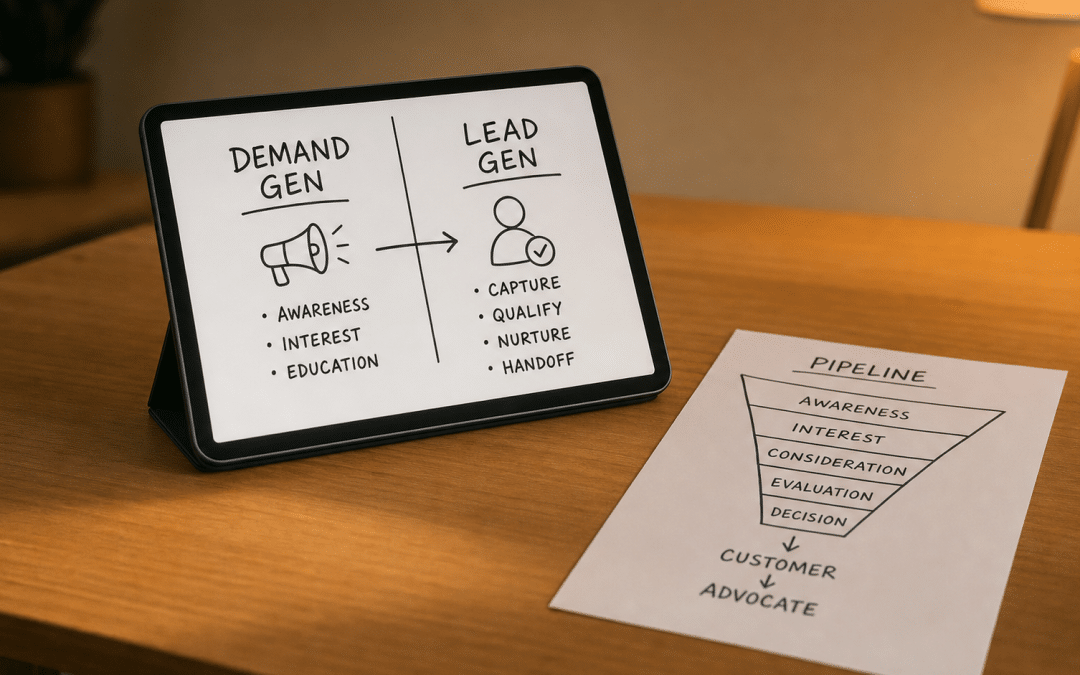
Demand generation vs lead generation is not a semantics debate — it is a strategic choice that determines whether your pipeline is self-sustaining or permanently dependent on interruption. If you want the direct answer: demand generation builds the market awareness and preference that makes future leads cheaper and faster to close; lead generation captures the intent that demand generation creates.
Our B2B Lead Generation Guide for South Africa covers the mechanics of capture in detail — this post explains what has to come first and why confusing the two costs SA companies real money.
Most B2B businesses in Johannesburg, Cape Town and Pretoria are running lead generation without demand generation underneath it. They buy lists, run cold outreach, and wonder why cost per qualified meeting keeps climbing. The answer is structural, not tactical. When the market does not already know you exist or why you matter, every lead you capture requires maximum convincing — and that convincing is expensive whether you do it via cold calling or paid search.
Quick Answer
Demand generation vs lead generation: demand gen creates the awareness and preference that puts you on buyers' shortlists before they raise their hand; lead gen captures and qualifies the hand-raisers. You need both, sequenced correctly — demand gen first, lead gen on top. Running lead gen without demand gen is like fishing in a pond you never stocked.
Do you know which motion your budget is actually funding right now?
Get a Free Demand AuditWhat Demand Generation vs Lead Generation Actually Means
Demand generation is the upstream discipline of creating market awareness, category education, and brand preference among buyers who are not yet actively shopping — lead generation is the downstream discipline of identifying and qualifying the buyers who are. The two are sequential, not competing: demand gen fills the top; lead gen harvests the bottom.
Demand generation tactics include thought leadership content, LinkedIn organic and paid reach, podcast appearances, industry event presence, and any channel that shifts how a target audience thinks about a problem. None of these tactics require the buyer to identify themselves. The payoff is indirect and lagged — but it compounds.
Lead generation tactics are transactional by design: gated assets, contact forms, demo requests, LinkedIn Lead Gen Forms, appointment-setting calls, and inbound enquiries from search. Every tactic requires the buyer to take an action that reveals their identity and some level of intent. The payoff is immediate and measurable — but it decays the moment spend stops.
The confusion between the two is understandable. Both live inside the marketing budget; both produce pipeline. The difference is timing. Demand gen changes what buyers believe before they are in-market. Lead gen captures them once they are. A business that only runs lead gen is competing for a fixed pool of already-active buyers; a business that runs demand gen as well is expanding that pool.
Key Insight
LinkedIn's own research shows that the typical B2B buyer consumes 7 to 10 pieces of content before making a purchase decision — and that 3.1 to 4.6 internal groups influence that decision. Most of that content consumption happens before a buyer ever fills in a form. Demand generation is how you get into that pre-form reading list.
Why the Demand Generation vs Lead Generation Confusion Hurts SA B2B Companies
South African B2B buyers behave in ways that make the demand generation vs lead generation distinction sharper here than in most markets. Deal cycles at enterprise level — FMCG groups, mining houses, large retailers, government-adjacent contractors — are long, consensus-driven, and heavily relationship-weighted. A cold form submission from Sandton rarely converts without prior exposure.
The EFT-preference culture carries into B2B procurement as well: buyers prefer to move slowly, verify thoroughly, and pay only once risk is reduced. That risk-reduction happens during the demand generation phase, not the lead generation phase. By the time a procurement committee fills in a contact form, the preferred vendor is usually already decided — the form is procedural.
This has a direct implication for where budget should go. Companies that spend 90% on lead generation tactics and 10% on demand generation are spending to compete at the end of a race they largely lost before the starting gun. Sales and marketing alignment breaks down here too: sales teams blame marketing for poor-quality leads, while marketing is measuring form fills that never had demand underneath them.
POPIA adds a legal layer that makes cold lead generation more constrained than it was three years ago. Under the Information Regulator's December 2024 guidance, electronic direct marketing — including live phone calls in the Regulator's current reading — requires prior consent or an existing customer relationship.
Bought lists sent unsolicited emails now carry real enforcement risk: the Regulator fined FT Rams Consulting R100 000 after ignored enforcement notices in 2024. Demand generation builds an opted-in audience organically; lead generation on a bought list builds legal exposure. See our POPIA-Compliant Lead Generation guide for the full compliance framework.
Unsure whether your current pipeline approach can survive a POPIA audit?
Get a Free Compliance and Pipeline ReviewHow to Balance Demand Generation vs Lead Generation by Business Stage
The right split between demand generation and lead generation is not fixed — it shifts with company stage, market maturity, and average deal size. A rule of thumb that works in practice: the higher your average contract value and the longer your sales cycle, the more budget weight should sit on the demand generation side.
Early-stage SA B2B companies with sub-R50 000 ACV deals and short cycles can run lean on demand gen and heavy on lead gen — the economics of volume and rapid iteration favour it. A Durban IT managed services provider targeting SMEs can generate meetings via LinkedIn outreach and cold email to opted-in contacts without a mature content engine behind it. Read the full guide for IT and MSP companies for specifics on that motion.
Mid-market and enterprise-focused companies — professional services firms, logistics providers, construction and engineering contractors — need a demand generation programme running at least six months before lead generation volume becomes meaningful. The buying committees are too large and the decision stakes too high for cold capture to work reliably. Manufacturing businesses targeting national clients are canonical examples: recognition at industry events and consistent LinkedIn presence routinely outperform paid search in pipeline quality.
LinkedIn is the most tractable demand generation channel for South African B2B, given that 89% of B2B marketers globally use it for lead generation and it generates leads at more than double the rate of the next-highest social channel, according to a State of B2B Marketing Report cited by LinkedIn's B2B lead generation resource hub.
In the South African context, LinkedIn's professional targeting filters let you reach decision-makers by seniority, job function, and company size — reaching a CFO in Rosebank without wasting budget on office managers in Boksburg.
| Dimension | Demand Generation | Lead Generation |
|---|---|---|
| Primary goal | Build awareness, preference, trust | Capture and qualify in-market buyers |
| Buyer state | Not yet actively shopping | Actively researching or comparing |
| Typical tactics | Thought leadership, LinkedIn content, events, podcast | Gated content, contact forms, LinkedIn Lead Gen Forms, cold outreach to opted-in lists |
| Time to pipeline | Months to a year (lagged) | Days to weeks (immediate) |
| POPIA exposure | Low — content is consumed voluntarily | Higher if using bought lists or unsolicited electronic contact |
| Measurement | Reach, share of voice, branded search volume, content engagement | MQLs, SQLs, cost per lead, pipeline value |
| Compounding effect | Yes — audience and authority grow over time | No — stops when budget stops |
| Best suited for | High ACV, long cycles, consensus buying | Shorter cycles, volume plays, warm audiences |
The Before/After: What Rebalancing Demand Generation vs Lead Generation Looks Like
The numbers below illustrate the pattern we see, not a guaranteed outcome. They are drawn from the directional shifts observable when SA B2B businesses add a structured demand generation programme to an existing lead generation operation over a twelve-month period.
| Metric | Before (lead gen only) | After (demand gen added, 12 months) |
|---|---|---|
| Cost per qualified meeting | R4 800 | R2 600 |
| Lead-to-meeting conversion rate | 8% | 19% |
| Average sales cycle (days) | 74 | 48 |
| Inbound enquiries per month | 6 | 21 |
| Deal close rate from pipeline | 17% | 31% |
| Proportion of pipeline from warm referrals or content | 12% | 44% |
Key Insight
The most expensive place to win a B2B deal is at the point of capture, when the buyer knows nothing about you. Every rand spent on demand generation before that moment reduces the cost and resistance at the moment of capture. The two motions are not in competition — demand gen makes lead gen cheaper.
The GPM Approach to Demand Generation vs Lead Generation
We built GPM out of a working SA ecommerce operation — not a marketing theory class — and the distinction between demand generation vs lead generation was something we learned the expensive way before we built systems around it. The pattern was the same: heavy spend on capture, thin spend on awareness, and a pipeline that worked only as long as we kept feeding it cash.
Our B2B lead generation service is structured so that both motions are mapped before any budget is committed. We identify which buyers in your target market are already in-market (using intent signals) and which need to be moved into awareness first. That two-layer view determines the channel mix, content calendar, and outreach cadence — and it means the lead generation activity we run has warmer soil to grow in.
We work across SA markets: law firms, accountancy practices, IT providers, logistics operators, construction businesses, and manufacturers. The demand generation vs lead generation balance looks different in each. A Pretoria-based engineering contractor and a Cape Town fintech have different buying committees, different content consumption habits, and different POPIA exposure profiles.
We size the demand programme accordingly, rather than applying a template. That sizing process includes reviewing what content already exists, which LinkedIn audiences are already warmed, and whether the sales team has the bandwidth to handle a meaningful increase in inbound volume before we accelerate the demand side.
For accounts using LinkedIn as their primary demand channel, we build the content engine and the lead gen infrastructure in parallel — so that by the time LinkedIn's algorithm has amplified enough thought leadership content to create inbound pull, the capture mechanisms are already live and compliant.
Who This Is NOT For
Businesses needing revenue this week. Demand generation does not produce leads in the short term. If your business has a cash flow crisis and needs pipeline within the next 30 days, you need aggressive lead generation on your warmest existing audience — not a content programme.
Demand gen is a 90-to-180-day investment minimum before it moves pipeline metrics. Starting a demand gen programme in a cash crunch and expecting it to rescue the quarter is a category error that wastes both time and money.
Very low ACV transactional businesses. If your average contract value is under R10 000 and the sales cycle is under a week, the economics of demand generation rarely justify the investment.
Volume-led, paid-search-driven lead generation with tight conversion optimisation is the right engine. Demand gen compounding works best when individual deal economics support a longer payback window. If a single deal pays for only a fraction of a month's content production, the maths simply do not stack up.
Companies without sales capacity to work pipeline. Demand generation will create more inbound attention and warmer leads — but if there is no structured sales process to receive them, the improvement dissipates.
We have seen businesses generate materially better inbound quality and then lose the leads to slow response times and no follow-up cadence. Fix the lead response time and the sales process before scaling demand gen, or you will be investing in awareness that competitors with faster sales teams convert.
Organisations expecting demand gen to replace all outbound. Even with a mature demand generation programme, outbound lead generation remains part of the mix — particularly for enterprise accounts and named target lists. Account-based marketing combines both: demand gen creates awareness inside a named account while outbound creates the conversation.
Expecting demand gen alone to fill an enterprise pipeline is unrealistic in the SA market, where relationship-led selling still dominates and a LinkedIn impression rarely substitutes for a well-timed direct approach to the right decision-maker.
Ready to see exactly where your pipeline budget is being wasted on late-funnel capture?
Get a Free Pipeline BreakdownFrequently Asked Questions: Demand Generation vs Lead Generation
What is the core difference in demand generation vs lead generation?
It is a question of timing and buyer state. Demand generation works on buyers who are not yet shopping — it shifts their awareness, builds preference, and puts your brand on their shortlist before a formal search begins. Lead generation works on buyers who are actively in-market — it captures their identity and intent and routes them into a sales process. One creates the pool; the other fishes in it.
Which should a South African B2B company invest in first?
Demand generation comes first if your average deal is above R100 000 and your sales cycle exceeds 45 days. Below those thresholds, lead generation alone can be sufficient to start.
The practical answer for most SA companies is to run minimal demand gen — a consistent LinkedIn content cadence costs less than a single paid campaign — from day one, while the primary spend goes into lead generation. The content flywheel starts slowly but it does start.
How does POPIA affect the demand generation vs lead generation balance?
POPIA tightens cold lead generation significantly. The Information Regulator's December 2024 guidance makes unsolicited electronic marketing — including emails and, in the Regulator's reading, live calls — opt-in only, unless there is an existing customer relationship. Demand generation, by contrast, distributes content voluntarily consumed — lower POPIA exposure and no consent requirement for the awareness phase. Shifting more budget toward demand generation reduces compliance risk as a side effect.
Can LinkedIn serve both demand generation and lead generation?
Yes, and it is the most efficient dual-purpose channel available to SA B2B marketers. Organic content and thought leadership build awareness and preference — the demand generation motion.
LinkedIn Lead Gen Forms and message campaigns capture intent from audiences already warmed by that content — the lead generation motion. Running both from a single company page means the audience you build for demand gen is the same audience your lead gen ads reach, which materially improves conversion rates.
How do you measure demand generation if there are no leads yet?
Measure reach and engagement on content (impressions, saves, shares), growth in branded search volume, inbound enquiry rate trends, and the proportion of pipeline that names content as a touchpoint. B2B lead generation KPIs for SA companies covers the full measurement framework. Early-stage demand gen metrics are leading indicators, not lagging — expect to track them for three to six months before they move downstream pipeline numbers.
What does a realistic demand generation vs lead generation budget split look like for a mid-market SA firm?
A practical starting point for a mid-market SA B2B business with ACV above R200 000 is roughly 40% demand generation and 60% lead generation in year one, moving toward 50/50 in year two as the content library and LinkedIn audience compound.
The demand gen budget covers content production, LinkedIn paid amplification, and event presence. The lead gen budget covers paid capture, outreach tooling, and appointment setting. These are directional ratios, not rules — ACV, cycle length, and competitive intensity all shift the balance.
Want to know exactly how your budget should be split between demand and lead generation?
We will map your current pipeline against both motions and deliver a prioritised action plan showing where to shift spend for maximum pipeline impact. No obligation — we'll get back to you within 24 hours.
Get Your Free Pipeline Allocation Plan