
 Add to Preferred Sources
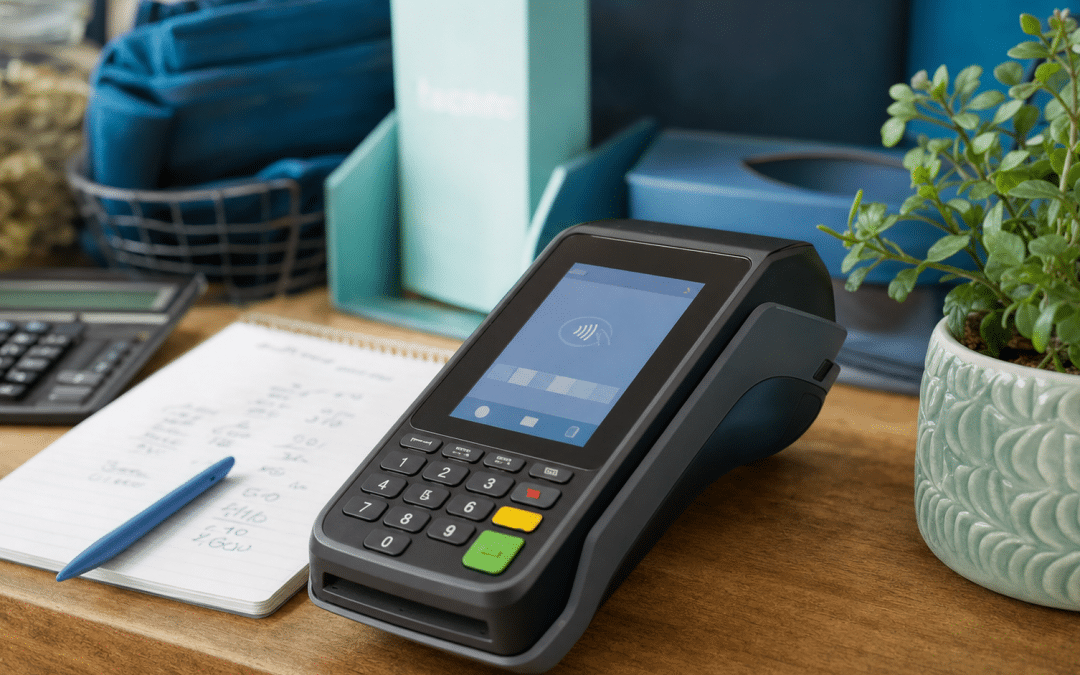
Card machine fees in South Africa are three separate costs: a percentage taken from every in-person sale, a monthly plan or rental charge, and the once-off price of the device. On the entry-band rates providers publish in October 2026, the percentage runs from 1.8% at the lowest FNB quote to 2.75% on iKhokha's first band and Absa's SmartPay.
Yoco's debit rate falls to 1.35% or lower in higher volume bands, and the other two costs decide which provider is actually cheapest for you.
If you also sell through a Shopify store, the counter and the website are billed by different providers on different terms, so this post prices the counter side on its own. Every figure below is taken from each provider's own page and dated, and every total shows its inputs.
Quick Answer
The cheapest card machine fees depend on your volume band and your mix of debit, credit and international cards. At R30,000 a month in local debit sales, Yoco's free Core plan costs R690, iKhokha R825 and Absa's SmartPay R1,124, using each provider's quoted rate. Yoco and iKhokha exclude VAT, while FNB and Absa do not say. On FNB's published prices, renting a Speedpoint costs more than buying it by the fourth to tenth month, depending on the model.
Jump to
Holding a merchant quote you cannot compare?
Send us the quote and your monthly sales split between counter and online store and we will show you how to put both on one basis.
What Does a Card Payment Cost You Beyond the Swipe Percentage?
A card payment costs the merchant one all-inclusive percentage that bundles the issuing bank's interchange, the card scheme's margin and the provider's own margin, plus whatever plan, rental or payout charges the provider adds on top. Peach Payments' explainer notes that South Africa's interchange is determined by the South African Reserve Bank and that merchants do not pay it separately: they pay one all-inclusive fee to their payment processor (Peach Payments on interchange).
That is why two providers can quote the same device price and still land far apart. The device is a once-off cost, while the percentage and the monthly charge repeat every month for as long as you trade.
Three details change the real cost more than the headline rate does:
- Card type. Yoco's Core plan charges 2.30% on local debit and 2.30% on credit up to R50k a month, but 3.20% on international cards. iKhokha lists 3.25% on international cards and 3.4% on in-person Amex.
- VAT. Yoco and iKhokha both state their rates exclude VAT. SARS puts the standard rate at 15%, so Yoco Core's R690 on R30,000 of debit sales becomes R793.50 once VAT is added. FNB's and Absa's pages do not say either way, so ask before you compare.
- Payout charges. iKhokha lists R2.50 per transaction settlement. Yoco says it charges no settlement fees and pays out in 1 to 2 business days.
Card Machine Fees Compared: Yoco, iKhokha, FNB and Absa
Card machine fees compared across these four providers show a spread of about one percentage point on headline rates and a spread of several hundred Rand a month in fixed charges. The table uses each provider's own page as shown in October 2026; promotional device prices can change without notice.
| Provider and device | Device price | Monthly charge | Local in-person rate (entry band) | Best For |
|---|---|---|---|---|
| Yoco Khumo 2 | R699 once-off (reduced from R1,299) | R0 on Core, R249 Plus, R499 Pro | Core 2.30% debit and credit, up to R50k a month | Businesses that want no contract and no rental |
| Yoco Khumo Print 2 | R1,399 once-off (reduced from R1,999) | Same three plans | Same plan rates | Counters that need printed receipts |
| iKhokha iK Flyer Lite | R699 (reduced from R999) | None | 2.75% up to R40k a month | Low-volume traders who want to own the machine and skip plans |
| iKhokha iK Flyer | R1,499 | None | 2.75% up to R40k a month | Same rate, fuller device |
| FNB Speedpoint Go | Buy R699 or rent R230 a month | Rental only if you rent | From 1.8%, set by your turnover | FNB Business account holders with steady volume |
| Absa MobilePay | No device; runs on a compatible Android phone | R0 rental | 2.25% local | Android-based sole traders testing card acceptance |
| Absa SmartPay | Rent only, R299 a month | R299 | From 2.75% local | Counters that want a touch-screen device on rental |
| Absa SmartMobi | Rent only, R399 a month | R399 | From 2.75% local | Mobile traders who want a device that needs no smart-device pairing |
Sources: Yoco pricing, iKhokha pricing, FNB merchant services and Absa merchant options. Yoco and iKhokha state their rates exclude VAT; FNB and Absa do not state their VAT treatment on those pages.
FNB's 1.8% is a starting point: its page says rates are customised to your turnover and subject to change after assessment. Treat it as the best case, not a quote.
What Does R30,000 a Month Cost on Each Provider?
A monthly cost model multiplies your card sales by the provider's rate and adds the fixed charge, which gives a Rand figure you can compare instead of a percentage you cannot. The first model uses R30,000 of local debit-card sales in a month, the volume where Yoco's first band and iKhokha's first band both apply.
| Provider and plan | Rate used | Fixed charge | Monthly total (VAT basis as quoted) | Best For |
|---|---|---|---|---|
| Yoco Core | 2.30% | R0 | R690 | No fixed charge and no contract; the lowest-cost Yoco plan at this volume |
| Yoco Plus | 2.10% | R249 | R879 | Not at this volume |
| Yoco Pro | 1.95% | R499 | R1,084 | Not at this volume |
| iKhokha | 2.75% | R0 | R825 | Owning the machine with no plan to manage |
| Absa MobilePay | 2.25% | R0 | R675 | Android phone users, if your phone is compatible |
| Absa SmartPay | 2.75% (from-rate) | R299 | R1,124 | Existing Absa merchants |
| FNB Speedpoint Go (rented) | 1.8% (lowest quoted) | R230 | R770 | Best case only; your own commission rate may be higher |
How the totals are built
Each total is R30,000 multiplied by the rate, plus the fixed charge. Yoco Plus: R30,000 × 2.10% = R630, plus R249 = R879. Absa SmartPay: R30,000 × 2.75% = R825, plus R299 = R1,124. FNB: R30,000 × 1.8% = R540, plus R230 rental = R770. The model assumes every sale is a local debit card, so credit-heavy or international-heavy tills will cost more.
Two things can move the ranking. First, Yoco and iKhokha quote rates excluding VAT while FNB's and Absa's pages are silent, so the VAT basis differs across rows: if Absa's 2.25% already includes VAT, its true pre-VAT cost is lower than R675. Second, iKhokha's R2.50 settlement fee is not in the R825. If it applied once per daily payout, 30 payouts would add R75, taking iKhokha to R900.
The headline rate on Yoco Plus is lower than Core's, but once the R249 is spread across R30,000 of sales, its effective rate is 2.93%. Yoco Pro comes to 3.61%. A lower percentage on a paid plan only helps once volume is high enough to cover the plan fee.
Reading the Monthly Totals
At R30,000 a month in local debit sales, the lowest totals are Absa MobilePay at R675 (if your phone is compatible), Yoco Core at R690 and FNB's best-case R770. A plan with a monthly fee only wins when the saving on the percentage is larger than the fee. Yoco and iKhokha totals exclude VAT; FNB and Absa do not state theirs.
Does a Paid Yoco Plan Ever Pay for Itself?
A paid Yoco plan pays for itself only when the percentage saved on your monthly sales exceeds the plan fee, and if Yoco's band rates apply to your whole month's volume, that does not happen on debit cards inside the published volume bands. The inputs for Yoco card machine fees are on Yoco's pricing page: Core is R0, Plus is R249 and Pro is R499 a month per location.
On local debit cards, Plus saves 0.20% against Core up to R50k a month (2.10% against 2.30%). R249 divided by 0.20% is R124,500 of monthly sales to break even, which is far above that band. In the R50k to R200k band the gap narrows to 0.10% (1.25% against 1.35%), so break-even rises to R249,000, again above the top of the band.
On the same whole-month assumption, R200,000 of debit sales totals R2,700 on Core, R2,749 on Plus and R2,899 on Pro. Core is still the cheapest at the top of the published band. On credit cards the Core-to-Plus gap is 0.10% (2.30% against 2.20%), which also breaks even at R249,000.
Worked check at R100,000 a month in debit sales. Core: R100,000 × 1.35% = R1,350. Plus: R100,000 × 1.25% = R1,250, plus R249 = R1,499. Pro: R100,000 × 1.20% = R1,200, plus R499 = R1,699. On the same sales iKhokha's R80k to R100k band at 2.5% gives R2,500, Absa MobilePay at 2.25% gives R2,250 and FNB at its lowest quoted 1.8% plus R230 rental gives R2,030.
Two caveats apply. Yoco's page does not say whether a band's rate applies to your whole month or only to the slice of sales inside the band, so these figures assume the whole month; confirm that with Yoco before you rely on them. And we compared rates only, so if a plan includes something else you value, that is a separate decision from the percentage.
Unsure which volume band you really sit in?
Send us three months of counter and online sales and we will help you work out which band and which provider the numbers favour.
Should You Buy or Rent the Machine?
Buying a machine costs more on day one and less within months, because a rental repeats every month while a purchase is paid once. FNB publishes both options for each Speedpoint model, which allows a direct comparison.
| FNB device | Buy | Rent per month | Rent passes the buy price | Best For |
|---|---|---|---|---|
| Speedpoint Go | R699 | R230 | By the 4th month (4 × R230 = R920) | Buy, unless you expect to stop trading within three months |
| Speedpoint Pro | R1,499 | R320 | By the 5th month (5 × R320 = R1,600) | Buy if you will use it for a year or more |
| Speedpoint Tablet | R4,999 | R500 | At month 10 (10 × R500 = R5,000 against R4,999) | Rent only if cash flow is tight and the term is short |
Absa lists rental only for its devices: SmartPay at R299 a month is R3,588 over a year and SmartMobi at R399 a month is R4,788. Rental on FNB's Speedpoint Go is R2,760 a year, against a once-off R699 to buy. Yoco's Khumo 2 and iKhokha's iK Flyer Lite are each R699 to own. Yoco says there is no contract and no monthly rental, and adds a 30-day money-back guarantee and a 1-year warranty.
For card machine rental South Africa banks quote a monthly charge, while the card machine price at purchase is paid once, and card machine transaction fees apply on top of either.
Rental can still make sense if you only need a machine for a short season, so price the full term, not the first month. Mobile-based options such as Absa MobilePay and iKhokha's iK Tap on Phone remove the device cost entirely if your phone is compatible.
How Do Counter Payments Differ From Online Store Payments?
Counter payments and online payments are priced separately: in-person rates are tied to the device and the provider, while online rates come from a payment gateway with its own percentages. iKhokha's own page shows the split, listing 2.85% excluding VAT for online local cards against the 2.75% entry rate in person.
For a store that sells online, the gateway is a separate decision. South Africa is not on Shopify's list of countries where Shopify Payments is supported as of October 2026, so an online store takes payments through a third-party gateway. Our comparison of online payment gateway rates and the guide to payment methods for SA stores cover that side.
If you sell in person and online from one stock pool, the question of whether one provider can serve both is covered in Shopify POS versus Yoco. The honest rule is to price each channel on its own volume first, then see whether combining them removes a fixed charge.
Counter and Online Are Two Bills
Card machine fees apply only to payments taken in person on a device. Online orders on your website run through a gateway with its own rate and charges, so a low counter rate tells you nothing about the cost of your web checkout. Price each channel on its own volume.
One more habit pays off: collect your last three statements and split card sales into local debit, local credit and international before you request any quote. Every table above changes with that mix, and a quote built on your real split beats one built on a guess.
Want the whole payment stack costed on one page?
Send us your current statements and we will show you where the monthly spend is concentrated and what overlaps.
Why South African Businesses Choose Growth Pulse Media
Growth Pulse Media is run by Dirk van Greuning, who built and scaled a large South African ecommerce business before founding the agency, so a payment line is judged the way an operator judges it: what does it cost per month, and what does it replace? All work is executed in-house and the client load is kept limited so senior attention stays on each account.
We are a registered Shopify Partner and an Omnisend Certified Partner.
Our digital strategy service starts from the full running cost of a business's digital stack so spend goes to the tools that earn a return. We do not sell or set up card machines; this post exists so you can price one properly before you talk to a provider.
Who This Is Not For
This post is not for readers who need a quote, a recommendation on service quality, or a high-volume negotiation, and the three blocks below say why.
You want an exact quote. Every figure here comes from a public page in October 2026. Providers change rates and promotional device prices, and FNB and Absa customise rates to your turnover. Only a written quote is binding.
You process well above R200,000 a month. Yoco's and iKhokha's published tables stop at custom rates above those bands, so negotiated pricing, not a public list, will decide your cost.
You are choosing on reliability, support or settlement speed. This is a cost comparison only. Test uptime, support and payout timing with the provider before you commit.
Frequently Asked Questions
How much are card machine fees in South Africa?
Card machine fees on published October 2026 entry-band rates run from 1.8% at FNB's lowest quote to 2.75% on iKhokha's first band and Absa's SmartPay, plus any monthly plan or rental. Yoco's Core plan starts at 2.30% with no monthly fee and its debit rate falls in higher volume bands. Device prices start at R699 to own.
Is it cheaper to buy or rent a card machine?
Buying is cheaper within months on FNB's published prices: the Speedpoint Go rental passes its R699 purchase price by the fourth month and the Speedpoint Tablet by month ten. Absa lists rental only, at R299 or R399 a month, and iKhokha and Yoco sell machines outright. Rent only if you need a machine for a short season.
Is the Yoco Plus plan worth R249 a month?
If Yoco's band rates apply to your whole month's volume, no: Plus saves 0.20% against Core on debit up to R50k a month, which breaks even at R124,500 of monthly sales, and 0.10% in the next band, which breaks even at R249,000. On that assumption Core stays cheapest through R200,000 of debit sales. Yoco's page does not say how band rates are applied, so confirm it with Yoco.
Do card machine fees include VAT?
Not on Yoco or iKhokha, which both state their rates exclude VAT, so 15% is added on top. At Yoco Core's 2.30% on R30,000 of sales, R690 becomes R793.50 with VAT. FNB's and Absa's pages do not state their VAT treatment, so ask before comparing.
Which card machine has no monthly fee?
Yoco's Core plan has no monthly fee and its Khumo 2 is R699 once-off with no rental. iKhokha lists no monthly fees on machines you own, and Absa lists R0 rental for its MobilePay Android app. Per-transaction percentages still apply on all three.
Get Your Payment Costs Down to One Number
We start from your statements, not from a provider's price page. As a registered Shopify Partner and Omnisend Certified Partner, we can also look at the online side of your sales. No obligation, and we will get back to you within 24 hours.
