
 Add to Preferred Sources
A business proposal is a document that offers a specific client a specific solution to a specific problem, with a price, a timeline and the terms under which you will do the work. It sits inside the wider digital strategy of how a business wins and keeps clients, and in South Africa it also has to survive a client's finance team, which will look at VAT, signatures and supplier paperwork before it looks at your design.
This guide covers how to write a business proposal for a South African client: what to put in it, in what order, how to show pricing with VAT correctly, and what to attach so procurement does not stall the deal. It is written for service providers (agencies, consultants, freelancers) pitching other businesses. It is not about investor pitches or government tenders, which follow different rules.
Quick Answer
A winning business proposal restates the client's problem in their own words, proposes one clear solution with options, shows the price with VAT broken out, sets a timeline and terms, and makes signing easy. Keep it as short as the deal allows: in Proposify's 2024 dataset, one vendor's global user base, won proposals averaged 11 pages and lost ones 13, an association rather than a rule. For South African buyers, add the VAT line, an e-signature route and your B-BBEE paperwork.
Jump to
Pitching a client and not sure the proposal holds up?
Send us your current proposal and we will tell you where a client's finance or procurement team is likely to push back.
Send us your proposalIs a Proposal the Same as a Quote or a Business Plan?
No: a proposal argues for a solution, a quotation states a price, and a business plan describes how a whole company will operate. Mixing them up is the most common reason people write the wrong document for the situation.
| Document | What it does | Who it is for | Best for |
|---|---|---|---|
| Quotation | States a price for specified goods or services, itemised and short | A buyer who already knows what they want | Repeat or clearly defined work |
| Proposal | Defines the client's problem, your solution, price, timeline and terms | A buyer comparing approaches or suppliers | Winning new work where you need to persuade |
| Business plan | Sets out a company's strategy, market and finances over time | Investors, lenders, your own team | Raising funds or steering the company |
If a client has sent you a specification and asked only for a price, a quotation is the right answer, and a ten-page proposal wastes their time. If they have described a problem and are weighing options, you are in proposal territory. Shopify's South Africa blog describes a typical business proposal template as eight parts, from title page to terms, and the order below follows the same logic with South African additions.
What Goes Into a Business Proposal Format That Clients Sign?
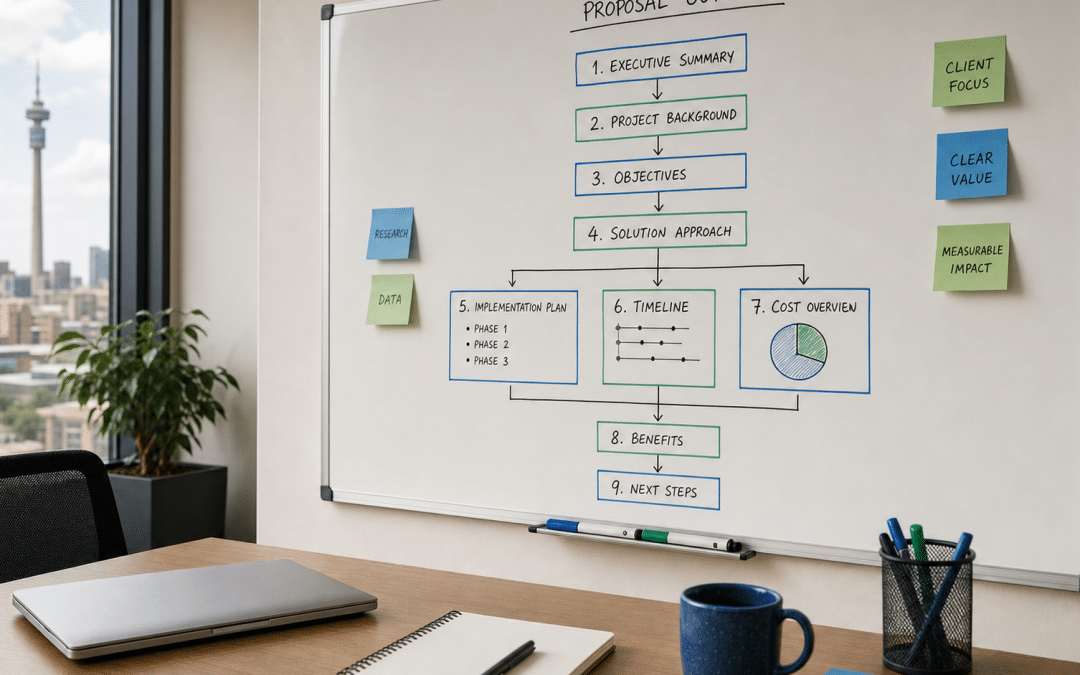
A business proposal format that closes deals puts the client's problem before your credentials, because the reader is asking "do they understand my situation?" before "who are they?". Use the sections below in this order and cut any that add no decision value for this particular client.
| Section | What it must achieve | South African check |
|---|---|---|
| Cover note | Names the client, the problem and the single outcome you are proposing to deliver | Use the registered company name the client will invoice against |
| Problem and goals | Shows you listened, using the client's own words and numbers | Agree what success is before pricing; see marketing goals versus KPIs |
| Proposed solution | Describes what you will do and, just as important, what is out of scope | Name the platforms and tools actually involved |
| Timeline and milestones | Gives dates or durations tied to what you need from the client | Allow for client approval time, not only your build time |
| Pricing and options | Shows the fee, what it covers and what triggers extra cost | VAT shown separately if you are registered |
| Proof | Gives a reason to trust you: work done, named references, credentials | Attach your B-BBEE certificate or affidavit if the client asks; check the client's requirement if your turnover is above R10 million |
| Terms and acceptance | States validity, payment terms, change process and how to accept | A signature route that works electronically |
Length follows the deal. Proposify's State of Proposals 2024 report, covering 1,280,657 proposals, found that won proposals averaged 11 pages and 7 sections, against 13 pages and 8 sections for lost ones. That is an association in one vendor's user base, not proof that trimming a page wins a deal, but it supports cutting padding.
Write the problem statement so the client can check it
A problem statement earns the rest of the document by showing the client you grasped their situation well enough that they could correct you. State what they told you, what it is costing them, and what you will not assume.
Stronger (illustrative wording, not a client case): "You told us the Johannesburg showroom gets walk-ins but the online store gets few orders, and that enquiries come through WhatsApp and are answered by one person. This proposal covers the online store and the enquiry flow. It does not cover stock management."
Weaker: "We are a full-service digital partner passionate about helping businesses grow. We deliver bespoke, results-driven solutions tailored to your needs."
The second version could be pasted into any proposal to any client, which is exactly why a buyer skims it. The first commits to facts the client can confirm or fix before a rand changes hands.
Takeaway: the client-first order
Open with the client's problem and the outcome you propose, not your company history. Put scope exclusions next to the solution, so disagreements surface before signing rather than during delivery.
How Do You Show Pricing With VAT in a South African Proposal?
Show the fee excluding VAT, the VAT amount and the total, so the client's finance team can see what they will be invoiced. The standard VAT rate in South Africa is 15% on supplies by registered vendors, according to SARS.
Whether you charge VAT depends on registration. SARS lists the compulsory threshold at R2.3 million of taxable supplies in any 12-month period from 1 April 2026, up from R1 million, and voluntary registration is open to businesses with taxable supplies between R120,000 and R2.3 million. If you are not registered, say "not registered for VAT" on the proposal so nobody assumes the price is inclusive of something it is not.
Worked example: one project fee, two instalments
Take an illustrative project fee of R25,000 excluding VAT, for a VAT-registered supplier. VAT at 15% is R3,750, so the total is R28,750 including VAT. If you bill 50% up front and 50% on delivery, each instalment is R12,500 excluding VAT, R1,875 VAT and R14,375 in total, and the two instalments add back to R28,750. The figures are an example of layout, not a price benchmark.
Two practical points follow. First, a proposal or quotation is not the same document as an invoice. SARS says a tax invoice must carry, among other things, the words "Tax Invoice", "VAT Invoice" or "Invoice", the supplier's name, address and VAT number, the recipient's details, a serial number and date, a description of the supply and the tax charged, so build your invoice separately and do not treat the proposal as the invoice. See SARS's tax invoice requirements. SARS permits abridged invoices at R5,000 or less; above that, a full tax invoice is needed.
Second, offer options rather than one take-it-or-leave-it number. Two or three scopes at different fees let a client choose a size instead of choosing between you and nothing. If you are working out where your fee sits, the marketing consultant hourly rate guide gives a South African reference point, and if the proposal includes media spend, keep it as a separate line from your fee and compare it with digital advertising spend in South Africa.
Unsure how to structure fee options?
Tell us the scope you are pitching and we will give you a timeline and fit assessment on how to split it into options a client can say yes to.
Get a fit assessmentWhat South African Paperwork Should Travel With Your Pitch?
The paperwork a South African pitch needs is whatever lets the client accept, onboard and pay you without a second round of emails: a valid way to sign, supplier details, and a B-BBEE certificate or affidavit where the client's procurement policy asks for one. Having them ready removes a round of emails when a client's procurement team asks.
Electronic acceptance
An electronic signature can be enough, but it depends on whether a law requires a signature. Under the Electronic Communications and Transactions Act, as summarised in an academic review of e-signature validity on SciELO South Africa, section 13(1) provides that where the law requires a signature, the requirement for a data message is met only if an advanced electronic signature is used. Section 13(3) covers the case where the parties to an agreement require a signature without specifying the type: a method that identifies the person and shows their approval, as reliable as appropriate, will do. The Act also does not give validity to some transactions, such as wills and the sale of immovable property, which follow their own statutes and in practice need signed paper.
For an ordinary services agreement, it is sensible to state the acceptance method in the proposal itself ("acceptance by signed PDF or e-signature platform is sufficient for both parties"). That is a drafting choice, not something section 13(3) prescribes. If the work involves something the law specifically requires to be signed, take legal advice on the signature type; this guide cannot decide that for you. The exclusions are summarised by a South African law firm; check the Act's schedules for your case.
B-BBEE proof
CIPC issues B-BBEE certificates electronically, at no cost, to Exempted Micro Enterprises with annual turnover of R10 million or less, and the certificate is valid for 12 months. According to CIPC, a sworn affidavit stamped by a Commissioner of Oaths serves as the certificate for an EME where a digital application is not possible. That route is for businesses at or under the R10 million turnover line; larger suppliers should ask the client what verification it accepts. Diarise the expiry date: a certificate that lapsed in the middle of a proposal process can delay an approval.
The terms that prevent arguments
Terms are where proposals quietly lose or win trust. Cover these five points in plain language:
- Validity: the date after which the price is withdrawn.
- Payment: deposit, milestone and final instalments, and the due date for each.
- Change process: how extra work is requested, priced and approved.
- Client dependencies: content, logins and approvals you need, and what happens to the timeline if they are late.
- Ownership and exit: who owns the finished work and the accounts, and how handover happens.
Takeaway: proposals fail on admin, not just on price
A business proposal for a South African client should show VAT separately, name an acceptance method both sides agree to, and have B-BBEE paperwork ready if the client asks. The admin you settle before signing is admin nobody can use as a reason to delay later.
What Does the Data Say About Winning Proposals?
Proposify's 2024 analysis of 1,280,657 proposals associates e-signatures and multiple viewers with higher close rates, but the data is global and vendor-based, so treat it as directional for South African work, not as a local benchmark. The report found that proposals sent through its platform closed at 36%, against what it calls a 20% industry average.
Two findings in that report are worth acting on. Proposals with e-signatures were 3.3X more likely to close, which matches the practical case for making acceptance easy. And the close rate nearly doubled when more than one person viewed a proposal, while most proposals went to only one stakeholder. Both are associations: Proposify's users self-select, and a closing deal naturally involves more signers. Still, the practical move is cheap, which is to ask the client who else needs to approve and write the proposal so that person can read it cold. The report is available as Proposify's State of Proposals 2024.
Make it readable by the second decision-maker. If the person who briefed you is not the one who signs, open with a half-page summary the finance director can read without the earlier emails: the problem, the proposed outcome, the total with VAT, and the date the offer lapses.
Define how you will prove it worked
If your proposal promises results, say how they will be measured and where the numbers will come from. For a digital project, that usually means agreeing the tracking set-up first; our guide to GA4 for South African businesses covers the analytics most clients already have. Do not promise a result number you cannot control. Promise the work, the reporting and the review dates.
Why South African Businesses Choose Growth Pulse Media
Growth Pulse Media is a Johannesburg digital agency whose founder, Dirk van Greuning, built and scaled a large South African ecommerce business before starting the agency. That background means a proposal is read the way an operator reads it: what will I get, what will it cost, and what happens if it does not work. All work is executed in-house, with a limited client load for senior attention, and the agency is a registered Shopify Partner and an Omnisend Certified Partner.
If the proposal you are writing is for a digital project and you want a second pair of eyes on the scope, see how digital strategy in South Africa is approached here, or ask for a free audit or consultation. No obligation, and we will get back to you within 24 hours.
Who This Is NOT For
This guide is not for founders raising investment, suppliers answering a formal tender, or anyone who needs a signed legal contract.
You are raising money. Investors and lenders want a business plan with market, financials and a funding ask. A client-facing proposal is a sales document for one buyer.
You are answering a formal tender. Tenders and government quotations come with their own documents, formats and supplier registrations that override anything here. Follow the issuer's instructions to the letter.
You need a legally reviewed contract. A proposal's terms are a summary for the client to accept. For high-value or regulated work, have an attorney draft the agreement the proposal refers to.
Want a second opinion before you send it?
Ask for a free audit of the scope, pricing and terms in your next proposal, and we will tell you what we would tighten.
Request a free auditFrequently Asked Questions
What is a business proposal?
A business proposal is a document that offers a client a specific solution to a specific problem, with the price, timeline and terms. It differs from a quotation, which only states a price, and from a business plan, which describes how a whole company will operate.
How do I write a business proposal?
Open with the client's problem and the outcome you propose, then describe the solution and what is out of scope, give a timeline, show pricing with options, add proof, and close with terms and how to accept. Keep it as short as the deal allows and cut any section that does not help this client decide.
How long should a business proposal be?
As short as the deal allows. In Proposify's 2024 dataset, won proposals averaged 11 pages and lost ones 13, though that is an association across one vendor's users, not a rule. A small, clearly defined job may need only a few pages.
Should a proposal include VAT?
If you are VAT-registered, show the fee excluding VAT, the 15% VAT amount and the total including VAT. If you are not registered, say so on the proposal. SARS sets the compulsory registration threshold at R2.3 million of taxable supplies in any 12-month period from 1 April 2026.
Is an electronic signature valid on a proposal in South Africa?
Often yes, but it depends. Under ECTA section 13(3), where parties require a signature without specifying the type, a reliable method that identifies the signer and shows approval can satisfy it, while section 13(1) requires an advanced electronic signature where the law itself requires a signature. Some transactions, such as wills and the sale of immovable property, are outside the Act, so take legal advice for anything the law requires to be signed.
Get Your Next Proposal Reviewed Before It Goes Out
Send us the draft and we will review scope, VAT presentation and terms. No obligation — we'll get back to you within 24 hours.
Request Your Free Audit