
 Add to Preferred Sources
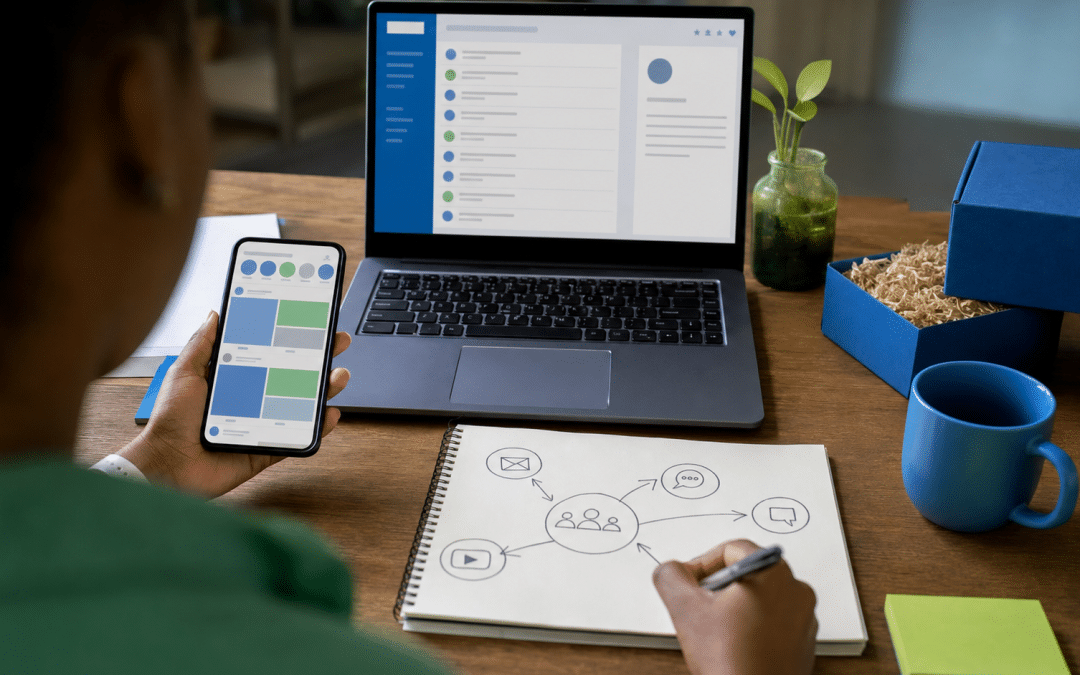
Email marketing vs social media is a choice between two different jobs: social platforms put you in front of people who do not know you yet, while email reaches people who have already given you an address. Our email marketing in South Africa guide covers the programme itself; this post covers the channel decision for a small South African business.
The short version is that neither channel wins on its own. Social media finds strangers, email keeps and sells to the ones who sign up, and the cheaper channel per click depends on whether you already hold a list. The sections below show that arithmetic in Rand, with every input sourced, so you can rerun it with your own numbers.
Quick Answer
In email marketing vs social media, fund social (organic plus Meta Ads) first if you have no customer contact details and need to be found, and fund email first if you already hold addresses collected at the point of sale. On the sourced inputs below, sending an email click costs about R1.67 against R5.12 for a Meta click in South Africa, assuming a 500-contact list uses a full 6,000-email plan allowance, and that excludes the cost of getting the address onto the list. In practice the two channels work in sequence: social acquires, email retains.
Not sure which channel your budget should go to first?
Send us your current channels and monthly spend and we will show you where the first rand should go.
Email Marketing vs Social Media: What Does Each Channel Do for an SA Business?
Social media is a discovery channel on rented ground, and email is a retention channel on ground you control, so the two answer different questions. Social answers "who has not heard of us?" and email answers "how do we get people who have heard of us to buy again?"
South Africa has plenty of people to discover. DataReportal's Digital 2026 South Africa report, published on 8 November 2025, counts 29.1 million social media user identities (44.9% of the population) and a Facebook ad reach of 27.9 million. Those are identities and ad-reach estimates, not unique buyers, but the scale explains why social is where most small businesses start.
The catch is distribution. Meta describes Facebook Feed ranking in its Transparency Centre as considering "thousands of 'signals'" per post and running "over 100 different prediction models". A Page post therefore goes through a ranking system before anyone sees it, so having a follower does not guarantee that follower sees the post. That is our reading of the ranking description, not a figure Meta publishes.
Email is not guaranteed either, because inbox providers filter, but you choose who receives each message rather than a feed algorithm choosing for you. Whether you pick email or social media for small business growth, the practical difference is who controls the first step of distribution.
Takeaway: discovery versus retention
Social media reaches people who have never heard of your business, through a ranking system you do not control. Email reaches only people who gave you an address, and you decide who is on each send. Judge email marketing vs social media on the job each channel does, not on one shared metric.
What Does a Click Cost on Each Channel?
The send cost of an email click is lower than the price of a paid Meta click, but only after the subscriber already exists, so the two figures measure different stages. The calculation below uses published inputs and shows where the comparison breaks.
Side calculation: send cost per click
Email. The Omnisend pricing page (viewed October 2026) lists the Standard plan at 500 contacts and 6,000 emails a month. Its displayed $11.20 a month is a 30% introductory price on a $48.00 three-month total, which makes the regular price $16 a month. At the SA Digital Cost Index (SADCI) assumption of R16.42 to the US dollar, that is about R263 a month. Using the whole allowance, $16 over 6,000 emails is about R44 per 1,000 emails.
Mailchimp's all-industry average click rate is 2.62% (last updated December 2023, global, campaigns to at least 1,000 subscribers). Applying that rate to emails sent as a simplification, 1,000 emails produce about 26.2 clicks, and R44 divided by 26.2 is about R1.67 per click. The calculation also assumes a 500-contact list that uses the whole 6,000-email allowance, or 12 emails per contact a month.
Meta. The SA Digital Cost Index (August 2026) puts the average South African Meta cost per click at R5.12 (US$0.31), roughly 71% lower than the global average. It puts the average cost per 1,000 impressions at R64 (US$3.92), roughly 72% lower.
| Measure | Email (Omnisend Standard, regular price) | Paid Meta (SADCI, Aug 2026) | Best For |
|---|---|---|---|
| Cost per 1,000 sent / per 1,000 impressions | About R44 per 1,000 emails sent (full 6,000-email allowance used) | R64 per 1,000 impressions | Email for people you already have; Meta for new audiences |
| Cost per click | About R1.67 (at a 2.62% click rate) | R5.12 | Email for repeat clicks to a known audience |
| Cost to add one new person | Not in the figure; needs a sign-up offer or ad | Included, you are reaching strangers | Meta Ads for first contact |
Read the table as a sequence, not a scoreboard. The R1.67 covers only the send, and excludes list building, design and the time to write. The R5.12 is an average across all Meta targeting, so it blends clicks from strangers with clicks from people who already know the business.
Often the cheapest route to an email address is a paid social click that lands on a sign-up offer, which is why the next section matters. For the wider cost picture, see our breakdowns of email marketing costs in South Africa and social media costs in South Africa.
Both inputs have limits. The Mailchimp rate is a global, all-industry average from a dated dataset, not a South African one, and your own click rate will differ. Treat R1.67 as an order of magnitude to test against your own sends.
Who Owns the Audience, and What Does POPIA Require?
Owning the audience means holding contact details you can message without a platform's permission, and in South Africa that comes with a legal condition: POPIA section 69 prohibits electronic direct marketing, including email, unless the person has consented or is an existing customer under the section 69(3) exception.
On the text of section 69, the customer exception covers contact details obtained during a sale, used to market similar products or services, with a reasonable chance to object at collection and in every later message. You may approach a non-customer only once to ask for consent, and every message must identify the sender and give a way to ask for it to stop. Our guide to POPIA email compliance walks through the practical steps.
Social does not escape these rules when it turns into messaging. The Information Regulator's Guidance Note on Direct Marketing, published on 3 December 2024, lists direct messaging on Instagram or LinkedIn among electronic direct marketing, according to ENS's summary. Mass-DMing your followers with promotions is not a loophole around consent. The Guidance Note is non-binding, and this is not legal advice.
Takeaway: ownership comes with a consent duty
An email list is an owned asset only if each address can be justified by consent or by the s69(3) existing-customer exception, whose conditions are similar products and a chance to object. Per ENS's summary of the Information Regulator's Guidance Note, the responsible party bears the onus of proving consent, so capture it at sign-up and keep the record.
How Much Organic Reach Can a Small Business Expect?
Organic reach is the number of people who see a post without paid promotion, and no source in this research gives a reach figure for South African accounts. The nearest public proxy is engagement: Rival IQ's 2026 benchmark, published through Quid in March 2026, puts the all-industry median Instagram engagement rate at 0.30%, down from 0.36%, a fall of roughly 17% year over year.
That rate is total interactions divided by follower count, across 150 randomly selected companies per industry from a database of over 200,000. It is a global figure, not a South African one, and engagement is not reach. As a worked example, 0.30% of 1,000 followers is 3 interactions on a typical post. That is arithmetic on a median, not a prediction for your account.
We left out a Facebook figure because the sources we read did not agree on one. Falling Instagram engagement per follower does not prove falling reach, but it is a reason not to rely on organic posting alone: many businesses add a paid layer or pair posting with an email list.
Posting every week and hearing nothing back?
Send us your last month of posts and we will show you what to keep, what to pay to boost and what to move to email.
Which Channel Should You Fund First?
The channel to fund first is the one that matches your biggest constraint: no audience points to social, an existing customer list points to email, and a need for results this week points to paid social. The table maps common South African situations to a starting point.
| Your situation | Fund first | Why | Best For |
|---|---|---|---|
| No list, nobody knows the brand | Social (organic and Meta Ads) with a sign-up offer | Email has no one to send to yet | New brands and new shops |
| Customer details collected at sale or checkout | The s69(3) exception can apply if you market similar products and offered a chance to object at collection and in every message; the send cost is low | Shops with repeat buyers | |
| Repeat-purchase product (bakery, butchery, pet shop) | Email for repeat orders; social for local discovery | Repeat buyers need a reminder, strangers need an introduction | Local food and pet retail |
| Long sales cycle (B2B, car dealership) | Social for first contact, email for follow-up | Buyers take weeks to decide and need several touches | Considered purchases |
| Very small budget, little time | Email only if you already hold customer addresses; otherwise organic social | Omnisend's Free plan lists 250 contacts and 500 emails a month at $0, so email can start with no platform fee, but only if there are addresses to send to | Owner-run businesses |
| Need enquiries this week | Paid social | A list you do not yet have has nobody to send to | Time-bound offers |
If your customers live on WhatsApp more than in their inboxes, a third option exists: see our comparison of WhatsApp vs email marketing in South Africa. For anyone asking about social media vs email marketing for a shop that already has a customer list, the table's second row is the usual answer: start where the addresses already are.
How Should a Small Business Split Its Effort?
A workable split treats the two channels as one pipeline: social finds people, a sign-up offer converts them to subscribers, and email turns them into repeat buyers. The point is to stop treating email marketing and social media for small business growth as rivals competing for the same hour.
- Capture addresses everywhere. Add a consent-based sign-up to checkout, the enquiry form, in-store sign-up and your social bios, and keep a record of when and how each person agreed. Our guide to building an email list in South Africa covers the offers that work.
- Use social to pay for the first contacts. Point a Meta Ads campaign at a sign-up offer, not at a product page, and track cost per subscriber.
- Send a welcome sequence. A person who has just chosen to hear from you has given you a reason to introduce the business properly, so use that first send for it.
- Judge it on revenue per subscriber. As a working rule of thumb, a channel is worth funding while a subscriber brings in more than they cost to acquire and send to. Replace the vague "engagement" with that comparison.
This also sets expectations: because email is the retention half, results compound only after the list has grown, so judge it over quarters rather than weeks.
Why South African Businesses Choose Growth Pulse Media
South African businesses choose Growth Pulse Media because the advice comes from an operator: founder Dirk van Greuning built and scaled a large South African ecommerce business before founding the agency, all work is executed in-house, and a limited client load keeps senior attention on each account. We are an Omnisend Certified Partner and a registered Shopify Partner, and we run Meta Ads campaigns.
That combination matters for the email marketing vs social media decision, because the pipeline only works when sign-up offers, Meta Ads campaigns and Omnisend flows are planned together around POPIA consent. If you want the list-building and sending side handled, see our email marketing service.
Who This Is Not For
This channel framework does not suit businesses that plan to buy a list, want one universal winner, or need sales this week with no list.
You plan to buy a list. The Information Regulator's Guidance Note puts the onus of proving consent on the sender, per ENS's summary. A purchased list does not come with your own consent record, so the cost per click above does not apply to it.
You want a universal winner. Whether email marketing or social media comes out ahead changes with whether you hold addresses, what you sell and how long buyers take to decide. No honest source publishes one answer for every business.
You need sales this week and have no list. Email cannot deliver that, and the R1.67 figure assumes subscribers you do not have yet. Paid social is the only part of this plan that works on that timeline.
Want an audit of what you are running today?
Send us your current social channels and any existing list and we will audit which half of the pipeline is missing.
Frequently Asked Questions
Is email marketing better than social media for a small business?
Neither is better in general, because they do different jobs. Email is usually better once you hold addresses, since you choose who receives each message; social is better for reaching people who do not know you yet.
Which is cheaper, email or social media?
Per click, sending is cheaper: about R1.67 per email click against R5.12 for a Meta click on the figures in this post, assuming a 500-contact list uses a full 6,000-email plan allowance. That excludes the cost of acquiring each subscriber, so the full cost of email depends on how you build the list.
Can I use social media to build an email list?
Yes. Point organic posts, bio links or a Meta Ads campaign at a sign-up offer and record each person's consent. Direct messages to followers count as electronic direct marketing under the Information Regulator's Guidance Note, so use them only with consent or the existing-customer exception.
Do I need consent to email people in South Africa?
POPIA section 69 prohibits electronic direct marketing unless the person has consented or is an existing customer under section 69(3). You may ask a non-customer for consent only once, and every message must identify you and give an opt-out route.
Does organic social media still work for small businesses?
Organic posting can build visibility, but the public evidence is about engagement, not reach. Rival IQ's 2026 benchmark puts median Instagram engagement at 0.30% of followers, down from 0.36%, so many small accounts add a paid layer or an email sign-up to turn attention into a list.
Get both channels working as one pipeline
We work in Omnisend and Meta Ads, and we plan sign-up offers, welcome flows and campaigns around POPIA consent. No obligation — we'll get back to you within 24 hours.
