
 Add to Preferred Sources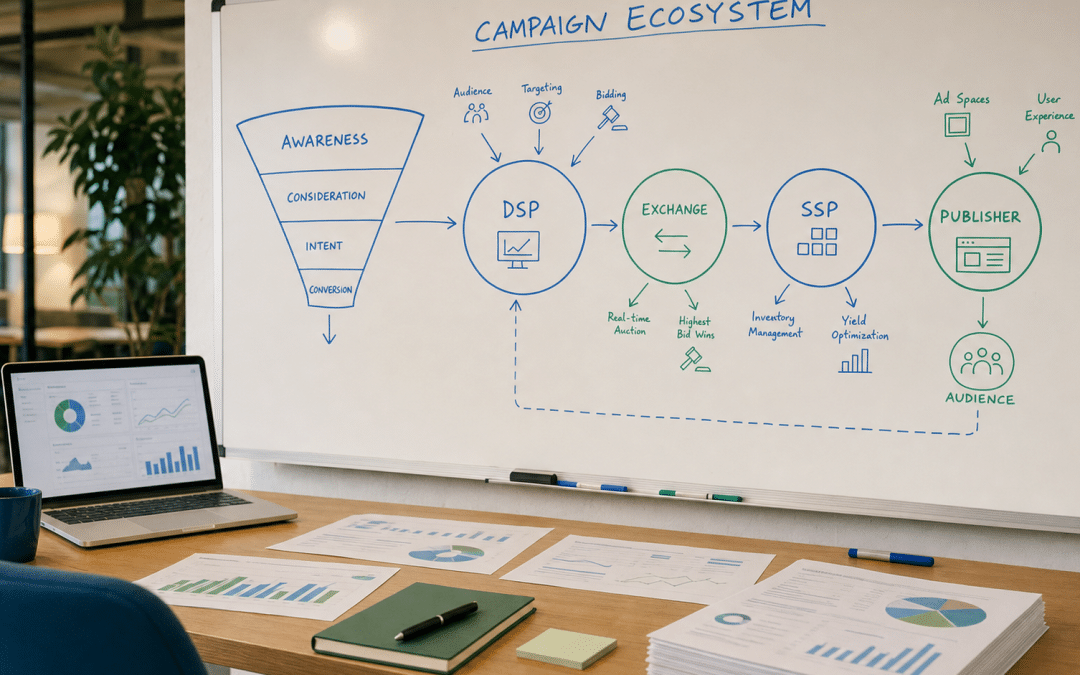
Programmatic advertising is the automated buying and selling of digital ad inventory in real time, using software algorithms rather than human negotiation or insertion orders. If you are working through a digital strategy for your South African business and weighing up where paid display or video fits, the short answer is: programmatic is worth understanding, but it suits specific budget levels and campaign objectives — it is not a universal upgrade from Meta Ads or publisher-direct placements.
South Africa's total digital advertising market reached R17.7 billion in 2023, according to the IAB SA/PwC annual revenue report — a 21.5% year-on-year increase, driven primarily by paid search and social. Display and video are growing within that, and industry projections put 83% of SA market revenue through programmatic channels by 2029. That makes the mechanics worth understanding whether you are an active buyer today or planning your first display campaign.
This post explains how programmatic works, what it costs at local budget levels, when it genuinely earns its place, and where a pilot audit of millions of SA programmatic impressions found that an estimated 40% of spend was flowing to low-quality or non-compliant inventory — a governance gap that every SA advertiser should understand before committing budget.
Quick Answer
Programmatic advertising is auction-based, automated media buying across digital inventory — display, video, native, and connected TV — handled by software in milliseconds. In South Africa it makes the most sense for brands needing broad reach, retargeting at scale, or cross-channel frequency management. As a practical working guide, campaigns need meaningful monthly media budgets for the platform algorithms to generate enough data to optimise; below that threshold, Meta Ads or publisher-direct placements typically deliver better returns for the spend. Brand safety and supply-chain governance are non-negotiable considerations in the SA market.
On This Page
Not sure where programmatic fits your media mix?
Send us your current channel spend breakdown and we will give you an honest view of where automated buying could reduce your cost per impression — and where it would not.
Send Us Your MixHow Does Programmatic Advertising Work?
Programmatic advertising connects advertisers with available publisher inventory through a chain of technology platforms — all within roughly 100 milliseconds of a page loading. The core components are:
- DSP (Demand-Side Platform): the advertiser's buying interface. You set your audience, budget, bid strategy, and creative. The DSP submits automated bids on your behalf.
- Ad Exchange: the marketplace where DSPs and SSPs transact. Open exchanges allow any buyer to bid; private marketplaces (PMPs) restrict access to pre-approved buyers.
- SSP (Supply-Side Platform): the publisher's selling tool. Publishers connect their available inventory to the exchange so advertisers can bid for it. SSPs take approximately 10–15% of publisher revenue as a technology fee.
When a South African user lands on a news site or scrolls through a lifestyle app, their browser or device signals to the publisher's SSP that an impression is available. The SSP auctions it on the exchange in real time. DSPs from multiple advertisers submit bids — each considering the audience match, the context, and the floor price set by the publisher. The winning bid's creative appears. The whole process concludes before the page finishes loading.
What distinguishes programmatic from traditional display buying is the targeting layer. Rather than buying space on a specific site and hoping your audience happens to be reading it, you buy access to a defined audience profile — by location, device, browsing behaviour, time of day, or first-party data signals — wherever they appear across the inventory network.
Key Programmatic Formats
- Display/Banner: standard image or HTML5 ads across websites and apps
- Native: ads that match the look of the editorial environment (sponsored cards, in-feed)
- Pre-roll & Outstream Video: video placements within content or between article sections
- Connected TV (CTV): ads served into streaming platforms and smart TV apps
- Programmatic DOOH: digital out-of-home screens at airports, malls, and high-traffic venues, bought and served dynamically
In South Africa, DSPs active in the market include Adobe Advertising Cloud, Scibids, and others that connect to local inventory via exchanges such as Google Ad Manager (which functions as both SSP and exchange for publishers using it). Supply reaches across news publishers, lifestyle sites, sports media, financial content, and increasingly into CTV and audio. The country's 74.7% internet penetration — with 99.3% of those users on smartphones — shapes what that inventory looks like: mostly mobile web and app placements, not desktop.
What Does Programmatic Advertising Cost in South Africa?
Programmatic advertising costs have three layers: the media spend (what you pay for the impressions), the platform technology fees, and the management fee if an agency or specialist is running the campaigns. Understanding all three is essential for budgeting honestly.
CPM Benchmarks by Format
Cost-per-thousand impressions (CPM) varies significantly by format and inventory quality. The table below shows global benchmark ranges from Sproutbox's programmatic pricing guide (2026); open-exchange CPMs in South Africa and other emerging markets typically sit toward the lower end of these ranges, while private marketplace deals command premiums.
| Format | Global CPM Range (USD) | Notes for SA Buyers |
|---|---|---|
| Display / Banner | $1–$8 | Open exchange cheapest; quality varies significantly |
| Native | $4–$12 | Higher engagement; placement context matters |
| Pre-roll & Outstream Video | $10–$25 | Requires polished video creative; higher minimums |
| Connected TV (CTV) | $20–$45+ | SA inventory is growing but still limited |
| Programmatic DOOH | $4–$20 | Price depends on screen location and venue category |
Source: Sproutbox programmatic pricing guide, 2026. Global benchmarks — SA open-exchange rates typically vary by inventory quality and exchange access.
Platform Technology Fees
Platform fees sit on top of media spend. Major DSPs charge differently: The Trade Desk is typically reported at around 20% of media spend for smaller buyers (Sproutbox 2026 guide), though enterprise contracts are negotiated and rates vary; Google Display & Video 360 (DV360) runs approximately 10–15% as a technology fee. SSPs take their cut from the publisher side (10–15%), but that affects how much of your media budget actually reaches quality inventory — what is sometimes called the "supply path."
Management and Minimum Budgets
Agency management fees typically run 15–25% of media spend for active campaign management. One local SA programmatic agency publishes starter campaign pricing from approximately R5,000/month in media spend, describing R10,000–R20,000/month as the "sweet spot" for campaigns to have sufficient data to optimise properly. Global pricing guidance aligns with this principle: campaigns running below approximately $2,000/month (USD) in media spend generally underperform because the platform algorithms need sufficient impression volume to make meaningful optimisation decisions.
What You Are Actually Buying
Programmatic media spend covers the inventory cost only. Add buy-side technology fees (10–20% of spend) and agency management (15–25% of spend) and your total investment typically runs 25–45% above the media figure alone. Build the full fee stack into your ROI model before committing to a monthly budget.
For smaller monthly media budgets, the overhead of DSP technology fees and management often makes a well-targeted Google Display campaign or direct publisher deal more cost-efficient, because you are not paying multiple layers of technology cost on a thin base.
Key Takeaway: Budget Thresholds
There is no single universal minimum for programmatic campaigns, but as a working rule of thumb, campaigns need enough monthly media spend to generate the impression volume required for algorithmic learning. Below that level — and it varies by format, targeting precision, and audience size — the technology fees absorb a disproportionate share and optimisation cycles are too slow. If your budget is modest, a direct placement or social channel often gives you more control for the spend.
When Does Programmatic Advertising Make Sense for SA Businesses?
Programmatic advertising earns its place in four specific scenarios. Outside these, simpler alternatives usually deliver better returns for South African advertisers at typical SME budget levels.
1. Broad Reach Across the Open Web
If you need to build awareness at scale across multiple publisher environments — news, sports, lifestyle, finance — simultaneously, programmatic lets you do this through a single DSP rather than negotiating with dozens of publishers individually. South Africa's mobile-first internet audience spans a wide range of sites and apps; programmatic reaches across that inventory in a way that direct buys cannot match for breadth.
2. Retargeting and Audience Sequencing
Retargeting — serving ads to users who have already visited your site or engaged with your content — is one of programmatic's most defensible use cases. The combination of first-party audience data and real-time bidding lets you follow qualified prospects across publisher environments without relying on a single platform's walled garden. One SA programmatic provider cites retargeting CTR uplifts of 3–5 times versus cold prospecting — independent results vary significantly by vertical, creative quality, and audience definition.
3. Cross-Channel Frequency Management
Running programmatic display alongside Meta or Google Ads creates a frequency problem if each channel counts separately. DSPs with cross-channel identity resolution let you cap how many times a specific user sees your brand across environments in a given period — protecting user experience and not wasting budget on the same impression served twenty times to the same person.
4. Connected TV and DOOH for Premium Brand Awareness
If you are in a category where brand presence at high-attention moments matters — financial services, insurance, automotive, FMCG — programmatic CTV and digital out-of-home provide access to premium placements that were previously negotiated manually. The Middle East and Africa DOOH market is projected to expand at approximately 23% annually through 2030, with South Africa leading the region. Programmatic DOOH lets you target specific high-traffic SA venues (airports, major shopping centres) and serve dynamic creative that changes by time of day or local conditions.
Unsure whether your budget unlocks meaningful programmatic reach?
Tell us your campaign goal and monthly media budget. We will give you an honest assessment of whether automated buying, Meta Ads, or a publisher-direct placement delivers better returns at your spend level — no sales pressure, just a straight answer.
Get a Budget Fit AssessmentBrand Safety, Waste, and POPIA: What SA Advertisers Must Know
Programmatic advertising in South Africa has a documented governance problem that too few advertisers discuss openly. A pilot audit by DY|DX, analysing millions of impressions in the SA market, found that an estimated 40% of digital programmatic ad spend was either wasted, compromised, or actively funding misinformation. In a display market estimated at approximately R1.5 billion annually, that means an estimated R600 million a year may be flowing to low-quality or non-compliant inventory.
The audit's finding was direct: "This is not a pricing problem, it's a governance problem." Organisations lack visibility into where budgets are actually allocated across the programmatic supply chain.
What Goes Wrong
Open-exchange programmatic buying without supply-path optimisation (SPO) can route impressions to made-for-advertising (MFA) sites — pages built purely to generate ad revenue with minimal real human readership. Your CPM looks cheap because it is cheap; the audience that sees your creative is not the audience you paid to reach. In a South African context, the audit also found instances of FSCA-regulated products being served in non-South African markets — a compliance exposure on top of a waste problem.
Three practices reduce this risk. First, use allowlists — define which publishers may carry your creative rather than relying on category exclusions. Second, demand supply-path transparency from your DSP partner: the shorter the path from advertiser to publisher, the lower the fee leakage and the greater your visibility. Third, review impression-quality metrics — viewability, invalid traffic (IVT) rates, and brand safety scores — not just clicks and cost.
POPIA and Programmatic Audience Data
Programmatic campaigns that target South African users must comply with the Protection of Personal Information Act (POPIA). The law covers cookie identifiers, device IDs, IP addresses, and behavioural data used in audience building — all the data signals programmatic relies on. Section 69 of POPIA governs direct marketing by electronic communication. The established interpretation is that existing customers may be marketed to on an opt-out basis, while new prospects require prior opt-in consent. Whether cookie-based programmatic display targeting falls within Section 69's scope is an active legal question — SA practitioner opinion has not fully converged. As a working guide, apply opt-in standards to any new-prospect audience build and obtain specialist legal advice for campaigns using first-party data at scale.
The Information Regulator published its Guidance Note on Direct Marketing in December 2024, clarifying how personal information must be processed for marketing purposes under the Act. Maximum penalties reach R10 million or imprisonment of up to 10 years — the Information Regulator applies a graduated enforcement framework and these maxima are reserved for serious or repeated violations. Practically, your consent banners, retargeting audience builds, and data-sharing with DSPs all need to meet POPIA's standards — not just GDPR equivalents, which is what many global ad-tech platforms default to.
Key Takeaway: Brand Safety Is Not Optional
Before running programmatic campaigns in South Africa, define your allowlist, confirm your DSP provides transparent supply-path reporting, and verify that your audience targeting and consent processes comply with POPIA. The technology delivers reach — governance determines whether that reach is real and legal.
For a broader view of where paid digital channels sit within your overall spend, the SA digital advertising spend benchmarks for 2026 provide useful context on how programmatic compares to search and social allocation across the market.
Why South African Businesses Choose Growth Pulse Media
Growth Pulse Media's founding director built and scaled a South African e-commerce business before founding the agency — which means every media recommendation comes from someone who has actually paid the invoices, interrogated CPM reports, and adjusted bids based on real conversion data, not benchmarks.
We work with a deliberately limited client roster so that every campaign gets senior attention. When we build a programmatic campaign, we start with supply-path transparency: defining the allowlist before the first impression is bought, setting up cross-channel frequency caps, and reporting on viewability, IVT rates, and brand safety scores alongside click and cost metrics.
Our campaign work sits inside a broader digital strategy framework that connects paid media to your owned channels. We use Google Ad Manager, Meta Ads Manager, and GA4 to measure actual business outcomes. Whether you are evaluating programmatic for the first time or auditing a campaign that is already running, we will give you a direct view of whether the channel and the budget are working — or what needs to change.
Who Programmatic Advertising Is NOT For
Small monthly media budgets without sufficient impression volume
If your monthly media budget sits below a meaningful threshold for your chosen format, the platform algorithms do not have enough data to optimise effectively. Technology fees and management costs absorb a disproportionate share, and you would almost certainly achieve better returns with a well-run Meta campaign or a publisher-direct placement where every rand is visible and controllable.
Businesses that need direct-response leads today
Programmatic display is primarily a reach and awareness tool. If your immediate goal is a measurable volume of enquiries, form fills, or purchases within a short time window, Google Search campaigns targeting high-intent keywords or Meta lead ads are structurally better suited to that objective — search captures users already looking; display reaches users who are not. Programmatic earns its place earlier in the funnel — not at the bottom.
Advertisers without governance capacity for supply-chain oversight
Running programmatic without actively monitoring impression quality, managing allowlists, and reviewing supply-path transparency means accepting that a meaningful share of your budget may not reach real SA audiences on quality inventory. If you do not have the internal capacity or a partner with genuine programmatic expertise to manage this, the technology creates as much risk as opportunity. A performance marketing approach with accountable channel partners may serve you better.
Hyper-local campaigns with narrow geographic targeting
Programmatic's strength is breadth. If your campaign needs to reach people within a 5 km radius of a specific location — a restaurant, a retail store, a local service — the available inventory within that tight radius may be insufficient for meaningful reach, and the targeting overhead does not justify the cost. Google Local campaigns or Meta geo-targeted social ads give you tighter local control with more predictable results.
Running programmatic campaigns but uncertain about where your budget is actually going?
Share your current campaign reports and we will audit your supply-chain quality — identifying the spend reaching real SA audiences versus inventory that is not earning its place in your plan.
Request a Supply Chain AuditFrequently Asked Questions
What is the difference between programmatic advertising and Google Display Ads?
Google Display Ads are a form of programmatic advertising, but they run exclusively through Google's own inventory network (GDN). Programmatic advertising in the broader sense refers to automated buying across multiple exchanges and networks through a DSP — giving access to inventory beyond Google's ecosystem. Google's DV360 is Google's enterprise-level DSP that connects to third-party exchanges as well as GDN. If you run Google Display Ads via Google Ads, you are using a simplified form of the same technology but with more limited inventory access and control than a full DSP provides.
Is programmatic advertising worth it for South African SMEs?
For most South African SMEs, the honest answer is: it depends on your budget level and campaign objective. SMEs with modest monthly media budgets generally achieve better returns through Meta Ads or Google Search, where the platform's targeting quality is high and the minimum effective spend is lower. Programmatic becomes more valuable as media budgets grow, when retargeting at scale becomes relevant, or when you need cross-publisher reach that a single walled-garden platform cannot provide. Start with what you can verify and control; add programmatic when your volume justifies the governance overhead.
How does POPIA affect programmatic advertising in South Africa?
POPIA applies directly to the data signals that programmatic relies on — cookies, device IDs, behavioural profiles, and location data. Under Section 69, new prospects must opt in before you can target them directly; existing customers operate on an opt-out basis. Practically, this means your website's cookie consent mechanism must be set up correctly, your retargeting audiences must only include users who have consented appropriately, and your DSP must process data in ways compliant with SA law, not just European GDPR standards. The Information Regulator's December 2024 Guidance Note on Direct Marketing clarified these obligations further.
What share of South Africa's digital advertising goes through programmatic channels?
According to data cited by industry sources, programmatic is projected to account for 83% of SA advertising market revenue by 2029. The SA digital ad market as a whole was valued at R17.7 billion in 2023 per the IAB SA/PwC report, with paid search dominant at 73.3% of digital spend. Display and video — where programmatic operates most directly — are the fastest-growing segments within the remaining share. The IAB South Africa tracks market data through its annual revenue report, published in partnership with PwC.
What questions should I ask a programmatic advertising partner in South Africa?
Five questions matter most. First: which DSP do you use, and what inventory can it access? Second: how do you define and enforce an allowlist for brand safety? Third: can you show us supply-path transparency — what percentage of media spend reaches the publisher after all tech fees? Fourth: how do you report on impression quality (viewability, invalid traffic, brand safety scores) not just clicks and CPMs? Fifth: how do you handle POPIA compliance in audience building and consent management? A provider who cannot answer all five clearly is not managing your supply chain — they are just placing orders.
Ready to Run Programmatic Campaigns That You Can Actually Verify?
Growth Pulse Media sets up and manages programmatic campaigns with full supply-chain transparency — allowlisted inventory, POPIA-compliant audience builds, and impression-quality reporting that shows exactly what your budget is buying. We use Google Ad Manager, Meta Ads Manager, and GA4 to connect campaign performance to actual business results. No obligation — we will get back to you within 24 hours.
Talk to a Programmatic Specialist