
 Add to Preferred Sources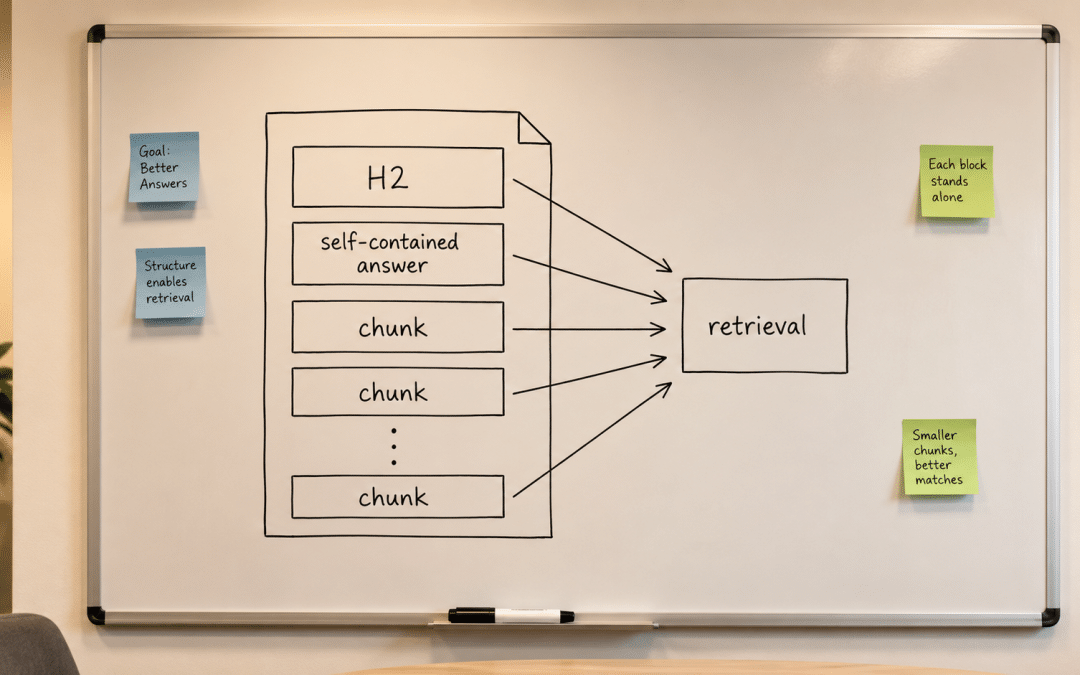
Structuring content for ai retrieval means writing and formatting your pages so that AI systems can lift a clean, self-contained answer straight out of them — because that is exactly how modern AI search works. Assistants like ChatGPT, Google's AI Overviews, and Perplexity do not read your page top to bottom; they retrieve small, relevant chunks and quote them. If your content is not built in liftable pieces, it simply does not get retrieved.
This guide explains how retrieval actually works, the specific structural techniques that make a page RAG-friendly, and how to apply them so your site becomes the source AI systems pull from. It sits under our AI search optimisation guide as the deep technical layer beneath it.
Quick Answer
Structuring content for ai retrieval works by matching how retrieval-augmented generation reads the web: content is split into chunks, and the most relevant chunk is pulled to answer a query. To win, write self-contained answers under clear question-style headings, keep paragraphs tight, front-load the answer, and add structured data. The goal is a page where any single section makes sense — and can be quoted — on its own.
Want to know whether your current pages are actually retrievable by AI?
Get a Free AI Retrieval AuditHow AI Retrieval Actually Works
Structuring content for ai retrieval starts with understanding the pipeline: AI retrieval works by breaking web content into small passages, converting them into mathematical representations, and pulling the closest-matching passage to answer a query — a process known as retrieval-augmented generation, or RAG. The AI does not summarise your whole page; it finds the single most relevant chunk and works from that.
This is the mental shift that changes everything about how you write. A traditional SEO page is built as one flowing argument that rewards reading start to finish. A retrieval-friendly page is built as a set of independent, self-sufficient blocks, each able to answer one question completely without relying on the paragraphs around it. The search foundations underneath that shift are covered in our SEO guide for SA businesses, which deals with how local sites get found.
Practically, retrieval systems chunk content along structural boundaries — headings, paragraphs, list items. When your headings are vague and your paragraphs sprawl across multiple ideas, the chunks come out muddy and match poorly. When each section is tightly scoped to one question, the chunk is clean, the match is strong, and your passage gets pulled into the answer.
Key Insight
AI does not rank your page — it retrieves a passage from it. That single distinction is the whole reason structure now matters more than length. A brilliant 3,000-word essay with no clean internal boundaries can lose to a clearly-chunked page that answers the exact question in one liftable paragraph.
The Core Techniques for Structuring Content for AI Retrieval
Structuring content for ai retrieval comes down to a handful of repeatable structural techniques, each designed to produce clean, self-contained chunks that retrieval systems can match and lift. None of them require rewriting your expertise — only reshaping how it is presented.
| Technique | What it does for retrieval | Best for |
|---|---|---|
| Question-style headings | Matches the user's actual query wording | Every section |
| Answer-first paragraphs | Puts the liftable answer in the first sentence | Under every heading |
| Self-contained sections | Each chunk makes sense alone, no "as above" | Whole page |
| Tight paragraphs | One idea per chunk, clean boundaries | Body content |
| Structured data | Gives machines an explicit, parseable copy | FAQs, how-tos, facts |
Write question-style headings
Headings that mirror real queries give retrieval systems an exact match to work with. "How much does a website cost in South Africa?" retrieves far better than a vague "Pricing", because the heading itself signals precisely what the chunk beneath it answers.
Front-load the answer
The first sentence under each heading should answer the heading's question completely and directly. Retrieval favours passages that resolve the query immediately, so a section that opens with the answer — then adds detail — is far more liftable than one that builds up to it.
Make every section self-contained
Each section must stand on its own, because a retrieved chunk arrives with no surrounding context. Avoid "as mentioned above" or "as we saw earlier" — those references break the moment a chunk is lifted out. Restate the subject in each section so the passage is complete by itself.
Keep paragraphs tight and single-idea
One idea per paragraph produces one clean chunk. When a paragraph tries to cover three points, the retrieval system either splits it badly or matches it weakly. Short, focused paragraphs give the machine crisp boundaries and strong matches.
Retrieval-friendly: An H2 reading "What does SEO cost in Johannesburg?" followed by "SEO in Johannesburg typically costs between R8,000 and R25,000 per month in 2026, depending on competition and scope." Self-contained, answer-first, query-matched — an AI can lift it verbatim.
Retrieval-hostile: An H2 reading "Our Approach" followed by "As we touched on above, there are many factors to consider before we get into the numbers…" No query match, no answer, and a dangling back-reference that collapses the moment the chunk is pulled out.
Want your top pages restructured into clean, liftable chunks?
Get a Free Content Structure PlanStructured Data: The Machine-Readable Layer
Within structuring content for ai retrieval, structured data is the most direct way to hand AI systems a clean, unambiguous copy of your key facts, because it removes the guesswork of parsing prose. Schema markup translates your content into a format machines read natively, which complements — rather than replaces — well-structured writing.
FAQ, How-To, and Article schema are the highest-value types for retrieval because they explicitly pair a question with its answer, or a step with its instruction. That is exactly the question-answer shape retrieval systems are looking for. A well-formed FAQ block gives an assistant a pre-packaged, liftable answer with zero ambiguity, which is why it pairs so well with the schema markup for AI search approach.
The principle is that structure and schema reinforce each other. Clean headings and self-contained paragraphs make your prose retrievable; schema makes your facts machine-readable. According to Google's own people-first content guidance, content that is genuinely helpful and clearly organised is what its systems aim to surface — structure and substance are not in tension.
Key Insight
Structured data does not replace good structure — it doubles it. Your clean headings and answer-first paragraphs make the prose retrievable, while FAQ and How-To schema hand machines a parallel, unambiguous copy of the same answers. Together they cover both how AI reads and how it parses.
Structuring Content for AI Retrieval: A Practical Page Blueprint
A retrieval-friendly page follows a predictable blueprint that turns each of these techniques into a repeatable layout, so structuring content for ai retrieval becomes a checklist rather than a guess. The pattern applies to almost any informational page.
| Page element | Retrieval job |
|---|---|
| Opening paragraph | States the direct answer and defines the topic in one liftable block |
| Question-style H2s | Each maps to one real query and scopes one clean chunk |
| Answer-first sections | First sentence resolves the H2; detail follows |
| Self-contained paragraphs | One idea each, no back-references, complete alone |
| FAQ block + schema | Pre-packaged question-answer pairs for direct lifting |
Follow this blueprint and every meaningful passage on the page becomes independently retrievable — which is the whole aim of structuring content for ai retrieval. The page still reads well for humans — answer-first, well-signposted writing is good for readers too — but it now also serves the machine that lifts one chunk at a time. That dual service is the entire point of the exercise. If reworking your existing pages into self-contained answer blocks is too much to take on in-house, our SEO content services handle it under a flat monthly retainer.
The South African Angle: A Quiet Structural Edge
South African businesses have an unusual opening in structuring content for ai retrieval because most local competitors have not restructured at all. While the concept of RAG-friendly content is spreading fast in the US, the majority of SA sites are still built as traditional flowing SEO pages, which leaves the retrieval slot wide open in local query spaces.
The practical implication is speed-to-advantage. A South African business that restructures its key pages into clean, question-matched, self-contained chunks can become the passage AI assistants lift for local queries — long before competitors even understand the shift. In a sparse local landscape, structure is a faster edge than sheer content volume.
There is a local-language dimension too. Because SA queries are often hyper-specific — naming a suburb, a payment method, or a courier — question-style headings that use that exact local language ("Does this work with PayFast?") give retrieval systems precisely the match they need. Generic phrasing throws that advantage away.
Working the gap: A Cape Town accounting firm rewrites its service pages into question-style H2s with answer-first paragraphs and an FAQ schema block. Within weeks its passages start appearing in AI answers for "small business accountant in Cape Town" — a slot no local rival had structured for.
Real-World Impact: Structure to Retrieval
The clearest way to see the payoff is a before-and-after view of a page restructured for retrieval without changing its underlying expertise. The figures below illustrate the pattern we see, not a guaranteed outcome.
| Metric | Before (flowing page) | After (chunked page) | Change |
|---|---|---|---|
| Passages cited in AI answers | Rarely | Regularly | New channel |
| Featured-snippet captures | 1 | 6 | +500% |
| Organic enquiries / month | R22,000 | R61,000 | +177% |
| Avg. time to restructure a page | — | 2–3 hours | Low effort |
The structuring content for ai retrieval mechanism is simple: the same expertise, reshaped into liftable chunks, gave both Google's snippet systems and AI assistants clean passages to pull. The snippet lift and the AI-citation lift arrived together because they reward the same structural clarity.
Key Insight
Restructuring is one of the highest-return, lowest-effort moves in AI search: you are not creating new content, only reshaping existing expertise into retrievable pieces. A two-hour edit that turns a flowing page into clean chunks can open a citation channel that new content alone would not.
A Common Mistake: Optimising Length Instead of Shape
The most frequent error teams make is reaching for more words when the real problem is shape. A page can be thorough, accurate, and expertly written yet still fail to be pulled into an answer, simply because its ideas are woven together instead of cleanly separated. Adding paragraphs to such a page usually makes matters worse, not better.
The fix is almost always subtraction and reorganisation rather than addition. Break the long argument into discrete, clearly-headed sections. Lift each answer to the top of its section. Cut the connective phrases that only make sense in sequence. What remains is shorter, sharper, and — crucially — far easier for a machine to lift one piece at a time. Shape beats length almost every time here.
The GPM Difference: Structure Built for How Machines Read
Most agencies still ignore structuring content for ai retrieval and optimise pages for how Google ranked content five years ago. We structure content for how AI systems retrieve it today — question-matched headings, answer-first paragraphs, self-contained chunks, and schema working together. Having scaled a South African business ourselves, we care that this converts into citations, snippets, and enquiries, not just tidy formatting. That operator lens shapes our AEO and content services.
Our process is deliberately practical: audit which existing passages are retrievable, restructure the highest-value pages into clean chunks, add the FAQ and How-To schema that matches, and measure the citation and snippet lift. We prioritise restructuring what you already have — because in most cases the expertise is already on the page, just trapped in a format machines cannot lift.
Who This Is NOT For
Sites chasing word count over clarity. If your instinct is to add another 1,000 words rather than sharpen structure, this approach will frustrate you. Retrieval rewards clean, liftable passages, not length — and padding actively muddies the chunks.
Businesses unwilling to touch existing pages. Most of the gain here comes from restructuring content you already have. If editing live pages isn't on the table, the technique can't do its work, and new content alone leaves easy wins behind.
Teams wanting a one-time fix. Retrieval-friendly structure is a writing habit, not a single project. If every new page reverts to flowing, unstructured prose, the advantage erodes as fast as you build it.
Anyone hoping to game it with keywords. Stuffing headings with query terms while the answers stay vague fails — retrieval matches on genuine, self-contained answers. If the substance isn't there, structure alone won't rescue it.
Ready to make your content the source AI pulls from? Let's start with your top pages.
Get a Free Content Retrieval PlanFrequently Asked Questions
What does structuring content for AI retrieval actually mean?
It means writing and formatting pages so AI systems can lift a clean, self-contained answer from them. Because tools like ChatGPT and AI Overviews retrieve small relevant chunks rather than reading whole pages, content must be built in independent, liftable blocks — each answering one question completely under a clear heading. That is what makes a page retrievable.
What is RAG and why does it matter for my website?
RAG stands for retrieval-augmented generation, the process where an AI breaks web content into chunks, finds the most relevant one, and uses it to answer a query. It matters because the AI pulls a passage from your page rather than reading it whole. If your content isn't structured into clean chunks, it won't be retrieved and quoted.
How do I make my content RAG-friendly?
Use question-style headings that match real queries, front-load the answer in the first sentence of each section, keep every section self-contained without back-references, hold paragraphs to one idea each, and add FAQ or How-To schema. Together these produce clean, liftable chunks that retrieval systems can match and quote directly.
Does structured data help with AI retrieval?
Yes. Structured data hands AI systems a clean, machine-readable copy of your key facts, removing the ambiguity of parsing prose. FAQ, How-To, and Article schema are especially valuable because they explicitly pair questions with answers — the exact shape retrieval systems look for. Schema complements well-structured writing rather than replacing it.
Is this different from normal SEO?
It overlaps but shifts the emphasis. Traditional SEO optimises a whole page to rank, while structuring content for AI retrieval optimises each passage to be lifted. Good retrieval structure — answer-first, well-signposted, self-contained — also improves classic SEO and featured snippets, so the two reinforce each other rather than conflict.
Can South African businesses benefit from this now?
Yes, and unusually easily, because most local competitors haven't restructured for retrieval yet. An SA business that reshapes its key pages into clean, question-matched chunks can become the passage AI assistants lift for local queries before rivals catch on. Using specific local language in headings sharpens the advantage further.
Ready to Make Your Content the Source AI Pulls From?
We'll audit which of your passages are retrievable today, restructure your highest-value pages into clean, liftable chunks, and add the schema that matches — with a prioritised action plan showing exactly what to change. No obligation — we'll get back to you within 24 hours.
Get Your Free Retrieval Strategy Session