
 Add to Preferred Sources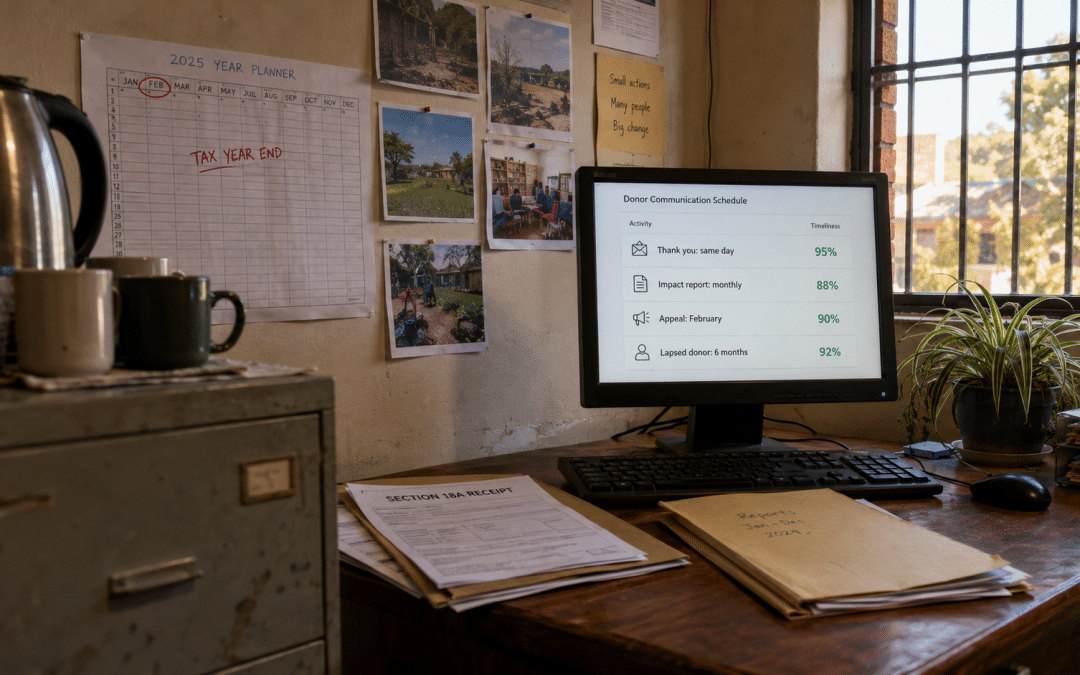
Email marketing for nonprofits South Africa is the cheapest way an NPO turns a once-off giver into a repeat donor. It is also the only channel where the Section 18A certificate, the February year-end, and a real impact story work together automatically — at near-zero cost per send, which matters more here than in any vertical in our email marketing South Africa guide. Below: the donor lifecycle, the 18A angle, POPIA consent, and costs.
Quick Answer
Email marketing for nonprofits South Africa runs on a donor lifecycle, not a sales funnel: thank instantly, report impact monthly, appeal before the 28 February tax deadline, win back lapsed givers. The local edge is Section 18A — donors may deduct qualifying gifts up to 10% of taxable income, so an automated receipt is both a compliance duty and your strongest retention tool. The mistake is writing only when money runs short.
Sitting on a donor list you only contact when funds run low? There's a lot more in it.
Get a Free Donor List ReviewEmail Marketing for Nonprofits South Africa: The Donor Lifecycle
An NPO's list is not a sales funnel with different labels. Donors give from conviction, need proof their money worked, and lapse quietly when nobody tells them. The lifecycle below is what the channel exists to serve.
| Stage | The Send | Its One Job |
|---|---|---|
| New supporter | Thank-you, same day | Confirm the gift landed; attach the receipt |
| Active donor | Impact report, monthly | Show exactly what the money did |
| Tax-motivated giver | February appeal | Deadline urgency plus a Section 18A reminder |
| Recurring donor | Milestone and renewal | Protect the debit order; thank the loyalty |
| Lapsed supporter | Win-back, 6-12 months | Re-open with proof, not guilt |
Two rules run through all of it. First, thank before you ask again — a supporter who never hears what happened to their gift has no reason to repeat it. Second, one message, one purpose: an appeal that also reports impact, promotes an event, and recruits volunteers achieves none of them. Our SA strategy playbook covers the calendar mechanics behind this.
Why the Sector's Economics Make This the Highest-Leverage Channel
No other channel fits an NPO's constraints as neatly. Budgets are thin, every rand spent on overhead is a rand not spent on the cause, and trustees ask hard questions about administrative costs. The inbox answers all three.
The cost structure suits a thin budget
Reaching 5,000 supporters costs a few rand. The same reach through paid advertising costs thousands, and print costs more again. When your board scrutinises every cent of overhead, a channel that turns a fixed monthly platform fee into unlimited supporter contact is the easiest spend to defend in a finance meeting.
You own the list outright
Social platforms rent reach and throttle it without warning — a real risk when a campaign's timing is fixed by a tax deadline you cannot move. A supporter database belongs to the organisation. No algorithm decides whether your February appeal is seen, which is precisely why it must not live only on a social page.
Retention beats acquisition, dramatically
Recruiting a new giver costs many multiples of what it costs to bring back someone who already believes in the work. Yet most SA organisations pour effort into finding new supporters while the ones from last year drift away unthanked. The win-back guide covers the recovery sequence in depth; the cheapest donation you will ever raise is the second one from a person who already gave.
The Thank-First Insight
The habit separating organisations that grow their donor base from those that churn it is thanking fast and reporting honestly, before the next ask. A giver who gets a same-day thank-you, then a monthly note showing what their money bought, gives again. One who hears nothing until the next crisis appeal has learned you make contact only when you want something — a lesson that is very hard to unteach.
Want a donor communication calendar built around your February deadline?
Get a Free Donor CalendarThe Section 18A Angle Nobody Else Has
This is where local NPO communication genuinely differs from the international playbooks. The tax certificate is not paperwork — handled well it is the most persuasive retention asset an approved organisation owns.
The rule is straightforward. As SARS sets out, a taxpayer donating cash or property in kind to an approved organisation may deduct it from taxable income, but only if supported by a valid Section 18A receipt from that organisation. Approval must precede any receipt, and is never granted retrospectively. No receipt, no deduction — and a donor who cannot claim gives less next year.
Three practical consequences shape the send calendar:
The receipt should be automated and instant. A certificate that arrives weeks later, after three phone calls, teaches a corporate donor that giving to you is admin. One that lands the same day, correct and complete, makes you the easy organisation to support. This is a transactional send that also happens to be your best relationship-builder.
February is the sector's Black Friday. The tax year closes on 28 February, and deductions may be claimed up to 10% of taxable income. Donors with a tax bill in view genuinely want to hear from you in the weeks before that date — an appeal timed to it is helpful rather than pushy, which is a rare and valuable thing in fundraising.
Receipt data now has to be right. Since 1 March 2023 an 18A receipt must carry additional donor detail — the nature of the person, identification type and number — to support third-party IT3(d) reporting to SARS. Organisations issuing more than 50 certificates a year must register as third-party data providers. That means your signup and donation forms have to capture the right fields from the start, because chasing them afterwards is miserable and error-prone.
The Compliance-as-Asset Insight
Most organisations treat the tax certificate as a burden and the deadline as a nuisance. Both are the strongest reasons a supporter has to open your message. An instant receipt is a service; a February reminder is a favour to someone with a tax bill; and the data those duties force you to collect is what makes segmentation possible. The compliance layer, automated properly, is the fundraising engine.
Consent, POPIA and the Donor Relationship
POPIA applies to supporter databases exactly as it does to customer lists, and the sector's habit of importing every business card and event attendee is where the risk sits. Someone who attended a gala, entered a raffle, or was handed a pledge form has not necessarily consented to ongoing appeals.
What that means in practice: an actively-ticked opt-in rather than a pre-ticked box, a clear statement of what the person will receive and roughly how often, a stored record of when and how permission was given, and a working unsubscribe in every send. Our POPIA guide covers the record-keeping in full.
There is a sector-specific sensitivity worth naming. Donor data is unusually personal — giving history reveals income, values, and sometimes religious or political affiliation. Handle it with more care than a retailer handles a purchase history, keep access tight, and never share or sell a supporter list. A single breach of that trust ends the relationship permanently, and in a small country, word travels through the donor community fast.
Before and After: What a Real Programme Changes
The table below reflects the typical trajectory of a mid-sized SA organisation moving from ad-hoc crisis appeals to a structured donor programme over one year. Figures are indicative composites from SA benchmark ranges.
| Metric | Before (crisis appeals only) | After (structured programme) |
|---|---|---|
| Donor retention, year on year | 20-30% | 45-60% |
| Section 18A receipt turnaround | Days to weeks, chased | Same day, automated |
| February appeal income | R40,000 – R80,000 | R120,000 – R220,000 |
| Recurring debit orders | Flat or declining | Growing month on month |
| Cost of the channel | Staff time, unmeasured | R350 – R2,500 / month, tracked |
What It Costs an SA Organisation
The honest answer is: less than almost anything else on the fundraising budget, and many platforms discount the sector heavily.
| Level | Indicative Cost | Best Suited To |
|---|---|---|
| Platform only, run in-house | R0 – R2,500 / month | Small NPOs; free tiers cover early lists |
| Once-off flow build | R6,000 – R14,000 | Thank-you, receipt, impact, win-back automations |
| Managed programme | R5,000 – R15,000 / month | Established organisations with a real donor base |
| February campaign sprint | R8,000 – R20,000 once-off | Organisations wanting the deadline handled properly |
The build-once logic matters especially here. Automations then run indefinitely without further spend, which suits an organisation whose staff capacity is the real constraint rather than its ambition. Our automation guide covers the mechanics.
Writing Impact Reports Supporters Actually Read
The monthly impact note is the send that does the quiet work, and it is also the one most organisations write badly. The failure is almost always abstraction: a paragraph about "continued commitment to community upliftment" tells a giver nothing and reassures them of nothing.
Be specific to the point of discomfort. "Your R500 bought 40 school lunches in Alexandra last month" beats any amount of mission language. A supporter gave a concrete amount and wants a concrete answer. Numbers, places, and dates do the persuading; adjectives do not.
Show one story, not the whole programme. A single named beneficiary — with permission — lands harder than a summary of every project running. The instinct to report everything comes from wanting to seem busy; the effect is that nothing is remembered. Pick one thing that happened and tell it properly.
Include what went wrong. This is counterintuitive and it works. An organisation that says a project ran over budget, or a partnership fell through, and explains what it learned, reads as trustworthy in a way that relentless good news never does. Sophisticated givers know nothing works perfectly, and honesty is the scarcest thing in their inbox.
Ask for nothing. The report is the send that earns the right to ask later. Putting a donate button in it converts the one message that was pure relationship into another transaction, and supporters notice immediately.
Measurement and Reporting Discipline
Strong email marketing for nonprofits South Africa programmes report on retention and rand raised, never on list size. Track donor retention year on year, average gift, recurring-donor growth, February campaign income against target, and win-back recovery rate. Retention is the number a board should ask about first, because a sector that loses 70% of its givers annually is running to stand still.
Watch second-gift conversion above all. The share of first-time supporters who give again within twelve months is the truest single measure of whether the thanking and reporting are working. If it sits below a third, the problem is almost never the appeal — it is the silence between appeals.
Report to the board in their language: rand raised per rand spent on the channel, and the retention curve. Both numbers flatter this vertical, which makes continued investment easy to justify. The SA benchmark guide covers the underlying open and click ranges.
The Growth Pulse Media Difference
Growth Pulse Media is run by an operator, not an account team. Before founding the agency, Dirk built and scaled a large SA ecommerce business on Klaviyo and Omnisend — the same instant-receipt, lifecycle, and win-back mechanics that a donor programme runs on, proven against real revenue and real deadlines rather than borrowed from an overseas fundraising manual.
All work is done in-house with a deliberately limited client load. No offshore outsourcing, no junior hand-offs, and reporting built on retention and rand raised — never subscriber counts presented to a board as progress.
If you would rather have this built by us, our managed inbox revenue service covers the full donor system — instant receipting, the impact-report rhythm, the February campaign, POPIA-clean consent capture, and win-back automation.
Who This Is NOT For
An honest disqualifier list saves both sides time. Bringing in help is the wrong move right now if any of the following describes you:
Your list is a few hundred names. At that size, run it yourself on a free platform tier and put every rand into the cause. Come back when the database is big enough that automation saves real staff hours.
You only want to send crisis appeals. If thanking, reporting impact, and building the relationship all feel like distractions from asking, the programme cannot work. The asks succeed because of the sends between them.
The database was built without consent. Event lists, business cards, and bought databases are a POPIA problem that automation makes bigger and faster. Fix the permission base before scaling anything on top of it.
Nobody can write honestly about the work. Impact reporting needs someone close enough to the programmes to tell a true, specific story. Without that voice, the sends become generic pleading — and supporters can tell instantly.
Not sure whether to run this in-house or bring help in? We'll tell you straight, free.
Request a Free Readiness ReviewFrequently Asked Questions
How does email marketing work for a nonprofit?
It runs on a donor lifecycle rather than a sales funnel: thank the giver the same day and attach their receipt, report impact monthly so they see what the money did, appeal before the 28 February tax deadline, and win back lapsed supporters with proof rather than guilt. The channel costs almost nothing per send, which is why it outperforms every other fundraising option an SA organisation has.
What is Section 18A and why does it matter for donor emails?
Section 18A lets a taxpayer deduct bona fide donations to a SARS-approved organisation from taxable income, up to 10% of that income, but only if supported by a valid receipt from the organisation. That makes an instant, accurate automated receipt both a compliance duty and your strongest retention tool. Approval must be granted before any receipt is issued and is never given retrospectively.
When should an SA nonprofit send its biggest appeal?
The weeks before 28 February, when the tax year closes. Donors with a tax bill in view actively want the reminder, so a deadline-timed appeal reads as helpful rather than pushy — a rare thing in fundraising. Pair it with a clear Section 18A note explaining the deduction, and give recurring supporters a simple way to add a once-off gift on top.
Is emailing our donor database POPIA compliant?
Only with demonstrable consent. Gala attendees, raffle entrants, and business-card contacts have not necessarily agreed to ongoing appeals. Use an actively-ticked opt-in, state what supporters will receive and how often, keep the record of when and how permission was given, and include a working unsubscribe. Donor data is unusually sensitive, so guard access more tightly than a retailer guards purchase history.
What donor retention rate should we expect?
Ad-hoc crisis appeals typically retain 20-30% of givers year on year. A structured programme that thanks instantly and reports impact monthly commonly lifts that to 45-60%. Watch second-gift conversion — the share of first-time supporters who give again within twelve months — as the truest measure. If it is under a third, the problem is the silence between appeals, not the appeals.
What does nonprofit email marketing cost in South Africa?
Platform-only and run in-house costs R0 to R2,500 monthly, since free tiers cover smaller lists and several providers discount the sector. A once-off build of the core automations runs R6,000 to R14,000, a managed programme R5,000 to R15,000 monthly, and a February campaign sprint R8,000 to R20,000. Automations then run for years without further spend.
Worried that spending on this takes money from the cause? It is the one line item that reliably returns more than it costs — and if your list is too small to justify it, we will say so.
Get Your Free Donor Programme Plan — SA Organisations
Growth Pulse Media builds donor communication systems serving SA NPOs — same-day automated Section 18A receipting, an impact-report rhythm your supporters actually read, a February campaign built around the tax deadline, and POPIA-clean consent capture on Klaviyo or Omnisend. Built by an operator who ran these exact lifecycle mechanics at scale, and reported the only way a board should accept: retention and rand raised.
No obligation — we will get back to you within 24 hours.
Request Your Free Programme Plan →