
 Add to Preferred Sources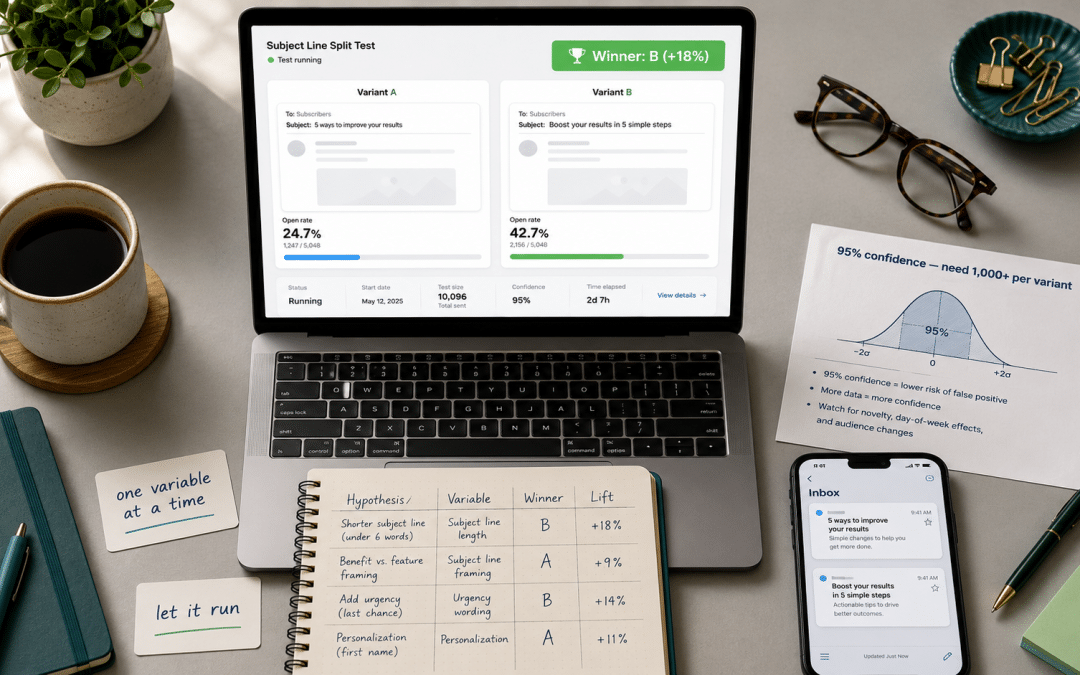
Email AB testing South Africa — A/B or split testing — means sending two versions of a campaign to a slice of your list, measuring which wins, then sending the winner to everyone else — the cheapest way to lift the numbers in our email marketing South Africa guide. Below: what to trial, how to reach a valid result on SA-sized lists, and how it feeds the wider SA strategy playbook.
Quick Answer
Email AB testing South Africa works by changing one variable — subject line, sender name, content, or send time — across two versions, sending each to a sample, then rolling the winner out to the rest. Change one thing at a time, aim for roughly 1,000 recipients per variant, and run it to 95% confidence. The mistake is trialling five things at once on a tiny list and calling a winner after an hour.
Not sure which of your emails is quietly losing you money? A quick test will tell you.
Get a Free Testing PlanEmail AB Testing South Africa: What to Test and Why
A split test isolates one change so the result is attributable — which is the whole point. Four variables carry almost all the value, and they sit in a rough order of impact. Test them in that order and the early wins fund the patience the later ones require.
| Variable | What It Moves | Best For |
|---|---|---|
| Subject line | Open rate — the biggest single lever | Every sender; fastest, cheapest win |
| Sender name | Open rate — person vs brand | Businesses with a known founder or face |
| Content and layout | Click rate and revenue | Stores measuring rand per send |
| Send time / day | Open and overall engagement | Established lists with enough volume |
| Call-to-action | Click rate — wording, colour, placement | Any send with a single clear goal |
The mechanics are the same across every SA-friendly platform. As Mailchimp's own documentation sets out, you pick one variable, build up to three variations, send them to a portion of the list, and let the tool crown a winner by open rate, click rate, or revenue before sending it to the rest. When the variable is content, judge on clicks or revenue rather than opens — the open happens before anyone sees the change.
The Rules That Separate Real Results From Noise
Most SA senders who "tried it and saw nothing" broke one of three rules. Each is simple, and each is the difference between data and superstition.
One variable at a time
Change the subject line or the sender name — never both in the same experiment. If two things move at once and the result shifts, you cannot know which one did it, and the "learning" you bank is false. Multivariate experiments exist for combined variables, but it needs far more volume than most SA lists carry, so single-variable discipline is the right default here.
Enough recipients to trust the result
Platforms and practitioners converge on roughly 1,000 recipients per variant as the floor for a confident read, with 5,000+ ideal. Below that, a "winner" is often just the coin landing heads. Keep both groups the same size, and if the whole list is small, treat the outcome as a strong hint rather than proof — and lean harder on the send-to-remainder approach.
Long enough to be real
Not everyone opens the second a message lands. Low-effort variables like subject lines can resolve within a day; high-effort ones like offers or full content need several days to a week. Ending a test after four hours because one version is "clearly ahead" is the most common way SA senders bank a false winner. Wait for 95% confidence, not the first lead.
One more discipline separates the pros: write the hypothesis down before the send goes out. "A first-name subject line will beat a benefit-led one because our audience skews relationship-driven" is a hypothesis; "let's see what happens" is not. A written prediction forces you to have a reason, and a reason is what turns a single result into a transferable rule you can apply to the next campaign and the one after that.
The Statistical-Significance Insight
A 22% open rate beating 20% on 200 recipients is noise; the same gap on 2,000 is signal. The discipline that turns experiments from theatre into a revenue engine is refusing to call a winner until the numbers are large enough to survive being repeated. If you would not bet money on the result holding next month, it is not a result — it is a hunch wearing a percentage.
Want a testing roadmap sequenced for your list size and send volume?
Get a Free Testing RoadmapTesting on SA-Sized Lists: The Small-List Reality
Email AB testing South Africa faces one hard local constraint: most SA businesses do not have 20,000 contacts, and the standard advice assumes they do. The workarounds below keep the method useful when the list is modest — which is the common case locally.
Send to the whole list, split down the middle. For subject-line and send-time experiments on a small list, skip the sample-then-winner model and split the entire list 50/50. You lose the roll-out mechanic but gain sample size, and next month's send applies the winner. Over several sends the learning compounds anyway.
Extend the duration instead of the audience. A small list can still reach significance — it just takes longer. Run the experiment across a full send cycle rather than a few hours, and accept that low-frequency senders learn more slowly. Patience substitutes for volume.
Trial the highest-impact variable first. With limited chances, spend them where the lift is biggest: subject lines for opens, then content for clicks. A small list cannot burn three months learning that green buttons beat blue by a rounding error. Our automation guide covers baking winners into flows so each result keeps paying out.
The Compounding Insight
The value of experimentation is not any single winner — it is the log of winners over time. A sender who documents every experiment, banks the winning pattern, and applies it to the next send builds a library of what their specific SA audience responds to. That library is a competitive asset no competitor can copy, because it is built on your list's behaviour. Test, record, apply, repeat — the archive is the product.
Before and After: What Disciplined Testing Changes
The table below reflects the typical trajectory for an SA retailer moving from never experimenting to a documented, one-variable-at-a-time cadence over two quarters. Figures are indicative composites from SA benchmark ranges.
| Metric | Before (no trials, guesswork) | After (documented test cadence) |
|---|---|---|
| Open rate | 18-22% | 26-32% |
| Click rate | 1.5-2.0% | 2.8-3.6% |
| Revenue per send (R250k store) | R8,000-R11,000 | R14,000-R19,000 |
| Decisions basis | Opinion and habit | Documented test log |
| Winning patterns banked | Zero | 6-8 per quarter, reused in flows |
Common Mistakes That Waste the Effort
Even disciplined senders trip over the same handful of errors, and each one quietly invalidates a result — turning hours of effort into a confident conclusion built on sand. Knowing the failure modes in advance is cheaper than discovering them in a botched roll-out.
Calling it too early. The most expensive habit: a variant leads by a wide margin in the first hour, the sender declares victory, and the gap reverses by day two. Early responders are not representative of the whole list — they are the most engaged slice — so a lead built on them rarely holds. Wait for the full window every time.
Peeking and stopping. Checking results repeatedly and halting the moment significance flickers into view inflates false positives badly. Decide the sample size and duration up front, then leave it alone until the window closes. A result you stopped early to capture is a result you cannot trust.
Re-using a stale winner forever. A subject-line style that won last year may lose today as the audience and inbox evolve. Winners have a shelf life; the strongest patterns earn a re-run every few months to confirm they still hold. Treat the log as a living record, not a stone tablet.
Ignoring the losers. A variant that lost still taught you something — that the idea does not resonate with this audience. Logged, that null result stops you wasting a future cycle on the same dead end. Discard nothing; the misses map the territory as usefully as the hits.
Measurement and Reporting Discipline
Strong SA experiment programmes report on learnings banked, not runs logged. Track the win rate of hypotheses, the average lift per winning experiment, and — crucially — whether winners hold up when re-run. A pattern that wins once and never again was noise; a pattern that wins twice is a rule worth building into every send.
Keep an experiment log religiously: hypothesis, variable, variant descriptions, sample size, duration, result, and confidence level, one row per experiment. Even null results earn their row — learning that a change does not move the needle saves you from trying it again and tells you where not to spend effort. That log is the institutional memory separating a programme from a run of guesses.
Beware the seasonal skew. Running an experiment across Black Friday, a festive-season peak, or a load-shedding-disrupted week produces a result that only holds for those conditions — and applying it to a normal month misleads. Wait for typical trading conditions, or compare a peak-period result only against other peak periods. Context is part of the data, not a footnote to it.
Match the metric to the variable, every time. Subject line and sender name are judged on opens; content and calls-to-action on clicks or revenue; send time on overall engagement. Judging a content test on opens — when the open happened before anyone saw the content — is the most common measurement error, and it quietly invalidates the result. The SA strategy guide covers how test learnings feed the wider calendar.
The Growth Pulse Media Difference
Growth Pulse Media is run by an operator, not an account team. Before founding the agency, Dirk built and scaled a large SA ecommerce business on Klaviyo and Omnisend — running real experiments against real revenue, keeping a real test log — so this playbook comes from banking winners on actual SA lists, not from a vendor's feature page.
All work is done in-house with a deliberately limited client load. No offshore outsourcing, no junior hand-offs, and reporting built on lift banked and rand per send — never a dashboard of tests run as if activity were the outcome.
If you would rather have this built for you, our managed inbox revenue service includes a structured experiment programme — sequenced trials, proper sample sizing, a maintained test log, and winners baked straight into your flows.
Who This Is NOT For
An honest disqualifier list saves both sides time. A formal experiment programme is the wrong priority right now if any of the following describes you:
Your list is a few hundred contacts. The maths cannot reach significance at that size in any reasonable timeframe. Grow the list and get the core flows live first; the payoff comes once there is a sample worth splitting.
You want to test five things at once. Multi-variable experiments on a normal SA list produce unattributable noise. If single-variable discipline feels too slow, this work will frustrate you and teach you nothing reliable.
You will not keep a log. Untracked runs are entertainment, not method — the same ideas get re-tested, and no learning compounds. If documentation will not happen, the programme cannot deliver its main asset.
You send once a quarter. Iteration needs send frequency to generate results in a useful timeframe. If the calendar is that sparse, fix cadence first — there is nothing to iterate on yet.
Wondering whether your list is big enough to test properly? Let's do the maths together.
Request a Free List-Size ReviewFrequently Asked Questions
What is email A/B testing?
Email AB testing South Africa is sending two versions of a campaign — differing in one element like the subject line — to samples of your list, measuring which performs better, and sending the winner to everyone else. It swaps opinion for data, lifting open and click rates on the same list without changing the offer or buying new subscribers.
How big does my list need to be to test?
Roughly 1,000 recipients per variant is the practical floor for a confident result, with 5,000+ ideal. Smaller lists can still test, but treat outcomes as strong hints rather than proof, extend the test duration to gather more data, and split the whole list 50/50 rather than using the sample-then-winner model. Patience substitutes for volume on small lists.
What should I test first?
Start with subject lines — they move open rates, which gate everything downstream, and they resolve fastest. Then trial sender name (person versus brand), then content and layout for clicks and revenue, and finally send time once you have the volume. Trial the highest-impact variable first so early wins justify the patience the slower experiments need.
How long should a test run?
Long enough to reach 95% confidence, not until one version pulls ahead. Low-effort variables like subject lines can resolve within a day; high-effort ones like offers or full content need several days to a week. Ending after a few hours because one variant leads is the most common way to bank a false winner — early leads frequently reverse.
Can I test automated flows, not just campaigns?
Yes, and it is where testing pays off most. A winning subject line inside a welcome or abandoned-cart flow keeps earning on every future trigger, unlike a one-off campaign. Most platforms support experiments within automations. Bank the winner into the flow and the lift compounds indefinitely rather than applying to a single send.
Which metric decides the winner?
Match the metric to the variable. Subject lines and sender names are judged on open rate; content and calls-to-action on click rate or revenue; send time on overall engagement. Judging a content test on opens is invalid because the open happens before the reader sees the content. For commercial sends, revenue is the truest metric where the platform supports it.
Worried testing means a fragile, over-engineered programme? It is the opposite — a test log makes the programme more robust, because every decision is one someone can check.
Get Your Free Testing Programme for Your SA Business
Growth Pulse Media builds structured experiment programmes for SA businesses — sequenced experiments sized to your list, proper significance thresholds, a maintained test log, and winning patterns baked straight into your Klaviyo or Omnisend flows. Built by an operator who ran these experiments while scaling an SA online store, and reported the only way that matters: lift banked and rand per send.
No obligation — we will get back to you within 24 hours.
Request Your Free Testing Programme →