
 Add to Preferred Sources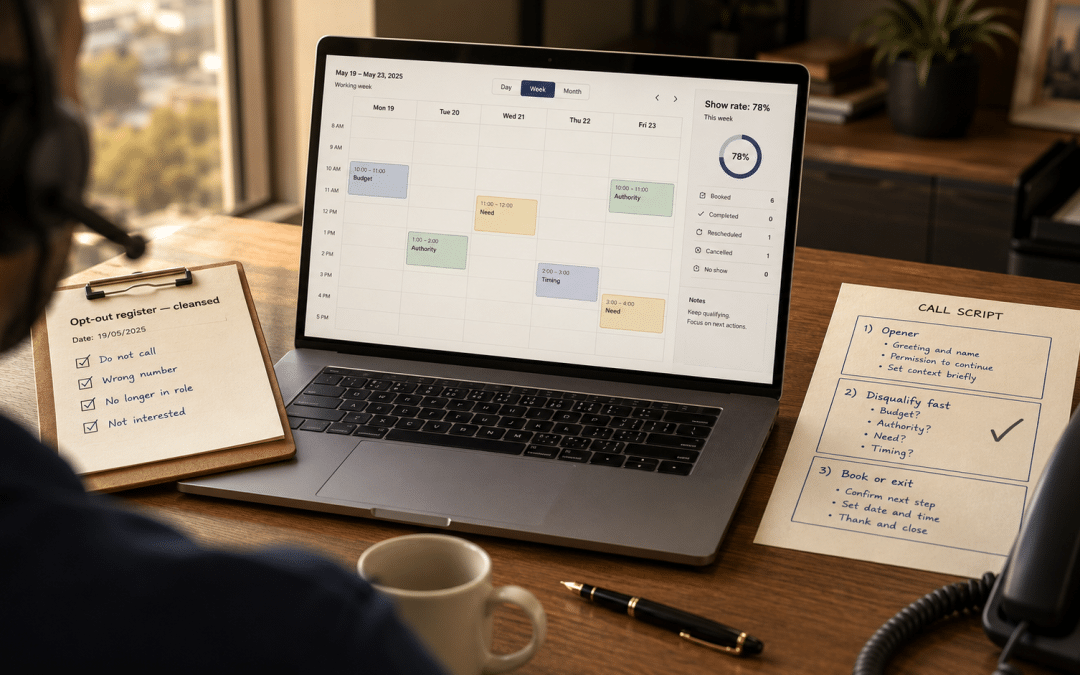
Appointment setting South Africa programmes cost R16,000–R55,000 monthly and should produce 8–20 qualified meetings per month — but the rules governing outbound calling in SA changed materially in April 2026, and most providers have not adjusted. A booked diary full of meetings that never convert is worse than an empty one, because it consumes the most expensive resource you have: senior selling time.
This guide covers what to pay, how to qualify properly, and the new compliance obligations that now apply to anyone doing outbound in this market — with the same rigour we apply in our B2B lead generation South Africa guide and our SA sales funnel guide.
Quick Answer
Appointment setting South Africa programmes run R16,000-R55,000 monthly, typically producing 8-20 qualified meetings and a 70-80% show rate when qualification is honest. Pay for qualified meetings, never raw bookings. Since 15 April 2026, the amended Consumer Protection Act Regulations require direct marketers to register with the National Consumer Commission's Opt-Out Registry and cleanse their databases against it monthly, with penalties reaching R1 million or 10% of turnover. POPIA's consent rules apply on top.
Want a free 60-minute session designing a qualified meeting engine for your SA business?
Get a Free Meeting Pipeline StrategyAppointment Setting South Africa: What It Actually Costs
Programmes in SA are priced either per month or per booked meeting, and the pricing model tells you almost everything about the incentives. Per-meeting pricing rewards volume; monthly retainers with a qualification standard reward quality. Choose deliberately.
| Model | Indicative Cost | Best For |
|---|---|---|
| Per qualified meeting | R1,800 – R4,500 each | Testing a new segment, low volume |
| Foundation retainer | R16,000 – R28,000 / month | One caller, single segment, 8-12 meetings |
| Growth retainer | R28,000 – R42,000 / month | Multi-channel, 12-18 meetings, list research |
| Managed team | R42,000 – R55,000+ / month | Multiple callers, enterprise targets, 15-20+ |
Beware per-meeting pricing without a written qualification standard. Paying R2,500 for a diary slot with someone who has no budget and no authority is not a bargain; it is a subsidy for someone else's activity metrics. Define what a qualified meeting means before signing anything, and make payment contingent on that definition. This is the single highest-leverage decision in appointment setting South Africa.
The 2026 Rules That Changed SA Outbound Calling
Outbound prospecting in SA is now governed by a materially stricter regime, and the change is recent enough that many providers are still operating on the old assumptions. This is a factual summary, not legal advice — take your own counsel on how it applies to your business.
On 15 April 2026 the amended Consumer Protection Act Regulations came into force, establishing a national Opt-Out Registry administered by the National Consumer Commission. As the Commission's own announcement sets out, direct marketers must register with the Registry, renew annually, and cleanse their databases against it every month before contacting anyone.
Registration commences in July 2026. Non-compliance may attract an administrative penalty of up to R1 million or 10% of annual turnover, whichever is greater.
These obligations sit alongside POPIA, not instead of it. POPIA continues to govern the lawful processing of personal information and places its own limits on unsolicited electronic direct marketing. Satisfying one framework does not discharge the other, and the two do not map onto each other neatly.
Register and cleanse: Register as a direct marketer with the Commission, renew annually, and reconcile your calling list against the Registry monthly before any outreach begins. Treat cleansing as a recurring operational duty with a named owner, not a once-off compliance task someone remembers in December.
Identify yourself properly: Every outbound communication must let the recipient identify who is contacting them — name, electronic address, physical address, contact number. Anonymous or generic bulk messaging does not meet the standard, and the requirement closes the loopholes that made spam economically viable.
Keep an internal do-not-contact list: Record every opt-out you receive directly and honour it immediately, regardless of what any prior consent record says. Do not rely on old consent to override someone's clearly expressed wish not to be contacted. This is both defensible and simply decent practice.
Common failure — the purchased list blitz: Buying a database and dialling it hard is now the fastest route to an enforcement problem as well as a reputational one. Consent cannot be assumed retrospectively, unregistered outreach is non-compliant on a strict reading, and penalties scale with turnover. The short-term meeting count never justifies the exposure.
The Compliance Insight
The new regime punishes exactly the behaviour that was already failing commercially. High-volume dialling of unresearched, unconsented lists produces poor conversations, damages the brand, and now carries statutory risk. Tight targeting of a researched list — fewer calls, better prepared, to people who plausibly want the conversation — is simultaneously the compliant path and the profitable one. Regulation has aligned itself with what good operators were already doing, which is unusually good news for anyone running appointment setting South Africa properly.
Want your outbound process reviewed against the current SA rules before you scale it?
Request a Free Outbound ReviewWhy Most Programmes Book Meetings Nobody Wants
A booked diary is not a pipeline. Programmes fail for SA firms because they optimise for the metric the provider gets paid on rather than the outcome the client needs, and three patterns account for nearly all of it.
Qualification is negotiable
When a caller is measured on bookings, every conversation becomes bookable. Budget becomes "they mentioned money", authority becomes "she said she would ask", and timing becomes "sometime this year". Write the qualification criteria down, make them binary, and let the caller disqualify freely. A caller who never disqualifies is not qualifying.
Nobody protects the show rate
A meeting that does not happen cost you the same to book and returned nothing. Show rates below 70% almost always indicate weak qualification rather than forgetfulness. Confirmation the day before, a clear agenda, and a genuine reason for the prospect to attend will lift the rate more than any reminder tool.
Handover is an afterthought
The caller books, the closer arrives cold, and the prospect repeats themselves. Every booked conversation must carry a short written brief: the trigger, the pain named, the qualification evidence, and the agreed agenda. Without it, the closer starts from zero and the meeting's value evaporates before it begins. Handover discipline is what separates appointment setting South Africa programmes that compound from those that churn.
How to Build a Booking Engine That Works
The mechanics are unglamorous and entirely learnable. Work through four steps in order, and expect the qualification step to be the one everybody wants to soften.
Step 1 — Research the list, do not buy it: Build a tight target list from a defined ideal customer profile, verified and enriched. Fewer, better-researched prospects outperform large purchased lists on every downstream metric, and researched lists survive scrutiny under the current rules. See our pipeline strategy guide.
Step 2 — Write a script that disqualifies: Open with a specific, credible reason for calling this person today. Then move quickly to the disqualifying questions. A script designed to find the exit early respects everyone's time and dramatically improves the quality of what remains.
Step 3 — Sequence across channels: The phone rarely works alone. Pair calls with email and a professional-network touch so the name is familiar before the dial. Multi-channel sequences meaningfully outperform single-channel ones. Our phone versus inbox comparison covers the trade-offs.
Step 4 — Instrument the handover: Log every booked conversation in your pipeline system with the qualification evidence attached, an owner, and a next action. A booking that lives only in a diary is a booking you will lose. Our guide to choosing a pipeline system covers the tooling.
The Qualification Rule
Pay for qualified conversations, never for diary slots. A programme delivering eight meetings where six become opportunities beats one delivering twenty where three do — the first costs less in senior time and produces more revenue. Insist that the qualification standard is written down before the engagement starts, that the caller is measured on opportunities created rather than bookings made, and that disqualification is celebrated rather than penalised. Done this way, appointment setting South Africa becomes a predictable revenue input rather than a cost centre.
Measurement and Reporting Discipline
Strong programmes report on downstream outcomes, not activity. Track qualified opportunities created, show rate, opportunity-to-proposal conversion, and revenue closed by cohort. Dial counts and bookings made are the two numbers most likely to look healthy while the pipeline quietly starves, which is precisely why weak providers lead with them.
Cohort tracking matters because deal cycles stretch across quarters. A conversation held in February may produce revenue in September, so month-by-month reporting systematically understates the programme's value and tempts you to cancel it just before it pays. Group booked conversations by the month they occurred, then follow each cohort through to closed revenue. Three or four cohorts in, a conversion curve appears, and that curve is what you should forecast against.
Weekly reviews should answer three questions. First, which conversations became opportunities this week, and what did those prospects have in common? Second, which booked conversations were disqualified after the fact, and where did the qualification fail? Third, which objections keep arriving that nothing in the script addresses? That third question improves the programme faster than any volume increase, and it costs nothing.
On tooling, discipline beats sophistication. Every booked conversation needs an owner, a written brief, a next action, and a date. Conversations without them decay silently, and a diary of decayed conversations manufactures false confidence about revenue that will never arrive.
Want an honest audit of whether your booked meetings are actually converting?
Request a Free Meeting Quality AuditThe GPM Differentiator: Meetings Measured on Opportunities, Not Bookings
Most SA appointment-setting providers are paid per booking, which quietly guarantees the outcome you least want: a full diary of conversations that were never real. When the caller's income depends on the slot rather than the fit, qualification softens on every call, and the cost lands on your closers weeks later in wasted hours.
Growth Pulse Media ran outbound to grow an SA business before offering it as a service, so we felt the cost of a bad meeting directly — an hour of senior time burned on someone who was never going to buy.
That is why our pipeline-building service for SA firms is measured on qualified opportunities created, works from researched lists rather than bought ones, and treats the current Consumer Protection Act and POPIA obligations as a design constraint from the first call, not a disclaimer bolted on afterwards.
The Operator Lesson
What a caller is paid on decides what a caller delivers. Pay for bookings and you get bookings; pay for qualified opportunities and the whole conversation changes — disqualification becomes a feature, not a failure. Before you judge any provider on price, ask what number their team is bonused against. That single answer predicts the quality of your diary better than any pitch.
Who This Is NOT For
A disciplined appointment-setting programme rewards firms ready to sell what it books, but four situations make it the wrong move right now — and saying so plainly saves you paying for a diary you cannot use.
You cannot staff the meetings it books: Eight to twenty qualified conversations a month need someone able to prepare for and close them. If your senior sellers are already at capacity, booked meetings will be rushed or missed, and a rushed meeting with a qualified buyer is worse than no meeting at all.
Your offer is unproven with strangers: Appointment setting puts your pitch in front of people who have never heard of you. If you have only ever closed warm referrals, test the offer on cold prospects manually first. A calling programme amplifies a message that already lands; it cannot rescue one that does not.
You are not prepared to meet the compliance duties: Registering as a direct marketer, cleansing against the Opt-Out Registry monthly, and honouring opt-outs are now operational obligations with a named owner. A firm unwilling to resource that should not be running outbound calling at all until it is — the exposure is real and scales with turnover.
You want meetings this week at any cost: Honest qualification means fewer, better conversations, which take a few weeks to ramp as lists are researched and scripts are tuned. If you need bodies in a diary immediately regardless of fit, you will be tempted back toward the volume-dialling model the new rules and your own margins both punish.
Frequently Asked Questions
How much does appointment setting cost in South Africa?
Per qualified meeting, expect R1,800-R4,500. Monthly retainers run R16,000-R28,000 for a single caller and segment producing roughly 8-12 meetings, R28,000-R42,000 for multi-channel programmes producing 12-18, and R42,000-R55,000+ for managed teams targeting enterprise accounts. Avoid per-meeting pricing unless the qualification standard is contractually defined.
What counts as a qualified meeting?
At minimum: a decision-maker or genuine influencer, a named problem your offer addresses, indicative budget capacity, and a plausible timeframe. Write the definition down before the engagement begins and make payment contingent on it. If the provider resists a written standard, that resistance tells you what their bookings are worth.
What is the National Opt-Out Registry, and does it apply to us?
It is a central registry administered by the National Consumer Commission under the amended Consumer Protection Act Regulations, in force since 15 April 2026. Direct marketers must register, renew annually, and cleanse their databases against it monthly. Registration commences July 2026 and penalties reach R1 million or 10% of turnover. Whether and how it applies to your outreach is a legal question — take proper advice.
Does POPIA still apply if we comply with the Registry?
Yes. The two frameworks regulate different things and both apply. POPIA governs the lawful processing of personal information and restricts unsolicited electronic direct marketing; the Consumer Protection Act regime governs unwanted direct marketing from a consumer-protection angle. Complying with one does not discharge the other, and the interaction between them is not fully settled.
Should we outsource or build an in-house team?
Outsource to test a segment or when you lack calling management capability; build in-house once the motion is proven and volume justifies the overhead. The deciding factor is usually management attention rather than cost. An unmanaged in-house caller performs worse than a well-managed external one, every time.
What show rate should we expect?
Seventy to eighty percent is achievable with honest qualification, day-before confirmation, and a clear agenda giving the prospect a reason to attend. Rates below seventy percent almost always signal weak qualification rather than forgetful prospects. Treat a falling show rate as a qualification problem first and a reminder problem second.
Get a Free Meeting Quality and Compliance Audit
Growth Pulse Media builds outbound programmes for SA businesses that are measured on opportunities created, not diary slots filled — with researched target lists rather than purchased ones, written qualification standards, instrumented handovers, and outreach designed around the current Consumer Protection Act and POPIA obligations. We would rather book you eight meetings that convert than twenty that waste your closers' time.
No obligation. No lock-in contracts. We will get back to you within 24 hours.
Request Your Free Audit →
Dirk van Greuning — Founder, Growth Pulse Media
Founder of Growth Pulse Media and a specialist in South African search dominance. Dirk translates his experience in scaling South African businesses into high-velocity digital strategies for B2B and retail leaders. He writes about SEO, lead generation, and paid media from an operator's perspective — prioritising pipeline value over impressions. Connect with Dirk on LinkedIn