
 Add to Preferred Sources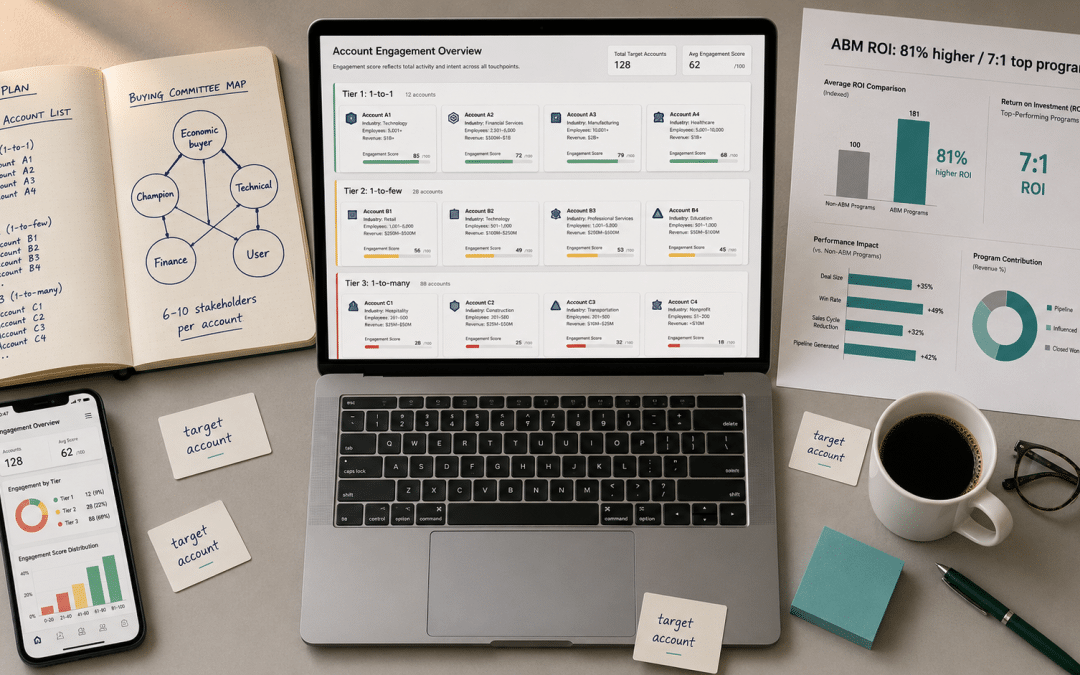
Account-based marketing in South Africa is a B2B strategy that flips the traditional funnel: instead of casting a wide net for leads, sales and marketing align to pursue a defined list of high-value target accounts with personalised, coordinated outreach. For SA businesses selling into corporates and mid-market firms, ABM concentrates budget where the revenue actually is — and the data backs it up, with practitioners reporting 81% higher ROI than broad-based approaches. This guide covers how to run the approach for SA companies, what it costs, and how to build the target-account system that makes it work — with the same rigour we apply in our B2B lead generation South Africa guide and our B2B strategy guide.
Quick Answer
Account-based marketing in South Africa works by defining a tiered list of high-value target accounts, aligning sales and marketing on those accounts, and running personalised multi-channel outreach to the 6-10 stakeholders in each buying committee. ABM suits SA B2B firms with high deal values and long sales cycles. Practitioners report 81% higher ROI than broad approaches, with top programmes reaching 7:1 returns and results typically showing in 6-12 months. The mistake is treating it as a campaign rather than a sustained, sales-aligned system.
Want a free 60-minute session mapping a target-account strategy to your SA business?
Get a Free ABM Strategy SessionAccount-Based Marketing: Why It Works for SA B2B
The approach works for SA B2B firms because it concentrates resources on the accounts that actually drive revenue, rather than spreading budget thinly across a broad audience. According to aggregated 2026 research from Forrester, Gartner, and ITSMA, practitioners report 81% higher ROI than non-targeted approaches, top programmes reach 7:1 returns, and most see results within 6-12 months. For SA companies where a handful of enterprise accounts can define a year's revenue, that concentration is decisive.
The model is not for everyone, though. It fits businesses with high deal values, identifiable target accounts, and longer sales cycles — where the effort of personalisation pays back. For low-value, high-volume transactional sales, broad demand generation is usually the better fit. Honesty about that distinction is what separates a programme that works from wasted budget.
The Fit Test
Before investing a rand, apply one test: can a handful of named accounts materially move your revenue this year? If yes, a target-account strategy concentrates budget exactly where it counts and the 81% ROI advantage is within reach. If your revenue depends on high volumes of small, undifferentiated deals, broad demand generation will serve you better. The strategy rewards focus, not scale — and forcing it onto the wrong business model wastes money.
The Four Building Blocks of a Working Programme
A durable target-account programme rests on four building blocks, in order. Skipping any one of them is the most common reason SA attempts stall. The framework below is what actually works in practice.
Block 1 — Tiered Target Account List: Define the accounts worth pursuing and tier them. Tier 1 gets fully personalised 1-to-1 treatment, Tier 2 gets 1-to-few by segment, Tier 3 gets 1-to-many light personalisation. A tight, well-researched list of the right accounts beats a large loose one on every downstream metric.
Block 2 — Sales and Marketing Alignment: The approach fails without it. Sales and marketing must agree on the account list, share KPIs, and coordinate every touch. When 93% of companies say alignment is crucial to success, that is not a soft skill — it is the operational core. Agree who owns which stakeholder before any outreach begins.
Block 3 — Buying Committee Mapping: Each target account has a buying committee of 6-10 stakeholders — economic buyer, champion, technical evaluator, finance, end user. Map them per account and plan a message angle for each. Targeting only one contact is the single biggest execution error, because no individual signs alone in high-value B2B.
Block 4 — Personalised Multi-Channel Outreach: Reach mapped stakeholders across LinkedIn, email, and phone with messaging tailored to each account's context. Personalised content is what lifts results — generic outreach to a named account is still generic. Coordinate the channels so touches reinforce rather than repeat.
Common failure — a "campaign" mindset: Running a six-week burst, declaring victory or defeat, and moving on. The model is a sustained system, not a campaign. High-value accounts move over quarters, so a start-stop approach never reaches the compounding phase where results appear. Programmes abandoned before month six systematically understate their own impact.
Want a tiered target-account list built for your specific SA market?
Get a Free Target Account AuditWhat a Target-Account Programme Costs SA Businesses
Cost depends on how many accounts you pursue and how much personalisation each tier demands. The ranges below are indicative for SA operators building a sustained programme rather than a one-off push.
| Programme Level | Indicative Cost | Best For |
|---|---|---|
| Foundation (1-to-many) | R25,000 – R42,000 / month | Tier 3 focus, lighter personalisation, 50-150 accounts |
| Growth (1-to-few) | R42,000 – R75,000 / month | Segment-level personalisation, 20-50 accounts |
| Strategic (1-to-1) | R75,000 – R130,000+ / month | Full personalisation, 5-20 named enterprise accounts |
| Intent-data add-on | +R12,000 – R30,000 / month | Signal-based targeting and prioritisation |
Companies working with a specialist partner report meaningfully higher returns than running the programme internally without the right data and systems — largely because the setup, alignment, and measurement are where most in-house attempts stumble. For the underlying execution mechanics by industry, see our vertical playbooks below, which apply this strategy to specific SA sectors.
The Alignment Insight
The single strongest predictor of whether a target-account programme succeeds is not budget or tooling — it is genuine sales and marketing alignment. When both teams share the account list, the KPIs, and the credit, the model compounds. When marketing runs it in isolation and hands "leads" to a sceptical sales team, it fails regardless of how good the targeting is. Fix alignment first, or do not start.
Measurement and Reporting Discipline
Strong programmes report on account-level outcomes, not lead volume. Track engagement per account, pipeline value per account, deal velocity, and revenue by account tier — never raw lead counts or impressions. Only about half of companies measure programme ROI properly, which is exactly why so many struggle to prove value; measurement is the difference between optimising and guessing.
Cohort tracking by account matters because high-value B2B cycles stretch across quarters. An account first engaged in February may open pipeline in May and close in October, so monthly snapshots understate impact. Group accounts by the quarter engagement began, then follow each cohort through to closed revenue. Within a few cohorts a clear pattern emerges that becomes the forecasting engine.
Weekly reviews should answer three questions. First, which accounts moved up an engagement tier this week and why? Second, which stalled, and what specific obstacle appeared — missing stakeholder, competing vendor, budget timing? Third, which personalised angles earned engagement and which did not? Those answers feed straight back into targeting and messaging, turning the programme into a compounding system.
On tooling, disciplined use of a simple CRM beats an elaborate platform used badly. Every account needs an owner, a next action, and a date. Accounts without next actions go cold silently. A Friday review — every active account, next action confirmed — is the cheapest habit separating programmes that produce steady pipeline from those that fade.
The Growth Pulse Media Difference
Growth Pulse Media is run by an operator, not a delivery team. Before founding the agency, Dirk built and scaled a large South African ecommerce business — so the frameworks in this guide come from pursuing real revenue with real budgets, not from agency theory.
All work is done in-house in Johannesburg with a deliberately limited client load, using the same stack we recommend to clients: Apollo.io and Sales Navigator for target-list research, and Google Search Console for the inbound side. No offshore outsourcing and no junior hand-offs.
If you would rather have this built for you, our pipeline-building service for SA firms runs exactly the system described above — tiered target lists, buying-committee mapping, and personalised multi-channel outreach reported on revenue per named company, never vanity numbers.
Who This Is NOT For
An honest disqualifier list saves both sides time. The target-account model is the wrong fit if any of the following describes you:
You sell low-value, high-volume deals. The economics of deep personalisation never pay back on small transactional sales. Broad demand programmes and paid channels will serve you far better.
You cannot name your top prospects. If the ideal customer is "anyone with a budget", there is no target list to build. Define who moves your revenue first, then come back to this model.
Your sales team will not share the list or the credit. The approach lives or dies on alignment. If sales treats the programme as someone else's project, it fails regardless of execution quality.
You expect a six-week campaign. High-value companies move over quarters, not weeks. If the budget cannot survive two quarters without proof, this is the wrong strategy for now.
Want a measurement framework that ties account engagement to revenue for your SA programme?
Request a Free Programme AuditFrequently Asked Questions
What is account-based marketing in simple terms?
It is a B2B strategy that targets a defined list of high-value accounts with personalised, coordinated outreach, instead of casting a wide net for leads. Sales and marketing align to pursue those specific accounts together, tailoring messaging to the individual stakeholders in each buying committee. The goal is revenue from the right accounts, not lead volume.
How much does account-based marketing cost in South Africa?
Costs range from R25,000-R42,000 monthly for a lighter 1-to-many programme covering 50-150 accounts, to R42,000-R75,000 for segment-level personalisation, up to R75,000-R130,000+ for full 1-to-1 treatment of named enterprise accounts. Intent-data add-ons for signal-based targeting add R12,000-R30,000 monthly. Cost scales with the depth of personalisation each account tier requires.
Is ABM worth it for SA businesses?
For SA B2B firms with high deal values, identifiable target accounts, and longer sales cycles, yes — practitioners report 81% higher ROI than broad approaches, with top programmes reaching 7:1. It is less suitable for low-value, high-volume transactional sales, where broad demand generation is usually more efficient. The deciding factor is whether a handful of accounts can materially move your revenue.
How long before ABM shows results?
Most programmes show measurable results in 6-12 months, tied to the length of your sales cycle. First engagement lifts appear within the first quarter, while pipeline and closed revenue build over subsequent quarters as high-value accounts progress. Programmes evaluated before six months systematically understate impact because the model compounds rather than spikes.
What is the difference between ABM and lead generation?
Traditional lead generation casts a wide net and optimises for lead volume, then qualifies down. The target-account approach starts with a defined list of high-value accounts and pursues them with personalised outreach, optimising for revenue per account. They complement each other — many SA firms run broad demand generation alongside a focused programme for their most valuable accounts.
How many accounts should an SA programme target?
It depends on the tier and personalisation depth. Full 1-to-1 programmes handle 5-20 named accounts because each demands deep personalisation. Segment-level 1-to-few programmes handle 20-50, and lighter 1-to-many programmes handle 50-150. Starting focused on fewer, better-researched accounts almost always outperforms spreading effort across too many.
Get a Free Account-Based Marketing Audit for Your SA Business
Growth Pulse Media builds target-account programmes for South African B2B firms — with tiered account list definition, sales and marketing alignment, buying-committee mapping, and personalised multi-channel outreach that concentrates budget where your revenue actually is. We build sustained systems tied to revenue outcomes, not six-week campaigns that fade.
No obligation. No lock-in contracts. We will get back to you within 24 hours.
Request Your Free Audit →