
 Add to Preferred Sources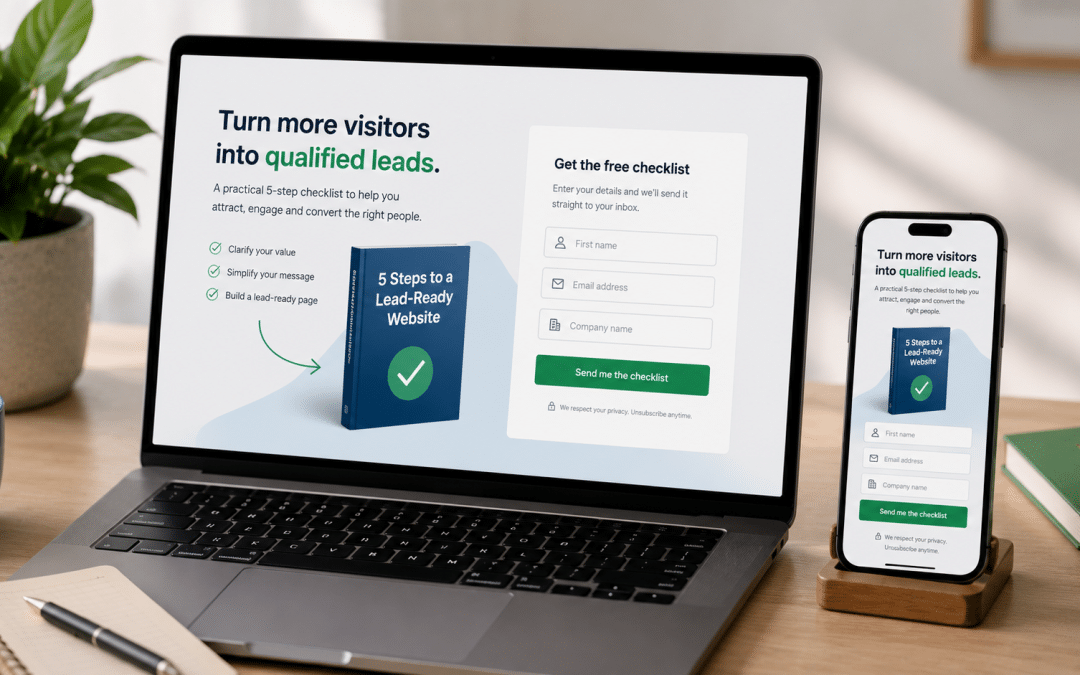
Landing page lead gen is the practice of building a single-goal page designed to do one thing: turn a visitor into a captured lead. It is not a general homepage and not a sales checkout — it is a focused page that offers something valuable in exchange for contact details. For the wider build context, see our web design guide; this page is specifically about pages built to generate leads, not landing pages in general.
The distinction matters because most landing pages fail at lead capture for the same reasons: too many goals, too much navigation, and a form that asks for too much. A page built deliberately for lead generation strips all of that away and points everything at a single action — which is exactly why it converts where a general page does not.
Quick Answer
A lead-gen landing page is a single-goal page built to convert a visitor into a contact: one clear offer (a lead magnet), one call to action, a short form, trust signals, and no distracting navigation. It differs from generic landing page design and from paid-ads conversion pages — its job is lead capture. Get the offer, the form, and the focus right, and it becomes one of the highest-ROI assets a business owns.
Want a landing page built to capture real leads? Let us design one for you.
Get a Free Landing Page PlanWhat a Lead-Gen Landing Page Is (and Isn't)
A lead-capture landing page is a focused page whose only purpose is to convert a visitor into a lead, usually by offering something useful in return for their details. That single-goal focus is what separates it from other page types — it is not trying to inform, entertain, or sell several things at once; it is engineered around one conversion.
It is worth being precise about the boundaries. General landing page design covers the look and structure of any landing page whatever its goal, while a Google Ads landing page is tuned for paid-click conversion and ad relevance. This guide is about the lead-generation use specifically — the page that captures a contact you can follow up and qualify.
The reason the lead-gen version is its own discipline is the offer-for-details exchange at its heart. Everything on the page exists to make that exchange feel worth it: a compelling offer, a frictionless form, and enough trust to overcome a stranger's natural hesitation about handing over their information. Miss any of those, and the page collects visitors but not leads.
One Goal: Capture a Lead
A lead-gen landing page exists to convert a visitor into a contact, nothing else — distinct from generic landing page design and from paid-ads conversion pages. Its engine is the offer-for-details exchange: a valuable offer, a short form, and visible trust. Strip away navigation and competing goals so everything points at that single action, and the page does the one job it was built for.
The Anatomy of a Page That Captures Leads
A high-converting lead page is built from a few non-negotiable parts working together. It needs a benefit-led headline that states the offer in seconds, a short form that asks only for what you genuinely need, a single prominent call to action, trust signals like testimonials or recognisable logos, and — crucially — no site navigation to lure the visitor away.
The numbers back the focus. HubSpot's landing page research found that businesses growing from around ten to fifteen dedicated landing pages saw roughly a 55% increase in leads, and that shorter forms consistently outperform longer ones. More focused pages, asking for less, simply capture more — a pattern that holds across industries.
| Element | Its job | Common mistake |
|---|---|---|
| Headline | State the offer's benefit fast | Clever but vague |
| Offer / lead magnet | Make the exchange worth it | Weak or generic offer |
| Form | Capture only what's needed | Too many fields |
| Single CTA | One clear next action | Competing buttons |
| Trust signals | Overcome hesitation | None at all |
Notice what is absent: menus, multiple offers, links to other pages. A lead page deliberately removes exits, because every extra path is a chance for the visitor to wander off without converting. The discipline is subtraction — the best lead pages are defined as much by what they leave out as by what they include. That subtractive focus is the heart of landing page lead gen done well.
Not sure why your current page isn't converting? Ask us to take a look.
Get a Free Page ReviewLanding Page Lead Gen South Africa: What Works Locally
For landing page lead gen south africa businesses get the most from a few local realities built in from the start. Most visitors arrive on a phone, so the page and its form must work flawlessly on mobile; offering WhatsApp as a contact option alongside the form often lifts response, because it matches how South Africans prefer to engage.
Trust and compliance carry local weight too. Because the page collects personal information, a short POPIA-aware consent line on the form is both good practice and a quiet trust signal — it tells a cautious visitor you handle data responsibly. Pair that with genuinely local proof, such as recognisable SA client names or results, rather than generic claims of excellence.
Keep the offer relevant to the local market. A lead magnet that speaks to a specific South African pain point — pricing in Rand, local regulations, local logistics — converts better than a generic global guide. The closer the offer sits to your actual audience's world, the more readily they will trade their details for it.
Connecting the Page to Real Lead Generation
A landing page captures the lead; it does not, on its own, generate business. The page is step one in a chain — capture, qualify, follow up, convert — and a beautiful page feeding a black hole of un-followed-up enquiries wastes the whole effort. This is where the page meets a proper B2B lead generation process.
The practical implications are simple. Decide upfront where the lead goes (a CRM, an inbox, a WhatsApp), who follows up and how fast, and what counts as a qualified lead. The page's job is to start the conversation cleanly; the system behind it turns that captured contact into revenue. Treating landing page lead gen as one connected system — page plus follow-up — is what separates a list of contacts from real pipeline.
The Page Is Step One, Not the Whole Job
A lead-gen page captures a contact — it does not close business by itself. It is the front end of a chain: capture, qualify, follow up, convert. Decide before launch where leads go, who responds, and how fast. A great page feeding no follow-up is wasted effort, so design the page and the lead-generation system that catches its output as one connected whole.
The Form: Where Leads Are Won or Lost
The form is the single most decisive element, because it is the moment of friction where a visitor decides whether the offer is worth their details. Every extra field costs conversions, so the rule is ruthless: ask only for what you will actually use to follow up. For most businesses that is a name and an email or phone number — not a job title, company size, and budget on first contact.
There is a balance to strike between volume and quality. A very short form captures more leads but some will be casual; a longer form captures fewer but more qualified ones. The right length depends on what you do with the lead afterwards — but when in doubt, start short, capture the contact, and qualify in the follow-up rather than at the form. You can always ask more later.
A Real-World Example: Before and After
The clearest illustration is a representative SA business that replaced a cluttered, multi-goal page with a single-purpose lead page — one offer, a three-field form, strong local proof, and no navigation. Nothing about the traffic changed; the page simply stopped competing with itself and started converting the visitors it already had.
| Metric (monthly) | Before — cluttered multi-goal page | After — focused lead-capture page | Change |
|---|---|---|---|
| Conversion rate | 1.2% | 4.8% | 4x |
| Leads captured | 14 | 56 | +300% |
| Form fields | 9 | 3 | Cut to essentials |
| Cost per lead | High | Markedly lower | Improved |
| Lead follow-up | Ad hoc | Defined process | Resolved |
The conversion-rate row is the headline. Quadrupling conversion on the same traffic — mostly by removing distractions and shortening the form — turned a page that leaked visitors into one that captured them. That is the leverage of a purpose-built lead page: it gets more from the audience you already have, without spending a cent more on traffic.
The GPM Differentiator
Plenty of agencies will design a pretty landing page; far fewer build one engineered for lead capture and wired into what happens next. We come at it from an operator's seat, having run South African pages where the form and follow-up were the difference between a list of leads and a list of nothing — so our web design services build lead pages around the conversion, not just the look.
For clients that means a single-goal page with a real offer, a form trimmed to what matters, POPIA-aware consent, local trust signals, and a clear plan for where the lead goes and who follows up — mobile-first, because that is where your audience is. You get a page that captures leads and a process that catches them, designed together rather than bolted on.
Who This Is NOT For
This focused, lead-capture view suits most businesses, but not everyone. Being clear about that upfront saves wasted effort — so here is who should read it differently.
Anyone wanting general landing page design advice. If your question is about landing pages in the broad sense — layout, structure, design principles for any goal — that is a different topic with its own guide. This page is narrowly about pages built to capture leads, so the wider design fundamentals sit better elsewhere and are linked for exactly that reason.
Businesses focused purely on paid-ads conversion. If you are optimising a page for Google Ads click-through and Quality Score, the priorities differ — ad relevance, message match, and post-click experience. Those belong in a dedicated ads-conversion guide. The lead-capture principles here overlap, but a paid-traffic page has its own specific demands worth treating separately.
Those with no offer worth opting in for. A lead page lives or dies on the value of its offer. If there is nothing a visitor genuinely wants enough to share their details for, no amount of design will rescue it. The work has to start with a compelling offer; the page only presents it well — it cannot manufacture value that isn't there.
Anyone with no plan to follow up leads. Capturing a lead you never contact is worse than not capturing it — you have raised an expectation and ignored it. If there is no one to respond, no system to route the lead, and no intention to follow up promptly, a lead page will simply generate disappointment on both sides. Build the follow-up first.
Want a lead page built to convert and a plan to follow up? Start free.
Get a Free Landing Page PlanFrequently Asked Questions
What is a lead generation landing page?
It is a single-goal page built to convert a visitor into a contact, usually by offering something valuable — a guide, checklist, quote, or consultation — in exchange for their details. Unlike a homepage, it has one focused call to action and no distracting navigation. Its whole purpose is lead capture, which is what separates it from general landing pages and sales pages.
How is this different from general landing page design?
General landing page design covers the look and structure of any landing page, whatever its goal. A lead-gen landing page is the specific use case of capturing contacts, built around an offer-for-details exchange. The design fundamentals overlap, but a lead page adds particular demands — the offer, the form, and the follow-up plan — that a general design guide does not focus on.
How many fields should my lead capture form have?
As few as you can while still being able to follow up. For most businesses that is a name and an email or phone number. Research consistently shows shorter forms convert better, so resist asking for job title, company size, or budget on first contact. Capture the lead, then qualify in the follow-up rather than at the form.
What makes a landing page convert in South Africa?
A relevant local offer, a mobile-first design (most SA visitors are on a phone), a short form, visible trust signals, and ideally a WhatsApp contact option alongside the form. A short POPIA-aware consent line also reassures cautious visitors. Local proof — real SA client names or results — converts better than generic claims, because it speaks directly to your actual audience.
How many leads should a landing page generate?
It depends on traffic and offer, but conversion rate is the metric to watch — a focused lead page commonly converts several times better than a cluttered general page. HubSpot's research shows that more dedicated landing pages generate more leads overall. The realistic goal is steady improvement: measure your conversion rate, test the offer and form, and lift it over time.
Do I need a separate page for each offer?
Generally yes. Each offer deserves its own focused page, because a single-goal page converts better than one juggling several offers. This is also why businesses with more landing pages tend to generate more leads — each page targets a specific audience and intent. Start with your most valuable offer, build a strong page for it, then add more as you go.
If you are unsure whether your current page is capturing the leads it should, that is worth checking — many businesses run a homepage as a default landing page and quietly lose conversions. A quick review of the offer, form, and focus usually reveals the gap, and the fix is often a simpler, sharper page rather than more traffic.
Get a Free Lead-Gen Landing Page Plan
Tell us about your offer and audience and we will map a single-goal landing page built to capture leads — the offer, the form, the trust signals, and where the lead goes next — mobile-first and POPIA-aware, as a one-page plan you own outright with no pressure. No obligation — we will get back to you within 24 hours.
Get My Free Landing Page Plan