
 Add to Preferred Sources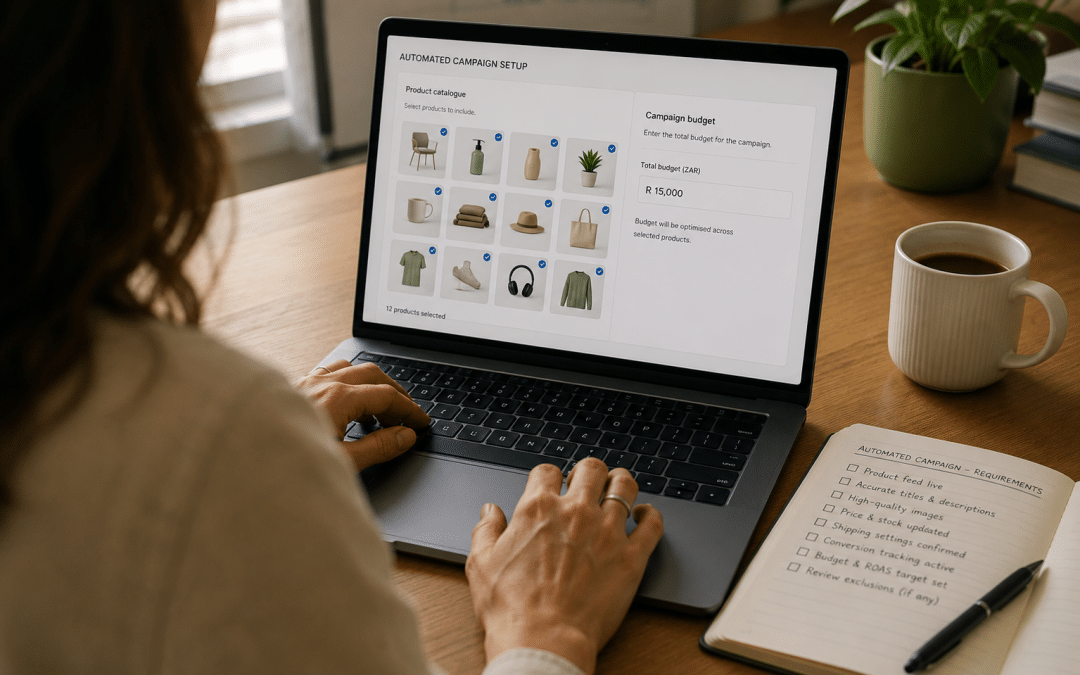
Meta advantage shopping south africa campaigns — Meta's AI-automated sales format, widely known as ASC — hand the algorithm your creative and budget and let it manage audience, placement, and bidding for you. For SA ecommerce stores with solid conversion data and a connected catalogue, ASC often lowers cost per purchase.
For brand-new accounts or high-ticket, long-cycle products, manual campaigns usually still win. This guide explains what the format does, when it fits an SA store, and what it needs to work.
It sits within our Meta Ads South Africa guide and covers the automated campaign type specifically. One naming note up front: Meta renamed this format to "Advantage+ Sales" in 2025, though most advertisers still search and refer to it as Advantage+ Shopping — the mechanics this guide describes are unchanged by the rename.
Quick Answer
Advantage+ Shopping (ASC) is Meta's automated, AI-driven campaign type for sales. Instead of building separate prospecting and retargeting campaigns and configuring audiences manually, you supply creative assets and a single budget, and the algorithm consolidates everything into one campaign — finding buyers across Facebook and Instagram automatically. The trade-off is control: you give up granular audience targeting in exchange for algorithmic efficiency.
For an SA ecommerce store, ASC fits when you have established conversion volume, a product catalogue connected to Meta, and Pixel plus Conversions API tracking in place. It struggles on brand-new accounts with no data, very high-ticket or long-cycle products, or tight budgets that cannot feed the algorithm enough signal to learn.
Wondering whether your SA store has the data and budget for Advantage+ Shopping to actually outperform your manual campaigns?
Get a Free ASC Readiness CheckWhat Advantage+ Shopping Actually Does
The meta advantage shopping south africa format consolidates what used to be several separate campaigns into one automated structure, and understanding that consolidation is the key to using it well. Where a standard setup has you build prospecting and retargeting separately, configure audiences, and split-test creatives one at a time, ASC folds all of that into a single campaign. You provide the creative and the budget; the algorithm handles audience, placement, creative rotation, and bidding.
Under the bonnet, the campaign type uses Meta's machine-learning delivery engine to match your products to the people most likely to buy, testing many creative combinations automatically and shifting spend toward the winners. It runs on a campaign-level budget with no separate ad-set budgets, and lets you cap how much of that budget goes to existing customers versus new ones.
The appeal is simple: less manual setup, faster launches, and — when conditions are right — markedly better efficiency than hand-building the same funnel.
The Core Trade-Off: Control for Performance
The defining feature of the automated format is what it takes away: custom audiences, lookalikes, and interest targeting all disappear. You set a budget, upload creative, define your existing-customer cap, and let the algorithm find buyers across the entire network. In exchange for surrendering that granular control, you get the platform's full optimisation power pointed at one goal.
For most SA ecommerce stores with enough data, that trade is worth taking — the algorithm usually allocates spend better than manual audience-building can. For advertisers who need tight control, sell to a narrow niche, or are still learning what converts, giving up that control is a real cost. The right answer depends entirely on your store's stage and data, not on whether automation sounds appealing.
When Advantage+ Shopping Fits an SA Store
Deciding whether to run the campaign type comes down to data, catalogue, tracking, and budget — not to whether automation is fashionable. ASC needs enough conversion signal to learn, which in practice means an established store with steady weekly sales rather than a brand-new account. It also needs a product catalogue connected to Meta and clean Pixel-plus-Conversions-API tracking, because the algorithm is only as good as the data it receives.
Budget matters too, though SA stores rarely run at the US benchmark figures quoted in global guides. The principle holds regardless of currency: the format needs enough daily spend to exit the learning phase and gather signal, so a budget too thin to generate consistent conversions will starve it. The table below sets out where the automated format tends to fit an SA store and where a manual campaign remains the better tool.
| ASC Tends to Fit When... | Manual Campaigns Still Win When... |
|---|---|
| Established store, steady weekly sales | Brand-new account, zero conversion data |
| Product catalogue connected to Meta | No catalogue or service-only business |
| Pixel + Conversions API tracking clean | Tracking broken or incomplete |
| Lower-ticket products, short purchase cycle | High-ticket products with long sales cycles |
| Several creative assets to test | Only one or two creatives available |
Data and Catalogue Are Non-Negotiable for ASC
The single most common reason the automated format underperforms for an SA store is launching it without the foundations: a connected catalogue and clean Pixel-plus-Conversions-API signal. Without them, the algorithm has nothing reliable to optimise toward, and an SA business ends up blaming the format for a tracking problem it never fixed.
Before even considering ASC, confirm the catalogue is connected and conversions are firing accurately server-side as well as in the browser. A store that gets this right gives the algorithm a clean map of who buys; a store that skips it hands the algorithm noise and gets noise back. The format amplifies the quality of your data — good or bad — so the data has to come first.
Not sure whether your catalogue and tracking are clean enough for Advantage+ Shopping to perform?
Get a Free Tracking & Catalogue AuditHow ASC Differs From Google Shopping
SA businesses often confuse the meta advantage shopping south africa format with Google Shopping, but they are different products on different networks solving the discovery problem from opposite ends. ASC runs on Facebook and Instagram, pushing your products into social feeds and surfaces where people are browsing rather than searching. Google Shopping appears in search results when someone is actively looking for a product to buy.
The practical implication is that they are complementary, not interchangeable. The automated social format excels at demand generation — putting products in front of people who were not actively searching — while search shopping captures existing purchase intent. Many SA ecommerce stores run both, using the social campaign type to create demand and search shopping to capture it. Treating one as a substitute for the other leaves a gap in the funnel. For stores that want the social side of that funnel handled, our managed Meta advertising runs Facebook and Instagram campaigns around return on ad spend, with no lock-in contract.
Patience Through the Learning Phase Is the Hidden Requirement
The automated format needs an uninterrupted learning period to find its footing, and the most common self-inflicted wound for an SA store is editing or restarting the campaign before that period ends. Every significant change resets the learning, so an impatient operator can keep a campaign permanently stuck in its least efficient phase without realising why.
Treat the first stretch after launch as non-negotiable settling time: resist the urge to tweak budgets, swap audiences, or pause underperforming-looking days. The algorithm is gathering signal it needs before it can deliver efficiently. An SA store that launches with clean data and then leaves the campaign alone to learn almost always outperforms one that fiddles constantly.
Common SA Mistakes With Advantage+ Shopping
Most SA stores that struggle with the automated format make the same handful of mistakes, and nearly all of them come from treating it like a manual campaign. The biggest is impatience — restarting or heavily editing the campaign before it exits the learning phase, which resets the algorithm's progress every time.
The second is starving it of creative: the format is built to test many assets, so feeding it one or two cripples its main advantage entirely.
The third common error is judging it on platform-reported figures alone rather than real business revenue, the same honesty gap that affects all paid social measurement. The table below shows how the approach shifts once an SA store stops fighting the automation and starts feeding it properly.
| Before (fighting the automation) | After (feeding it properly) |
|---|---|
| Editing the campaign mid-learning phase | Left to exit learning — stable delivery |
| Launching with one or two creatives | 10-15 diverse assets supplied — algorithm has room to test |
| Catalogue not connected, Pixel only | Catalogue linked, CAPI added — clean signal |
| Judging on dashboard ROAS alone | Measured against real revenue — true cost per purchase visible |
How Growth Pulse Media Approaches Advantage+ Shopping
Most SA agencies either avoid the automated format because it removes the levers they are used to pulling, or switch everything to it and hope the algorithm carries them. The honest approach is neither: assess whether the store actually has the data, catalogue, and creative volume to make ASC outperform a well-built manual campaign, and only then deploy it — often alongside manual campaigns rather than replacing them entirely.
Dirk built and scaled an SA ecommerce business on paid social, where the decision to automate was made on data readiness rather than on what the platform was promoting that quarter — running automated and manual structures side by side and letting performance, measured against real revenue, decide the budget split. That operator habit means the campaign type is treated as one tool among several, deployed when the foundations justify it, not as a default.
SA ecommerce stores wanting an honest assessment of whether the automated format suits them can use our digital marketing service, covering catalogue and tracking setup, creative strategy for automated testing, and the manual-versus-automated decision for your specific store. We pair it with the full Meta Ads South Africa framework and link it to the broader Instagram ecommerce playbook for SA stores.
Who This Guide Is NOT For
The automated format is not the right tool for every SA advertiser. Here is who should approach it with caution.
Brand-new ad accounts with no data: ASC needs conversion signal to learn, and an SA account with zero purchase history gives the algorithm nothing to optimise toward. Launching the automated format on day one usually wastes budget during an endless learning phase. Build conversion volume with manual campaigns first, then graduate to automation once the data exists to feed it.
High-ticket, long-cycle products: The format performs best on lower-ticket products with short purchase cycles, where conversions are frequent enough for the algorithm to learn quickly. An SA business selling expensive, considered purchases with long decision windows will find the campaign type starved of the frequent signal it needs. Manual structures with tighter control usually serve these better.
Advertisers who need tight audience control: Because the automated format removes custom audiences, lookalikes, and interest targeting, businesses that depend on reaching a precisely defined segment lose their main lever. An SA advertiser with a narrow, specific target audience may get worse results from broad automation than from a manual campaign built around that exact segment.
Stores unwilling to fix tracking first: The meta advantage shopping south africa format amplifies data quality, so a store unwilling to connect its catalogue and implement Conversions API tracking will get amplified noise. An SA business hoping automation will paper over a broken measurement setup is asking the algorithm to optimise toward signal it cannot trust. Fix the foundations or stay manual.
Want an honest read on whether automation will beat your current manual setup, or just burn budget?
Get a Free Campaign Strategy SessionThe discipline that ties this together is deploying the automated format on readiness, not on hype. Per Meta's own Advantage+ Shopping documentation, the format combines machine learning with proven best practices to automate creative, audience, budget, and delivery — but it can only do that well when fed a connected catalogue, clean signal, and enough creative to test. The platform supplies the automation; the SA store supplies the foundations.
The 2026 picture makes this more relevant, not less: as Meta pushes automation toward the default across sales, app, and lead campaigns, SA stores will increasingly meet the automated format whether they sought it out or not.
The businesses that win will be the ones that treat it as a powerful tool requiring real foundations — connected catalogue, server-side tracking, diverse creative, and patience through learning — rather than a magic button that removes the need to understand their own data.
Frequently Asked Questions
What is Meta Advantage+ Shopping in South Africa?
It is Meta's automated, AI-driven campaign type for sales, often abbreviated ASC. Instead of building separate prospecting and retargeting campaigns and configuring audiences manually, an SA advertiser supplies creative and a single budget, and the algorithm consolidates everything into one campaign, finding buyers across Facebook and Instagram. Meta renamed it "Advantage+ Sales" in 2025, but the mechanics are unchanged.
When should an SA store use Advantage+ Shopping?
Use it when you have established conversion volume, a product catalogue connected to Meta, and clean Pixel-plus-Conversions-API tracking. The format fits lower-ticket products with short purchase cycles and needs several creative assets to test. Stick with manual campaigns for brand-new accounts with no data, high-ticket long-cycle products, or when you need tight audience control.
How is ASC different from Google Shopping?
They run on different networks and solve discovery from opposite ends. ASC runs on Facebook and Instagram, pushing products into social feeds where people are browsing rather than searching. Google Shopping appears in search results when someone is actively looking to buy. They are complementary — many SA stores run both, using social to create demand and search to capture it.
How much budget does Advantage+ Shopping need in South Africa?
SA stores rarely match the US figures in global guides, but the principle holds: the format needs enough daily spend to exit the learning phase and gather consistent conversion signal. A budget too thin to generate steady conversions will starve the algorithm. Rather than a fixed Rand figure, ensure your spend produces enough weekly purchases for the algorithm to learn reliably.
Why is my Advantage+ Shopping campaign underperforming?
The most common causes are launching without a connected catalogue or clean Conversions API tracking, editing the campaign before it exits the learning phase, or starving it of creative. The format amplifies data quality, so a broken measurement setup produces amplified noise. Fix tracking and catalogue first, supply diverse creative, and leave the campaign to learn before judging it.
Does Advantage+ Shopping work for non-ecommerce businesses?
It is primarily designed for ecommerce with a connected product catalogue. B2B and lead-generation businesses are usually better served by standard Advantage+ campaigns or manual structures that allow more control over audience targeting and conversion optimisation. If your SA business has no product catalogue, the shopping-specific automation has little to work with.
Want to Know If Advantage+ Shopping Will Actually Beat Your Manual Campaigns?
Growth Pulse Media gives SA ecommerce stores an honest assessment of automated campaigns — catalogue and Conversions API setup, creative strategy, and the manual-versus-automated decision for your store. Real operator experience running both structures side by side for a South African business, with performance against real revenue deciding the split. No obligation — we will get back to you within 24 hours with a frank read on whether automation fits your store.
Get Your Free Advantage+ Shopping Assessment