
 Add to Preferred Sources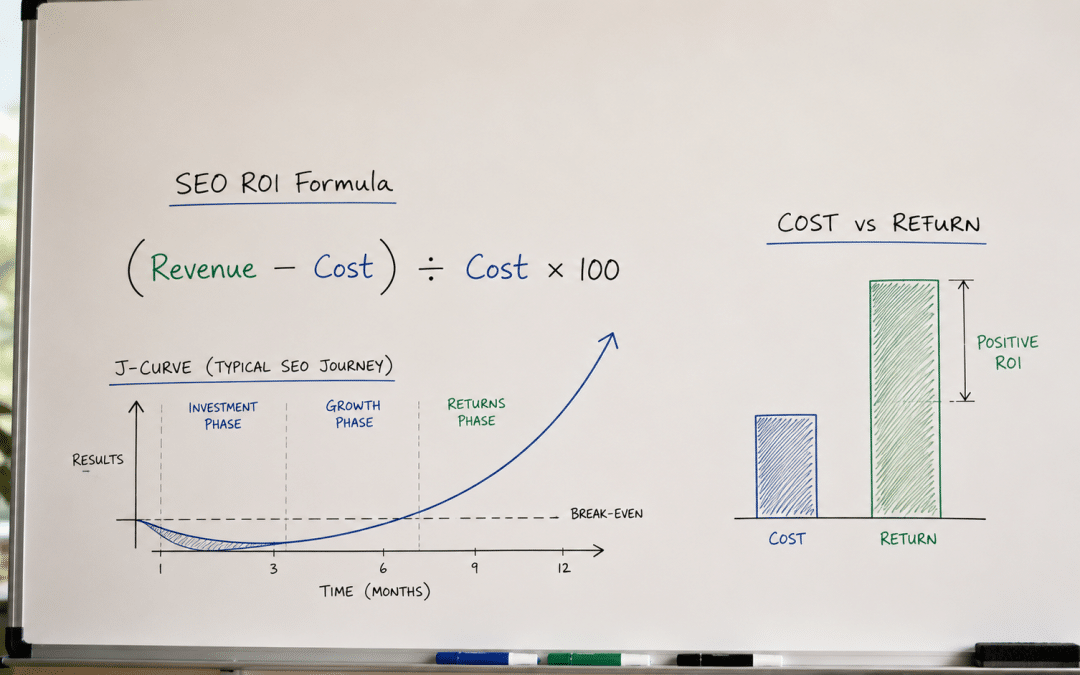
Working out your SEO ROI South Africa return comes down to one honest question: for every rand you put into organic search, how many rand come back? The formula is simple — revenue from organic search, minus what you spent, divided by what you spent — but the discipline is in measuring each side accurately and giving the payoff time to arrive.
Done right, it turns organic search from an act of faith into a tracked line on the SEO in South Africa budget.
The reason most businesses cannot answer the question is not that organic search is unmeasurable — it is that the payoff is delayed and multi-touch, so it gets written off before the numbers mature, leaving the SEO ROI South Africa case unproven. The cost side is usually clear, sitting next to the figures in our SEO pricing guide; the return side is where the measurement work lives, and where most teams give up too early.
That is a mistake, because the return is real and trackable once the right tracking is in place, and the SEO ROI South Africa figure becomes a number you can defend. This guide covers the formula, why the measurement is genuinely harder than it looks, how to do it properly in GA4, and the local realities that shape what a good return looks like in this market.
Quick Answer
The formula is [(revenue from organic search − cost of SEO) ÷ cost of SEO] × 100. Cost includes the retainer or salary, content, tools and link building; revenue means the rand value of conversions from organic search specifically — isolated from branded and paid traffic in GA4.
The hard parts are giving it time (meaningful returns usually compound over 6 to 12 months) and counting assisted conversions, since organic search often starts the journey that another channel finishes. Measure too early and the number lies.
SEO ROI South Africa: The Formula and What Goes Into It
The calculation itself is the easy part, and it is the same one every analyst uses: take the revenue organic search generated, subtract the cost of the work, divide by that cost, and express it as a percentage. The difficulty is being honest about the two numbers you feed into it.
Want a straight answer on what your organic search is returning?
We'll build the cost and revenue picture properly and show you the real number — not a vanity traffic chart. No jargon, no obligation.
Get a Free ROI AssessmentThe cost side is everything you spend to earn organic rankings: the agency retainer or in-house salary, content production, tools, and any link-building outreach. Leave any of these out and your SEO ROI South Africa figure flatters itself — a return that ignores half the cost is not a return, it is a story.
According to Semrush's guide to SEO KPIs, conversions from organic search are the metric that actually ties the work to revenue, which is why they sit at the centre of the calculation.
The revenue side is where most of the judgement lives. You assign a rand value to each conversion that organic search produced — a sale's actual value, or a lead's value based on how often leads close and what a customer is worth. A credible SEO ROI South Africa number depends on that value being grounded in real business figures rather than a hopeful guess, because the whole calculation rests on it.
Both Numbers Must Be Honest
The formula only works if both inputs are real. Count every cost — retainer, content, tools, links — and assign conversion values drawn from actual sales data, not optimism. A return built on a complete cost and a grounded revenue figure tells you the truth; one that hides costs or inflates lead values tells you what you want to hear. The arithmetic is trivial; the honesty is the work.
Why SEO ROI Is Hard to Measure
If the formula is so simple, why do so few businesses track their SEO ROI South Africa well? Because organic search breaks the neat, immediate attribution that paid channels offer — the payoff arrives months after the spend, and rarely in a single clean click.
The first complication is time. Organic search typically takes months to produce meaningful traffic and conversions, so an SEO ROI South Africa figure measured at month two will look like a loss even when the work is on track. The second is attribution: organic search often starts a journey a buyer finishes through a branded search, a direct visit or an ad, so a last-click view credits the wrong channel and undercounts the real contribution.
The third trap is branded traffic. People searching your company name would likely find you anyway, so counting branded organic conversions as an SEO win inflates the number. An accurate calculation isolates non-branded organic search — the demand the work actually created — from the branded traffic that was already yours.
SEO ROI South Africa: How to Actually Measure It
Measuring it properly starts in Google Analytics 4, where you set up conversion tracking and — for an online store — revenue tracking, then segment to the organic search channel so you are looking only at unpaid search. This is the foundation every reliable measurement is built on, because without it you are guessing at the revenue side.
From there, assign rand values to conversions that are not already monetised. A lead-based business multiplies its organic leads by a close rate and an average customer value; a store reads revenue directly from GA4's organic channel. The discipline behind a defensible SEO ROI South Africa figure is doing this for non-branded organic only, and including assisted conversions so the channel gets credit for journeys it started but did not finish.
Not sure your GA4 is even tracking organic revenue correctly?
We'll check your conversion tracking, isolate organic search, and show you the return your current setup is hiding. No jargon, no obligation.
Get a Free Tracking AuditThen give it a window. Tally the full cost over the same period you measure the revenue, and judge the return over six to twelve months rather than weeks — a fair SEO ROI South Africa assessment matches a delayed-payoff channel to a patient measurement window. Comparing a month of cost against a month of immature revenue is the single most common way the number gets misread.
| Input | Where it comes from | Watch out for |
|---|---|---|
| Cost of SEO | Retainer/salary, content, tools, links | Leaving out tools or content |
| Organic conversions | GA4, organic channel, non-branded | Counting branded traffic |
| Conversion value | Sale value, or leads × close rate × value | Optimistic lead values |
| Assisted conversions | GA4 attribution paths | Last-click undercounting |
| Time window | 6–12 months | Measuring at month one |
SEO ROI South Africa: The Local Picture
What counts as a good return depends on the market, and a few local realities shape it here. The first is the payback curve: organic search in this market tends to show little in the first few months and then compounds, so the picture is a J-curve, negative early and accelerating as rankings and authority build.
The second is the comparison businesses actually care about — organic versus paid. Paid search delivers a fast, measurable return that stops the moment the budget does; organic search is slower to prove but compounds and keeps returning after the spend slows.
Weighing the SEO ROI South Africa case against paid is exactly the trade-off our SEO vs Google Ads comparison works through, and the honest answer is usually a blend rather than one or the other.
The third is value, not volume. A smaller local market means lower search volumes, so a healthy return here is built on conversion value and intent rather than raw traffic — a handful of high-value local leads can outperform thousands of unqualified visits. Judging the SEO ROI South Africa result on rand returned rather than traffic gained is what separates a real measurement from a vanity one.
| Month (R25k/month organic investment) | Early read | Mature read (month 12) |
|---|---|---|
| Organic revenue attributed | R8,000 | R140,000 |
| Return on the month's spend | Negative | +460% |
| Cost per organic lead | R900 | R190 |
| Revenue after spend slows | n/a | Continues |
The Local Edge
A South African return follows a J-curve — flat or negative early, compounding later — so it must be judged over time, not at month one. An SEO ROI South Africa result is built on conversion value rather than traffic volume in a smaller market, and its real advantage over paid is that it keeps returning after the spend eases.
Measure it on rand earned over a fair window and organic search is one of the most durable returns available locally.
Common Mistakes That Distort the Number
The most common SEO ROI South Africa mistake is measuring too early and declaring failure. Organic search is a delayed-payoff channel, so a verdict at month two judges the work before the returns it was always going to produce have arrived — patience is not optional, it is part of the method.
The rest cluster around dishonest inputs. Counting branded traffic as an SEO win, ignoring assisted conversions so the channel is undercredited, comparing organic's month-one return against paid's, and reporting rankings or traffic instead of revenue all distort the picture. Each one quietly turns a real measurement into a misleading one, which is how good organic programmes get cut on bad numbers.
What works: a business tracks organic conversions in GA4, isolates non-branded organic, assigns lead values from real close rates, counts assisted conversions, and reviews the return at six and twelve months. The figure is defensible, and the early dip does not trigger a panic cut.
What fails: a company measures at month two, counts every branded search as an SEO win, ignores assisted conversions, and reports traffic instead of revenue. The number is meaningless in both directions — falsely low early, then falsely inflated — and the budget decision rests on noise.
The One Rule
Measure SEO ROI South Africa honestly and late enough. Wait for the channel to mature, isolate non-branded organic, count assisted conversions, and report rand returned rather than rankings or traffic. The shortcuts that distort the number — early verdicts, branded inflation, vanity metrics — are the exact ones that get profitable organic programmes cancelled or worthless ones wrongly praised. The figure is only as useful as the honesty behind its inputs.
Why Growth Pulse Media Reports Returns Differently
Growth Pulse Media reports the return, not the activity — part of treating SEO as a measurable investment rather than a monthly mystery. On every SEO ROI South Africa engagement we set up the tracking to isolate non-branded organic, assign conversion values from your real close rates and customer worth, count assisted conversions, and report rand returned against rand spent over a window that fits a delayed-payoff channel.
That discipline matters because most reporting hides behind traffic charts and ranking screenshots that never answer the only question that counts — is this making money. We work the SEO ROI South Africa cost and revenue sides honestly, which sometimes means telling a client the early months are a loss they should expect, and other times proving a programme is returning several rand for every one spent and deserves more budget.
It also connects to the decisions around it. A clear return makes the pricing conversation rational and the organic-versus-paid split a numbers decision rather than a hunch. We would rather show a business an honest, patient measurement than a flattering early figure that falls apart the moment anyone checks how it was built.
Who This Is NOT For
You need a verdict this month. Organic search is a delayed-payoff channel, and any return measured in weeks is noise. If the business needs a number it can judge immediately, paid search reports faster — weigh the two in SEO vs Google Ads before forcing an early call.
You will not set up conversion tracking. Without GA4 tracking organic conversions and their values, the revenue side is a guess and the return is unmeasurable. If proper tracking is off the table, the honest position is that you cannot calculate this yet — fix the tracking first.
You want to count every organic visit as a win. Branded searches and assisted-but-uncredited journeys make the raw number meaningless. If the plan is to report flattering totals rather than isolate what the work actually created, the measurement will not survive scrutiny.
You judge success by rankings and traffic. Positions and visits are inputs, not returns. If revenue is not the scorecard, this measurement is the wrong tool — and a programme optimised for traffic rather than rand will look busy while returning little.
Want to know what your organic search has actually returned?
We'll build the honest cost-and-revenue picture and tell you the real number, plus whether it justifies more or less spend. No jargon, no obligation.
Get a Free Return ReviewSEO ROI South Africa: Frequently Asked Questions
How do you calculate SEO ROI?
Use the formula [(revenue from organic search − cost of SEO) ÷ cost of SEO] × 100. The cost includes your retainer or salary, content, tools and link building; the revenue is the rand value of conversions from organic search specifically. Expressed as a percentage, it tells you the return on every rand invested in organic search.
Why is SEO ROI so hard to measure?
Because the payoff is delayed and multi-touch. Organic search takes months to produce results, so early figures look like losses, and it often starts journeys that another channel finishes, so last-click attribution undercredits it. Branded traffic that would convert anyway also inflates the number unless you isolate non-branded organic search.
How long before SEO shows a positive return?
For most businesses, organic search shows little in the first few months and then compounds, with meaningful returns typically appearing over six to twelve months. The curve is negative or flat early and accelerates as rankings and authority build, which is why the return must be judged over a window rather than at a single early point.
What counts as the cost of SEO?
Everything you spend to earn organic rankings: the agency retainer or in-house salary, content production, SEO tools, and any link-building or outreach costs. Leaving any of these out inflates the return artificially. An accurate calculation tallies the full cost over the same period you measure the revenue.
Should I compare SEO ROI to Google Ads?
It is a fair comparison if you account for timing. Paid search returns fast but stops the moment the budget does; organic search is slower to prove but compounds and keeps returning after spend slows. Comparing organic's early months against paid is unfair — judge them over a longer window, where the durable nature of organic shows.
What is a good SEO ROI?
There is no universal figure, as it varies by investment level, lead value and industry. Many businesses target a return of several rand for every rand spent once the channel matures. What matters more than a benchmark is that the number is built on honest costs, non-branded organic revenue and a fair time window.
Find out what your organic search is really returning
Growth Pulse Media measures SEO returns for South African businesses honestly — isolated non-branded organic, real conversion values, assisted conversions counted, and rand returned reported against rand spent over a fair window. No vanity traffic charts, no flattering early figures. No obligation — we will get back to you within 24 hours.
Get Your Free SEO ROI ConsultationMost businesses do not need another agency pitching them — they need an honest read on whether their organic search is actually paying off, measured properly rather than dressed up. That is the conversation we start with, and there is no cost or commitment to having it.
