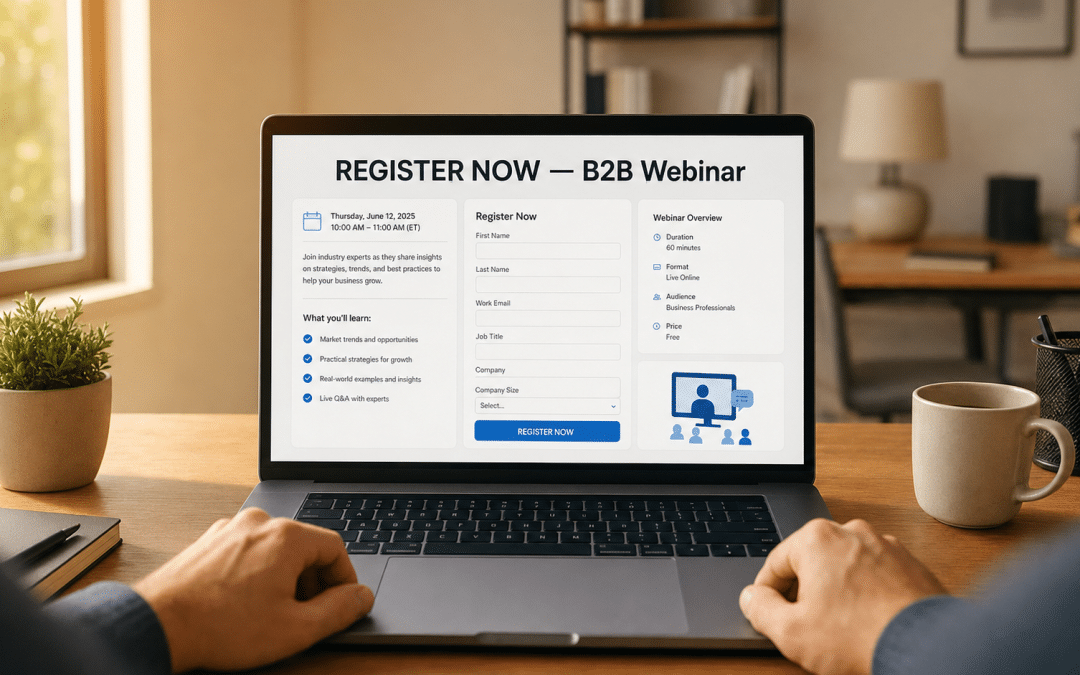
Webinar lead generation South Africa is one of the most underused channels in local B2B marketing — and that gap is the opportunity. Our full B2B lead generation guide for South Africa covers the whole channel mix, but webinars deserve their own playbook because the mechanics are different: you are building a room of self-selected buyers and giving them a reason to raise their hand.
The core challenge is that most South African B2B marketers treat webinars as one-off events rather than a repeatable lead engine. This post covers the full production and promotion cycle, the tools that work in the local context, and the POPIA obligations you cannot skip. If you want a POPIA-compliant lead generation framework alongside this, read that guide next.
Quick Answer
Webinar lead generation South Africa works when you combine a tight topic, a LinkedIn-first promotion strategy, a POPIA-compliant registration flow, and a structured follow-up sequence. Most local B2B companies skip two of those four steps — that is why their webinars fill poorly and convert worse.
Not sure which webinar format will actually fill seats with your target buyers?
Get a Free Webinar Strategy SessionWhy Webinar Lead Generation South Africa Is a Channel Gap Right Now
Webinar lead generation South Africa sits in a rare position: demand from buyers is real, but supply from local vendors is thin. Most South African B2B companies publish blog posts and run Google Ads. Very few run a consistent webinar programme. That means the first credible operator in a niche — IT services, logistics, construction procurement — can own the slot.
LinkedIn's own research confirms the B2B context that makes this work. According to LinkedIn's lead generation resource hub, B2B buyers consume multiple pieces of content before making a purchase decision. A webinar is the highest-density single piece of content in that sequence: one session can replace several blog posts in a buyer's evaluation journey.
There is also a load-shedding caveat worth naming. Scheduling a webinar during a Stage 4 window in Johannesburg or Durban will tank attendance. Build your promotion calendar around the Eskom schedule and offer a recording as a default opt-in for anyone who cannot attend live. That one adjustment materially improves your registered-to-attended ratio.
Key Insight
The channel gap in webinar lead generation South Africa is structural, not accidental. Most competitors are not running webinars consistently, which means a company that shows up monthly in its niche builds a proprietary database of in-market buyers faster than any paid channel can.
Choosing the Right Webinar Format for B2B Lead Gen
The format you choose determines who registers, not just who attends. Four formats work consistently in the South African B2B market, each suited to a different stage of the funnel.
The expert panel works best for top-of-funnel awareness. Invite two or three recognised voices in your sector — a CFO from a Sandton firm, a supply-chain head from Durban — and the combined audiences fill seats without heavy paid promotion. The webinar lead generation South Africa benefit here is borrowed credibility: your brand is the convener.
The product demo webinar targets mid-funnel prospects who already know the problem. Keep it under 45 minutes, reserve 15 minutes for live questions, and gate the replay behind a separate registration form. That gives you a second lead-capture event from the same content asset.
The case study session is the strongest mid-to-bottom-funnel format. A named South African client — say, a Midrand-based manufacturer or a Cape Town logistics operator — walks through a real project. Regulatory and procurement buyers respond well to this format because it reduces perceived risk.
The micro-webinar (20 minutes, no fluff) is underused in local webinar lead generation South Africa campaigns. Shorter runtime lowers the commitment barrier for senior decision-makers. Pair it with a post-session PDF download and you have two lead-capture touchpoints from one 20-minute block.
Running a webinar programme but not converting registrants into qualified pipeline?
Get a Free Lead Conversion AuditThe Promotion Stack for Webinar Lead Generation South Africa
Promotion is where most local webinar lead generation South Africa programmes fail. The default approach — one LinkedIn post and an email to the existing list — produces thin registration numbers and a false signal that webinars "don't work" in South Africa.
A structured promotion stack runs across three layers. The first is owned: your email list, your LinkedIn company page, and your team's personal LinkedIn profiles. LinkedIn's platform data shows that members come to the platform specifically to research business topics, creating a receptive mindset for exactly the kind of thought-leadership invitation a webinar represents. Activating both company and personal profiles maximises that reach.
The second layer is paid. LinkedIn Lead Gen Forms attached to a webinar event ad remove the friction of a landing-page click. You can target by job title, seniority, and company size — reaching, for example, financial directors at manufacturing companies in Gauteng with a minimum employee count. That targeting precision is the core argument for LinkedIn as the paid channel of choice for LinkedIn lead generation in South Africa.
The third layer is partner amplification. Co-host with a complementary vendor — a Klaviyo implementation partner, an Aramex account manager, a PayFast integration consultant — and ask them to promote to their own lists. This costs nothing and can double your registration count from a single outreach email.
POPIA and Registration: What You Must Get Right
POPIA compliance in your webinar registration flow is not optional, and it is more specific than a generic privacy tick-box. When you collect name, email, company name, and job title through a registration form, you are processing personal information as defined under POPIA.
Practices commonly interpret this as requiring a clear statement of purpose at the point of collection — what you will use the data for and whether you will contact registrants after the session.
The practical implication for webinar lead generation South Africa campaigns is that your registration form must include an explicit opt-in for post-webinar follow-up that is separate from the webinar attendance confirmation. Do not bundle consent into the terms and conditions checkbox. Your Klaviyo or ActiveCampaign automation should tag registrants by their consent status and suppress non-consenting contacts from your sales sequences. For a full framework, the POPIA-compliant lead generation guide covers this in detail.
One practical note: LinkedIn Lead Gen Forms pre-populate fields from the member's profile. Ensure your form includes a clearly labelled marketing consent question — LinkedIn allows custom questions on Lead Gen Forms — rather than assuming profile submission equals consent to follow-up.
Tools for Webinar Lead Generation South Africa
The right tool stack removes friction for both your team and your registrants. Here is how the main options stack up in the local context.
| Tool | Best For | SA-Specific Note | Approximate Cost (ZAR/month) |
|---|---|---|---|
| Zoom Webinars | Up to 500 attendees, familiar UX | Widely recognised by SA corporate IT teams; most firewall-friendly | R1,200–R3,500 |
| Demio | Automated and hybrid webinars | Strong replay and on-demand gate; integrates with Klaviyo | R2,000–R5,500 |
| Livestorm | Full webinar pipeline with built-in analytics | GDPR-aligned (relevant for POPIA parallels); good CRM integrations | R1,800–R6,000 |
| StreamYard | Panel and LinkedIn Live simulcast | Low bandwidth requirement — important during load-shedding on mobile data | R700–R2,200 |
| LinkedIn Events (native) | Top-of-funnel awareness events | No separate registration tool needed; lead data stays in LinkedIn | Free (organic) or paid via Campaign Manager |
For follow-up automation, Klaviyo handles the post-webinar sequence well if you already use it for email. Connect it to your webinar platform via Zapier or a native integration. The sequence should fire within 30 minutes of session end — lead response time matters as much after a webinar as after a contact form submission.
Before and After: What a Structured Webinar Programme Delivers
The figures below illustrate the pattern we see, not a guaranteed outcome. Results depend on audience size, topic relevance, and follow-up quality.
| Metric | Before: Ad Hoc Webinars | After: Structured Programme |
|---|---|---|
| Monthly registrations | 35–60 per event, irregular | 120–180 per event, monthly cadence |
| Registered-to-attended rate | 28% | 47% |
| Post-webinar MQL conversion | 4% | 18% |
| Cost per MQL | R2,800–R4,200 | R900–R1,400 |
| Pipeline attributed to webinars (90-day) | Unmeasured | Tracked via UTM + CRM tagging |
Key Insight
The biggest single lever in webinar lead generation South Africa programmes is not the session itself — it is the 72-hour follow-up window. Companies that automate a three-touch sequence within three days of the webinar consistently convert registrants at a multiple of those who send a single thank-you email.
The Follow-Up Sequence That Converts Webinar Leads
Your post-webinar follow-up sequence is where the actual lead generation happens. The webinar fills a room; the sequence fills a pipeline. Structure it across three touches within 72 hours.
Touch 1 (within 30 minutes): Automated replay link plus a one-question survey. "What's your biggest challenge with [topic]?" The answer segments your follow-up. Integrating B2B lead generation KPIs tracking from this point lets you attribute every subsequent conversation to the webinar event.
Touch 2 (24 hours later): A personal email from the webinar host, not a template blast. Reference a specific moment from the session — a question that came up, a poll result. This is the email most people actually reply to. If your audience skews toward IT buyers in Johannesburg, reference the local angle directly.
Touch 3 (72 hours later): A calendar link for a 20-minute discovery call, framed around the survey answer. Keep it frictionless: one Calendly link, no lengthy form. This is the hand-raise moment. For companies running appointment setting alongside their webinar programme, this touch feeds directly into the SDR queue.
How GPM Runs Webinar Lead Generation South Africa Programmes
GPM manages the full webinar lead generation South Africa cycle: topic selection, landing-page build, LinkedIn ad creative, registration-flow POPIA compliance, session facilitation support, and post-event automation sequences. We do not hand you a template and wish you luck.
The difference in our approach is operational. Dirk built and scaled an ecommerce business before founding GPM — the follow-up sequences, the load-shedding scheduling logic, the LinkedIn Lead Gen Form structure — these come from running campaigns in the South African market, not from adapting a US playbook.
Our B2B lead generation service packages webinars as a channel within a broader pipeline strategy, so the leads your webinar generates flow into the same CRM and attribution model as every other source.
We have run webinar programmes for IT and MSP businesses, manufacturing suppliers, and professional services firms across Gauteng, Cape Town, and KZN. The common thread is that the first three sessions are slower — list-building and format testing — and sessions four through twelve are where the compounding effect kicks in.
Who This Is NOT For
Transactional B2C businesses. If your average order value is under R500 and your buyer makes a purchase decision in minutes, a webinar funnel is a poor use of budget. The format suits considered B2B purchases with multiple stakeholders, not impulse retail.
Teams without follow-up capacity. Webinar lead generation South Africa programmes fail most often not in registration but in post-event silence. If your sales team cannot action leads within 72 hours, you will spend on production and promotion and convert almost nothing.
Businesses with no defined ICP. A webinar with a topic like "grow your business in 2026" attracts everyone and converts no one. If you cannot name a specific job title, industry, and pain point, you are not ready to run a webinar programme — start with your account-based marketing strategy first.
Companies expecting immediate ROI from session one. Webinar lead generation compounds over time. The database you build across six sessions is worth more than any single session's registrants. If the business needs pipeline in the next 30 days, a different channel — cold outreach or paid search — is a faster lever.
Ready to build a webinar programme that fills your CRM with qualified B2B leads?
Get a Free Webinar Programme PlanFrequently Asked Questions: Webinar Lead Generation South Africa
What makes webinar lead generation South Africa different from running webinars elsewhere?
It is primarily the infrastructure and scheduling constraints. Load-shedding, variable broadband quality outside major metros, and a B2B audience concentrated in Gauteng, Cape Town, and KZN all shape when and how you promote. POPIA also adds a registration-consent layer that is more explicit than what many US-derived playbooks account for.
How many registrants should I expect from my first webinar?
First-session registration counts vary widely depending on your existing list size, your topic specificity, and whether you run paid promotion. Expect more modest numbers in sessions one and two while you build the format and audience. By session four or five, with a consistent monthly cadence and LinkedIn promotion, registration counts typically grow materially. Track your registered-to-attended rate, not just raw registrations.
Which platform is best for webinar lead generation South Africa campaigns?
Zoom Webinars is the most widely accepted in corporate South African environments from a firewall and IT-policy perspective. Demio and Livestorm are stronger if you need built-in automation and on-demand replay gating. For low-bandwidth environments or simulcast to LinkedIn Live, StreamYard is a practical choice. Match the tool to your audience's technical environment, not your own.
How do I stay POPIA-compliant when collecting webinar registrant data?
Collect only the data fields you will actually use, state clearly at registration what you will do with it, and include a separate marketing-consent checkbox that is not pre-ticked. Store consent records in your CRM and suppress non-consenting contacts from sales sequences. If you are using LinkedIn Lead Gen Forms, add a custom question for marketing consent rather than relying on form submission as implied consent.
What should go into the post-webinar follow-up sequence?
Three touches work consistently: a replay link within 30 minutes, a personalised email from the host at 24 hours, and a calendar-link offer at 72 hours. The personalised middle email is the highest-reply-rate touch — reference something specific from the session rather than sending a generic nurture template. Segment by the survey answer from touch one for the best conversion rates.
How does webinar lead generation South Africa fit into a broader B2B strategy?
Webinars produce warm leads — people who have spent 45 minutes with your thinking — which makes them high-quality inputs for appointment-setting and ABM sequences. Feed webinar attendees into the same CRM and attribution model as your other channels so you can measure pipeline contribution accurately. The broader framework is covered in the B2B lead generation guide for South Africa.
Want a webinar programme built for the South African B2B market?
We will map your topic, audience, promotion stack, and follow-up sequence into a prioritised action plan. No obligation — we'll get back to you within 24 hours.
Get Your Free Webinar Programme Plan