
 Add to Preferred Sources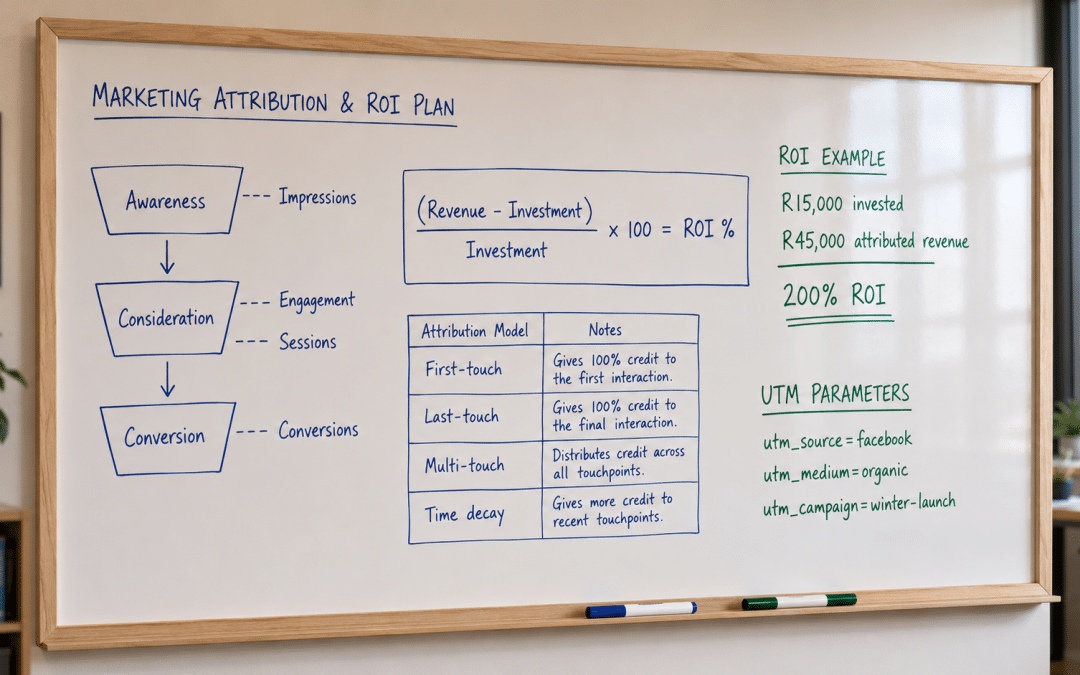
A working social media roi south africa measurement framework rests on three operational layers — UTM-tagged traffic attribution from every social platform, conversion tracking in GA4 with revenue values configured, and a CRM or spreadsheet layer that connects social-acquired leads to closed revenue and customer lifetime value.
Without all three layers in place, social media looks expensive and unprofitable even when it is genuinely driving revenue, because the attribution chain breaks before reaching the revenue number.
This guide breaks down each layer of the framework for South African businesses — covering the attribution models that actually work in 2026, the platform-specific tracking realities, the UTM tagging conventions, the GA4 setup, and the calculation method that produces a defensible ROI number you can present to leadership. For the broader social media context, see our complete social media marketing guide for Johannesburg businesses.
Quick Answer
The most reliable approach for measuring social media roi south africa is the three-layer attribution stack — UTM tags on every social post and ad URL (utm_source + utm_medium + utm_campaign), GA4 conversion events configured with monetary values, and CRM lifecycle tracking that connects social-acquired leads to closed deals. The standard ROI formula is (Revenue – Investment) ÷ Investment × 100 = ROI %. Most SA brands measuring properly find their social media ROI lands between 80% and 350% in the first 12 months — meaning every R1 invested in social returns R1.80 to R4.50 in attributable revenue once the measurement layer is built. The single biggest reason SA brands underreport social ROI is incomplete UTM tagging and reliance on last-click attribution.
Want a measurement audit on your current social media tracking and attribution setup?
Get a Free Social ROI Tracking AuditSocial Media ROI South Africa: Why Most SA Brands Underreport Returns
Most SA businesses calculating social media ROI south africa returns underreport their actual results by 40-70% — not because social media is underperforming, but because the attribution chain is broken. HubSpot's 2026 marketer survey found that 36% of marketers globally cite platform linking restrictions as the top barrier to social attribution, with Instagram and TikTok specifically making it structurally difficult to track direct traffic to external sites. Patchy attribution is a strong reason to judge social inside a wider channel plan, which our South African digital strategy guide sets out.
For SA brands, the underreporting problem compounds because most still rely on last-click attribution as the default GA4 model. Last-click attribution gives all conversion credit to the final touchpoint before purchase — which is rarely social media. A buyer might discover your brand on Instagram, research it on your website three days later, click a Google Ad the following week, and purchase via a direct visit. Last-click credits the direct visit and ignores Instagram entirely.
The structural attribution problem
Instagram, TikTok, and Facebook all add tracking parameters to outbound links that strip in transit, replace your UTM tags, or route traffic through intermediate domains. The result is that GA4 often records social traffic as "direct" or "referral" rather than attributing it correctly to the originating platform. Without manual UTM tagging on every clickable social link, the attribution data Google records is structurally incomplete.
The Tagging Discipline
The single highest-leverage fix for accurate social media measurement is consistent UTM tagging on every clickable link from every social platform — profile bio links, ad creative URLs, story links, post link clicks, DM-shared links. SA brands that adopt strict UTM tagging discipline typically see attributed social traffic increase 60-150% within 30 days because the data was always there — it was just being misclassified as direct or referral traffic.
Social Media ROI South Africa: The Three Attribution Layers
Building reliable social media roi south africa measurement requires three distinct attribution layers working together — platform-level metrics, website-level attribution, and revenue-level attribution. Each layer answers a different question about overall performance, and none of them in isolation produces a defensible ROI number.
Layer 1 — platform-level metrics
Platform-level metrics answer "is the content resonating with the audience?". This layer includes reach, impressions, engagement rate, watch time, completion rate, and follower growth. These metrics are reported natively in Instagram Insights, TikTok Analytics, Facebook Business Suite, and LinkedIn Analytics. They do not measure revenue — they measure content performance and audience signal.
Layer 2 — website-level attribution
Website-level attribution answers "is social media driving traffic and conversions on the website?". This layer uses GA4 with UTM-tagged links to track social-attributed sessions, pages per session, bounce rate, conversion events, and revenue per session by platform. This is where the SA brand starts seeing dollar values attached to social activity.
Layer 3 — revenue-level attribution
Revenue-level attribution answers "did social-acquired leads become paying customers?". This layer requires CRM integration or a manual lead-tracking spreadsheet that tracks every social-acquired lead through the sales funnel to closed revenue and ongoing customer lifetime value. Most SA brands skip this layer entirely and end up unable to defend the social budget when growth conversations happen.
Social Media ROI South Africa: The UTM Tagging Standard
UTM tagging is the bridge between social activity and trackable revenue, and it is the single highest-leverage component of any social media roi south africa measurement setup. The standard UTM parameters every SA brand should use consistently across every platform are utm_source (the platform name), utm_medium (organic or paid), utm_campaign (the specific campaign name), utm_content (the specific post or creative variant), and utm_term (optional, for paid keyword tracking).
| UTM Parameter | Purpose | SA Example Value |
|---|---|---|
| utm_source | Identifies the originating platform. | facebook, instagram, linkedin, tiktok, twitter. |
| utm_medium | Distinguishes paid versus organic traffic. | cpc, social, paid-social, organic, story, reel. |
| utm_campaign | Names the specific campaign or content theme. | winter-launch-2026, valentines-promo, jhb-brand-awareness. |
| utm_content | Distinguishes between creative variants. | video-a, video-b, carousel-3, founder-story, customer-review. |
| utm_term | Optional — tracks paid targeting terms. | jhb-professionals, sa-ecommerce-buyers, age-25-34. |
SA naming conventions that prevent measurement chaos
Consistency in UTM naming matters more than the specific values you choose. Standardise on lowercase-with-hyphens for every value, never mix "facebook" and "Facebook" or "tik-tok" and "tiktok" within the same brand, and document the convention in a shared spreadsheet that every team member or freelancer can reference. SA brands working with multiple agencies or freelancers often have fragmented UTM data because every contributor uses their own naming convention.
Need a custom UTM tagging convention built for your SA team and platforms?
Get a Free UTM Tagging TemplateSocial Media ROI South Africa: GA4 Configuration for Attribution
GA4 is the foundation of website-level attribution for social media roi south africa measurement — but the default GA4 setup does not produce reliable social ROI numbers out of the box. SA brands need to configure four specific things in GA4 before the data becomes defensible: conversion events with monetary values, the correct attribution model, custom channel groupings, and proper UTM ingestion.
Conversion events with monetary values
Configure GA4 to fire conversion events for every business-relevant action — form submissions, purchases, demo bookings, newsletter signups, WhatsApp click-throughs. For ecommerce, attach Rand values to purchase events. For lead generation, assign an estimated value per lead based on close rate and average deal size. A R5,000 average deal at a 15% close rate gives an estimated lead value of R750.
The attribution model question
GA4 defaults to data-driven attribution, but for SA brands without sufficient conversion volume to power machine learning, manually selecting linear or position-based attribution often produces more usable data. Linear distributes credit evenly across all touchpoints. Position-based gives 40% to first touch, 40% to last touch, and 20% spread across middle touches. Both produce more useful social media ROI numbers than last-click for most SA businesses.
Custom channel groupings
Default GA4 channel groupings often misclassify social media traffic. Build custom channel groupings that explicitly bucket each platform — "Facebook Organic", "Facebook Paid", "Instagram Organic", "Instagram Paid", "TikTok Organic", "TikTok Paid", "LinkedIn Organic", "LinkedIn Paid". This separation reveals platform-level ROI differences that the default "Social" bucket hides entirely. Once those groupings show where returns come from, our digital strategy consultancy can help reset the budget, using the Growth Pulse Matrix to map stage, audience, budget and timeline.
Social Media ROI South Africa: The Real ROI Calculation
The standard formula for calculating social media roi south africa returns is ((Attributable Revenue – Total Social Investment) ÷ Total Social Investment) × 100 = ROI percentage. This looks simple, but the inputs are where SA brands consistently make mistakes. Both sides of the equation need careful definition before the number means anything.
What counts as total social investment
Total social investment is more than just paid ad spend. It includes paid ad spend, content production costs (freelancer fees, photographer costs, video editor fees, equipment), agency or in-house management costs (proportional salary or retainer fees), creator partnership fees, scheduling tool subscriptions (Hootsuite, Buffer, Later), and analytics tool subscriptions if used.
What counts as attributable revenue
Attributable revenue is the revenue from customers acquired through social media touchpoints. It can be measured at three increasing levels of accuracy — direct-attribution revenue (only purchases with a clear social-source UTM), assisted-attribution revenue (purchases where social was any touchpoint in the journey), and CLV-adjusted attribution (lifetime value of social-acquired customers, not just first-purchase revenue). Most SA brands measure only direct attribution and miss 40-60% of actual social revenue contribution.
The CLV Multiplier
SA brands measuring only first-purchase attribution from social media systematically underreport returns by 40-60%. Customers acquired through social media touchpoints typically have 1.5-2.5x higher lifetime values than direct-search customers because the relationship started with brand familiarity and trust. Including 12-month CLV in the ROI calculation often shifts a "break-even" social investment into clearly profitable territory and changes the budget conversation entirely.
Social Media ROI South Africa: SA Benchmark Returns by Industry
Realistic social media roi south africa returns vary significantly by industry, platform, and execution quality. Below are observed benchmark ranges for SA businesses measuring properly with the three-layer framework in place — these are first-year returns, with returns typically improving 30-50% in years two and three as the audience compounds.
| SA Business Type | Typical Year 1 ROI Range | Notes |
|---|---|---|
| D2C consumer brands | 180-450% | Highest returns with visual products and short purchase cycles. |
| SA ecommerce stores | 120-300% | Strong with Shopify or WooCommerce + retargeting infrastructure. |
| Local service businesses | 80-220% | Service businesses with strong personal-brand founders. |
| B2B SMB (smaller deal sizes) | 100-280% | LinkedIn-led with content marketing supporting outbound. |
| B2B enterprise (larger deal sizes) | 50-180% | Longer attribution windows, harder to measure cleanly. |
| Hospitality and tourism | 200-500% | Highly visual, decision-window-aligned content. |
SA brands consistently underperform these benchmarks for one of three reasons — incomplete attribution setup (the most common cause), insufficient content production cadence to feed the algorithm, or platform mismatch where the audience is not actually on the platform being measured. Fix attribution first; the other two issues become visible only once the measurement layer is reliable.
The Before-After Reality for SA Brands
The operational difference between SA businesses with reliable social media ROI measurement and those operating on platform-native metrics alone crystallises into specific business-decision differences over 12 months. Below is a realistic comparison for an SA SMB consumer brand investing R15,000/month total in social media across organic production and paid amplification.
| Metric | Platform-Metrics Only (Before) | Three-Layer Attribution (After) |
|---|---|---|
| Reported social ROI | Unknown or guessed | 180-280% measured monthly |
| Decision confidence | Low — "social feels expensive" | High — decisions backed by attribution data |
| Budget defensibility to leadership | Weak — vanity metrics only | Strong — revenue numbers per platform |
| Platform-level investment shifting | Reactive guesswork | Data-driven reallocation every 90 days |
| Creator partnership ROI visibility | Engagement counts only | Per-creator revenue attribution |
| Campaign optimisation cycle | Quarterly best-guess revisions | Monthly performance-based optimisation |
| Annual social spend confidence | R180,000 with weak ROI defence | R180,000 with R300,000-R500,000 attributed revenue |
| Likelihood of budget cuts | High in tough quarters | Low — measured returns protect the budget |
The table makes the strategic point clear — the difference between social media being a cost centre and a profit centre is not the activity level but the measurement discipline. SA brands measuring properly with the three-layer framework defend their social budgets through tough quarters and reallocate spend intelligently based on attributed performance. Brands operating on engagement metrics alone get budget-cut first whenever cash gets tight.
Why GPM Approaches Social Media ROI Differently
Most SA agencies handling social media report on platform-native metrics — reach, engagement rate, follower growth, video views — and present these to clients as "social media performance" without ever producing a real social media roi south africa number. These metrics measure content quality but say nothing about revenue. Brands receiving monthly engagement reports cannot answer the question their CEO will eventually ask: "did we make money on social last quarter?".
Growth Pulse Media builds digital marketing programmes for South African businesses from operator experience — we set up GA4 attribution properly from day one, build UTM tagging conventions specific to each brand, integrate CRM tracking where it exists, and report monthly on attributed revenue per platform rather than platform-native engagement metrics. The reporting layer is built into every engagement, not added later as an upgrade.
Our typical onboarding starts with a measurement audit — auditing current GA4 setup, identifying attribution gaps, building the UTM tagging standard, configuring conversion events with monetary values, and producing a baseline ROI report so the brand understands its actual social returns before we change a single thing in the content strategy. The measurement work happens first, not last.
According to HubSpot's 2026 Social Media Marketing Report, social often influences pipeline long before it shows up in conversion reports, and the top barriers to attribution are platform linking restrictions and reliance on last-click thinking. Our framework addresses both directly through manual UTM discipline and configured attribution models.
Who This Measurement Framework Is NOT For
A serious attribution framework is not the right fit for every SA business stage, and being upfront about that saves wasted time on both sides.
SA brands spending under R3,000/month on social media. At low investment levels, the measurement infrastructure cost outweighs the optimisation value. If your total social spend is under R3,000/month, focus on consistent execution and use platform-native analytics until investment scales to R5,000-R10,000/month where attribution data starts justifying its setup cost.
Businesses with no website or single-page sites without conversion events. The attribution framework requires a website with trackable conversion events as the destination for social traffic. Businesses operating purely through WhatsApp catalogues, Facebook Marketplace, or single-page brochure sites cannot use this framework — the conversion layer is missing. Either build the website infrastructure first or accept platform-native metrics as the measurement layer.
Brands seeking immediate ROI within 30 days of setup. Building reliable attribution takes 60-90 days to produce trustworthy data because the system needs sufficient conversion volume to validate the chain. Brands needing immediate ROI numbers should wait until 60 days of clean data have accumulated before drawing strategic conclusions. Premature decisions on incomplete data produce worse outcomes than no attribution at all.
Operators uncomfortable with technical setup work. The measurement layer requires GA4 configuration, UTM standard implementation, conversion event setup, and potentially CRM integration work. SA business owners unwilling to either invest in this setup themselves or pay an agency to handle it should not attempt the framework — partial implementation produces unreliable data that is worse than admitting attribution is not in place.
Want help building the measurement infrastructure before scaling social media spend?
Book a 20-Minute Measurement Setup CallFrequently Asked Questions
Questions about measuring social returns that come up most often when SA business owners and marketing managers start trying to track performance honestly.
What is a realistic social media roi south africa for SMB brands?
Realistic year-one social media ROI for SA SMB brands measuring properly with the three-layer framework typically lands between 100% and 300%, meaning every R1 invested returns R2 to R4 in attributable revenue. D2C consumer brands and hospitality businesses often exceed 250% in year one. B2B SMB and local service businesses typically start in the 100-200% range.
Returns generally improve 30-50% in years two and three as the audience compounds, retargeting pools grow, and content production efficiency improves. Brands reporting 500%+ ROI in year one are usually measuring with assisted attribution or CLV-adjusted attribution rather than direct attribution alone.
How long does it take to set up reliable social ROI measurement?
Initial setup of the three-layer framework — GA4 configuration, UTM tagging standard, conversion event setup, basic CRM integration — typically takes 15-25 hours of focused work across 2-3 weeks. After setup, expect 60-90 days of data accumulation before the attribution numbers become reliable enough for strategic decisions.
SA brands working with an experienced agency or analytics specialist usually complete setup within 2 weeks. Brands attempting setup internally without analytics experience typically take 4-6 weeks and produce unreliable data on the first attempt.
Which attribution model should SA businesses use in GA4?
For most SA SMB brands, position-based or linear attribution produces more usable social media ROI numbers than the default data-driven model. Data-driven attribution requires sufficient conversion volume to power its machine learning, and most SA SMBs lack that volume in the first 12 months of measurement.
Position-based gives 40% credit to the first touchpoint, 40% to the last, and 20% spread across middle touches. Linear distributes credit evenly across all touchpoints. Both produce more representative attribution than last-click for typical SA buyer journeys involving multiple platforms.
How do SA brands measure organic social media ROI specifically?
Organic social ROI is measured the same way as paid social ROI — UTM-tagged links from organic posts, GA4 conversion tracking, and revenue attribution. The key difference is that organic social investment is primarily content production cost and team time rather than ad spend. A team member spending 15 hours weekly on social at a R350/hour internal cost represents R21,000/month organic investment that must be included in the ROI calculation.
Most SA brands measuring organic ROI properly find it delivers stronger returns than paid social on a per-Rand-invested basis, but at lower absolute scale because organic reach is naturally bounded.
Should SA businesses measure social media ROI per platform or in aggregate?
Per platform — always. Aggregate "social media" ROI numbers hide the platform-level differences that determine where to reallocate budget. An SA brand might be earning 380% ROI on Instagram and 80% ROI on LinkedIn while aggregate "social ROI" shows 230%. Without platform-level visibility, the brand cannot make the obvious budget shift toward Instagram.
Build custom channel groupings in GA4 that explicitly bucket each platform, and report ROI per platform monthly. This single discipline shift typically improves social media efficiency 30-60% within 6 months by enabling intelligent reallocation.
What is the difference between ROI and ROAS for social media in SA?
ROI (return on investment) measures total returns against total investment including content production, team time, tool subscriptions, and ad spend. ROAS (return on ad spend) measures only revenue against paid ad spend, ignoring all other costs. ROAS will always look higher than ROI because the denominator is smaller.
SA brands defending social budgets to leadership should use ROI as the primary metric because it reflects the true cost of social media activity. ROAS is useful for in-platform paid campaign optimisation but is misleading as a standalone profitability measure for the overall social channel.
Get Your Custom Social Media ROI Measurement Framework
Receive a custom social media roi south africa measurement framework covering your GA4 configuration, UTM tagging standard, conversion event setup, attribution model recommendation, and baseline ROI report so you know exactly what your current social media is actually returning. Built by operators who measure social ROI for SA brands daily, not by reporting agencies showing engagement metrics dressed up as performance. No obligation — we will get back to you within 24 hours.
Request Your Custom ROI Framework