
 Add to Preferred Sources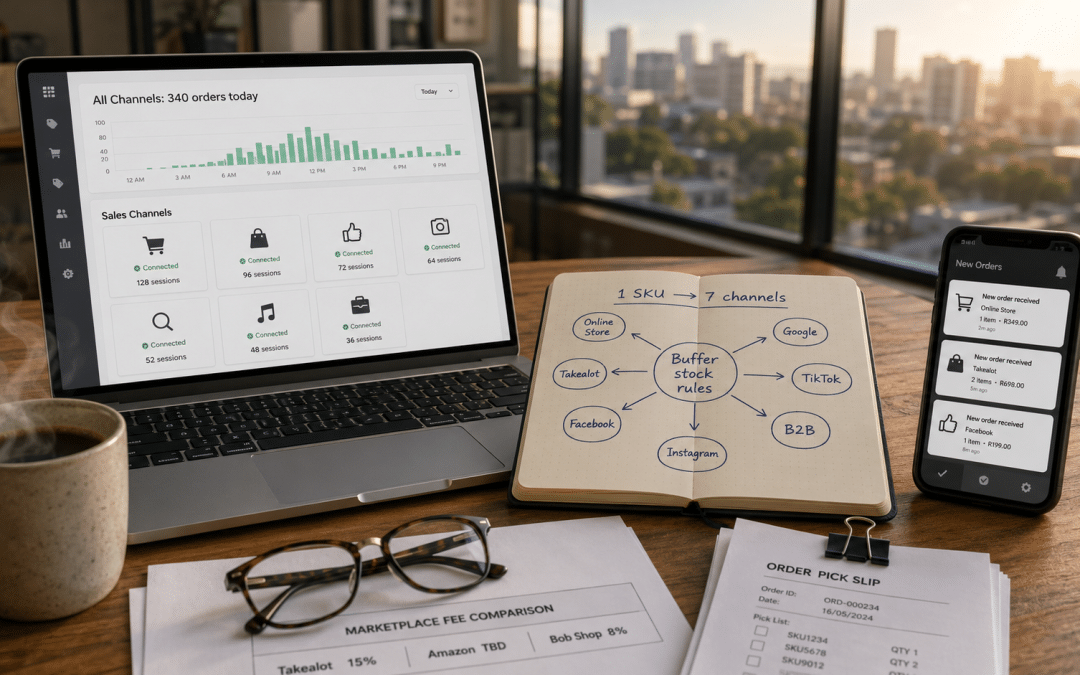
Shopify multichannel South Africa is the operational discipline of running one Shopify store as source of truth for inventory, orders, and pricing across Takealot, Facebook Shop, Instagram Shopping, Google Shopping, TikTok Shop, Bob Shop, and B2B channels. It is not multi-currency (that is Shopify Markets), not marketing across social platforms (that is omnichannel), and not simply "having a Takealot store alongside Shopify". The wrong framing produces channel chaos.
This guide covers what SA operators actually need to run multichannel selling from Shopify: sales channel architecture, SA marketplace realities, inventory sync mechanics, order routing, and the operational discipline required to prevent overselling. For broader Shopify context, see our Shopify South Africa guide. For narrower channel-specific guides, see our TikTok Shop South Africa guide and Shopify Markets multi-currency guide.
Quick Answer
Shopify multichannel South Africa works when operators treat Shopify admin as source of truth and connect Takealot, Facebook Shop, Instagram, Google Shopping, TikTok Shop, and Bob Shop through official sales channels or third-party sync apps. Stores running 3+ channels see 60-190% revenue increases over single-channel sellers. The mistake is running channels as separate operations instead of sync'd extensions of Shopify admin.
Want a free 60-minute channel architecture audit for your SA Shopify store?
Get a Free Channel AuditWhy Shopify Multichannel Selling is Genuinely Different in SA
Global Shopify multichannel guides assume Amazon, eBay, Walmart, and Etsy as primary marketplace destinations. None of those are dominant in SA. Shopify multichannel South Africa operates with different marketplace economics — Takealot as dominant marketplace (with its own listing API and 12-25% commission), Bob Shop for smaller merchants (8% commission), TikTok Shop as emerging channel, and Facebook/Instagram Shops with SA-specific catalogue rules. Global playbooks miss all of this.
According to Shopify's enterprise research on omnichannel strategy, multichannel, omnichannel, and unified commerce describe different levels of integration. Multichannel means selling on multiple channels with disconnected systems. Omnichannel coordinates the customer experience. Unified commerce connects backend systems, inventory, customer profiles, and workflows on one platform. Shopify natively supports unified commerce — which is why running channels correctly delivers structurally better economics than juggling separate marketplace accounts.
The Critical Reframe
Generic multichannel advice treats each sales channel as an independent operation with its own inventory management, pricing rules, and order fulfilment. Shopify multichannel South Africa done correctly treats Shopify admin as source of truth — every channel pulls from the same catalogue, inventory count, and pricing (with channel-specific markups). This structural difference determines whether channels scale profitably or produce chaos.
The Six-Step Shopify Multichannel Framework for SA Operators
Effective Shopify multichannel South Africa selling follows a repeatable six-step framework. Skipping steps or reordering them produces channel expansion that damages rather than helps the business. The framework below reflects what actually works for SA operators, not overseas theoretical models.
| Step | What It Involves | Timeline |
|---|---|---|
| 1. Channel prioritisation | Rank Takealot, Bob Shop, Facebook, Instagram, Google, TikTok by product-market fit — not by size | Week 1 |
| 2. Inventory architecture | Buffer stock rules per channel, safety stock levels, oversell prevention thresholds | Week 2 |
| 3. Pricing strategy per channel | Marketplace fees calculated into price; channel-specific price lists; price parity rules | Weeks 2-3 |
| 4. Channel integration | Official Shopify sales channels first; third-party sync apps for marketplaces without native integration | Weeks 3-5 |
| 5. Order routing and fulfilment | Marketplace orders route to Shopify admin; unified pick/pack workflow; SA courier integration | Weeks 5-6 |
| 6. Ongoing monitoring | Channel P&L per SKU; oversell alerts; price parity audits; commission fee reconciliation | Ongoing |
SA operators who follow this framework typically scale from 1 channel to 4-5 channels within 6 months while maintaining operational sanity. Those who skip step 2 (inventory architecture) suffer overselling incidents that damage marketplace ratings. Those who skip step 3 (pricing) discover marketplace fees have eroded margin below profitability. Both mistakes are common and both are avoidable through disciplined sequencing.
The Three Most Common SA Multichannel Mistakes
Three mistakes consistently derail SA Shopify multichannel South Africa programmes. Each is invisible during setup. Identifying them ahead of time saves months of margin erosion and marketplace rating damage.
Mistake 1 — Launching Marketplaces Without Buffer Stock Rules
SA operators regularly launch Takealot, Bob Shop, or Facebook Shop with full Shopify inventory exposed to each channel. When 5 units sell simultaneously across 3 channels, overselling triggers cancellations, refunds, marketplace penalties, and customer service escalations. The fix is buffer stock rules — when stock drops below threshold, marketplaces auto-set to zero. Every serious Shopify multichannel South Africa programme configures buffer stock as step 1.
Mistake 2 — Ignoring Marketplace Commission Fees in Pricing
SA operators list products on Takealot at the same price as Shopify, forgetting Takealot's 12-25% commission plus fulfilment fees. On a R500 product with 40% margin, 15% commission eats R75 — leaving R125 gross margin. When fulfilment, courier costs, and returns are factored in, the marketplace channel becomes unprofitable. The fix is channel-specific pricing with fees factored in — typically 8-15% markup. See our ecommerce vs marketplace guide.
Mistake 3 — Treating Social Commerce Channels as "Just Ads with a Buy Button"
Facebook Shop, Instagram Shopping, and TikTok Shop are genuine sales channels with their own catalogue rules, checkout mechanics, and customer expectations — not extensions of paid social ads. SA operators treating them as ad extensions get catalogue rejections and checkout abandonment. The fix is treating each social channel as a first-class channel with its own strategy and workflow. See our TikTok Shop guide.
Want to see which of these three mistakes might be draining your SA multichannel operation?
Request a custom channel diagnosticThe GPM Differentiator: Operator Perspective on SA Multichannel
Most SA agencies offering Shopify multichannel South Africa services come from either theme development backgrounds (which treat channels as add-ons) or marketplace consulting backgrounds (which treat Shopify as one channel among many rather than as source of truth). Both approaches produce sub-optimal outcomes. Channels get treated as separate operations, inventory sync becomes fragile, and pricing strategy is retrofitted after margin damage.
Growth Pulse Media built and scaled an SA ecommerce operation through real multichannel decisions — choosing which marketplaces to launch, sequencing channel expansion, learning which channels compound and which create operational drag. The operator instinct that comes from running channels under revenue pressure — knowing when to expand and when to consolidate, knowing which channels justify overhead and which do not — applies directly to multichannel programme management.
Our Shopify marketing agency service works with SA operators on channel prioritisation, inventory architecture, pricing strategy across channels, and integration selection on a senior-level basis. Limited client load ensures senior attention through the channel expansion phases that determine outcome — sequencing, pricing discipline, and operational architecture, not just tool selection.
The Operator Lesson
Two SA Shopify operators launching identical channel sets can end up on completely different economics. The variable is rarely marketplace selection. It is whether inventory architecture was built before channel launch, whether marketplace fees were factored into pricing before listing, and whether channels were sequenced or launched simultaneously. Disciplined Shopify multichannel South Africa expansion compounds; simultaneous channel launch produces chaos.
Real-World Impact: SA Mid-Sized Shopify Store Before and After Multichannel
This is a representative SA mid-sized Shopify Advanced store selling home and lifestyle goods with 580 SKUs and 11 staff, based in Cape Town with warehousing in Johannesburg. The "before" period reflects Shopify-only selling with no marketplace presence. The "after" period captures 9 months after implementing a structured Shopify multichannel South Africa programme adding Takealot, Facebook Shop, Instagram, and Google Shopping.
| Metric | Before (Shopify only) | After (5 channels) | Change |
|---|---|---|---|
| Active sales channels | 1 | 5 | +400% |
| Monthly orders | 640 | 1,840 | +188% |
| Overselling incidents monthly | 0 | 2-4 | Manageable with buffer stock |
| Weighted average marketplace fee | 0% | 8.5% | Factored into pricing |
| Blended gross margin (all channels) | 42% | 37% | −5pp (acceptable) |
| Monthly revenue | R485,000 | R1.42m | +193% |
| Monthly gross profit | R204,000 | R525,000 | +157% |
| Annual revenue trajectory | R5.8m | R17.0m | +193% |
What Drove the Result
The Shopify multichannel South Africa programme cost R38k monthly across channel integration apps (Market Sync equivalent), listing management, and analyst time. Takealot delivered the largest incremental revenue at 42% of new channel revenue. Facebook Shop and Instagram together added 31%. Google Shopping added 18%. TikTok Shop added 9% but is trending up. Total programme investment year 1: R456k. Additional annual revenue: R11.2m. Programme ROI: 8.4x on 12-month view.
Who This Is NOT For
Structured multichannel expansion applies to most SA Shopify operators at the right scale, but four scenarios where multichannel is the wrong call right now deserve honest acknowledgement.
Your Shopify store does under R80,000 monthly revenue. Multichannel adds operational overhead — channel apps, listing management, inventory sync monitoring, and customer service across channels. Below R80k monthly, the overhead consumes more than incremental channel revenue produces. Focus on growing your Shopify base first. Multichannel makes commercial sense when the operator has capacity to manage the added complexity — typically at R80k+ monthly revenue.
Your product margins are below 25%. Marketplace commissions typically run 8-25% depending on channel and category. At 25% margin, marketplace fees can eliminate profit entirely once fulfilment and returns are factored in. Multichannel selling for low-margin products is often a net-negative — high revenue growth alongside zero or negative profit growth. Confirm profitability per channel before scaling channel count.
You cannot commit 10+ hours weekly to channel management for 3+ months. Multichannel programme setup requires channel prioritisation decisions, listing approval workflows, buffer stock configuration, pricing rule setup, and integration testing per channel. Operators expecting to hand this entirely to an agency or app get patchy outcomes. If internal capacity is constrained, delay multichannel expansion until capacity exists.
Your product catalogue is highly customised (made-to-order, personalised, or configurable). Marketplaces enforce catalogue structure that suits standard SKUs — fixed variants, defined attributes, standard product types. Highly customised products fight marketplace catalogue rules and produce constant listing rejections. Standardise product catalogue first (often by consolidating variants), then layer multichannel expansion. Custom-heavy catalogues rarely fit marketplace channels.
SA-Specific Multichannel Tactics That Global Playbooks Miss
Three SA-specific Shopify multichannel South Africa tactics consistently produce disproportionate results. Each requires direct SA market experience because each plays against SA marketplace realities and consumer behaviour.
Tactic 1 — Takealot-First Sequencing for SA Operators
Global multichannel playbooks recommend Amazon or eBay first. In SA, Takealot dominates marketplace traffic and consumer trust — approximately 40% of SA online retail spend runs through Takealot channels. SA operators building Shopify multichannel South Africa programmes should sequence Takealot first (with proper buffer stock and pricing), then add Facebook/Instagram/Google, then TikTok Shop and Bob Shop later. Sequencing determines whether multichannel expansion generates positive cash flow from month one or requires months of catch-up.
Tactic 2 — Local Courier API Integration Across Channels
SA courier APIs (The Courier Guy, Aramex, PUDO, Bob Go) need integration on every sales channel, not just Shopify. Marketplace orders should route to the same courier workflow as Shopify orders, with unified tracking and unified customer notifications. Operators running separate fulfilment workflows per channel typically double their customer service load unnecessarily. Bob Go multi-courier aggregation solves this cleanly — worth the R500-R2,000 monthly cost for operations at scale.
Tactic 3 — POPIA-Compliant Customer Data Across Channels
SA operators running multichannel must maintain POPIA compliance for customer data captured across channels — marketplace customer records, Facebook Shop customers, and Shopify customers all require consistent consent tracking and marketing preference records. Best practice is centralising customer data in Shopify admin with channel source tags — enabling POPIA-compliant email/SMS marketing without cross-channel privacy violations. Global playbooks miss this SA-specific requirement.
Want all three SA-specific tactics applied to your multichannel programme with a custom 6-month roadmap?
Request a free channel planning sessionFrequently Asked Questions About Shopify Multichannel in SA
Which sales channels should SA Shopify stores prioritise?
SA operators should sequence Takealot first (dominant SA marketplace with 40% online retail share), then Facebook Shop + Instagram Shopping (largest social commerce reach), then Google Shopping (search-intent conversion), then TikTok Shop (emerging with strong growth), then Bob Shop (smaller marketplace, lower fees). Sequence based on effort-to-revenue ratio, not by global popularity. Channel prioritisation is the single biggest determinant of programme success.
How much does Shopify multichannel South Africa cost to set up and run?
Shopify multichannel South Africa setup costs run R25,000-R80,000 depending on channel count and integration complexity. Ongoing costs include channel sync apps (R500-R3,500 monthly), marketplace commissions (8-25% per channel), and operational overhead (10-30 hours monthly management). Total programme cost typically 12-18% of multichannel revenue. Programmes below this cost typically indicate scope gaps that surface as overselling incidents or margin erosion.
Does Shopify have native integrations for SA marketplaces?
Shopify has native sales channels for Facebook, Instagram, Google, TikTok, YouTube, and Shop app. Takealot and Bob Shop require third-party sync apps (Market Sync, Codisto, or custom integration). Amazon SA is not yet available (Amazon's SA launch is expected but not confirmed). Native integrations reduce operational complexity; third-party sync adds capability at monthly cost. Combine both for full SA marketplace coverage.
How do we prevent overselling across multiple Shopify channels?
Every Shopify multichannel South Africa operation should configure buffer stock rules — when Shopify inventory drops below threshold (typically 3 units), marketplaces auto-set to zero to prevent simultaneous multichannel sales exceeding stock. Use safety stock levels for channels with higher fulfilment SLAs. Monitor oversell alerts weekly. Combined with real-time inventory sync, buffer stock rules eliminate 95%+ of overselling incidents.
Are marketplace channels profitable for SA Shopify stores?
Depends on product margin and marketplace commission. At 40%+ product margin, marketplace channels typically remain profitable after 15-25% commission and fulfilment fees. At 25-40% margin, profitability requires channel-specific pricing markups. Below 25% margin, marketplace channels are often unprofitable without significant volume compensating. Calculate per-channel P&L monthly rather than assuming all channels contribute equally.
What's the biggest Shopify multichannel mistake SA operators make?
Launching multiple marketplaces simultaneously without buffer stock rules, channel-specific pricing, or unified fulfilment workflow. This produces overselling incidents in month one, margin erosion by month three, and customer service crises by month six. The fix is sequenced launch — one channel at a time with 4-6 week gaps. Discipline beats speed in Shopify multichannel South Africa expansion.
Shopify Multichannel South Africa: The Bottom Line for SA Ecommerce Operators
Shopify multichannel South Africa selling delivers 100-200% revenue growth for SA operators willing to run channels with operational discipline — buffer stock rules, channel-specific pricing, sequenced launch, and unified fulfilment. The programmes that fail all launch multiple channels simultaneously without inventory architecture — producing overselling, margin erosion, and customer service chaos that damages the entire business, not just the new channels.
The single biggest predictor of a successful multichannel programme is not channel selection. It is whether the operator commits to Shopify admin as source of truth, sequences channel launches one at a time, and treats marketplace fees as pricing inputs rather than afterthoughts.
If you would rather skip the trial-and-error and have a senior operator who has run SA multichannel programmes under revenue pressure walk you through what would work for your store, that is exactly what the conversation below is for.
Get a Free Multichannel Audit for Your SA Shopify Store
We will review your current channel setup, inventory architecture, marketplace pricing structure, and integration stack — and give you a written audit covering the two or three highest-leverage channel priorities, realistic 6-month revenue projections, and a phased expansion roadmap tuned to your product margin and operational capacity.
No sales pitch, no pressure — just an honest read from senior operators who have built and scaled SA ecommerce stores. No obligation — we will get back to you within 24 hours.
Request a Free Multichannel Audit →