
 Add to Preferred Sources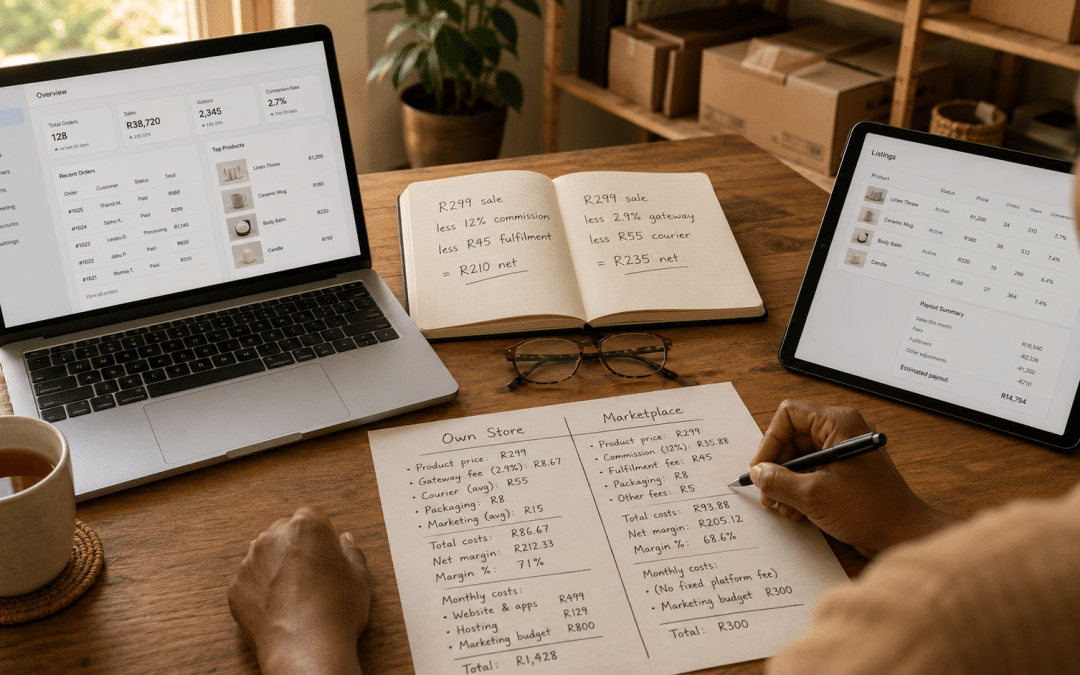
Ecommerce vs marketplace south africa comes down to a single strategic trade-off — a marketplace like Takealot gives you instant access to millions of ready buyers but takes 8-20% commission and owns the customer relationship, while your own ecommerce store costs more to build and market but keeps the margin, the customer data, and the brand asset. For most serious SA businesses, the answer is not one or the other but a deliberate sequence.
This guide breaks down the real economics of both models in the SA market — commission structures, true margin comparison, customer ownership, brand equity, and the decision framework that determines which model fits your specific stage and product. For the broader context, see our complete ecommerce marketing guide for South African businesses.
Quick Answer
The ecommerce vs marketplace south africa decision is not permanent and not binary. Marketplaces like Takealot, Bidorbuy, and Makro Marketplace win on speed-to-first-sale and built-in buyer trust — ideal for testing product demand, generating early cash flow, and reaching buyers you cannot yet acquire yourself. Your own ecommerce store wins on margin retention (no 8-20% commission), customer data ownership, remarketing ability, and building a sellable brand asset. The strongest SA strategy for most product businesses is a hybrid: use a marketplace to validate demand and generate cash flow while building your own store in parallel, then shift acquisition spend toward the owned channel as brand recognition grows. A pure marketplace strategy caps your long-term enterprise value because you are renting an audience you will never own.
Want a channel recommendation tailored to your specific SA product, margin, and stage?
Get a Free Channel Strategy SessionEcommerce vs Marketplace South Africa: The Core Trade-off
The fundamental ecommerce vs marketplace south africa trade-off is audience access versus economic ownership. A marketplace rents you an existing audience and charges for it through commission; an owned store requires you to build the audience yourself but lets you keep everything you build. Understanding which side of that trade matters most at your stage is the entire decision.
What a marketplace actually gives you
A marketplace like Takealot provides immediate access to a large existing buyer base, established consumer trust, and handled logistics. According to Takealot's official seller programme, sellers reach over 3 million active SA online shoppers and pay a monthly seller fee plus category-based commission, with the marketplace handling warehousing, delivery, and returns. The value is real — you skip the hardest part of ecommerce, which is acquiring traffic from zero.
What a marketplace takes from you
The marketplace charges for that audience in three ways beyond the visible commission, and these are central to the ecommerce vs marketplace south africa calculation. It takes 8-20% of every sale depending on category, it owns the customer relationship entirely so you cannot remarket or build loyalty, and it controls your visibility through its own algorithm and competing listings. You are building someone else's asset, not your own.
Ecommerce vs Marketplace South Africa: The Real Margin Comparison
The margin reality is the heart of the ecommerce vs marketplace south africa decision, and it is consistently underestimated by sellers who look only at headline commission. The full cost comparison must include every fee on both sides, not just the obvious ones, to produce an honest margin picture.
| Cost Factor | Marketplace (Takealot-style) | Own Ecommerce Store |
|---|---|---|
| Monthly platform cost | R400 seller fee | R200-R1,500 (Shopify/WooCommerce) |
| Commission per sale | 8-20% by category | 0% (you keep the margin) |
| Payment processing | Included in commission | 2-3% gateway fee |
| Fulfilment per order | R20-R50 plus weight shipping | R55-R110 courier (negotiable) |
| Customer acquisition | Low (marketplace traffic) | High (you fund all traffic) |
| Customer data ownership | None — marketplace owns it | Full — yours to remarket |
| Brand equity built | Minimal — marketplace brand wins | Full — a sellable asset |
The hidden cost most SA sellers miss
The single most underestimated factor in the ecommerce vs marketplace south africa comparison is lifetime value. A marketplace sale is typically a one-time transaction because you cannot email, remarket, or build loyalty with a customer the marketplace owns. An owned-store sale creates a customer you can convert into repeat purchases at near-zero acquisition cost — which is where ecommerce profitability actually compounds.
The Lifetime Value Blind Spot
Most SA sellers compare ecommerce versus marketplace on first-sale margin alone and conclude the marketplace is competitive because the commission roughly equals their owned-store acquisition cost. This misses the entire point. On a marketplace, every sale requires paying the full audience cost again because you never own the customer. On your own store, the second, third, and tenth purchase from the same customer costs almost nothing to generate through email and retention. A business with a 30% repeat-purchase rate on its own store can be twice as profitable as the identical business on a marketplace, even when first-sale economics look similar — because the marketplace silently resets customer acquisition to zero on every single order.
Need help modelling the true margin difference for your specific SA product and volume?
Get a Free Margin Comparison AnalysisEcommerce vs Marketplace South Africa: When the Marketplace Wins
There are specific situations where the marketplace is genuinely the better choice in the ecommerce vs marketplace south africa decision, and being honest about them matters. The marketplace is not a worse option universally — it is the right option for particular stages and product types.
The marketplace wins for
The marketplace is the stronger choice when you are validating whether a product has demand before investing in store infrastructure, or when you need immediate cash flow and cannot wait three to six months for SEO and brand building to work.
It is also the better option when your product is a commodity where buyers do not care about brand, or when you lack the capital and skill to drive your own traffic. For early-stage testing, the marketplace removes the single hardest barrier in ecommerce — getting in front of buyers at all.
The marketplace as a deliberate launchpad
The smartest SA operators treat the marketplace not as a destination but as a deliberate launchpad. They use it to prove demand, generate the cash flow that funds an owned store, and learn which products sell — then they build the owned channel with validated products and real revenue rather than guessing in the dark. The marketplace funds the transition; it is not the end state.
Ecommerce vs Marketplace South Africa: When Your Own Store Wins
The owned ecommerce store becomes the stronger model in the ecommerce vs marketplace south africa decision once specific conditions are met — and recognising when you have crossed that threshold prevents leaving significant margin on the table indefinitely.
Your own store wins for
The owned store is the stronger choice when you have validated product demand and proven repeat-purchase behaviour, when your margins cannot absorb 8-20% commission sustainably, when brand differentiation is part of your value proposition, when you sell products customers buy repeatedly, or when you are building a business you intend to sell — because enterprise value lives in owned customer relationships and brand equity, not in marketplace sales history that transfers to no one.
The brand equity argument
The most strategically important reason to own your store is that you are building a transferable asset. A business doing R500,000 monthly through its own store with an owned customer list and recognised brand can be sold for a meaningful multiple. The identical revenue earned entirely through a marketplace is worth dramatically less to an acquirer because none of the customer relationships or brand equity transfers — you were renting, not building.
The Channel Dependency Risk
Beyond margin, the most underrated danger in a marketplace-only strategy is total channel dependency. A business that earns 100% of revenue through a single marketplace is one policy change, fee increase, or account suspension away from zero — with no customer list to email and no brand demand to redirect. SA marketplace sellers have lost entire businesses overnight to suspension disputes with no recourse and no fallback channel. An owned store is not just higher-margin; it is the insurance policy that means a single platform decision cannot end the business. Channel diversification is risk management, not just economics.
The Before-After Reality for SA Product Businesses
The strategic difference between a marketplace-only approach and a deliberate hybrid-to-owned sequence crystallises into specific business outcomes over an 18-month period. Below is a realistic comparison for an SA product business starting from zero with a validated product.
| Metric | Marketplace-Only (Before) | Hybrid-to-Owned Sequence (After) |
|---|---|---|
| Time to first sale | 1-3 weeks (marketplace traffic) | 1-3 weeks (marketplace first) |
| Effective margin after all fees | 18-32% (commission erodes it) | 42-58% (owned channel share grows) |
| Customer data owned | Zero records | Full list built from month 3 |
| Repeat purchase rate | 3-7% (no remarketing possible) | 22-38% via owned email |
| Customer acquisition cost trend | Flat (resets every sale) | Declining as retention compounds |
| Brand recognition built | Negligible | Measurable branded search growth |
| Enterprise value at month 18 | Low (no transferable asset) | 3-5x higher sale multiple |
| Channel dependency risk | Total (one policy change ends it) | Diversified across channels |
The table makes the strategic point clear — the marketplace-only path and the hybrid path start identically but diverge sharply. By month 18, the hybrid-to-owned business has materially higher margin, a customer asset, declining acquisition cost, and dramatically higher enterprise value. The marketplace-only business is still profitable but structurally capped — it has built revenue without building anything it owns.
Why GPM Approaches the Channel Decision Differently
Most SA agencies will simply run ads to whatever channel the client already chose, without questioning whether the channel itself is the constraint on the business. That produces activity but ignores the most consequential decision in the ecommerce vs marketplace south africa question — where the business builds its customer relationships. The channel decision shapes every downstream marketing economic.
Growth Pulse Media builds ecommerce marketing programmes for South African businesses by starting with the channel-strategy question before committing spend. We have sold through marketplaces and owned stores in the SA market, watched the margin and lifetime-value difference play out over real trading periods, and seen how many SA businesses cap their own enterprise value by staying marketplace-only too long. The channel sequence recommendation comes before the campaign recommendation.
Our typical engagement starts with a 7-day channel audit — modelling the true blended margin on each channel for the specific product, calculating the lifetime-value gap between marketplace and owned customers, assessing brand and repeat-purchase potential, and mapping the realistic marketplace-to-owned transition timeline before any tactical marketing work begins.
Who This Channel Approach Is NOT For
Being upfront about who this strategic framing does not suit saves time. The hybrid-to-owned sequence is the right answer for most product businesses, but not for everyone.
Pure resellers of commodity products with no brand intent. If you resell generic commodity goods where buyers genuinely do not care who they buy from and never will, the brand-equity argument does not apply to you. A marketplace-only strategy can be rational for pure price-competitive commodity reselling where there is no brand to build and no loyalty to capture — the owned-store advantages mostly do not materialise.
Businesses with zero capacity to fund owned-channel acquisition. The hybrid sequence requires eventually investing in SEO, content, or paid traffic to build the owned channel. SA businesses with no capital and no capacity to ever fund customer acquisition will not complete the transition — for them the marketplace is not a launchpad but the only viable channel, and pretending otherwise wastes planning effort.
Service businesses without physical products. This comparison is specifically about product businesses choosing sales channels. SA service businesses, consultancies, and agencies do not sell through product marketplaces and this entire framework does not apply — their channel decisions centre on lead generation and reputation, not marketplace versus store.
Sellers wanting a guaranteed passive outcome. Neither channel is passive. The marketplace requires constant pricing competitiveness and listing management; the owned store requires sustained marketing investment. SA sellers seeking a set-and-forget income with no ongoing work will be disappointed by both models equally — the choice is about which kind of work compounds, not about avoiding work.
Want help deciding which channel sequence fits your SA product business right now?
Book a 20-Minute Channel Fit CallFrequently Asked Questions
Questions on the ecommerce vs marketplace south africa decision that come up most often when SA product businesses are choosing where to sell and looking to avoid capping their own growth potential.
Is it better to sell on Takealot or your own website in South Africa?
It depends on your stage. Takealot is better when you are validating product demand, need immediate cash flow, or lack the capital to drive your own traffic, because it gives instant access to over 3 million SA shoppers. Your own website is better once demand is proven, because it keeps the 8-20% commission, owns the customer relationship, and builds a sellable brand asset.
For most serious SA product businesses, the strongest approach is to start on the marketplace to validate and generate cash flow, then build the owned store in parallel and shift acquisition toward it as the brand grows.
How much commission does Takealot take from sellers?
Takealot charges a monthly seller fee of around R400 plus a category-based success commission typically ranging from 8% to 20% of the sale price depending on the product category. Electronics commission tends to sit lower around 8-12%, while categories like fashion can reach up to 15-20%.
Additional costs include fulfilment fees of roughly R20-R50 per order plus weight-based shipping, optional storage fees, and optional advertising. The all-in effective cost frequently lands meaningfully higher than the headline commission once every fee is included.
Can I sell on a marketplace and my own store at the same time?
Yes, and for most SA product businesses this hybrid approach is the strongest strategy. Running a marketplace presence alongside your own store lets you capture marketplace buyers you cannot yet acquire yourself while simultaneously building an owned customer base, brand recognition, and higher-margin direct sales.
The key discipline is treating the marketplace as a customer-acquisition and validation channel while deliberately shifting repeat and high-margin sales toward the owned store over time, rather than letting the marketplace remain the permanent primary channel by default.
Why is owning my ecommerce store better for business value?
Enterprise value in a product business lives in transferable assets — an owned customer list, recognised brand, and repeatable owned-channel revenue. A business generating revenue through its own store with these assets can be sold for a meaningful multiple because the buyer acquires the customer relationships and brand.
The identical revenue earned entirely through a marketplace is worth far less to an acquirer because none of the customer relationships or brand equity transfers — the marketplace owned them, not the seller. This is why marketplace-only businesses structurally cap their own sale value.
What is the biggest risk of selling only through a marketplace?
The biggest risk is total channel dependency. A marketplace-only SA business has no direct customer relationships, so a single policy change, fee increase, account suspension, or algorithm shift can eliminate the entire revenue base overnight with no fallback. The seller has no list to email and no brand demand to redirect.
This concentration risk is why even businesses that start successfully on a marketplace should deliberately build owned-channel resilience — diversification is not just about margin, it is about survival if the single channel changes its terms.
How long should I stay marketplace-only before building my own store?
There is no fixed timeline, but the practical trigger is validated demand plus repeat-purchase evidence. Once a marketplace has proven that a product sells consistently and that customers would buy it again, the marketplace has served its validation purpose and the owned store should begin in parallel.
Staying marketplace-only well past demand validation is the most common strategic mistake — every month of marketplace-only operation after that point is margin and customer data permanently surrendered. Most SA businesses should begin the owned channel within three to six months of consistent marketplace sales.
Get Your Custom Channel Strategy for Your SA Product Business
Receive a custom ecommerce vs marketplace south africa channel strategy covering your true blended margin on each channel, the lifetime-value gap analysis, your realistic marketplace-to-owned transition timeline, and a prioritised implementation roadmap. Built by operators who have sold through both marketplaces and owned stores in the SA market, not by consultants who have only read the seller documentation. No obligation — we will get back to you within 24 hours.
Request Your Custom Channel Plan