
 Add to Preferred Sources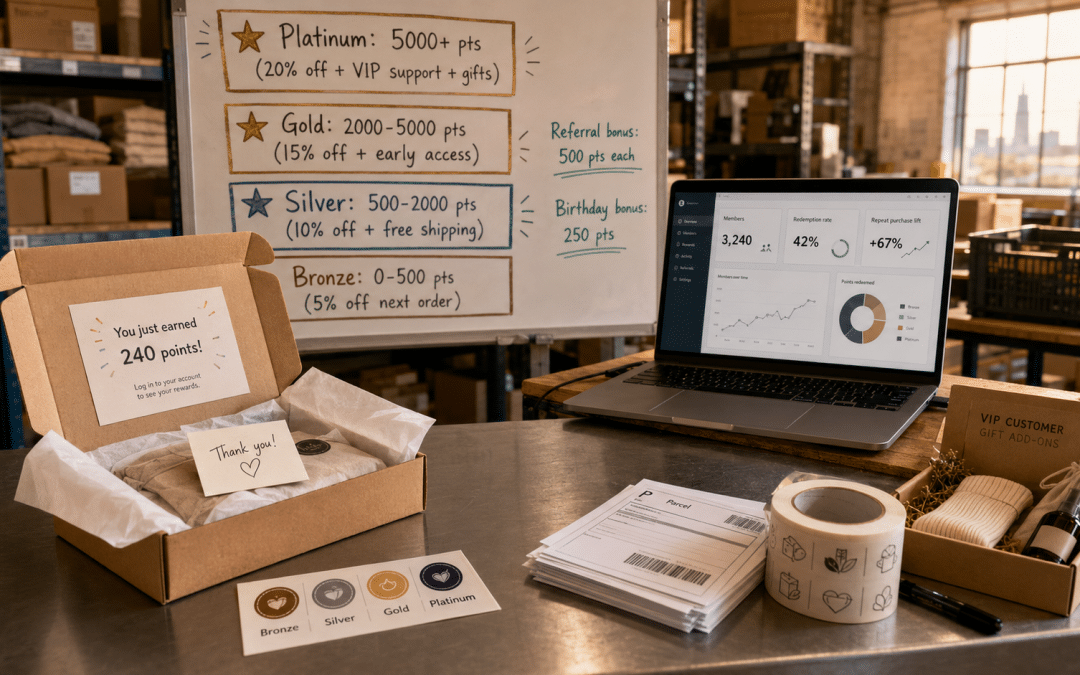
Shopify loyalty rewards in South Africa are the app-based points, tiers, and referral mechanics SA operators deploy on their Shopify store to lift repeat purchase rate from the 28% platform average toward the 40-60% top performers achieve. The commercial case is unambiguous: repeat customers spend 67% more per order and cost 5-7x less to engage than new customers, yet most SA operators pour budget into acquisition while their existing customers quietly disappear.
This guide covers what SA operators need to build a loyalty and rewards programme that actually moves retention metrics: programme structure, app selection (Smile.io, Rivo, Yotpo, LoyaltyLion, Growave), tier design, referral mechanics, and the POPIA-compliant data workflow behind it. For broader Shopify context, see our Shopify South Africa guide. For retention adjacencies, see our abandoned cart recovery guide and email marketing pillar.
Quick Answer
Shopify loyalty rewards work when SA operators build points-based programmes with tier structures (Bronze/Silver/Gold/Platinum), referral mechanics, and clear redemption paths — deployed through Smile.io, Rivo, or Yotpo. SA store average repeat purchase rate is around 28%; disciplined programmes lift this to 40-60% within 6-9 months. Members make 67% more purchases and generate 115% more revenue per customer than non-members.
Want a free 60-minute loyalty programme design review for your SA Shopify store?
Get a Free Loyalty ReviewWhy Shopify Loyalty Rewards Matter More for SA Operators in 2026
Shopify loyalty rewards matter more for SA operators than global averages suggest because SA acquisition costs have risen sharply while retention infrastructure remains underused. According to Shopify's official research on loyalty analytics, acquiring a new customer costs 5-25x more than retaining an existing one, and a 5% increase in retention can lift profits 25-95%. This math has always been true — what has changed is that acquisition costs are compounding.
The industry data is unambiguous. Average ecommerce repeat customer rate sits at 28.2%. Top-performing Shopify stores achieve 40-60% repeat purchase rates through structured loyalty programmes. Loyalty programme members make 67% more purchases than non-members, generate 115% more revenue per customer, and show 2.5x higher repeat rates. Customers who actively redeem points show a 50% repeat purchase rate versus 10.7% for those who do not.
The Critical Reframe
Shopify loyalty rewards are not "discount programmes with a fancy interface". They are retention infrastructure that changes customer behaviour — driving members to purchase 67% more often, spend 115% more per customer, and refer new customers at 2x the rate of average buyers. Programmes framed as discount mechanisms train customers to wait for lower prices. Shopify loyalty rewards designed as belonging and status structures build genuine repeat behaviour. The framing determines the outcome.
The Five-Step Shopify Loyalty Programme Framework for SA Operators
Effective Shopify loyalty rewards programme design follows a repeatable five-step framework. Skipping the programme structure phase and jumping to app selection is the most common failure. The framework below reflects what actually works for SA stores, not generic loyalty programme templates.
| Step | What It Involves | Timeline |
|---|---|---|
| 1. Retention baseline diagnosis | Current repeat purchase rate, 30/60/90-day repeat windows, CLV by cohort | Week 1 |
| 2. Programme structure design | Points earn rules, tier thresholds, redemption paths, referral mechanics | Week 2 |
| 3. Loyalty app selection | Smile.io, Rivo, Yotpo, LoyaltyLion, or Growave based on scale and stack fit | Week 2-3 |
| 4. Integration and launch | Klaviyo/Omnisend triggers, Shopify customer tag sync, theme widget integration | Weeks 3-5 |
| 5. Redemption optimisation | Redemption rate monitoring, tier promotion campaigns, POPIA-compliant reporting | Ongoing |
SA operators who follow this framework typically lift repeat purchase rate 15-30 percentage points within 6-9 months. Those who skip step 1 (baseline diagnosis) cannot measure programme impact and abandon programmes that were working. Those who skip step 5 (redemption optimisation) end up with high enrolment but low active engagement. Around R10 billion in US loyalty points goes unspent annually; the same pattern applies proportionally to SA.
The Three Most Common SA Shopify Loyalty Mistakes
Three mistakes consistently damage SA Shopify loyalty rewards programmes. Each looks reasonable during setup. Identifying them ahead of time saves months of low-engagement enrolment that produces no retention lift.
Mistake 1 — Designing Rewards Customers Cannot Realistically Reach
SA operators regularly design programmes where the first meaningful reward requires R2,000-R5,000 in cumulative spend to redeem — a threshold most first-time buyers never approach. Members enrol, browse the rewards page, and disengage. The fix is designing first redemption at 30-40% of average first-order value, so customers see a realistic path. Shopify loyalty rewards work when the reward is visible and reachable, not distant.
Mistake 2 — Launching Without Klaviyo or Omnisend Trigger Integration
SA operators launching Shopify loyalty rewards programmes without email trigger integration miss 60-70% of the engagement lift. Loyalty programmes drive repeat behaviour through communication — points balance reminders, tier progression celebrations, birthday bonuses, redemption expiry alerts. Without triggered email flows, members forget the programme exists between purchases. See our email marketing pillar. The programme is only as effective as its communication cadence.
Mistake 3 — Ignoring POPIA Consent for Loyalty Data
SA operators enrolling customers in Shopify loyalty rewards programmes must maintain POPIA-compliant consent for the personal data collected — birthday, phone, purchase history, communication preferences. Programmes with vague or missing consent language create legal exposure that eventually surfaces as customer complaint or regulator query. Explicit POPIA-compliant opt-in language at enrolment, clear data-use disclosure, and easy opt-out mechanisms are non-negotiable. Global loyalty programme templates rarely address this SA-specific requirement.
Want to see which of these three mistakes might be limiting your SA Shopify loyalty programme?
Request a custom loyalty diagnosticThe GPM Differentiator: Operator Perspective on SA Shopify Loyalty
Most SA agencies offering Shopify loyalty rewards services come from either loyalty consulting backgrounds (which design elegant programmes without understanding Shopify app ecosystem trade-offs) or generic Shopify agency backgrounds (which install Smile.io on default settings and call it a programme). The result is either theoretically sound programmes that break during Shopify integration, or default installations that produce enrolment without engagement.
Growth Pulse Media built and scaled an SA ecommerce store through real retention decisions — deploying loyalty programmes under revenue pressure, learning which tier structures drive tier progression, learning when Klaviyo integration matters and when it does not. The operator instinct that comes from managing programmes with actual redemption data — knowing which programme changes lift redemption and which are vanity — applies directly to programme design.
Our Shopify marketing agency service works with SA operators on Shopify loyalty rewards retention baseline diagnosis, programme structure design, loyalty app selection, and integration architecture on a senior-level basis. Limited client load ensures senior attention through the design phases that determine outcome — programme mechanics and communication cadence, not just app installation.
The Operator Lesson
Two SA Shopify stores running identical loyalty apps can end up on completely different retention trajectories. The variable is rarely app selection. It is whether programme structure was designed against baseline retention data, whether rewards were made reachable at typical first-order values, and whether email trigger integration was built alongside app installation. Shopify loyalty rewards discipline compounds; default app installations do not.
Real-World Impact: SA Mid-Sized Shopify Store Before and After Loyalty Launch
This is a representative SA mid-sized Shopify Advanced store selling beauty and wellness products with 240 SKUs and 8 staff, based in Cape Town. The "before" period reflects no structured Shopify loyalty rewards programme — just occasional discount codes. The "after" period captures 9 months after launching a structured programme via Smile.io with Klaviyo trigger integration and four-tier design.
| Metric | Before | After (9 months) | Change |
|---|---|---|---|
| Repeat purchase rate | 24% | 52% | +28pp |
| Loyalty programme members | 0 | 4,200 | New |
| Active members (past 90 days) | N/A | 2,650 | 63% active rate |
| Point redemption rate | N/A | 44% | Above 30% benchmark |
| Average order value (members) | N/A | R680 | 67% above non-members |
| Referral orders monthly | 0 | 85 | New channel |
| Customer lifetime value (12mo) | R820 | R1,940 | +137% |
| Annual store revenue trajectory | R4.8m | R11.2m | +133% |
What Drove the Result
The Shopify loyalty rewards programme cost R28k monthly across Smile.io Growth plan, Klaviyo integration work, and analyst time. First reward set at 250 points (roughly 30% of average first-order value) drove strong initial engagement. Tier progression to Silver at 2,000 points lifted average purchases per member from 1.2 to 2.4. Referral mechanic added 85 monthly incremental orders. Total investment: R252k. Additional annual revenue: R6.4m. Programme ROI: 25x on 12-month view.
Who This Is NOT For
Structured loyalty programmes apply to most SA operators at meaningful scale, but four scenarios where loyalty investment is misplaced deserve honest acknowledgement.
Your store gets under 500 monthly orders. Loyalty programmes need order volume to produce statistical repeat behaviour. Below 500 monthly orders, member enrolment is too small to measure programme impact meaningfully. Focus on traffic acquisition and first-purchase conversion first — SEO, paid channels, checkout optimisation. Return to loyalty programme investment when monthly orders reach the volume where retention data becomes actionable.
Your product category has genuinely low repurchase frequency. Some product categories — furniture, appliances, high-ticket electronics — have natural repurchase cycles of 3-7 years. Loyalty programmes optimising for repeat behaviour do not fit these product economics. Referral programmes may still apply, but points-based loyalty typically does not. Confirm your category's natural repurchase frequency before investing in retention infrastructure designed for high-frequency categories.
You have not yet solved product-market fit or margin problems. Loyalty programmes amplify existing store performance — they do not fix broken value propositions. On a store with weak product-market fit or margins under 25%, loyalty programme costs consume more than programme gains deliver. Fix product and margin first, then layer loyalty. Loyalty on an unprofitable base produces enrolment metrics that do not translate to profit.
Your team cannot allocate 4+ hours weekly to programme management. Loyalty programmes require ongoing tier campaign design, redemption monitoring, member communication planning, and engagement analysis. Operators expecting to install Smile.io and forget it get low-engagement enrolment producing no retention lift. If internal capacity is genuinely constrained, delay programme investment until capacity exists — do not attempt part-time loyalty programme management with predictably poor results.
SA-Specific Shopify Loyalty Tactics That Global Playbooks Miss
Three SA-specific Shopify loyalty rewards tactics consistently produce disproportionate results. Each requires direct SA market experience because each plays against SA consumer behaviour and infrastructure realities global playbooks do not cover.
Tactic 1 — WhatsApp Trigger Integration for SA Members
SA Shopify loyalty rewards programmes running Klaviyo email triggers alongside WhatsApp Business API messages achieve 3-5x higher engagement than email-only equivalents. SA consumer WhatsApp open rates exceed 90% versus 22-28% email open rates. Loyalty point balance reminders, tier progression celebrations, and Shopify loyalty rewards redemption expiry alerts via WhatsApp lift active member rate 40-60% for SA stores based on observed data. Global loyalty templates rarely address WhatsApp as loyalty channel.
Tactic 2 — POPIA-Compliant Enrolment Workflow
SA Shopify loyalty rewards programmes must maintain explicit POPIA consent for member data — birthday, phone, purchase history, communication preferences. Compliant enrolment workflow uses layered consent (loyalty enrolment consent separate from marketing communication consent), clear data-use disclosure at signup, and one-click opt-out mechanisms accessible from every member communication. Non-compliant workflows generate customer complaints that eventually surface as Information Regulator queries.
Tactic 3 — Local Reward Redemption Structures
SA Shopify loyalty rewards programmes offering redemption options aligned to SA consumer preferences — free Courier Guy delivery, mobile data top-ups, Woolworths or Checkers vouchers, local charity donation options — see 20-35% higher redemption rates than programmes offering only store credit. SA consumers value tangible rewards with clear cash equivalent. Global loyalty templates default to store-credit-only redemption, missing the SA-specific opportunity.
Want all three SA-specific tactics applied to your loyalty programme with a custom 90-day roadmap?
Request a free loyalty planning sessionFrequently Asked Questions About Shopify Loyalty Rewards in SA
Which Shopify loyalty app should SA operators choose?
Smile.io is the strongest entry-level Shopify loyalty rewards fit — clean Shopify integration, generous free plan, straightforward setup (R0-R850 monthly for SA store volumes). Rivo suits Shopify-native brands wanting deeper customisation and Shopify Plus integration. Yotpo is best for mid-market brands wanting loyalty integrated with reviews, UGC, and SMS in one platform. LoyaltyLion suits data-driven brands prioritising analytics and segmentation. Growave bundles loyalty with reviews, wishlists, and Instagram integration for smaller operators.
How much do Shopify loyalty rewards programmes cost for SA operators?
Shopify loyalty rewards app costs range from R0-R850 monthly (Smile.io free tier through Growth plan) to R2,500-R8,500 monthly (Rivo, Yotpo, LoyaltyLion mid-market plans) to R15,000+ monthly for enterprise plans. Setup and integration work typically adds R25,000-R80,000 one-time, covering programme structure design, Klaviyo integration, theme widget deployment, and staff training. Total programme cost typically 2-5% of retention-attributable revenue.
What repeat purchase rate should SA Shopify stores target?
SA Shopify stores average 24-30% repeat purchase rate. Structured loyalty programmes typically lift this to 40-55% within 6-9 months. Top-performing SA stores exceed 55% through combined loyalty + email retention infrastructure + subscription mechanics. Targets should be benchmarked against your product category — beauty and consumables reach 45-55%, apparel reaches 35-45%, furniture and electronics reach 15-25% due to natural repurchase cycles.
How long does a Shopify loyalty programme take to show impact?
First Shopify loyalty rewards enrolments arrive within days of launch. Meaningful repeat purchase impact appears at months 3-4 as members complete first redemption cycles. Full programme impact (25-50% repeat purchase lift) typically appears at months 6-9 as tier progressions accumulate and referral mechanics compound. Programmes evaluated below 6 months systematically underestimate loyalty impact because retention behaviour is backweighted. Plan for 9-12 month evaluation minimum.
Do referral programmes work for SA Shopify stores?
Yes — referral mechanics typically add 5-15% incremental order volume for SA stores running structured loyalty programmes with referral rewards. Referred customers make 2x more purchases than average acquisition and cost meaningfully less. Referral works best when the referrer reward (bonus points) and the referee reward (welcome discount) are both meaningful and clearly communicated. Weak dual-sided incentives produce weak referral rates.
What's the biggest Shopify loyalty mistake SA operators make?
Launching without Klaviyo or Omnisend trigger integration and without POPIA-compliant enrolment consent. Programmes launched as installations without communication workflows produce enrolment metrics but not retention behaviour. Programmes launched without compliance workflows produce legal exposure. The fix is designing communication cadence and consent workflow before app installation — not after enrolment has already begun. Design first, install second.
Shopify Loyalty Rewards South Africa: The Bottom Line for SA Ecommerce Operators
Shopify loyalty rewards for SA operators lift repeat purchase rate from the 28% platform average toward the 45-60% top-performer range for stores willing to design programmes deliberately — structured tiers, reachable rewards, Klaviyo trigger integration, POPIA-compliant consent, and ongoing redemption optimisation. The programmes that fail all launch as app installations without upstream design or communication workflows.
The single biggest predictor of a successful programme is not app selection or budget. It is whether programme structure was designed against baseline retention data, whether the first reward sits at a reachable threshold for average customers, and whether email trigger integration was built alongside app installation rather than as an afterthought.
If you would rather skip trial-and-error and have a senior operator who has run SA Shopify loyalty programmes under revenue pressure walk you through what would work for your store, that is exactly what the conversation below is for.
Get a Free Loyalty Programme Design Review for Your SA Shopify Store
We will review your current retention data, run a structured programme design workshop covering tier structure, reward reachability, app selection, and Klaviyo integration architecture, and give you a written diagnostic covering the two or three highest-leverage programme priorities and realistic 9-month retention projections tuned to your product category.
No sales pitch, no pressure — just an honest read from senior operators who have built and scaled SA ecommerce stores. No obligation — we will get back to you within 24 hours.
Request a Free Loyalty Review →