
 Add to Preferred Sources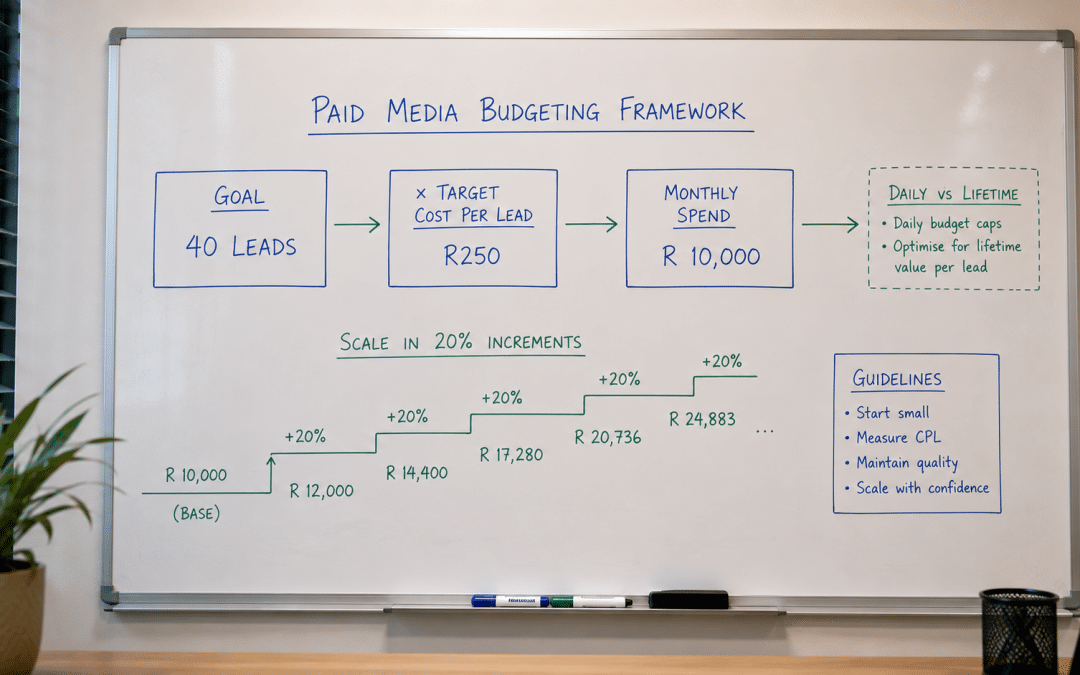
Facebook ads budget south africa decisions should start from your goal, not a guess: work backwards from how many leads or sales you need and your target cost per result, and the right monthly number reveals itself.
As a practical floor, most SA businesses need a minimum of R6,000-R12,000 a month for the algorithm to learn — but the correct figure depends entirely on what one lead or sale is worth. This guide shows the method for setting and scaling your number, not a one-size price tag.
It sits within our Meta Ads South Africa guide and focuses purely on the spend decision and mechanics. For what the full thing actually costs — spend plus management plus setup — see our Meta ads cost breakdown; for per-impression rates, the CPM benchmarks. Here the question is narrower: how much should YOU spend, and how do you manage it?
Quick Answer
Set your spend by working backwards from a goal, not by picking a round number. Decide how many leads or sales you want monthly, multiply by your target cost per result, and that is your starting figure — with a practical floor of roughly R6,000-R12,000 so the algorithm has enough signal to learn. Use daily budgets for ongoing campaigns and lifetime budgets for fixed-window promotions.
Once running, scale in steps of roughly 20% every few days rather than doubling overnight, which would reset the algorithm's learning. The biggest mistake SA businesses make is setting a number based on what they can afford rather than what the goal requires — then judging the channel on a spend too small to ever work. To ground a goal-based number, our SA Digital Cost Index gives dated South African Meta CPM and CPC benchmarks you can work back from.
Want help working out the right starting number for your specific SA goals — instead of guessing?
Get a Free Budget-Setting SessionHow to Set Your Starting Spend
The correct way to set a facebook ads budget south africa figure is to work backwards from a business goal, because a number chosen from what feels affordable rarely matches what the goal actually requires. Start with the outcome you need — say, 40 leads a month — multiply by a realistic target cost per lead for your industry, and you have a goal-based starting figure. This method replaces guesswork with arithmetic.
The arithmetic is simple but most SA businesses skip it. If you need 40 leads and your target cost per lead is R150, you need roughly R6,000 in spend to hit that goal — before testing inefficiency, which means budgeting a little above the theoretical minimum. Setting the number this way means you know what the spend is supposed to produce, which makes every later decision about scaling or cutting far clearer.
| Step | How to Work It Out |
|---|---|
| 1. Set the goal | Leads or sales you need per month (e.g. 40 leads) |
| 2. Estimate cost per result | Realistic target cost per lead/sale for your SA industry |
| 3. Multiply | Goal × cost per result = baseline monthly spend |
| 4. Add a testing buffer | Allocate 15-25% above baseline for the learning phase |
| 5. Check the floor | Never below ~R6,000/month — the algorithm needs signal volume |
The Spend Mistake That Sinks SA Campaigns
The most common error is setting the number from what the business can comfortably afford rather than from what the goal requires — then concluding "Facebook doesn't work for us" when a goal-mismatched spend underperforms. A R2,000 monthly spend chasing 50 leads was never going to succeed, regardless of the platform's quality.
Working backwards from the goal exposes this before any money is spent. If the arithmetic says you need R8,000 to hit your target and you only have R3,000, the honest options are to lower the goal, raise the spend, or choose a different channel — not to spend R3,000 and blame the platform. Goal-based budgeting turns a vague gamble into a clear decision.
Daily vs Lifetime Budget: Which to Use
The platform offers two ways to structure your spend — daily and lifetime — and choosing correctly affects both control and results. A daily budget is the average amount you want spent each day and suits ongoing, open-ended campaigns; a lifetime budget is a total for a fixed campaign window and suits promotions with a defined start and end. Most SA businesses running always-on campaigns should default to daily.
Lifetimes earn their place for time-boxed pushes — a Black Friday window, a product launch, a limited promotion — because they let the algorithm spend more on high-opportunity days and less on quiet ones across the period. For steady lead or sales generation, though, daily budgets give simpler control and easier scaling. The choice is about campaign shape, not which is "better".
| Structure | Best For (SA Context) |
|---|---|
| Daily | Ongoing always-on campaigns; easier scaling; the default for most SA SMEs |
| Lifetime | Fixed-window promotions — Black Friday, launches; lets the algorithm pace across the period |
Not sure whether daily or lifetime structure fits the campaigns you are planning for your SA business?
Get a Free Campaign Structure ReviewThe Daily-vs-Lifetime Rule of Thumb for SA Campaigns
If your campaign has no fixed end date — ongoing lead or sales generation — use a daily structure for the control and easy scaling most SA businesses need. If it is a defined push with a hard start and stop, such as a festive-season promotion, a lifetime structure lets the algorithm pace spend intelligently across the window.
Defaulting to daily for always-on work and reserving lifetime for time-boxed promotions keeps the decision simple and avoids the common SA mistake of locking an open-ended campaign into a lifetime cap that complicates scaling later. Match the structure to the campaign's shape, and the rest of the management gets easier.
How to Allocate Across Campaigns
Once you know your total monthly spend, allocation across campaigns determines how hard each Rand works, and the principle is to concentrate rather than scatter. Spreading a small SA spend thinly across many campaigns and audiences starves each of the signal volume it needs to optimise — the algorithm learns best with enough conversions flowing through fewer, better-funded campaigns. Fewer, larger allocations almost always beat many tiny ones.
For a constrained SA spend, the practical rule is to run one or two well-funded campaigns rather than five underfunded ones. Each campaign needs enough weekly conversions to exit the learning phase; splitting the spend too finely means none of them gets there. As the spend grows, you add campaigns deliberately — never by dividing the same small total into ever-smaller slices. If you want help structuring a small budget into a few well-funded campaigns, our Meta ads agency service starts with a free audit and works without a lock-in contract.
Why Concentrating Spend Beats Spreading It
The platform's algorithm optimises on conversion signal, and each campaign needs a threshold volume of conversions per week to learn properly. An SA business that splits R8,000 across five campaigns gives each too little to ever stabilise; the same R8,000 in one or two campaigns lets the algorithm actually optimise. Concentration is not a preference — it is how the system is built to work.
This is why "let's test ten audiences with R10,000" usually fails for smaller SA budgets. Ten thinly-funded tests teach the algorithm nothing conclusive. Two well-funded campaigns produce real signal and real learning. Add complexity only as the spend grows enough to fund each new campaign past its learning threshold.
How to Scale Your Budget Without Breaking It
Scaling spend is where many SA businesses accidentally destroy working campaigns by increasing too fast. Each time you change spend significantly, the algorithm partially re-enters its learning phase — so doubling spend overnight on a profitable campaign often makes it temporarily worse, not better. The disciplined approach is to scale in modest steps that let the system adjust without resetting.
The widely-used rule is to raise spend by roughly 20% every three to four days on campaigns that are performing, allowing the algorithm to absorb each increase before the next. When you need to scale faster, the cleaner route is duplicating a winning campaign into a fresh one with a higher allocation rather than shocking the original. Patience in scaling protects the performance you have already earned.
| Before (guessing & shocking) | After (goal-based & paced) |
|---|---|
| R3,000 picked because "it felt affordable" | R8,000 derived from goal × cost per lead — spend matched to target |
| Spread across 6 audiences, none learning | Two well-funded campaigns — algorithm exits learning phase |
| Doubled spend overnight, performance crashed | 20% increases every 3-4 days — scaling holds performance |
| Cut spend in panic after one bad day | Judged on weekly trend — stable, predictable results |
How Growth Pulse Media Approaches Spend Setting
Most SA agencies will happily accept whatever number a client proposes and spend it — even when that figure was never going to hit the client's goal.
The honest approach starts with the arithmetic: what outcome does the business need, what is a realistic cost per result, and therefore what spend does the goal require? If the answer is more than the business has, that is a conversation to have upfront, not a failure to discover after three wasted months.
Dirk built and scaled an SA ecommerce business on paid social, where setting and pacing spend against real unit economics was a weekly discipline — scaling winners carefully, cutting losers on evidence, and never confusing a number that felt comfortable with one that produced profit. That operator habit means spend is set to achieve a goal and scaled to protect performance, not chosen to fit a comfort zone. The work runs in-house on every account.
SA businesses wanting their spend set by goal and managed by method rather than guesswork can use our digital marketing service, covering goal-based spend setting, campaign structure, paced scaling, and honest performance review. We pair it with the full Meta Ads South Africa framework and the channel-mix view from SA Google Ads.
Who This Spend-Setting Guide Is NOT For
A goal-based method will not suit every advertiser. Here is who should approach it with caution.
Businesses unwilling to define a goal: The whole method depends on knowing what outcome you need — leads, sales, or revenue. An SA business that "just wants to try Facebook" with no target has nothing to work backwards from, and will struggle to judge whether any spend was worthwhile. Define the goal first; the number follows. Without a goal, any spend is a guess dressed up as a plan.
Sub-R6,000 budgets expecting steady volume: Below the learning-phase floor, campaigns cannot gather enough conversion signal to optimise, so the goal-based arithmetic breaks down. An SA business whose goal-derived number lands under roughly R6,000 a month should either lower the goal, save until the budget is viable, or pick a cheaper-entry channel — not spend below the floor and expect reliable results.
Advertisers who cut and boost on impulse: Paced scaling only works if you hold your nerve. An SA business that doubles spend after one good day and slashes it after one bad day keeps the algorithm permanently in learning mode, never letting it stabilise. If you cannot resist reacting to daily noise, the method's discipline will frustrate you — and your results will suffer for it.
Businesses wanting one universal number: There is no single correct facebook ads budget south africa figure, because the right spend depends on your goal and your cost per result. Businesses hoping this guide hands them a flat amount to copy will be disappointed. The method gives you your number; it deliberately refuses to pretend one figure fits every SA business.
Want help running the goal-based arithmetic for your business and setting a number you can defend?
Get a Free Budget PlanThe discipline that ties this together is treating spend as a derived figure, not a starting assumption. Per Meta's own budget documentation, daily and lifetime budgets behave differently and the algorithm paces against them — but neither structure rescues a number that was wrong from the start. The businesses that win set their spend from the goal, structure it to give the algorithm signal, and scale it patiently enough to keep the performance they earned.
The 2026 SA picture rewards this method more than ever: AI-driven optimisation means the algorithm performs best when fed adequate, concentrated spend and left to learn without constant budget shocks. Set the number from the goal, hold the learning-phase floor, allocate into fewer well-funded campaigns, and scale in measured steps. That is how an SA business turns a spend figure from a hopeful guess into a controlled lever on profit.
Frequently Asked Questions
How much should I budget for Facebook ads in South Africa?
Work backwards from your goal: decide how many leads or sales you need monthly, multiply by a realistic target cost per result for your SA industry, and add a 15-25% testing buffer. That is your starting figure, with a practical floor of roughly R6,000-R12,000 a month so the algorithm has enough signal to learn. There is no universal number — it depends on what a result is worth to you.
What is the minimum Facebook ads budget in South Africa?
A practical minimum is roughly R6,000-R12,000 per month. Below about R6,000, campaigns usually cannot gather enough conversion signal to exit the learning phase and optimise reliably, so very small budgets produce volatile, inconclusive results. If your goal-based arithmetic lands below the floor, lower the goal or save until the budget is viable rather than spending below it.
Should I use a daily or lifetime budget for Facebook ads?
Use a daily budget for ongoing, always-on campaigns — it gives simpler control and easier scaling, and is the default for most SA SMEs. Use a lifetime budget for fixed-window promotions like Black Friday or a product launch, where it lets the algorithm spend more on high-opportunity days across the period. The choice depends on campaign shape, not which is inherently better.
How do I scale my Facebook ads budget without losing performance?
Scale in modest steps — roughly 20% every three to four days on performing campaigns — so the algorithm absorbs each increase without re-entering its learning phase. Doubling spend overnight usually makes a profitable campaign temporarily worse. To scale faster, duplicate a winning campaign into a fresh one with a higher allocation rather than shocking the original.
Why are my Facebook ads not working on my budget in South Africa?
The most common reason is a budget set from what felt affordable rather than from what the goal requires — a spend too small to ever hit the target was never going to work. The second is spreading a small budget across too many campaigns, starving each of signal. Set the number from the goal, then concentrate it into one or two well-funded campaigns.
How much does it cost to run Facebook ads in South Africa overall?
Budget is only the spend portion — the full picture also includes management and setup costs like creative and tracking. For a typical SA small business the all-in monthly figure runs higher than the ad spend alone. See our dedicated Meta ads cost breakdown for the complete cost-of-ownership view across spend, management, and setup.
Want a Facebook Ads Budget Set by Goal, Not Guesswork?
Growth Pulse Media sets paid-social spend for SA businesses by working backwards from your actual goal — leads, sales, or revenue — then scales it to protect performance. Real operator experience pacing spend for a South African business against real unit economics. No obligation — we will get back to you within 24 hours with a goal-based number you can defend, not a figure picked to fit a comfort zone.
Get Your Free Budget Plan