
 Add to Preferred Sources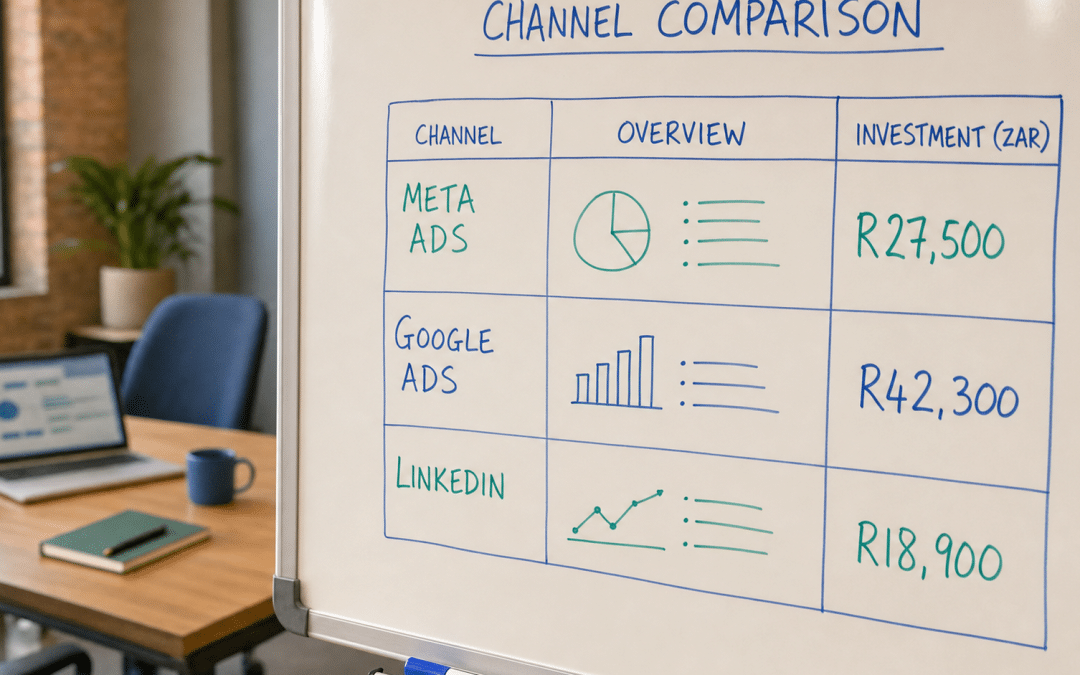
Cost per lead benchmarks in South Africa span a wide range — from under R50 per Meta lead-form submission to about R8,600 for a B2B Google Ads lead at global benchmark rates — and the channel that looks cheapest is rarely the most profitable once you match the number to your deal size and close rate. Understanding where each channel sits, and why, is the first step any SA operator should take before committing a monthly budget. The fundamentals of how CPL connects to pipeline targets are covered in our B2B lead generation service for South Africa; this post provides the benchmark data and a calculation framework to set your own ceiling.
Understanding your cost per lead by channel is the starting point — and where you set that number depends heavily on which country you are operating in. South Africa sits in a distinctly cheaper advertising environment than the US or Western Europe. The SA Digital Cost Index (SADCI) puts the average Meta cost per click at R5.12 — roughly 71% below the global average — which flows directly into lower Meta CPL figures compared with what global benchmarks suggest. Google Ads and LinkedIn Ads are harder to pin down at a country level, but global B2B datasets give a workable reference point when converted at the SADCI's index assumption of R16.42 per US dollar (Aug 2026). What follows uses every verifiable number available and is clear about where SA-specific data ends and global conversion begins.
Quick Answer
Cost per lead benchmarks in SA vary sharply by channel. SA-targeted Meta campaigns produce a median CPL of ZAR 9.11 (Superads.ai, Jul 2025–Mar 2026) though with extreme month-to-month swings; global B2B data from metadata.io's 2025 study of 153 advertisers puts Facebook at $145 (~R2,400) per B2B lead, LinkedIn at $202 (~R3,300) and Google Ads at $524 (~R8,600). The right benchmark for your business is whichever channel's CPL sits below your acceptable threshold: average deal value × gross margin × lead-to-close rate.
On this page
Not sure which channel suits your deal size?
Share your average contract value and current channels and we will identify where your CPL ceiling sits relative to what each channel typically delivers.
Get a channel assessment →How SA cost per lead benchmarks compare across channels
The cost per lead benchmarks below pair the best available SA-specific data with global B2B reference points. Where no SA dataset exists, global B2B figures from metadata.io's 2025 study (153 advertisers, $57.6 million spend, 211,000 leads) are converted at R16.42/USD — the SA Digital Cost Index calculation assumption for Aug 2026, not a live rate. Treat the converted figures as directional anchors, not SA-measured CPL.
| Channel | SA-Specific CPL | Global B2B Benchmark (converted) | Best For |
|---|---|---|---|
| Meta Ads (Facebook + Instagram) | ZAR 9.11 median† | ~R2,400 (B2B advertisers)‡ | Brand awareness, re-engagement, volume lead capture |
| Google Ads (Search) | No SA-specific dataset | ~R1,500 (Business Services)§ / ~R8,600 (B2B pure)‡ | High-intent service searches; urgent-need buyers |
| LinkedIn Ads | No SA-specific dataset | ~R3,300 (B2B advertisers)‡ | Title- and industry-filtered senior decision-makers |
| SEO / Organic (mature, 12+ months) | No SA-specific dataset | ~R3,400 (global B2B)¶ | Long-term pipeline with declining cost over time |
| Cold email outreach | No SA-specific dataset | ~R3,700 (global B2B)¶ | Specific company or title targeting; POPIA-governed |
† Superads.ai, SA-targeted Meta campaigns, all industries/campaign types, Jul 2025–Mar 2026; median of five measurement points (ZAR 3.73–178.69); high volatility — see next section. ‡ metadata.io B2B Advertising Benchmarks 2025, 153 B2B advertisers globally, $57.6M spend; converted at SADCI R16.42/USD assumption, Aug 2026. § WordStream/LocalIQ 2026, Business Services category, global; confirmed via webtonic.io Google Ads Benchmarks 2026. ¶ FirstPageSage, Jan 2022–Jun 2025 B2B study; confirmed via lead-spot.net.
The wide gap explained
Meta's low SA CPL reflects both the country's cheaper CPC environment and native lead-form conversion rates (users fill in pre-populated forms without leaving the platform). Google Ads' B2B-pure figure ($524 globally) skews high because it covers enterprise SaaS and professional services paying for extremely competitive keywords. "Business Services" on the WordStream data ($93.69, ~R1,500) is the more applicable anchor for most SA B2B businesses.
Meta Ads — what SA campaigns actually pay
SA Meta CPL is the only channel where a purpose-built, country-specific dataset exists from a large managed-spend source. Superads.ai, drawing on its large managed-spend dataset of SA accounts, tracked five measurement points between July 2025 and March 2026: ZAR 3.73 (Jul), ZAR 9.11 (Aug), ZAR 5.51 (Dec), ZAR 178.69 (Jan 2026), ZAR 20.35 (Mar). Median: ZAR 9.11. Mean: ZAR 43.48. The standard deviation of ZAR 75.80 tells you more than the median — SA Meta CPL is volatile, and January 2026's spike is not an anomaly to ignore.
Two important caveats apply before using ZAR 9.11 as your planning figure. First, the Superads.ai SA CPL dataset covers all Meta campaign types and all industries — it is not filtered to "Lead generation" objective campaigns or to B2B audiences. A consumer brand running a traffic campaign with a landing-page form will produce very different CPL dynamics to a professional services firm running Instant Forms. Second, the SA Digital Cost Index (SADCI) puts average Meta CPC at R5.12 (range R2.86–R7.39, Aug 2026) — cheap relative to global, but the per-lead cost depends heavily on how well the form or landing page converts that click. An SA digital agency's manually estimated range of R40–R250 per lead in 2026 sits closer to what optimised, intentional lead-generation campaigns actually produce.
For B2B specifically: the Meta Ads cost per lead South Africa operators experience in optimised lead-gen campaigns sits closer to the global B2B anchor. metadata.io's 2025 study of 71 Facebook B2B advertisers puts the global B2B Meta CPL at $145 (~R2,400 at the SADCI assumption). The gap between that and ZAR 9.11 is explained by audience sophistication and campaign objective — a Johannesburg IT services firm running "Leads" objective campaigns to senior buyers is not the same campaign type that produced the Superads median.
What the volatility means for planning
A January spike to ZAR 178.69 — from ZAR 5.51 in December — illustrates the scale of monthly swings SA Meta accounts can experience. Budget planning on median CPL will blow through monthly spend limits in competitive periods. As a working rule of thumb, build at least a 3× buffer when using Superads' median figure for annual budget forecasting.
Google Ads — the purchasing-intent premium
Quantifying the B2B cost per lead South Africa operators face on Google Ads is harder than on Meta — no SA-specific Google Ads CPL dataset comparable to the Superads study currently exists in published form. The best available anchor is WordStream/LocalIQ's 2026 Google Ads benchmark study (confirmed via webtonic.io), which reports a Business Services average CPL of $93.69 — approximately R1,500 at the SADCI index rate. That is the most applicable cross-industry figure for the majority of SA professional services and B2B businesses.
The gap between $93.69 (Business Services) and $524 (metadata.io's B2B-pure advertisers) reflects a real difference: metadata.io's sample skews toward companies that define a "lead" strictly — a booked meeting or a qualified form submission, not any web enquiry. B2B advertisers who pay R8,600 per lead on Google are typically selling contracts worth hundreds of thousands of Rand and can afford it. For a deeper drill into SA Google Ads CPL by industry tier, CPL is best derived from local CPC data divided by your campaign's actual conversion rate rather than applied from a global average.
The practical takeaway for SA operators: Google Ads CPL is higher than Meta CPL, but the leads carry more immediate purchase intent. Someone who searched "B2B logistics software Johannesburg" and submitted a form is further down the buying journey than someone who filled in a Meta lead form between Instagram posts. Higher CPL with a better close rate may produce a lower cost per acquired customer — which is the metric that ultimately matters.
LinkedIn — precision targeting at a price
LinkedIn's ability to filter by job title, seniority, company size, and industry makes it the default B2B channel for SA companies selling to specific decision-maker profiles. The price reflects that precision. metadata.io's 2025 dataset of 138 B2B LinkedIn advertisers — the most rigorous publicly available study — puts the global median CPL at $202, approximately R3,300 at the SADCI rate. CPM on LinkedIn was $63.19 in the same study; CPC $9.39.
A June 2026 B2B SaaS benchmark from cleverzebo.com puts the LinkedIn CPL at $125 median — lower, but flagged as directional only (single agency aggregate, undisclosed sample size). The spread between $125 and $202 reflects the heterogeneity of LinkedIn campaigns: lead-gen forms typically produce cheaper CPL than campaigns driving to landing pages, and software-focused audiences differ from, say, manufacturing procurement directors.
For SA context: LinkedIn Ads cost in South Africa is generally consistent with global pricing because LinkedIn's inventory is not as deeply discounted in emerging markets as Meta's. Expect CPC and CPL closer to global benchmarks than you would on Meta. The business case for LinkedIn is not cheap CPL — it is targeted CPL, where the R3,300 lead is a finance director at a company that fits your ICP rather than a broad audience respondent.
Working out your acceptable ceiling
Every channel benchmark in the table above is meaningless without a reference point: the maximum CPL your business can sustain and still generate a positive return. The formula is straightforward:
Maximum acceptable CPL formula
Max CPL = Average deal value × Gross margin % × Lead-to-close rate
To use it: multiply your average deal value by your gross margin and by your lead-to-close rate. The result is the highest CPL your business can sustain and still generate a positive return. Compare that ceiling to the channel benchmarks in the table above — every channel whose typical CPL sits below your ceiling is economically viable for your business.
This framework changes the channel-selection question. Using lead generation benchmarks South Africa-specific context makes a real difference here: the country's cheaper Meta CPC environment means an acceptable ceiling that rules out LinkedIn globally may still accommodate it locally once close rates are factored in. A business with a small average deal and a modest close rate will find its ceiling sits below most B2B paid channels, while a business with larger contract values and a reliable close rate will find even LinkedIn's typical CPL sits comfortably within reach. Tracking and refining your close rate by channel is part of building a reliable B2B lead generation KPI framework for South Africa. CPL without close-rate data is a cost metric, not a performance metric. Applying published cost per lead benchmarks to your own threshold is where channel selection becomes a real decision rather than a guess.
Don't optimise on CPL alone
A Meta lead at ZAR 9.11 and a LinkedIn lead at ZAR 3,300 are not comparable without close rates. Lead-spot.net's compilation of FirstPageSage's B2B study (Jan 2022–Jun 2025) reports that organic leads cost less than paid in 13 of 14 B2B industries — but organic takes 12+ months to reach volume. Your acceptable CPL ceiling decides whether you can afford to wait for organic or need paid channels to fund near-term pipeline.
Is your current CPL aligned with your deal economics?
Send us your average deal value, close rate, and active channels and we will run the ceiling formula against your real numbers — no obligation.
Check my CPL ceiling →Why SA B2B operators choose Growth Pulse Media
Growth Pulse Media was built on the back of scaling a South African ecommerce business before moving into agency work — which means the approach to paid acquisition comes from someone who has paid invoices, tracked real CPL, and managed pipeline against revenue targets, not just media plans. Dirk van Greuning's B2B lead generation service for South Africa runs on the same philosophy: every channel recommendation starts with the acceptable CPL calculation, not with what's currently being promoted by the ad platforms.
Client work is kept intentionally limited so that every campaign gets senior attention — no account handed to a junior analyst four weeks in. Campaigns are built and managed in-house across Meta Ads, Google Ads, LinkedIn, and content-led organic programmes. The SA Digital Cost Index benchmarks used in this post are part of how the practice maintains platform-current data rather than relying on global benchmarks applied without local conversion.
Four situations where this approach does not fit
Paid lead generation campaigns require setup, audience testing, and at minimum two to four weeks of optimisation before CPL stabilises. If you need a sales pipeline filled in days, paid digital is not the mechanism — this is a longer-term, system-building investment.
If your average contract is small, the CPL ceiling it implies will sit below most B2B paid channels in South Africa. Below a viable ceiling, the economics of paid lead generation do not work without exceptional conversion rates throughout the funnel.
Lead quality degrades rapidly after submission. A Meta or LinkedIn lead that sits for three days is already cold. If your sales team lacks the bandwidth to respond same-day or next-day, driving higher lead volume will not fix the problem — it will add cost while the pipeline stalls.
LinkedIn targeting by title, seniority, and company size is only as good as your ICP. Meta audience selection for B2B is even more dependent on a clear profile to anchor lookalike audiences against. Campaigns built without a defined ICP produce volume, not qualified pipeline — and CPL ceases to be a meaningful measure of anything.
Want to know if B2B lead generation makes sense for your budget?
Book a no-obligation fit assessment and we will tell you honestly whether your deal economics support paid channel investment — and which channel to start with.
Book a fit assessment →Frequently asked questions
What is a good cost per lead in South Africa for B2B?
Published cost per lead benchmarks are a starting point, not a verdict — the right number for your business depends on deal value, gross margin, and lead-to-close rate. A B2B software company with high-value annual contracts can sustain a far higher cost per lead and still profit; a training provider selling low-priced packages cannot. As a directional anchor, global B2B benchmarks from metadata.io's 2025 study (153 advertisers, $57.6M spend) put Facebook at ~R2,400, LinkedIn at ~R3,300, and Google Ads at ~R8,600 when converted at R16.42/USD. Use the formula (deal value × margin × close rate) to set your own ceiling before comparing channels.
Why is LinkedIn cost per lead so much higher than Meta in South Africa?
LinkedIn charges a premium because it offers something Meta cannot: precise filtering by job title, seniority, company size, and industry. Meta audiences are broader and cheaper — the SA Digital Cost Index (SADCI) puts average Meta CPC at R5.12 versus LinkedIn's global B2B CPC of ~$9.39 (~R154 at the SADCI rate). The higher LinkedIn CPL often comes with better lead quality for B2B roles: the person submitting a LinkedIn lead-gen form is more likely to be the actual decision-maker, which improves close rate and lowers cost per acquired customer even when CPL is higher upfront.
How do I calculate my maximum acceptable cost per lead?
Multiply your average deal value by your gross margin percentage, then multiply by your lead-to-close rate. The result is the most you can pay per lead and still break even on acquisition. Any channel that delivers qualified leads consistently below that threshold is economically viable for your business. Track close rates by source — channels that look expensive on CPL may perform differently once close rate is factored in.
Which B2B channel has the lowest cost per lead in South Africa?
On raw CPL, Meta Ads produce the lowest numbers in the SA market — Superads.ai's SA dataset shows a median of ZAR 9.11 across all campaign types, though with significant volatility and no B2B-only filter applied. For B2B-qualified leads, SEO and organic content tend to produce the lowest long-run CPL (FirstPageSage's B2B study across Jan 2022–Jun 2025 puts it at $206 globally) but require 12 months or more before volume materialises. In the near term, well-structured Google Ads Search campaigns reach buyers who are already searching for a B2B solution, so judge them on lead quality as well as headline CPL.
Does POPIA apply to leads collected through paid digital campaigns in South Africa?
Yes. Under section 69 of POPIA, electronic follow-up communications (email, SMS) to new B2B prospects require their consent — collected at the point of form submission. POPIA also applies to juristic persons (companies), so there is no general B2B exemption from the consent requirement for electronic marketing. Lead forms on Meta and LinkedIn should include clear consent language for follow-up contact. Telephone follow-up sits under different POPIA grounds and may have more flexibility, but electronic channels require documented consent at collection.
Ready to build a B2B pipeline with measurable CPL?
Growth Pulse Media runs B2B lead generation across Meta, Google, and LinkedIn — all work executed in-house by senior practitioners who understand SA platform costs, SADCI benchmarks, and what deal economics a campaign needs to support. We work with a limited client roster so every account gets the attention it needs.
No obligation — we will get back to you within 24 hours.
Start the conversation →