
 Add to Preferred Sources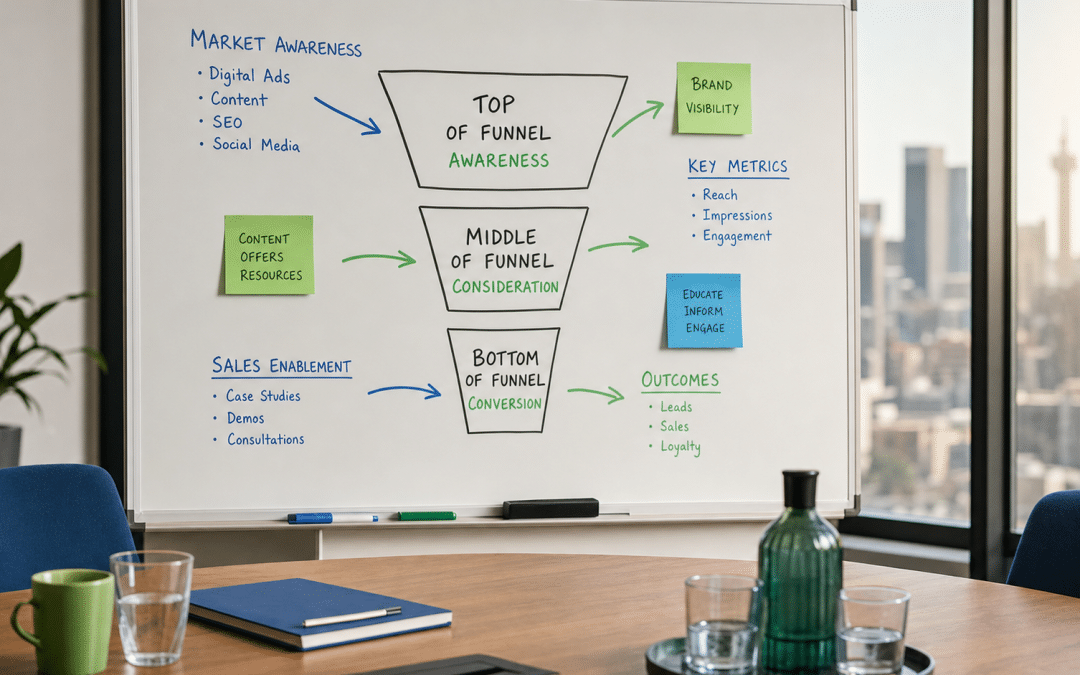
B2B SEO is the practice of optimising a business's website to rank on Google and other search engines for the queries that commercial buyers type when they are evaluating suppliers — and in South Africa, those queries look very different from the consumer searches that most SEO advice is built around. According to GPM's SA SEO pillar, Google holds 91.94% of the South African search market (StatCounter, August 2026), making search engine visibility the highest-leverage organic channel available to B2B operators in this market.
The challenge is that business to business SEO runs on different logic from ecommerce or local service optimisation. Keyword volumes are lower, sales cycles run from 3 to 18 months, and the average B2B buying committee involves 6 to 10 people — each running their own searches at different stages of the decision. A tactic calibrated for a consumer who makes a purchase decision in minutes will systematically under-serve a procurement team that spends months evaluating vendors. This b2b seo guide lays out what to do instead.
Quick Answer
B2B SEO is the discipline of ranking on search engines for the queries that business buyers use when researching suppliers, evaluating options, and building internal business cases. It differs from B2C SEO in three structural ways: lower keyword volumes with higher commercial value per query, longer buying cycles that require content at multiple funnel stages, and multi-stakeholder intent (procurement, technical, finance, and C-suite all search differently). For South African operators, local regulatory context — SARS integration requirements, BBBEE compliance, sector-specific supplier ecosystems — shapes the actual search phrases that matter most. Organic search reaches buyers at the moment they are actively looking, so the enquiry arrives with the need already declared rather than having to be created — which is the whole difference between a search-led pipeline and an interruptive one. Widely circulated close-rate comparisons put numbers on that gap, but they trace back to a 2012 blog post with no study behind it, so treat the direction as reliable and the figures as folklore. It remains the highest-value lead generation channel available for most SA professional services and B2B technology companies.
In This Guide
- Why B2B SEO works differently from B2C
- B2B keyword research in South Africa
- Content strategy across the full buying funnel
- Technical SEO for B2B websites
- Authority building and link strategy
- Measuring B2B organic search performance
- Why SA businesses choose Growth Pulse Media
- Who this approach is NOT for
- Frequently asked questions
Not Sure Where Your Organic Pipeline Is Breaking Down?
Send us your site URL and we'll identify the top three structural gaps holding back your B2B organic leads — with specific fixes, not a list of tools to subscribe to.
Get Your Free B2B SEO AssessmentWhy B2B SEO Works Differently From Consumer SEO
The structural difference in business-to-business SEO is not complexity — it is intent. A consumer buying running shoes knows what they want and searches for it directly. A financial director evaluating an ERP system for a Johannesburg manufacturer is not typing "ERP software" into Google. They are typing "ERP system for South African manufacturing companies," "SARS e-filing integration ERP," or "ERP software BBBEE compliance." Each query reflects a specific concern, a specific stakeholder, and a specific stage in a multi-month evaluation process.
Three structural facts define the B2B search landscape and shape everything that follows:
| Factor | B2C SEO | B2B SEO |
|---|---|---|
| Keyword volumes | Hundreds to millions of monthly searches | Often 50–500 monthly SA searches — but each search represents a potential deal, not a basket |
| Decision speed | Minutes to days | 3–18 months; Forrester (2025) finds 61% of the journey completes before vendor contact |
| Number of searchers | One buyer | 6–10 committee members, each with different search queries |
| Conversion event | Purchase | Demo request, RFQ, discovery call, or downloaded brief |
| Content that works | Product pages, reviews, category pages | Thought leadership, technical guides, comparison content, regulatory explainers |
The business case for investing in organic search is strong even at low SA volumes. Organic leads arrive with intent already established: the buyer came looking for the answer rather than being interrupted with it, which is why a search-led pipeline needs less persuasion per deal. The specific percentages you will see quoted for this gap circulate widely but have no traceable study behind them, so we do not repeat them here. What holds up is the mechanism, and it means a single well-ranked page targeting a high-value SA query may generate higher-quality pipeline than a cold outreach programme running in parallel — at a fraction of the ongoing cost.
Key Takeaway
Do not dismiss a B2B keyword because it shows 80 monthly searches in South Africa. Evaluate it by commercial value: 80 searches per month that represent active procurement processes in your target sector can be an extraordinary pipeline asset. Volume is a denominator, not the point.
B2B Keyword Research in South Africa: Start With Intent, Not Volume
Effective keyword research for South African B2B companies begins with the Ideal Customer Profile, not a keyword tool — because the queries that matter most are the ones a specific buyer persona types at a specific stage of their evaluation, not the queries with the highest search volume in your category.
The practical framework has four layers:
Layer 1 — Problem-aware queries (top of funnel)
These are searches a senior manager or director runs when they recognise a business problem but have not yet named a solution category. In South Africa, this layer includes regulatory and compliance angles that are invisible to global competitors. Examples: "how to manage supplier compliance BBBEE," "payroll software SARS integration South Africa," "construction ERP for CIDB-registered firms." These keywords rarely appear in global keyword tools at meaningful volumes — but they are real searches from real decision-makers.
Layer 2 — Solution-aware queries (middle of funnel)
The buyer now knows the category and is evaluating options: "best fleet management software South Africa," "CRM for professional services Johannesburg," "HR software comparison South Africa 2026." This is where comparison content, side-by-side breakdowns, and "X alternatives" pages compete for the same searcher.
Layer 3 — Vendor-aware queries (bottom of funnel)
The buyer has a shortlist and is stress-testing it: "[Vendor name] vs [Competitor] South Africa," "[Vendor name] implementation timeline," "[Vendor name] POPIA compliance." Your own branded queries belong here too — a competitor can rank for your brand name if you are not defending it with content.
Layer 4 — Stakeholder-specific queries
In a 6–10 person buying committee, procurement searches for pricing and contract terms, IT searches for integration specs and security, and the CFO searches for ROI models and total cost of ownership. Mapping content to each persona's likely queries — not just the primary decision-maker — is the structural advantage most SA B2B companies leave unexploited.
SA Search Intent Context
South African B2B buyers append local regulatory and compliance terms to otherwise generic queries. SARS, BBBEE, CIDB, POPIA, NCA, and sector-specific bodies (FSCA, SACPCMP, ECSA) all appear in real B2B search phrases. Content that addresses these local compliance angles ranks for queries that global competitors — and local competitors using generic templates — simply cannot target. If you need help building content around those compliance queries, our content SEO service is founder-led and runs on a flat monthly retainer agreed before work begins.
Content Strategy for the Full B2B Buying Funnel
A complete B2B SEO strategy covers three funnel stages, each requiring different formats and different calls-to-action.
| Funnel Stage | Keyword Intent | Content Format | SA Search Volume Profile | Conversion Action |
|---|---|---|---|---|
| Top of funnel | Informational — problem recognition | Educational guides, industry explainers, regulatory primers | 50–300/month SA; higher if compliance angle is specific to a sector | Newsletter signup, gated guide download |
| Middle of funnel | Commercial investigation — option evaluation | Comparison pages, "best X for Y" lists, case studies (sourced), feature breakdowns | 20–150/month SA; multiple related queries cluster together | Demo request, contact form, free trial |
| Bottom of funnel | Transactional — vendor selection | Pricing pages, implementation guides, FAQ pages, proposal templates | 10–80/month SA — but these are the highest-intent searches on the site | Direct enquiry, quote request, discovery call |
The critical structural choice in B2B content is NOT to focus all effort on top-of-funnel traffic. Traffic from broad educational content rarely converts to pipeline without a coherent middle-funnel layer that catches buyers once they have named the category. Many SA B2B companies publish thought leadership continuously and then wonder why their inquiry forms stay quiet — the middle funnel is missing.
On content depth: research consistently shows that long-form content earns 77.2% more backlinks than shorter content (SEO Sherpa, aggregated from multiple studies), and original research earns 42.2% more backlinks. For B2B companies in South Africa, commissioning or publishing proprietary data — a salary benchmarking survey, sector-specific cost index, compliance audit checklist — is one of the highest-ROI b2b seo content investments available, both for rankings and for thought leadership positioning. This is also how your content gets cited by AI systems like ChatGPT and Perplexity, extending reach beyond classic search.
Key Takeaway
Map every content piece to a funnel stage before you write it. Ask: who searches this query, when in their buying process, and what do they need to do next? If you cannot answer those three questions, the content brief is not ready yet.
Unsure Which Funnel Stage Your Content Is Actually Covering?
Share your current content list and we'll show you where the gaps are — which stage is overserved, which is empty, and what pages would most improve your organic pipeline.
Request a Content Gap ReviewTechnical SEO for B2B Websites
Technical search engine optimisation for B2B companies covers the same fundamentals as any website — crawlability, indexation, page speed, mobile performance, and structured data — but the common failure modes look different because B2B sites typically have more complex architectures: product catalogues with thousands of variants, gated resource libraries, multi-language or multi-region setups, and legacy CMS platforms that create crawl inefficiencies.
Four areas that routinely hold back SA B2B organic performance:
- Indexation of the wrong pages. Service pages, case study pages, and sector-specific landing pages are often the highest-value pages on a B2B site. If your CMS is accidentally preventing Google from indexing them — through a meta robots noindex tag on the wrong template, or via orphaned URLs that no internal link points to — the rest of your effort is wasted. Start with a crawl audit using Screaming Frog or a similar tool.
- Page speed on mobile. South Africa's mobile infrastructure creates real speed constraints for buyers researching on LTE or lower. A B2B website that loads in under three seconds on a mid-tier Android device is a competitive advantage, not a baseline. Core Web Vitals — Largest Contentful Paint, Cumulative Layout Shift, Interaction to Next Paint — are the metrics to optimise against.
- Schema markup for professional services. Adding structured data (Organization schema, FAQPage schema, Service schema) helps Google understand your business context and increases the likelihood of enhanced results in search. For B2B service businesses in South Africa, this is one of the simplest technical improvements with measurable impact on click-through rates from search.
- Internal link architecture. Your highest-authority pages (typically the homepage and key service pages) need to pass ranking signals to your commercial content through deliberate internal linking. Many B2B sites have strong service pages that are islands — no links in from blog posts or resource pages. See how to improve crawlability and how to identify and fix orphan pages for the technical process.
For a full technical foundation walkthrough, Google's SEO Starter Guide remains the authoritative reference on what Google actually needs from a site structure — recommended reading before any site architecture decision.
Authority Building and Link Strategy for B2B Companies
Link building for business-to-business companies in South Africa works best when treated as a by-product of genuine thought leadership and industry participation — not as an outreach programme that asks strangers for backlinks. The structural reason: the publications and directories that SA B2B decision-makers actually read (industry body sites, trade publications, sector-specific directories, professional association registers) are the same sites that carry authority signals for Google.
The practical sequence for building links in the SA B2B context:
- Create genuinely citable content. Original data, sector benchmarks, regulatory guides, and comprehensive comparison resources attract links without outreach. For South African topics with limited existing coverage, a well-researched piece on something like "POPIA compliance for SMEs: cost and timeline" fills a gap that journalists and consultants will reference.
- Appear in the industry publications your buyers read. Guest articles, expert commentary, and contributed research in SA trade media (sector-specific digital publications, the major business news outlets) build both referral traffic and domain authority simultaneously.
- Claim and optimise directory listings. Professional and industry body directories in South Africa — sector-specific supplier databases, chambers of commerce, SANAS-accredited body registers — are legitimate and often high-authority link sources that many companies neglect.
- Earn coverage through research publication. Original research earns 42.2% more backlinks than standard content (SEO Sherpa, aggregated across multiple studies). A well-designed survey of SA decision-makers in your sector, published as a downloadable report, can generate media coverage and backlinks from publishers who would not respond to a generic outreach email.
For a deeper dive on building links through original assets, see how to create linkable assets — the same principles apply to B2B sectors, with the audience being trade journalists and procurement influencers rather than consumer bloggers.
Measuring B2B Organic Search Performance
The most common measurement mistake in B2B organic search is optimising for traffic when the business goal is pipeline. Traffic is a leading indicator, not a result — and in B2B SEO with its characteristically low search volumes, traffic can look flat while pipeline-generating keyword rankings improve significantly.
The metrics that matter for a B2B organic programme:
| Metric | What It Tells You | What It Does Not Tell You |
|---|---|---|
| Organic sessions | Whether your indexed pages are attracting clicks from search | Whether those clicks are from your ICP or vanity traffic |
| Keyword rankings | Visibility for target queries at each funnel stage | Revenue contribution; rankings can improve while commercial traffic stays flat |
| Organic-attributed leads / enquiries | The actual pipeline impact of search — your primary B2B metric | Lead quality without a CRM qualification layer |
| Organic-attributed pipeline value | Revenue impact; what the board cares about | Attribution certainty in long multi-touch cycles |
| Share of voice for target keyword set | Competitive position relative to specific rivals | Total addressable market size; SoV can look dominant in a small keyword set |
The minimum viable measurement stack for B2B SEO South Africa programmes: Google Search Console for keyword-level visibility data, GA4 with conversion events (form submissions, demo requests) properly configured, and a CRM field capturing lead source at the point of entry. Without the CRM layer, you cannot close the loop from organic session to signed contract — and the board tends to prioritise channels they can attribute directly.
On timelines: organic search is a compounding asset. The first three to six months of a well-structured programme typically produce ranking improvements and some early-stage traffic. Commercial pipeline impact becomes measurable from month six to twelve. See how long SEO takes in South Africa for the realistic sequencing and why compressing the timeline by cutting foundational work creates expensive problems later.
Key Takeaway
Report organic leads, not organic sessions, to your leadership team. Sessions are inputs; pipeline is the output. A B2B organic programme that generates 200 sessions per month and 8 qualified leads is a stronger commercial outcome than one generating 2,000 sessions and 2 leads — by a wide margin on every metric that actually matters.
Why South African B2B Companies Choose Growth Pulse Media
Growth Pulse Media was built by someone who ran a South African business before running an agency — meaning the perspective on B2B organic search comes from paying the invoices, not just writing the reports. Founder Dirk van Greuning translates his experience scaling South African operations into high-velocity organic strategies for B2B and professional services companies that need pipeline, not pageviews.
The practical differences in how we work:
- We work in-house, with a limited client load. Every engagement gets senior attention from week one — no account managers passing off to junior writers three months in. The strategic thinking and execution stay consistent throughout.
- SA-specific search intelligence. We build keyword strategy around real South African buying behaviour — the SARS integration queries, the BBBEE compliance searches, the sector-specific supplier evaluation phrases that global agencies overlook and local template shops cannot research properly.
- Pipeline-first measurement. We set up measurement from the outset to track organic-attributed leads and pipeline value, not sessions. If a keyword cluster is not converting to enquiries, we know within the first 90 days and adjust — we do not wait for a six-month review to flag the problem.
- Full-funnel content architecture. We build content across all three funnel stages simultaneously — not just top-of-funnel content that attracts visitors who never convert. The goal is a self-reinforcing content ecosystem that generates qualified pipeline as it compounds over time.
If you want to explore whether our approach fits your growth objectives, our SEO services for South African businesses page has the full picture on how we structure engagements and what realistic outcomes look like.
Who This Approach Is NOT Right For
Ready to Build an Organic B2B Pipeline in South Africa?
Tell us about your current organic performance and target accounts — we'll assess whether an SEO-led strategy fits your growth timeline and what realistic outcomes look like for your sector.
Book a Free Strategy CallFrequently Asked Questions
How long does B2B SEO take to generate leads in South Africa?
Most SA B2B organic programmes produce measurable ranking improvements within 3–6 months for targeted keyword clusters. Organic-attributed leads become consistently trackable from month 6–9, and the programme reaches full commercial momentum — compounding traffic, consistent pipeline — typically between 12 and 18 months from a standing start. Programmes that launch with strong technical foundations and clear funnel-stage content tend to reach that momentum faster than those that address technical issues reactively. The realistic expectation: organic is a 12-month investment before it becomes a reliable lead source, and a multi-year compounding asset after that.
What keywords should a South African B2B company target first?
Start with bottom-of-funnel, high-intent queries in your specific sector — even if they have low monthly search volumes. A page ranking for a specific sector query that generates one qualified lead per month at a high annual contract value is a stronger commercial asset than a top-of-funnel article attracting 500 sessions and no enquiries. Once the commercial keyword layer is in place, build upward through the funnel with content that captures buyers earlier in their evaluation journey. Prioritise SA-specific angles — local regulatory requirements, sector body compliance, SARS integrations — because these queries have less competition and more specific intent than generic category terms.
How does B2B SEO differ from building links for an ecommerce store?
Ecommerce link building targets product categories, brand mentions, and review sites that reach consumer audiences. B2B link building targets industry publications, professional association directories, trade media, and sector-specific databases — the sources that the decision-makers and procurement teams in your market actually read. The acquisition methods differ too: B2B links more often come from original research, thought leadership contributions, and industry body registrations rather than outreach campaigns targeting consumer bloggers. The authority signals Google draws from these sources are structurally different because they reflect genuine industry standing, not just link volume.
Should a South African B2B company focus on Google or LinkedIn for organic growth?
Google and LinkedIn serve different organic roles and are not directly comparable. Google captures active demand — buyers already searching for a category, vendor, or specific feature. LinkedIn builds brand familiarity with buyers before they have articulated a need. The most effective SA programmes run both: Google organic captures in-market buyers at the right moment; LinkedIn shapes the preference of buyers who will run those searches months later.
What content format works best for B2B SEO in South Africa?
The content format depends entirely on funnel stage. Top-of-funnel content that works for SA B2B buyers includes comprehensive guides to local regulatory topics — POPIA implementation, BBBEE procurement, sector compliance requirements — that attract organic traffic and establish credibility. Middle-of-funnel content that converts is comparison-based: feature breakdown tables and sourced case studies. Bottom-of-funnel content that closes deals includes pricing pages, implementation timelines, and FAQ pages that address the specific objections procurement teams raise. All formats benefit from SA-specific context — the closer the content is to a real South African buyer's situation, the better it performs.
How much does B2B SEO cost in South Africa?
B2B SEO programme costs in South Africa vary by scope, competitive intensity of the target keyword set, and the volume of content required. An organic programme covering technical foundations, monthly content production, and link building typically runs as a multi-month retained engagement rather than a one-time project, because the compounding nature of organic search rewards consistent investment over time. For a detailed cost breakdown by component, the SEO pricing guide for South Africa covers how agencies structure these engagements.
Build Your B2B Organic Pipeline — Not Just Your Traffic
Growth Pulse Media runs organic search programmes for South African B2B and professional services companies that are measured on pipeline, not pageviews. We build full-funnel content architectures, fix the technical gaps holding back your rankings, and develop the authority signals that put you in front of buyers before they reach your competitors. All work is executed in-house. No obligation — we'll get back to you within 24 hours.
Start the Conversation