
 Add to Preferred Sources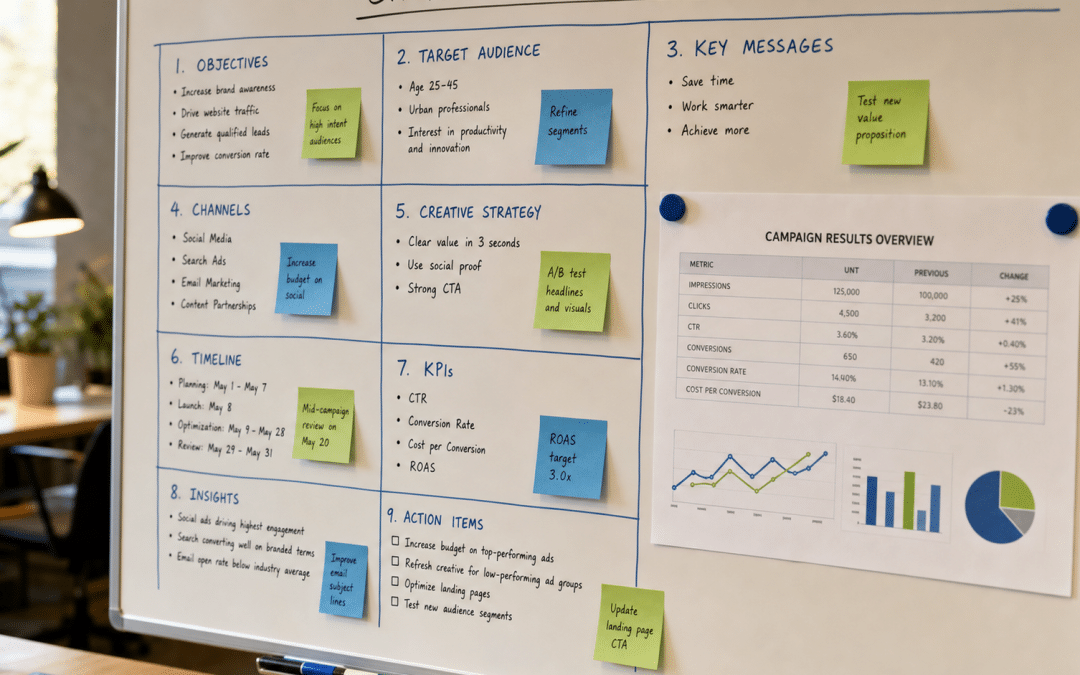
A marketing campaign post mortem template is a structured document that captures what you planned, what actually happened, and what changes before the next brief goes out — and as part of your broader digital strategy, it is the review step most South African businesses either skip entirely or replace with a verbal debrief that no one records.
That skip is expensive: a TrustList audit published in partnership with IAB South Africa found that roughly 40% of programmatic ad spend in South Africa is wasted, compromised, or funding non-compliant inventory — a systemic problem that structured campaign reviews can begin to correct at the account level.
This guide gives you a working post mortem template you can run in under two hours, calibrated to the channels South African businesses actually spend on: Meta, Google Ads, WhatsApp, and email. If you have tracked your marketing goals vs KPIs during the campaign, you already have most of the data you need.
Quick Answer
A marketing campaign post mortem template is a structured review document completed after a campaign ends. It captures the original brief, actual results by channel, what worked and why, what failed and why, and specific changes to apply next time. Aim to run it within one week of campaign end; most practitioners set a hard cut-off at two weeks, after which contextual memory degrades faster than the data. The template below walks through every section with South Africa-specific context.
Jump to a Section
What Is a Campaign Post Mortem?
Why SA Campaigns Need a Structured Review
The Post Mortem Template: Section by Section
When and How to Run the Session
Not Sure What Your Last Campaign Actually Proved?
Send us your campaign data and we'll show you which channels are earning their spend and which are running on assumption.
Get a Campaign ReviewWhat Is a Marketing Campaign Post Mortem?
A campaign post mortem is a structured debrief held after a campaign concludes. It documents the original intent, the resources committed, the actual results by channel, and the specific decisions that should change before the next campaign launches. The term "post mortem" is borrowed from incident management — the idea that every significant event, whether a success or a failure, contains information that should change how you operate next time.
The distinction that separates a useful post mortem from a box-ticking exercise is the final question: Did this review extract an insight that will change a future decision? If the only output is a slide deck confirming that you hit (or missed) your targets, the review has produced administrative record-keeping, not strategic intelligence.
The Four Questions Every Post Mortem Must Answer
Intent: What were we trying to achieve, and was that the right goal?
Input: What did we spend — including team time, not just media budget?
Output: What did we actually get, by channel, against target?
Insight: What specific decisions will be different because of this review?
Why South African Campaigns Need a Structured Review
South Africa's digital advertising market reached R17.7 billion in the 2023 fiscal year — 21.5% year-on-year growth, and the most recently published audited figures from IAB South Africa — with paid search accounting for 73.3% of that total. When campaigns are structured, measured, and reviewed, that concentration in a few high-intent channels is an advantage. When they are not, budget accumulates quietly in the wrong places.
A TrustList pilot audit conducted with IAB South Africa found that roughly 40% of programmatic spend across the brands studied was wasted, compromised, or funding non-compliant inventory. Across finance, consumer goods, and mobile telephony, researchers identified approximately R600 million in annual spend flowing to substandard inventory — a figure that, if representative of the broader SA programmatic market, points to a governance failure well within the reach of account-level post-campaign review.
The three failure patterns that show up most consistently in SA campaign reviews are: targeting set at launch that was never narrowed as data accumulated; creative fatigue that went unactioned because no one owned the decision mid-flight; and channel budgets that remained static even when one channel was clearly outperforming another.
A structured post mortem surfaces all three — and routes the fix into the next brief rather than leaving it as a verbal debrief that no one records.
SA context note: South Africa is a mobile-first market — the majority of users access the internet via mobile data, which means campaign timing relative to peak mobile usage hours affects results differently than desktop-primary markets. SA internet penetration data for 2026 shows the user base skewing heavily toward mobile. Load-shedding schedules also shift online behaviour — this is worth a one-line note in your timing section if it affected your campaign window.
The Marketing Campaign Post Mortem Template: Section by Section
Use this review framework as a shared document owned by the campaign lead. Each section is labelled with the information it captures and the questions it answers.
Section 1 — Campaign Brief (The Plan)
Document the original intent before touching the results. This section is completed from the brief, not from memory.
| Field | Record Here |
|---|---|
| Campaign name | |
| Campaign owner | |
| Start date / End date | |
| Total approved budget (Rand) | |
| Primary objective (one sentence) | |
| Target audience segment | |
| Channels used | |
| Primary KPI and target | |
| Secondary KPIs |
Section 2 — Headline Results vs. Plan
Compare what you planned against what happened. Include a variance column and a one-line reason for each significant gap. Variance without explanation is noise; explanation without variance is spin.
| Metric | Target | Actual | Variance | Reason |
|---|---|---|---|---|
| Total spend (R) | ||||
| Impressions / Reach | ||||
| Clicks / CTR | ||||
| Conversions (leads / sales) | ||||
| Cost per lead / Cost per sale (R) | ||||
| ROAS (for ecommerce) | ||||
| Revenue attributed (R) |
On ROAS targets: Global published averages for Google Ads and Meta vary widely by industry, geography, and data source — they are not reliable SA benchmarks. South African audiences, pricing, and platform costs differ materially from global composites. Track your own Rand-denominated ROAS across three to four successive campaigns; your own data becomes a more defensible benchmark than any external figure.
Section 3 — Channel-by-Channel Breakdown
Fill one row per channel. If a channel received no spend, record that explicitly — silence in a table column often means the channel was forgotten rather than omitted.
| Channel | Spend (R) | Conversions | CPA / ROAS | Notes |
|---|---|---|---|---|
| Meta (Facebook/Instagram) | ||||
| Google Ads (Search) | ||||
| Google Ads (Performance Max) | ||||
| WhatsApp (broadcast / API) | ||||
| Email marketing | ||||
| Organic / SEO | ||||
| Other (specify) |
Check your GA4 channel groupings before populating this table — default attribution in most SA accounts over-credits last-touch paid channels and under-credits email and organic by a meaningful margin.
Section 4 — What Worked
Record specific decisions that produced above-target results. The standard is: "Audience segment X on channel Y produced a cost per lead of R[amount], against a target of R[amount]." Vague positives ("the creative was good") belong in conversation, not in a document that shapes next quarter's brief.
Section 5 — What Didn't Work
Apply the same specificity standard. Each entry should name the decision, the result, and the working hypothesis for why it underperformed. If you do not know why, say so — "hypothesis TBC, requires A/B test in next campaign" is a legitimate entry and more useful than a confident-sounding guess.
For SA campaigns, common post mortem findings in this section include: Google Ads search terms reports containing irrelevant queries that drained budget before negative keywords were added; Meta ad sets left running past the point of audience saturation; and WhatsApp broadcasts sent to unsegmented lists, producing low engagement and POPIA risk on consent records.
Section 6 — Budget Actuals
Compare planned versus actual spend at channel level. Also record internal effort as an honest cost — time is spend. A campaign that hit its lead target but required 60 hours of unplanned team time at full overhead cost may have been loss-making at the true cost base.
Use the marketing budget review checklist to cross-reference spend categories if your accounts contain multiple nested campaigns.
Section 7 — Lessons Learned and Next-Campaign Actions
This is the only section that matters for improving results. Write it as a numbered action list, not as a reflection paragraph. Each item should be ownable by a specific person and executable before the next campaign launches.
- Add 40 negative keywords to Google Ads Search campaigns before next go-live. Owner: [name]. Deadline: [date].
- Segment WhatsApp broadcast list by purchase history before sending offers. Owner: [name]. Deadline: [date].
- Test two creative concepts at campaign launch rather than one to allow early rotation. Owner: [name]. Deadline: [date].
The POPIA Note
If your campaign collected any personal data — lead forms, WhatsApp opt-ins, email sign-ups — include a compliance row in Section 7. Record which data was collected, under which lawful basis (consent, legitimate interest, or contractual necessity under POPIA's s11), how it is stored, and the retention period. POPIA compliance is not just a legal requirement — an auditable consent trail also protects list quality over time.
When and How to Run the Post Mortem Session
Aim to run the post mortem within one week of campaign end. Most practitioners draw a hard cut-off at two weeks — beyond that, the decisions that explain variances blur into collective assumption faster than the data itself degrades. The South African digital advertising market moves quickly enough that a six-week debrief produces lessons that are already outdated.
Preparation (before the session): The campaign owner pulls all data and populates Sections 1–3 before anyone sits down. Do not populate tables in a group discussion — it wastes time and introduces consensus bias into what should be independent data reads.
Session structure (as a working guide, 90 minutes): Fifteen minutes reviewing Sections 1–3 for shared understanding, thirty minutes building Sections 4–5 as a group, thirty minutes building Section 7 as specific action items with owners and deadlines, and fifteen minutes confirming the top three changes that will show up in the next brief.
Invitees: Campaign owner, channel owners (paid media, email, SEO), creative lead, and at least one commercial stakeholder (sales lead or client). Exclude people who were not involved in execution — large post mortems become presentation events rather than working sessions.
Want a Second Set of Eyes on Your Campaign Data?
Tell us which campaign you ran, what your KPIs were, and what you think went wrong — we'll give you a straight read on the numbers within 48 hours.
Get Your Campaign AssessedFive Review Mistakes That Waste the Whole Exercise
Running a structured debrief is better than skipping it entirely — but several common patterns undermine the value even when the process is in place. Here are the ones that show up most consistently across South African businesses.
Waiting too long. A debrief run three weeks after wrap-up recycles talking points, not decisions. The media buyer has moved on to the next account. The creative director cannot recall why that ad set was paused. The data is still there; the context that explains it is not. Timing is the single biggest variable in how useful the exercise turns out to be.
Populating data during the session. If the team is pulling numbers in real time while the group watches, the session becomes a data entry exercise rather than a strategic discussion. All tables should be complete before anyone enters the room. The session is for interpretation, disagreement, and decisions — not for screen-sharing dashboards and waiting for GA4 to load.
Omitting internal time cost. Section 6 of the template asks you to record team time as well as media spend — because a campaign that hit its CPL target but consumed significant unplanned hours in creative revisions may have been unprofitable at the true cost base. This row is frequently skipped; without it, the brief next time repeats the same structural assumptions.
No named action owners. Lessons documented as observations rather than instructions do not change anything. "We should test narrower audiences" is not actionable. "Use a tight lookalike audience for the first two weeks of the next run, then broaden once the algorithm has data — owner: [name], confirmed by [date]" is. The debrief's usefulness is proportional to how many items in Section 7 have a person's name next to them.
Skipping the review on campaigns that hit their numbers. Successful runs are the best source of replicable insight. When a campaign exceeds its conversion target, the review should document exactly which decisions drove the result and which audience, creative, and timing choices are worth repeating. A team that only debriefs failures never builds a deliberate advantage — they just stop making the same mistakes twice.
Why South African Businesses Choose Growth Pulse Media
Dirk built and scaled a South African e-commerce business before founding GPM. That means when we run a campaign post mortem, we are not applying a global framework to local data — we are reading a Google Ads account that runs in Rand, on South African search volumes, against SA audience pools that behave differently from what the international benchmarks assume.
GPM works across Meta, Google Ads, WhatsApp Business API, Klaviyo, and Omnisend — the channels that make up the majority of South African digital campaign spend. Our digital strategy service includes a structured campaign review process as a standard component, not an add-on.
When a campaign ends, we produce a post mortem document that goes to the client before the next brief is built — because a brief grounded in real post mortem findings is more specific and accountable than one built on memory and optimism.
We keep a limited active client load by design. That means senior attention on your account: someone who was in the campaign manager during execution reads the post mortem data, not someone reading it for the first time in a handover document.
Who This Post Mortem Process Is NOT For
Ready to Build a Campaign Framework That Actually Improves Over Time?
Send us your brief and your last campaign's data — we'll audit the structure and show you where the review process needs to start before the next spend goes out.
Request a Campaign AuditFrequently Asked Questions
What is a marketing campaign post mortem template?
A marketing campaign post mortem template is a structured document completed after a campaign ends. It records what was planned, what actually happened by channel and metric, what specific decisions produced the results, and what changes before the next campaign launches. The template is different from a campaign report: reports communicate results to stakeholders; post mortems extract decisions for the team that runs the next campaign.
How long after a campaign should you run the post mortem?
Aim for within one week of campaign end; most practitioners set a hard cut-off at two weeks — beyond that, contextual memory degrades faster than the data. The specific decisions that explain variances — why a budget was reallocated mid-flight, why a creative was paused, why targeting was narrowed — begin to blur into consensus after two weeks. Schedule the debrief session on your calendar the same day the campaign wraps, even if the session itself is a few days away.
What sections should a campaign post mortem include?
A complete post mortem review covers: the original brief (objective, budget, audience, channels, KPIs); headline results vs. targets with variance explanations; a channel-by-channel breakdown of spend and output; specific findings about what worked and what did not; budget actuals including internal team time; and a numbered action list with owners and deadlines for changes before the next campaign. Skipping the action list turns the review into a record rather than a tool.
How is a post mortem different from a campaign report?
A campaign report communicates results to stakeholders — it answers 'what happened?' A post mortem is a working document for the team that ran the campaign — it answers 'what decisions should change?' The audience, the tone, and the output differ. A campaign report may go to a board or a client; a post mortem is an internal tool. In practice, the analysis that feeds a good post mortem also improves the quality of the report, because it forces specificity about why results landed where they did.
Should a campaign post mortem cover successful campaigns or only failed ones?
Both, without exception. A post mortem on a campaign that hit every target is more valuable than it sounds — it forces the question of whether the targets were ambitious enough, whether the result was repeatable, and which specific decisions drove the outperformance. Campaigns that succeed without a review leave the team unsure which decisions to repeat. Campaigns that fail without a review leave the team repeating the decisions that caused the failure.
Run Better Campaigns. Start With the Review.
GPM runs structured campaign post mortems as part of every active engagement — Meta, Google Ads, WhatsApp, and email, in Rand, against South African benchmarks. No obligation — we will get back to you within 24 hours.
Talk to a Strategist