
 Add to Preferred Sources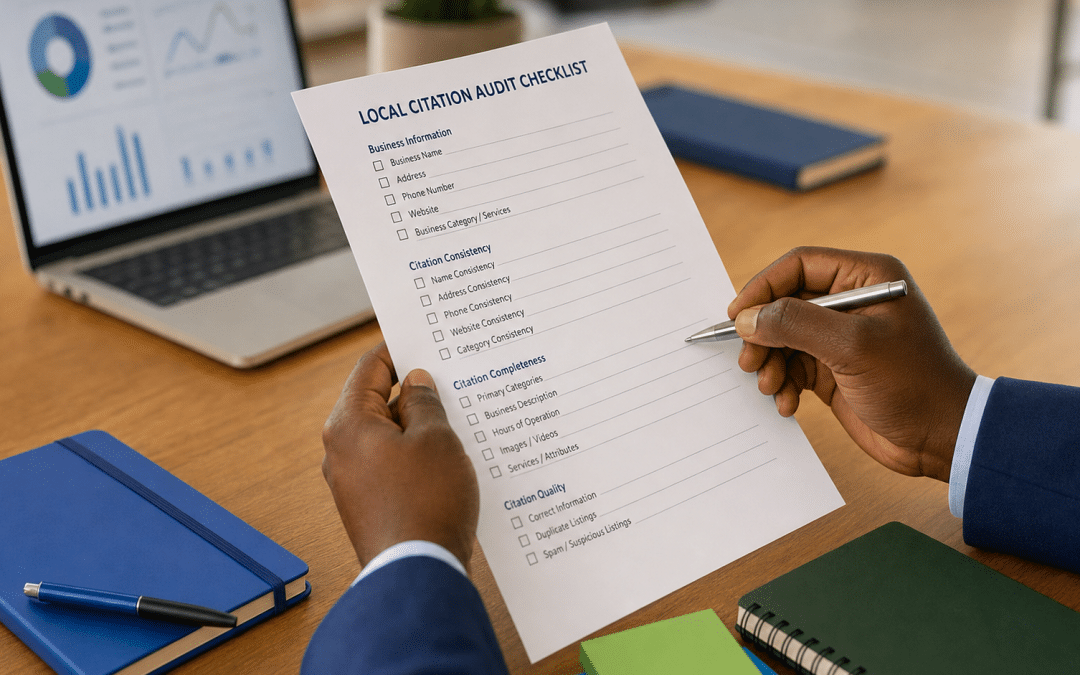
A local seo citation checklist is a structured audit framework that ensures your business name, address, and phone number (NAP) appear accurately and consistently across every directory, mapping platform, and data aggregator that influences Google's local rankings. According to Growth Pulse Media's SA SEO guide, local citations are one of the five pillars of local search visibility — yet they are the pillar most commonly left to drift after launch.
The mechanics are straightforward: Google, Apple Maps, AI assistants, and South Africa's own directories each cross-reference your business data independently. A single wrong phone number on Brabys.com can create a confidence problem that suppresses your entire local pack ranking while your Google Business Profile looks perfectly optimised. This checklist walks through every category of citation work — from the master NAP record to niche SA directories — so you can fix inconsistencies before they cost you map visibility.
Quick Answer
A local seo citation checklist covers six areas: establishing a master NAP record, building Tier 1 citations (Google Business Profile, Apple Maps, Facebook), listing on priority SA directories (Yellowpages.co.za, Brabys, SAYellow, YelloSA), earning unstructured citations from SA media, implementing LocalBusiness schema markup, and scheduling a quarterly audit. Citations account for approximately 9% of local ranking importance — a modest share that punches above its weight when inconsistencies actively undermine your GBP signals.
Jump to a section
Not sure where your citations stand right now?
Send us your business name and suburb — we will run a citation audit across South Africa's core directories and show you exactly where your NAP data is contradicting itself.
Request a citation auditWhat Are Local SEO Citations and Why Do They Matter?
A local citation is any online mention of your business's name, address, and phone number — whether on a formal directory listing or inside an editorial article. Google's own SEO Starter Guide notes that helping search engines understand your business's details is fundamental to visibility; citations are how that understanding propagates across the web beyond your own website.
According to BrightLocal's 2026 Local Search Ranking Factors data, citations account for 9% of overall local ranking importance, sitting behind on-page optimisation (24%), Google Business Profile signals (17%), links (15%), and reviews (14%). That figure looks modest until you consider that citation inconsistency actively undermines GBP signals — the 17% factor. Fixing a broken NAP record often releases ranking potential that was being cancelled out, rather than simply adding a new signal.
The trust loop: Google cross-references your GBP data against SA directories including Yellowpages.co.za, Brabys.com, and SAYellow. When three independent sources agree on your address and phone number, Google's confidence in your business location increases. When they disagree, it hedges — and that hedge shows up as a lower local pack position. A complete GBP increases customer consideration by 70% and purchase likelihood by 50% (Google research, cited by BrightLocal, 2026), but those gains are diluted when surrounding citation data contradicts it.
The consumer stakes are just as real: BrightLocal research shows 80% of consumers will lose trust in a business due to inconsistent contact details, and 93% are frustrated by incorrect information on online directories. For a Cape Town plumber or Johannesburg HR consultant, that means a wrong phone number is not just an admin oversight — it is a direct conversion leak.
Structured vs Unstructured Citations: What's the Difference?
Citations split into two types with different roles in your local search strategy. Structured citations appear in standardised directory fields — name, address, phone, website, category — on platforms like Yellowpages.co.za, Brabys, and Yelp. Unstructured citations are editorial mentions: a local news article quoting your managing director, a community blog listing your business as a sponsor, or a Sunday Times feature on Gauteng SMEs.
| Type | Where they appear | Your control | SEO role |
|---|---|---|---|
| Structured | Business directories, mapping apps, review platforms | High — you create and manage the listing | Establishes baseline NAP consistency; feeds data aggregators |
| Unstructured | News, blogs, press coverage, event listings, community forums | Low — third parties create them organically | Builds authority and trust; harder to scale but higher editorial weight |
Most SA businesses have a structured citation gap — they're listed on Google but missing from Brabys, ActiveWeb.co.za, or nichemarket.co.za. Starting with structured citation building gives you the NAP consistency baseline that makes everything else work; unstructured citations compound on top of that foundation.
Your Local SEO Citation Checklist — Step by Step
This local seo citation checklist runs in seven phases. Work them in order — each phase depends on the one before it.
Phase 1 — Establish Your Master NAP Record
Before submitting a single listing, define the exact version of your business data that every future citation must match, character for character.
| Field | SA-specific guidance |
|---|---|
| Business name | Use your legal trading name — no keyword stuffing. "Smith Plumbing" not "Smith Plumbing Johannesburg Plumbers" |
| Street address | Use the full street name (not abbreviations: "Street" not "St") |
| Suburb | Always include suburb — essential for SA postal routing |
| City | Use official municipality name (City of Cape Town, eThekwini, etc.) where required, city common name otherwise |
| Postal code | 4-digit SA postal code — verify against the SA Post Office database |
| Phone | Use +27 international format for all directories (e.g. +27 11 234 5678, not 011 234 5678) |
| Website URL | Use the canonical version (https://www.yourdomain.co.za/ with trailing slash) consistently |
| Business category | Match your primary GBP category exactly where the directory allows it |
Key Takeaway: Never use dynamic call-tracking numbers as your primary NAP phone
Call-tracking numbers change when you switch providers or campaigns. Every change breaks your NAP consistency across dozens of directories. Use a stable direct line as your canonical number and apply call-tracking at the website/GBP level only.
Phase 2 — Optimise Your Google Business Profile
Your Google Business Profile is the most important citation source. Before building any directory listing, your GBP should be complete and verified.
| GBP element | Status check |
|---|---|
| Profile verified | Verified by postcard, phone, or video — unverified profiles carry no ranking weight |
| Business name matches master NAP | Exact match — no extra descriptors |
| Primary category set correctly | The most specific category that describes your main service |
| Description written (up to 750 chars) | Include suburb, service area, and primary service naturally |
| Service areas listed | Cover your actual delivery/service geography — not all of South Africa |
| Business hours set and updated | Include public holiday hours; check before every SA public holiday |
| Photos added (exterior, interior, team) | At least 10 photos (recommended starting point); GBP listings with photos receive more direction requests than those without |
| Questions & Answers seeded | Populate with your own Q&As before customers do it for you |
Phase 3 — Build Tier 1 Citations
Tier 1 citations are the universally trusted platforms that Google, Apple Maps, and AI assistants (ChatGPT, Gemini) use as authoritative data sources. These must be live and consistent before you build anywhere else.
- Google Business Profile (verified)
- Apple Maps (via Apple Business Connect)
- Facebook Business Page (name, address, phone in the About section)
- Bing Places for Business
- Foursquare (feeds numerous downstream aggregators)
Phase 4 — Build Priority SA Directory Citations
See the SA directory table in the next section for the full priority list. Work down from Tier 2 (high-authority SA generalist directories) to Tier 3 (industry-specific and regional SA directories).
Phase 5 — Submit to Data Aggregators
Data aggregators distribute your NAP to hundreds of downstream directories automatically. Submitting to them amplifies your structured citation footprint without manual effort. International aggregators with SA coverage include Foursquare, Data Axle, and Neustar Localeze. Correct any errors at the aggregator level first, or those errors propagate widely. If you would rather not chase directory listings yourself, our local SEO service in South Africa starts with a free audit and runs on a flat monthly retainer.
Phase 6 — Earn Unstructured Citations
Unstructured citations come from SA press coverage, local news, community blogs, and event listings. They're harder to build systematically but carry more editorial authority. Useful SA sources include:
- Business Day, Daily Maverick, and IOL local business sections
- Nichemarket.co.za editorial posts and business features
- Local suburb and chamber of commerce newsletters
- Industry association membership directories (SACCI, SAICA, etc.)
Phase 7 — Implement LocalBusiness Schema Markup
Schema markup is not a citation in the traditional sense, but it gives search engines a machine-readable version of your NAP embedded in your own website — which anchors all your directory citations to a verified source. Add LocalBusiness JSON-LD schema to your homepage and contact page, and ensure the NAP values match your master record exactly. Read our local business schema guide for implementation steps.
Getting your first SA citations set up and not sure where to start?
Tell us your business type and location — we will map out which SA directories matter most for your category and identify the three fixes that will move the needle fastest.
Get a citation roadmapPriority SA Directories for Your Citation Checklist
Based on Whitespark's vetted list of South Africa's top local citation sources, these are the directories that carry the most weight for SA local rankings. Work through them in tier order.
| Tier | Directory | Notes |
|---|---|---|
| Tier 1 | Google Business Profile | Non-negotiable; the primary citation signal |
| Tier 1 | Apple Maps (Apple Business Connect) | Critical for iOS users and Siri local results |
| Tier 1 | Facebook Business Page | Widely used in SA; Marketplace and local discovery |
| Tier 2 | Yellowpages.co.za | SA's longest-running general business directory |
| Tier 2 | Brabys.com | High DA; frequently cross-referenced by Google for SA data |
| Tier 2 | SAYellow | Core SA generalist directory |
| Tier 2 | YelloSA (yellosa.co.za) | Verified SA business portal; strong regional search presence |
| Tier 2 | Cylex South Africa | Active SA presence; indexed well by Google |
| Tier 2 | HotFrog SA | Good for service businesses; free basic listing |
| Tier 2 | ActiveWeb.co.za | SA-focused; useful for professional services |
| Tier 3 | nichemarket.co.za | SA-specific; editorial and directory hybrid |
| Tier 3 | MySheriff | SA services directory |
| Tier 3 | Fyple | International directory with SA coverage |
Key Takeaway: Quality over quantity for SA citations
As a practical starting point (no published threshold study exists), 15–20 accurate, consistent citations on high-authority directories tend to deliver stronger ranking signals than 100 low-quality directory submissions. Focus on building the Tier 1 and Tier 2 list correctly before expanding toward the 50–100 range across niche and regional directories.
NAP Consistency: The Non-Negotiable Rule
NAP consistency is the single most operationally critical element of any local seo citation checklist. BrightLocal's data shows businesses with consistent NAP data across major citation sources are 40% more likely to appear in the local pack — and that advantage compounds because consistent citations reinforce each other's credibility signals, whereas inconsistent citations cancel each other out.
Common SA-specific inconsistency traps to watch for:
Bad: Using "011 234 5678" on your website, "+27 (11) 234-5678" on Brabys, and "0112345678" on YelloSA. Google treats these as three different numbers on three potentially different businesses.
Good: "+27 11 234 5678" appears identically on every directory, your website, and your GBP. No parentheses, no hyphens, no 0xx prefix — one canonical format across the board.
Address formatting is equally important. In South Africa, many businesses have a complex address with a unit or floor number, building name, street address, suburb, and city. Establish one formatting convention — write it out completely — and apply it without variation.
Bad: "Suite 4, Century City" on GBP, "4 Century City Business Park, Millennium Drive" on Yellowpages.co.za, and "Millennium Dr, Century City" on Facebook. Three citations, three different confidence signals.
Good: "Suite 4, Century City Business Park, Millennium Drive, Century City, Cape Town, 7441" — the same string on every platform, without variation.
How to Audit and Fix Citation Errors
Running your first citation audit reveals the current state of your NAP data across the web. Enter your business name into BrightLocal, Whitespark's Citation Audit tool, or Moz Local to pull a snapshot of your existing listings. You're looking for three categories of problem:
| Problem type | Example | Fix |
|---|---|---|
| Inconsistent NAP | Old address still showing on Brabys after a business move | Log in and update the listing directly; request a correction if no owner access |
| Duplicate listings | Two live listings on Yellowpages.co.za for the same business | Merge or remove the duplicate; duplicates split authority and confuse Google |
| Missing citations | Not listed on SAYellow or Apple Maps at all | Create new listings using your master NAP record |
After the initial fix cycle, maintain your citation health with a quarterly review of your four core listings (GBP, Apple Maps, Facebook, Yellowpages.co.za), and run a full audit annually or any time you change your address, phone number, or business name. Building strong citation foundations supports all your broader local search and link building work — a clean NAP profile makes every other ranking signal more credible.
Key Takeaway: Audit schedule for SA businesses
Run a full citation audit annually and a manual check of your core four listings (GBP, Apple Maps, Facebook, Yellowpages.co.za) every quarter. Trigger an out-of-cycle audit immediately if you change your address, phone number, or business name — directory data takes time to propagate, and the gap creates a temporary ranking risk. Check your technical SEO checklist at the same time for a combined site and local health review.
Ready to know your local search ranking potential?
Share your business details and we will assess your current citation coverage, GBP completeness, and local pack positioning against your nearest competitors — no obligation, we will respond within 24 hours.
Book a local SEO assessmentWhy South African Businesses Choose Growth Pulse Media for Local Search
Growth Pulse Media's founder built and operated a South African ecommerce business before founding the agency — which means the local search work here is grounded in campaigns that have paid actual SA invoices, not theory borrowed from American case studies. When we optimise a local citation profile, we work from the SA directory ecosystem that SA consumers actually use — Yellowpages.co.za, Brabys, SAYellow, YelloSA, nichemarket.co.za — prioritising the directories that consistently appear in SA local search results over generic global platforms with limited SA presence.
We carry a deliberately limited client roster, so each business we work with gets senior attention rather than being handed to a junior after the first month. Local search work — citation auditing, GBP management, local content, review strategy — is treated as a coordinated system, not a checklist of isolated tasks. Visit our South Africa SEO services page to understand the full scope of how we approach local and organic search, or read our SEO case study showing the kind of traction this approach produces.
Who This Is NOT For
Not for: businesses with a single, unchanging address that have already run a citation audit. If your NAP is clean, your Tier 1 and Tier 2 directories are live, and your GBP is verified and fully populated — you do not need this checklist. Shift your local search effort to review velocity and local content instead.
Not for: e-commerce businesses with no physical location. Local citations require a verifiable address. A purely online business with no staff location cannot create a credible GBP presence (against Google's terms) and citation building will not improve rankings meaningfully without a legitimate local footprint.
Not for: national brands that rely on Google Ads for local lead generation. If you are spending a significant budget on performance campaigns and seeing consistent results, local organic citation work has a long compounding timeline that may not fit your immediate return horizon. Address citations when you are ready to invest in organic visibility over 6–12 months.
Not for: businesses in extremely niche B2B verticals with no consumer-facing address. A mining equipment supplier selling to Zambian buyers from a Johannesburg head office is not a local search play. Your growth channels are outbound, industry platforms, and account-based work — not local directory citations.
Frequently Asked Questions About Local SEO Citations
How many citations does a South African local business need?
For most SA local businesses, building 15–20 accurate citations on high-authority directories (Tier 1 and Tier 2) provides the core foundation as a practical starting point. Expanding into 50–100 citations across niche and regional directories adds incremental benefit once your core listings are clean and consistent. Citation accuracy and consistency carry more weight in local rankings than raw volume — 20 perfectly consistent listings typically deliver stronger ranking signals than 100 where 40 carry old or conflicting data.
What happens if my NAP details are inconsistent across directories?
Inconsistent NAP data sends conflicting signals to Google, reducing its confidence in your business location and legitimacy. This translates directly to lower local pack rankings. BrightLocal research shows 80% of consumers lose trust in a business when they encounter inconsistent contact details — so the damage is both algorithmic and reputational. Fix your highest-authority listings first (GBP, Apple Maps, Facebook), then work through SA directories in Tier 2 order.
How long does it take for citation fixes to affect local rankings?
Directory updates typically take several weeks to be re-crawled and indexed by Google. Data aggregator corrections can take longer to propagate through their downstream partners. For GBP changes, the effect is usually faster — sometimes within days. As a working rule, allow 60–90 days to see meaningful ranking movement from a comprehensive citation clean-up — consistent with typical SEO timelines for South African businesses.
Can I use call-tracking numbers in my SA citations?
Using a dynamic call-tracking number as your primary NAP phone is a consistency risk. If the number changes when you switch tracking providers or campaigns, every directory listing it was submitted to becomes inconsistent. Use a stable direct line as your canonical NAP number, and apply call-tracking through your website and GBP using the forwarding or secondary number approach — that way the canonical NAP stays clean while you still capture call attribution data.
Do AI search tools like ChatGPT use citation data to recommend local businesses?
Yes. ChatGPT, Gemini, and Perplexity draw on Google Business Profile data, structured directory citations, and web content when making local business recommendations to users. A complete, consistent citation profile — particularly on GBP and high-authority directories — improves the likelihood your business is surfaced in AI-generated local recommendations, extending the value of your local seo citation checklist beyond traditional map pack rankings.
Build a local citation profile that actually moves your rankings
Growth Pulse Media handles the full citation audit, clean-up, and build-out for South African businesses — from master NAP record to priority SA directories to LocalBusiness schema. We have done this across Johannesburg, Cape Town, Durban, and Pretoria for businesses where local pack visibility directly drives foot traffic and enquiries. No obligation — we'll get back to you within 24 hours.
Start a conversation