
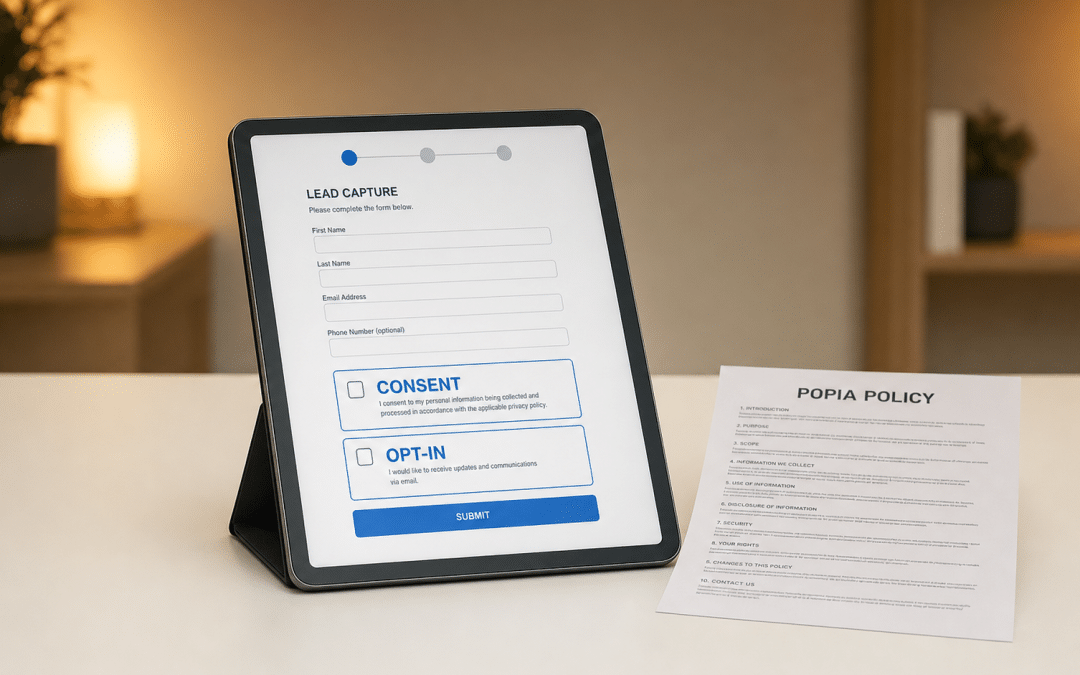
Popia compliant lead generation is not a box-ticking exercise — it is the legal foundation on which every South African B2B pipeline must now be built, and our B2B lead generation guide for South Africa covers the broader strategy.
The Protection of Personal Information Act came into full effect in July 2021, and the Information Regulator has since made clear that non-compliance carries real consequences: administrative fines of up to R10 million and potential criminal liability for responsible parties.
This guide cuts through the noise to give you a practical, legally grounded framework. Whether you are running LinkedIn campaigns, cold email sequences, or gated content funnels, the rules governing how you collect, store, and use prospect data are the same.
Get them right and your pipeline is defensible; get them wrong and a single complaint can unwind months of work. See also our LinkedIn lead generation South Africa guide for channel-specific tactics that sit within this framework.
Quick Answer
Popia compliant lead generation in South Africa requires a lawful processing ground for every data touch point — typically consent or legitimate interest — plus a privacy notice, a retention policy, and a documented opt-out mechanism. Build these into your funnel architecture before you launch, not after your first complaint.
Not sure whether your current lead capture forms meet POPIA's requirements?
Get a Free POPIA Funnel AuditWhat POPIA Actually Requires for Lead Generation
POPIA sets eight conditions for lawful processing; popia compliant lead generation must satisfy all eight, not just the consent condition most marketers fixate on. The Act governs any South African entity that collects, stores, uses, or shares personal information — and a business email address qualifies as personal information.
The eight conditions are: accountability, processing limitation, purpose specification, further processing limitation, information quality, openness, security safeguards, and data subject participation. In plain terms: know why you are collecting data, collect only what you need, tell subjects what you are doing with it, keep it accurate, secure it properly, and honour requests to access or delete it.
The accountability condition means your organisation — not your CRM vendor, not your agency — is the responsible party. You must be able to demonstrate compliance on demand. That means documented policies, not good intentions.
Key Insight
Consent is only one of several lawful processing grounds under POPIA. Legitimate interest is equally valid for B2B outreach — provided you document it and offer a clear opt-out every time you make contact.
Lawful Grounds: Consent vs. Legitimate Interest
Popia compliant lead generation can rest on either consent or legitimate interest — the choice shapes your entire funnel architecture. Consent requires a positive, informed action: a pre-ticked box is not consent under the Act. Legitimate interest allows you to process data without upfront consent where a reasonable person in the data subject's position would expect such processing and where the processing does not override their rights.
For B2B cold outreach — LinkedIn InMails, cold email to work addresses, or phone prospecting — many South African practitioners rely on legitimate interest. The logic: a financial director at a Sandton firm might reasonably expect to receive relevant vendor outreach. Practices commonly interpret this as permissible, provided you identify your organisation clearly, state the processing purpose, and include a working opt-out mechanism in every communication.
Consent-based funnels are cleaner from a compliance standpoint but typically generate lower volumes. A gated whitepaper with a clear opt-in checkbox, a POPIA-compliant privacy notice linked from the form, and a confirmed double opt-in sequence is the gold standard for inbound lead generation. The trade-off is volume versus defensibility.
Running cold email or LinkedIn outreach to South African prospects — and unsure which legal ground covers you?
Get a Free Compliance AssessmentBuilding a Popia Compliant Lead Generation Funnel
A popia compliant lead generation funnel has four non-negotiable layers: a lawful collection point, a purpose-specific privacy notice, a consent or legitimate-interest record, and a suppression list mechanism. Miss any one layer and the funnel is non-compliant regardless of how well the rest is built.
Layer 1 — Collection point. Every form, chatbot, or list-import event must specify the processing purpose at the point of collection. "We will use your details to send you relevant B2B marketing content; you may unsubscribe at any time" is the minimum. Link to your full privacy policy from the form.
Layer 2 — Privacy notice. Your privacy notice must name the responsible party, list the categories of data collected, state the retention period, explain how data subjects can request access or deletion, and identify any third-party processors — including your CRM (HubSpot, Salesforce), your email platform (Klaviyo, Mailchimp), and your ad platforms.
Layer 3 — Processing record. Keep a record of when consent was given (timestamp, source, version of the form) or document your legitimate-interest assessment in writing. This record is your defence if the Information Regulator receives a complaint.
Layer 4 — Suppression list. When a prospect opts out, remove them from all active sequences within a reasonable time — the Act does not specify a number of days, but industry practice treats 48 to 72 hours as the standard — and add them to a permanent suppression list so they are not re-imported from a future data purchase.
Third-Party Data and Purchased Lists
Popia compliant lead generation and purchased data lists are a difficult combination. When you buy a list of South African company contacts from a data broker, you inherit the compliance risk: if those records were not collected lawfully, processing them makes you a co-responsible party under the Act.
Before using any purchased list, ask the supplier for their processing ground, their original consent mechanism or legitimate-interest assessment, the date the data was collected, and their data subject notification procedure. Reputable local brokers can produce this documentation. Any supplier who cannot provide that documentation should be removed from your consideration — using their list is not a viable path to popia compliant lead generation.
LinkedIn Sales Navigator operates differently. The data subjects have consented to LinkedIn's terms, and LinkedIn's platform controls limit how you can use that data. Running popia compliant lead generation through Sales Navigator is generally lower-risk than cold list imports, provided your outreach messages include your company identity, processing purpose, and opt-out option.
| Approach | Lawful Ground | Key Requirement | Risk Level |
|---|---|---|---|
| Inbound gated content | Consent | Opt-in checkbox + privacy notice on form | Low |
| LinkedIn InMail / Sales Navigator | Legitimate interest | Identity, purpose + opt-out in every message | Low–Medium |
| Cold email to business addresses | Legitimate interest | Documented LI assessment + suppression list | Medium |
| Purchased contact lists | Inherited from supplier | Supplier compliance documentation required | High |
| Scraped web data | Generally none | Avoid unless purpose, context, and opt-out are verifiable | Very High |
| Event badge scans / business cards | Legitimate interest / implied consent | Follow-up must reference the event; opt-out required | Low–Medium |
| Scenario | Before POPIA Audit | After POPIA Audit |
|---|---|---|
| Monthly outreach volume | 4,200 contacts (mixed sources) | 2,100 contacts (verified lawful ground) |
| Email open rate | 11% | 19% |
| Complaint / unsubscribe rate | 4.8% | 0.9% |
| Qualified meetings booked per month | 6 | 11 |
| Cost per qualified meeting | R9,400 | R5,200 |
| Information Regulator exposure | Undocumented | Documented processing records held |
These figures illustrate the pattern we see, not a guaranteed outcome. A smaller, cleaner list typically outperforms a larger non-compliant one because the signal-to-noise ratio improves and delivery reputation improves alongside it.
POPIA, ECTA, and the CPA: Which Law Governs What
Popia compliant lead generation does not exist in isolation — the Electronic Communications and Transactions Act and the Consumer Protection Act layer additional obligations on top of POPIA. Understanding which law governs which element of your funnel prevents the common error of satisfying one statute while violating another.
ECTA Section 45 governs unsolicited commercial electronic communications (spam). It requires that you identify yourself as the sender, provide a valid reply address, and include an opt-out mechanism in every message. A POPIA-compliant consent record does not override ECTA — both must be satisfied simultaneously.
The CPA applies where your B2B prospect is a juristic person with an annual turnover or asset value below the threshold set by the Minister (currently R2 million). Practices commonly interpret this as meaning smaller business owners who receive your outreach may enjoy CPA protection, which includes the right to opt out of direct marketing. When in doubt, treat every South African prospect as CPA-covered.
POPIA Compliance on LinkedIn: A Practical View
LinkedIn is the platform of choice for South African B2B marketers running popia compliant lead generation programmes. According to LinkedIn's own resources, 89% of B2B marketers use LinkedIn for lead generation, and 62% say it generates more leads than the next-highest social channel. The platform's professional targeting — by seniority, function, industry, and company size — also reduces the risk of reaching irrelevant data subjects, which strengthens a legitimate-interest argument.
LinkedIn Lead Gen Forms pre-populate prospect data from their profile. This is convenient but does not eliminate your POPIA obligations: the form must still display your processing purpose, link to your privacy policy, and trigger an automated confirmation email that includes an opt-out link. Set this up inside your CRM integration before you launch any Lead Gen Form campaign.
For organic LinkedIn outreach — connection requests and direct messages — document your legitimate-interest basis for each prospect segment you target. A written note in your CRM record ("Targeted: CFO at Gauteng manufacturing firm; LI basis: relevant vendor outreach") takes thirty seconds and creates a defensible audit trail. See our dedicated LinkedIn lead generation South Africa post for campaign build specifics.
Key Insight
LinkedIn Lead Gen Forms reduce friction but do not transfer POPIA responsibility to LinkedIn. Your organisation remains the responsible party and must document processing purpose, link to a privacy notice, and honour every opt-out request.
GPM's Approach to POPIA Compliant Lead Generation
At GPM, popia compliant lead generation is not an optional add-on — it is the operating standard for every B2B campaign we build. Dirk built and scaled a South African ecommerce business before founding the agency; we have lived through a POPIA audit from the inside and understand what documentation the Information Regulator actually asks for.
Our process starts with a lawful-ground mapping session: for each data touch point in your funnel, we document the processing ground, the retention period, the third-party processors involved, and the opt-out mechanism. We then build or audit your CRM configuration — whether you are on HubSpot, Salesforce, or Klaviyo — to ensure suppression lists are enforced automatically rather than manually.
For outbound campaigns, we produce a written legitimate-interest assessment for each prospect segment before the first contact is made. For inbound campaigns, we audit every form, landing page, and lead magnet against the eight POPIA conditions. The result is a pipeline that is both effective and defensible. Visit our B2B lead generation South Africa service page to see how we structure engagements.
Who This Is NOT For
Businesses that want to buy a list and blast it. If your go-to-market plan relies on purchasing a 50,000-record contact list and mailing it without supplier compliance documentation, POPIA compliance is incompatible with that approach. The risk exposure — fines, reputational damage, CRM blacklisting — materially outweighs the short-term volume gain.
Organisations with no appointed Information Officer. POPIA requires every private body processing personal information to designate an Information Officer and register with the Information Regulator. If that step has not been taken, lead generation compliance cannot be meaningfully implemented — there is no accountable person to own the processing records.
Teams that treat compliance as a once-off project. POPIA compliance requires ongoing maintenance: form updates when processing purposes change, annual reviews of third-party processor agreements, and suppression list hygiene. If your team cannot commit to that maintenance cycle, the compliance framework will degrade within months.
Companies whose CRM has no suppression-list functionality. If your current system cannot enforce opt-outs automatically — preventing a suppressed contact from being re-enrolled when a new campaign launches — you cannot reliably run popia compliant lead generation at scale. Fix the tooling first; the campaign strategy follows.
Ready to build a lead generation funnel that is both high-converting and legally defensible under South African law?
Get a Free POPIA Lead Gen Strategy SessionFrequently Asked Questions: Popia Compliant Lead Generation
What does popia compliant lead generation actually require in practice?
It requires a documented lawful ground for every data collection point, a privacy notice that names the responsible party and states the processing purpose, a mechanism for data subjects to opt out or request deletion, and a suppression list that is enforced automatically by your CRM. You must also be able to produce these records on request — good intentions without documentation do not satisfy the Act.
Can I legally cold-email South African business prospects under POPIA?
Yes, provided you rely on a documented legitimate-interest assessment and include your company identity, processing purpose, and a working opt-out mechanism in every email. You must also comply with ECTA Section 45, which independently requires an opt-out and a valid reply address. If the recipient opts out, they must be suppressed within a reasonable time and not re-contacted.
Do I need consent for every lead I capture?
No. Consent is one lawful ground under POPIA, but legitimate interest is equally valid for many B2B scenarios. The choice affects your funnel architecture: consent-based funnels require a positive opt-in action at every collection point, while legitimate-interest funnels require a documented assessment and a clear opt-out in every communication. Both are legally defensible when implemented correctly.
What happens if the Information Regulator receives a complaint about my lead generation?
The Regulator can investigate, issue an enforcement notice requiring you to stop processing, and ultimately impose an administrative fine of up to R10 million or refer the matter for criminal prosecution. The most effective defence is documentation: processing records, legitimate-interest assessments, and suppression logs. Organisations with documented compliance programmes typically resolve complaints faster and with lower penalties.
Are LinkedIn Lead Gen Forms POPIA compliant by default?
Not automatically. LinkedIn pre-populates the form fields, but your organisation remains the responsible party for how that data is processed after submission. Your form must display your processing purpose, link to your privacy policy, and trigger an automated confirmation that includes an opt-out link. Your CRM integration must enforce suppression lists automatically.
How long can I retain B2B lead data under POPIA?
The Act requires that personal information be retained no longer than necessary for the purpose for which it was collected — or as required by law. For B2B lead data, practices commonly interpret this as retaining active-prospect records while an opportunity is live, plus a reasonable post-close period for relationship management. You must state a specific retention period in your privacy notice; "we keep data indefinitely" is not compliant.
Want a POPIA compliance review of your existing lead generation funnel?
We will map every data touch point in your funnel against the eight POPIA conditions, identify gaps, and deliver a prioritised action plan. No obligation — we'll get back to you within 24 hours.
Get Your Free POPIA Funnel Review