
 Add to Preferred Sources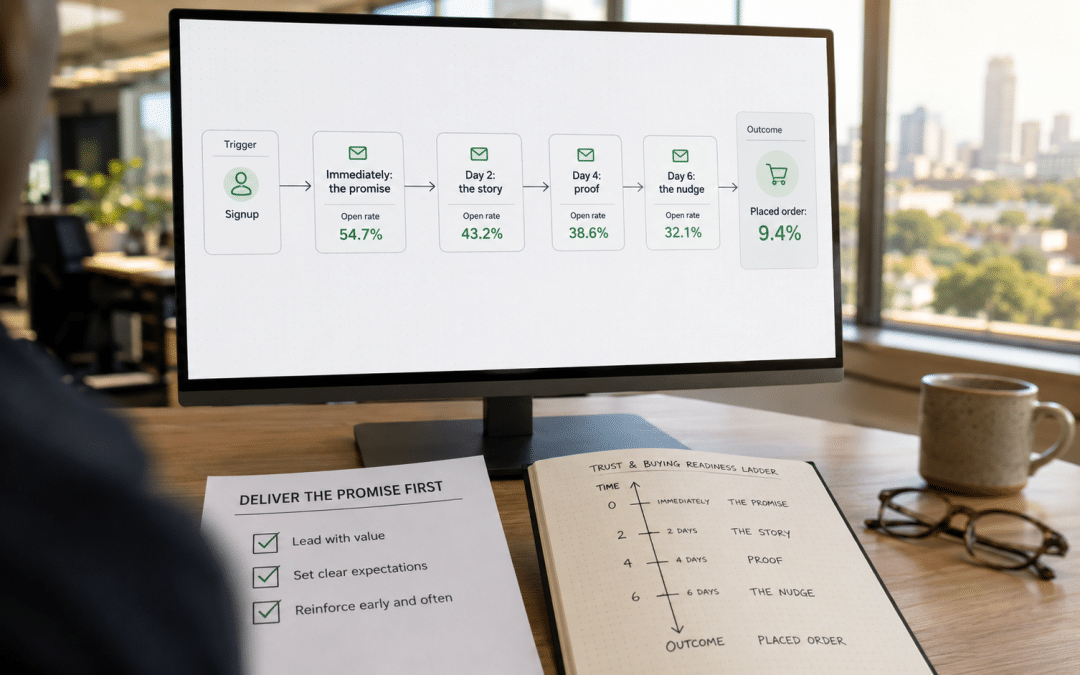
A welcome email sequence South Africa subscribers actually open is the highest-performing automation an SA business can build: 3 to 5 messages triggered the moment someone signs up, earning roughly double the opens of a normal campaign. It is the first flow to build in our email marketing South Africa guide, and the one most local businesses reduce to a discount code. Below: the message ladder, the timing, the consent step, and the numbers.
Quick Answer
A welcome email sequence South Africa businesses can rely on runs 3 to 5 automated messages over about a week: deliver the promised incentive immediately, tell the brand story on day 2, show proof on day 4, nudge the first purchase around day 6. Opens routinely hit 40-55% because attention is at its peak. The mistake is one discount code and then silence — a single greeting leaves most of the value on the table.
Not sure your first flow is doing anything beyond firing off a coupon? Let's take a look.
Get a Free Onboarding Flow ReviewWelcome Email Sequence South Africa: The Message Ladder
The flow is a short, deliberate conversation with a job for each rung. Three to five messages over roughly a week, each with one goal and one dominant call-to-action. The ladder below is the durable default for SA businesses.
| Message | Timing | Its One Job |
|---|---|---|
| 1 — The promise | Immediately | Deliver the incentive you offered; confirm they are in |
| 2 — The story | Day 2 | Who you are, why you exist, what to expect |
| 3 — The proof | Day 4 | Reviews, bestsellers, results from real customers |
| 4 — The objection | Day 6 | Answer the hesitation: delivery, returns, pricing |
| 5 — The nudge | Day 7-8 | Final reminder, incentive expiring, one clear action |
The structure is not local invention. As Klaviyo's Academy guidance sets out, this is a list-triggered flow that greets subscribers the moment they join, it is usually their first real interaction with the brand, and the first message should carry any signup incentive you promised. One further rule is worth holding: run a separate flow per channel, so email and text subscribers each get their own greeting.
Why the First Flow Outperforms Everything Else
No other automation catches a person at a higher point of interest. They have just chosen you — typed their address, clicked the button, raised their hand. That moment decays fast, and the flow exists to spend it well.
Attention is at its absolute peak
Opens on a first flow routinely land between 40% and 55%, roughly double a healthy campaign. That is not clever copy; it is timing. The subscriber is thinking about you right now, which they will not be next Tuesday. Every day you delay the first message, that peak flattens — which is why the opening send must fire immediately, not on a schedule.
It sets the terms of the relationship
The opening messages teach the subscriber what you are for. Show up with value, a clear voice, and a reason to keep reading, and you have set an expectation that lifts every send for years. Show up with a coupon and silence, and you have taught them you are a discount channel — and they will only open you when they want a sale.
It does the work once and earns forever
Unlike a campaign, this flow is built once and greets every new subscriber automatically from then on. A well-built one compounds quietly in the background at zero marginal cost, which is exactly the logic behind our automation guide. It is the cheapest revenue in the entire programme, and the most neglected.
The Peak-Interest Insight
This flow outperforms every other automation because it arrives when interest is highest. A subscriber who signed up ninety seconds ago is more receptive than that person will ever be again. Spend that moment on a bare discount code and you have converted the peak of the relationship into a once-off transaction. Spend it on a real introduction and you have bought years of opens.
Want the exact message ladder we would build for your list, copy angles included?
Get a Free Flow BlueprintTiming: Fast First, Then Breathe
Timing is where most SA flows go wrong in one of two directions — either the whole run lands in a single day and reads as desperate, or it dribbles out over a month and the subscriber forgets who signed up. The rhythm below holds for most local businesses.
Message one goes out immediately. No delay, no batching, no overnight queue. If you promised a code, it must arrive while the person is still on the site with their wallet open. A discount that lands three hours later is a discount for someone who has already left.
Everything after that gets at least a day of air. One message per day is the ceiling, and a two-day gap between the middle rungs reads better than a one-day one. The flow should feel like a considered introduction, not a chase.
Match the run to your buying cycle. This is the SA-specific tuning that matters. A R400 impulse purchase justifies a compressed run of three messages over five days; a R80,000 solar installation or a considered professional service needs a longer, education-led run of five or more spread across three weeks. Fit the length to how long your buyer actually takes to decide, not to a template.
One structural rule holds across every length: one job per message, one dominant call-to-action. A rung that asks the reader to follow you socially, browse bestsellers, read the founder story, and claim a code will achieve none of them.
The discipline is deciding what each step is for before writing a word of it, then cutting whatever does not serve that purpose. If a paragraph cannot justify its place against the goal, it belongs in a later message or nowhere at all.
The commonest local failure is the one-and-done: a single "here's your 10% off" send, then silence until the next promo blast. The subscriber never learns who you are, the code converts once or expires, and the most valuable moment in the relationship is spent on a coupon. It is a flow that technically exists while doing almost none of the job.
Consent and the SA Signup Moment
The flow is only compliant if the signup that triggered it was. POPIA requires demonstrable consent for direct marketing, which means the form that captured the address must have made it clear the person was opting into marketing — not just downloading a guide or entering a competition.
Practically: an actively-ticked box rather than a pre-ticked default, a clear line stating what they will receive and roughly how often, and a stored record of when and how consent was given. The first message is also the natural place to confirm expectations and offer a preference option, which reduces later unsubscribes and doubles as a consent audit trail. Our POPIA compliance guide covers the record-keeping in full.
One SA-specific note on the incentive. Local subscribers are cautious with data, so the value exchange has to be visible at the point of signup — "10% off your first order, plus first access to sales" earns the address honestly, while a bare "join our mailing list" underperforms badly. Lead with the benefit and both the signup rate and the consent quality improve together.
The Promise-Delivery Insight
Whatever you offered at signup is a contract, and the first message is where you honour it. Break that promise — the code arrives late, or broken — and you have taught a brand-new subscriber that your emails cannot be trusted, at the moment they were most willing to. Every downstream flow inherits that judgement. Test the first send monthly; it is the one message where a technical failure costs the whole relationship.
Before and After: What a Real Flow Changes
The table below reflects the typical trajectory for an SA business moving from a single automated greeting to a structured 4-to-5 message run over one quarter. Figures are indicative composites from SA benchmark ranges.
| Metric | Before (one discount send) | After (structured run) |
|---|---|---|
| Flow open rate | 25-35% | 40-55% |
| First-purchase conversion | 2-4% | 7-10% |
| Revenue per new subscriber | R18 – R30 | R55 – R95 |
| Engagement at 90 days | Mostly lapsed | Materially higher retention |
| Build effort | One-off, then ignored | Built once, earns indefinitely |
Measurement and Reporting Discipline
Strong welcome email sequence South Africa programmes report per message, not on the run as a whole. Track opens, clicks, and placed-order rate at every rung, plus revenue per new subscriber and the drop-off between steps. An aggregate number hides the one message that is failing, which is usually the one worth fixing first.
Watch the drop-off shape. A steep fall between rungs one and two means the introduction is not earning the second open; a flat run with no conversion means the offer or the proof is weak. Both are fixable, both invisible in a blended report. Compare the ninety-day behaviour of subscribers who completed the run against those who did not — that gap tells you whether the flow built a relationship or just moved a coupon.
On tooling, the platform's native flow reporting is enough. What the flow really needs is an owner and a monthly test: sign up with a fresh address, walk the run yourself, and confirm every message fires, the code works, and the timing feels right. Flows rot silently — a broken link or an expired code can run for months while the dashboard reports healthy opens. The drip campaign guide covers the wider automated-series mechanics.
The Growth Pulse Media Difference
Growth Pulse Media is run by an operator, not an account team. Before founding the agency, Dirk built and scaled a large SA ecommerce business on Klaviyo and Omnisend — where the onboarding run was the single highest-earning automation in the account — so this playbook comes from watching real subscribers move through a real ladder, not from a template library.
All work is done in-house with a deliberately limited client load. No offshore outsourcing, no junior hand-offs, and reporting built per message on revenue per new subscriber — never a blended flow number that hides the rung that is failing.
If you would rather have this built for you, our managed inbox revenue service includes the full onboarding system — the message ladder, timing tuned to your buying cycle, POPIA-clean signup capture, and monthly testing so it never rots.
Who This Is NOT For
An honest disqualifier list saves both sides time. Building this out is the wrong priority right now if any of the following describes you:
Nobody is signing up. The best flow in the country earns nothing with no trigger. If your capture is broken or absent, fix the signup form and the offer first — the flow is worth building the day subscribers start arriving.
You only want to send the discount. If the brand story, the proof, and the objection-handling all feel like padding, you will build the one-and-done version and get the one-and-done result. The value is in the rungs after the coupon.
Your signup consent is not clean. If addresses were collected without an explicit marketing opt-in, automating a greeting to them compounds a POPIA problem at scale. Fix the capture mechanics before you automate anything against the list.
Nobody will own it. This is built once and then quietly rots — expired codes, dead links, stale copy. If no one will walk the run monthly, it will be earning less than the dashboard suggests within a year.
Wondering whether your current flow is earning or just running? We'll walk it and tell you.
Request a Free Flow AuditFrequently Asked Questions
How many emails should a welcome sequence have?
Three to five for most SA businesses, spread over roughly a week. Three suits impulse purchases and simple offers; five or more suits considered, higher-value decisions like professional services or solar. Match the length to how long your buyer actually takes to decide rather than a template. Each message needs one clear job and one dominant call-to-action, otherwise the run dilutes itself.
When should the first welcome email send?
Immediately, with no delay. The subscriber's interest peaks the second they submit the form, and if you promised a discount code it must arrive while they are still on your site. Every subsequent message should get at least a day of air, with one send per day as the ceiling. A code that lands three hours later is a code for someone who has already left.
What open rate should an SA welcome flow achieve?
Roughly 40-55%, about double a healthy campaign, because it arrives at the moment of peak interest. Below 35% usually means the first send is delayed, the signup promise is not being honoured immediately, or the subject line is not matching what the person just asked for. Track the rate per message, not across the run — an aggregate hides the rung that is failing.
What should each welcome email actually say?
Message one delivers the incentive you promised and confirms they are in. Message two tells your brand story and sets expectations. Message three shows proof through reviews, bestsellers, or real results. Message four answers the obvious hesitation about delivery, returns, or pricing. A final message nudges the first purchase with the incentive expiring. One job, one action, per send.
Is a welcome sequence POPIA compliant?
Only if the signup that triggered it was. POPIA requires demonstrable consent for direct marketing, so the form must have made clear the person was opting into marketing rather than just downloading a guide or entering a competition. Use an actively-ticked box, state what they will receive and how often, and store the record of when and how consent was given.
Should I run a separate welcome flow for SMS?
Yes. Best practice is one greeting flow per channel, triggered by that channel's own subscriber list, because people opt into email and text at different moments. Keep the text version much shorter, typically one to three messages, and lead with the promised incentive. Merging both into one flow means somebody gets a greeting they did not sign up for, which risks a consent problem.
Worried this is a lot of build for a flow most people will only half-read? It runs once and greets every subscriber you ever get — it is the cheapest work in the programme, and we will tell you honestly if yours is already fine.
Get Your Free Welcome Flow Plan for Your SA Business
Growth Pulse Media builds onboarding flows for South African businesses — the full message ladder, timing tuned to your buying cycle, POPIA-clean signup capture, and monthly testing on Klaviyo or Omnisend so the run never rots. Built by an operator whose own onboarding flow was the highest-earning automation in the account while scaling an SA online store, and reported per message on rand per new subscriber.
No obligation — we will get back to you within 24 hours.
Request Your Free Flow Plan →