
 Add to Preferred Sources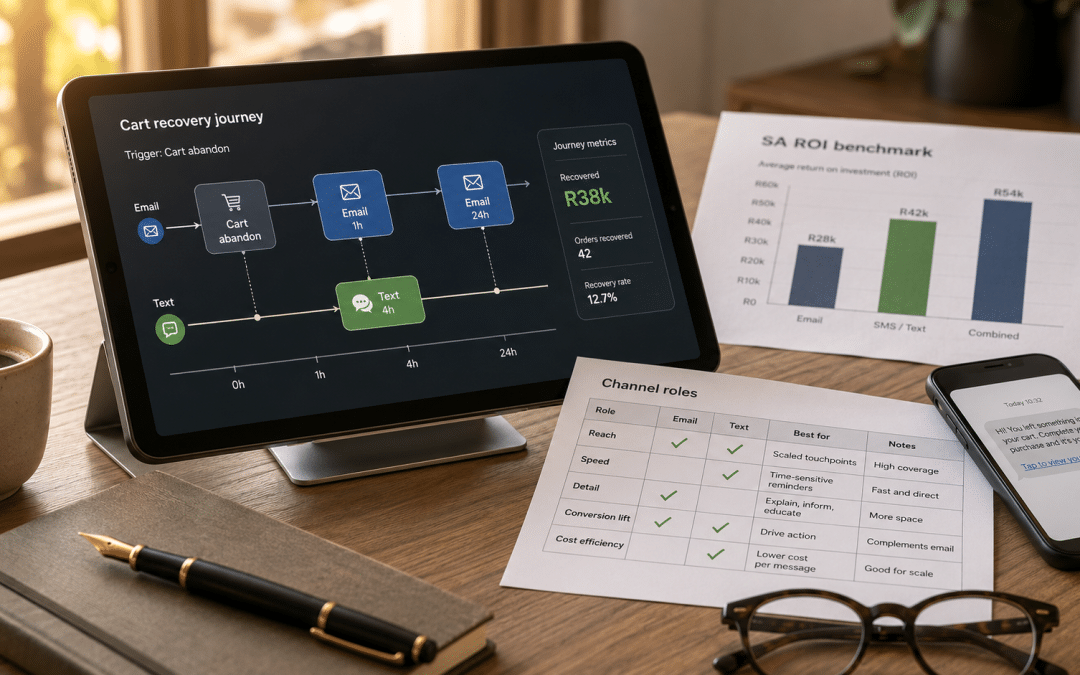
Email SMS marketing South Africa runs text and email as one coordinated system. Email handles depth and low-cost reach; text handles urgency and near-instant opens. Each channel does what it does best. Combined well, the pairing lifts revenue beyond either alone, earning its place in our email marketing South Africa guide. Below: when to use each channel, how to sequence them, Rand costs, and the POPIA consent rules that govern text.
Quick Verdict
For most SA businesses, the inbox channel should carry the volume and text the urgency, not one or the other. The inbox side costs cents to reach thousands and suits considered offers; text is read within minutes and suits time-critical moments like cart recovery. Run them as one coordinated flow, not two silos, and the combined programme out-earns a single channel. The condition: every text needs explicit opt-in and a working opt-out.
Curious how much revenue a coordinated two-channel flow could add to your store? Let's model it.
Get a Free Two-Channel Revenue ModelEmail SMS Marketing South Africa: Which Channel Does What
The two channels are complements, not rivals — each wins on a different axis, and the whole point of running them together is to use each where it is strongest. The table sets out the division of labour that works for SA businesses.
| Dimension | Text | Best For | |
|---|---|---|---|
| Open speed | Minutes to hours | Read within ~3 minutes | Text for time-critical moments |
| Open rate | 25-30% (healthy SA list) | 90%+ device-level | Text for guaranteed eyes |
| Cost per send | Fractions of a cent | Per-message fee | Email for volume economics |
| Message depth | Long-form, rich, visual | 160 characters, one link | Email for storytelling |
| Ideal use | Newsletters, education, considered offers | Cart recovery, order updates, flash deals | Match channel to moment |
The performance gap is real but easy to misread. According to Twilio's benchmark guidance, text click-through averages around 36% against email's low single digits — but text carries a hard per-message cost and a 160-character ceiling, so the right question is never "which is better" but "which fits this moment". Text's job is the short, urgent nudge; email's job is everything that needs room to breathe.
Why Coordination Beats Running Two Silos
The revenue is not in adding text alongside email — it is in sequencing them so each touch reinforces the other. Businesses that bolt on a text channel and blast it separately get two disconnected streams; those that coordinate get a compounding flow.
The reinforcement effect
A cart-abandonment sequence that opens with an email, follows with a well-timed text a few hours later, and closes with a final email recovers more than any single-channel version — because different people respond to different nudges, and the repetition across channels builds familiarity. The text catches the reader the email missed, and vice versa.
The cost-efficiency effect
Because text carries a per-message cost, the smart pattern is email-first for reach and text-reserved for the high-intent moments where its premium is justified. Sending the whole calendar by text is expensive and irritating; reserving text for cart recovery, order confirmations, and genuine urgency spends the premium exactly where it converts. This is the same margin logic behind our WhatsApp versus email comparison.
The trust effect
Text is intimate — it lands in the same inbox as messages from family. That intimacy is why it converts, and why abusing it costs you fastest. A coordinated programme respects the channel: text only the moments that genuinely warrant it, and the reader stays opted in. Over-text them and the opt-outs erase the channel entirely.
The Sequencing Insight
The businesses that win with both channels stop thinking in silos and start thinking in sequences. One customer journey, two channels, each deployed at the moment it fits — email to inform and persuade, text to prompt action when timing matters. A single coordinated cart-recovery flow using both typically out-recovers the best email-only version by a wide margin, because it reaches the same buyer through two doors instead of knocking twice on one.
Want a coordinated cart-recovery flow mapped across both channels for your store?
Get a Free Flow BlueprintWhat It Costs SA Businesses
The two channels have very different cost structures, and understanding them is what keeps a combined programme profitable. The inbox side is near-free per send; text carries a real per-message fee that must be earned back.
| Cost Element | Indicative SA Cost | Notes |
|---|---|---|
| Inbox platform (Klaviyo/Omnisend) | R350 – R4,000+ / month | Scales with subscriber count |
| Text per message | R0.20 – R0.45 each | Varies by provider and volume |
| Combined managed programme | R6,000 – R28,000 / month | Strategy, flows, both channels |
| Setup and integration (once-off) | R5,000 – R14,000 | Consent capture, flow build, testing |
The per-message cost is exactly why text is reserved for high-intent moments. At roughly R0.20-R0.45 a message, blasting a full list weekly burns budget fast; deploying it on cart recovery — where conversion runs far higher than a standard promo — turns that cost into clear profit. The SA benchmark guide covers the email side in depth.
The Per-Message Insight
The discipline that keeps a two-channel programme profitable is treating each text as a paid action that must earn its fee. The inbox side can be generous because it is nearly free. Text cannot. Ask of every planned text: does this moment justify the cost and the intrusion? If not an obvious yes, it belongs in the inbox. That filter separates a profitable programme from an expensive annoyance.
Consent and Compliance: The Non-Negotiable Layer
Text marketing in South Africa carries stricter consent expectations than the inbox channel, and getting it wrong risks both POPIA penalties and instant reputational damage. Explicit opt-in and a frictionless opt-out are not optional extras — they are the price of using the channel at all.
POPIA requires demonstrable consent for direct marketing, and text is held to it tightly because of how intrusive text is. Collect opt-in explicitly — a ticked box the customer actively chose, not a pre-ticked default — keep the record of when and how consent was given, and honour opt-out requests immediately. Every message needs a clear way to stop receiving them.
Frequency is its own compliance-adjacent risk. Even with perfect consent, over-texting drives opt-outs and spam complaints faster than any other mistake, because the channel's intimacy cuts both ways. Set a sensible cap, reserve text for moments that matter, and the opt-in list stays healthy. Our POPIA compliance guide covers the record-keeping detail for both channels.
The Consent Insight
Consent is not paperwork to survive — it is the asset that makes the channel work. A list of customers who actively chose to receive texts converts precisely because they opted in; a list assembled by assumption converts poorly and complains fast. Treat the opt-in as the valuable thing it is: gather it explicitly, honour the opt-out instantly, and the permission compounds into a channel competitors cannot buy their way into.
Before and After: What Coordination Changes
The table below reflects the typical trajectory for an SA online retailer moving from email-only to a coordinated email-and-text programme over one quarter. Figures are indicative composites from SA benchmark ranges.
| Metric | Before (email only) | After (coordinated both channels) |
|---|---|---|
| Cart recovery rate | 10-15% | 18-28% |
| Time-critical offer reach | Slow, often missed | Read within minutes |
| Monthly channel revenue (R250k store) | R32,000 | R44,000-R58,000 |
| Cost added by text | R0 | R1,500-R4,000 / month |
| Net revenue lift | Baseline | Clearly positive after text cost |
Getting the Sequence Timing Right
Coordination lives or dies on timing, and the right intervals are learned, not guessed. Too fast and the two channels feel like nagging; too slow and the moment passes. The pattern below is a durable starting point for SA cart recovery, to be tuned against your own data.
First touch, within the hour. The inbox channel opens the sequence while intent is still warm, with the full context a longer message allows: the abandoned item, the reason to return, any reassurance about delivery or payment. This does most of the recovering on its own for readers who simply got distracted.
Second touch, three to five hours later. Now the text earns its fee. Short, direct, one link straight back to the checkout, sent while the buyer is still likely to act today. This is the touch that catches the reader who never opened the first message, and its immediacy is precisely what the inbox could not provide.
Final touch, around 24 hours. A closing inbox message, often with a gentle incentive, gives the sequence a clean end before it starts to irritate. Beyond three touches the returns fall away and the annoyance climbs, so a disciplined sequence knows when to stop rather than chasing every last recovery into an opt-out.
The intervals are a hypothesis, not a rule. Track recovery by touch, watch where the opt-outs cluster, and adjust. A store selling considered, high-value goods can stretch the windows; an impulse-buy retailer should compress them. The right rhythm is the one your own numbers confirm.
Measurement and Reporting Discipline
Strong email SMS marketing South Africa programmes report on each channel's contribution separately, then on the combined lift. Track email revenue, text revenue, and — most importantly — the incremental revenue the second channel adds versus the single-channel baseline. Reporting a blended number hides whether text is earning its per-message cost, which is the one thing you most need to know.
Attribution matters more here than in single-channel work, because a sale often touches both. When an email and a text both precede a purchase, credit the journey, not just the last click — otherwise you will under-value whichever channel tends to open the sequence. Track cost per recovered cart and revenue per message on the text side specifically, since that is where the spend lives and where waste hides.
On tooling, a platform that runs both channels natively beats stitching two systems together. Klaviyo and Omnisend both handle email and text in one flow builder, which keeps sequencing clean and reporting unified. Review the combined flows quarterly: is the text still earning its fee, is frequency staying under the opt-out threshold, and is the sequence timing still right? The automation guide covers building these flows in depth.
The Growth Pulse Media Difference
Growth Pulse Media is run by an operator, not an account team. Before founding the agency, Dirk built and scaled a large SA ecommerce business running exactly this pairing — email for depth, text for urgency — on Klaviyo and Omnisend, spending real per-message budget and measuring what it returned. So this playbook comes from running both channels against real revenue, not from a vendor's pitch deck.
All work is done in-house with a deliberately limited client load. No offshore outsourcing, no junior hand-offs, and reporting built on incremental revenue and cost per recovered cart — never a blended number that hides whether the text is paying for itself.
If you would rather have this built for you, our managed inbox revenue service runs the full two-channel system — coordinated flows, POPIA-compliant consent capture, per-message discipline, and reporting that separates each channel's contribution.
Who This Is NOT For
An honest disqualifier list saves both sides time. Adding text alongside email is the wrong move right now if any of the following describes you:
You have no explicit text opt-in. Texting customers who only consented to email is a POPIA breach and a fast route to complaints. Build a compliant opt-in first; without it, the channel is a liability, not an asset.
Your email programme is not working yet. Text amplifies a functioning system; it cannot fix a broken one. If your email flows and list health are not in order, fix those first — adding a paid channel on top of a leaky base wastes money.
You want to blast text like a newsletter. The per-message cost and the channel's intimacy punish high-frequency broadcasting. If the plan is weekly text blasts to the whole list, the opt-outs and the bill will both arrive quickly.
Your offers are not time-sensitive. Text earns its premium on urgency — cart recovery, flash sales, order updates. A business with nothing genuinely time-critical to say is better served putting the budget into email depth.
Not sure whether text is worth adding to your email programme yet? We'll give you a straight answer.
Request a Free Channel Fit ReviewFrequently Asked Questions
Should I use email or SMS for my SA business?
Both, coordinated — not one or the other. The inbox channel carries volume, depth, and low-cost reach; text carries urgency and near-instant opens for time-critical moments. Run the inbox channel as the backbone and reserve text for high-intent points like cart recovery and order updates. The combined programme consistently out-earns either channel alone, provided every text has explicit opt-in and a working opt-out.
How much does SMS cost compared to email in South Africa?
The inbox channel costs fractions of a cent per send through a platform like Klaviyo or Omnisend, scaling with list size from R350 monthly. Text carries a per-message fee of roughly R0.20-R0.45 each. That cost difference is why text is reserved for high-conversion moments rather than routine broadcasts — a combined managed programme typically runs R6,000-R28,000 monthly depending on volume and scope.
Is SMS marketing legal in South Africa?
Yes, with explicit consent. POPIA requires demonstrable opt-in for direct marketing, held especially tightly for text because of its intrusive nature. Collect consent explicitly through an actively-ticked box, keep records of when and how it was given, and honour opt-out requests immediately with a clear stop mechanism in every message. Texting customers who only consented to email is a breach.
How do I combine email and SMS effectively?
Sequence them into one coordinated flow rather than running two silos. A strong cart-recovery example: open with an email, follow with a well-timed text a few hours later, close with a final email. Different people respond to different nudges, and the repetition across channels builds familiarity. Reserve text for the high-intent moments where its per-message cost is justified by conversion.
What conversion lift should I expect from adding SMS?
Coordinated programmes commonly lift cart recovery from a 10-15% email-only rate to 18-28% combined, with strong incremental revenue after the text cost. The exact lift depends on your list quality, timing, and how disciplined you are about reserving text for genuine urgency. Measure the incremental revenue the second channel adds versus your single-channel baseline, not a blended number.
Which platform runs both email and SMS?
Klaviyo and Omnisend both handle email and text natively in a single flow builder, which is far cleaner than stitching two systems together. Native integration keeps your sequencing tidy, your reporting unified, and your consent records in one place. Both manage SA senders and POPIA compliance well; the platform matters less than the discipline of reserving text for moments that justify its cost.
Worried adding a second channel means twice the work and twice the risk? Run properly through one platform, it is one coordinated flow — and we will tell you honestly whether your business is ready for it.
Get Your Free Two-Channel Revenue Plan for Your SA Business
Growth Pulse Media builds coordinated email-and-text programmes for South African businesses — one platform, sequenced flows that use each channel for what it does best, POPIA-compliant consent capture, and per-message discipline that keeps the text profitable. Built by an operator who ran both channels against real revenue while scaling an SA online store, and reported the only way that matters: incremental rand after cost.
No obligation — we will get back to you within 24 hours.
Request Your Free Revenue Plan →