
 Add to Preferred Sources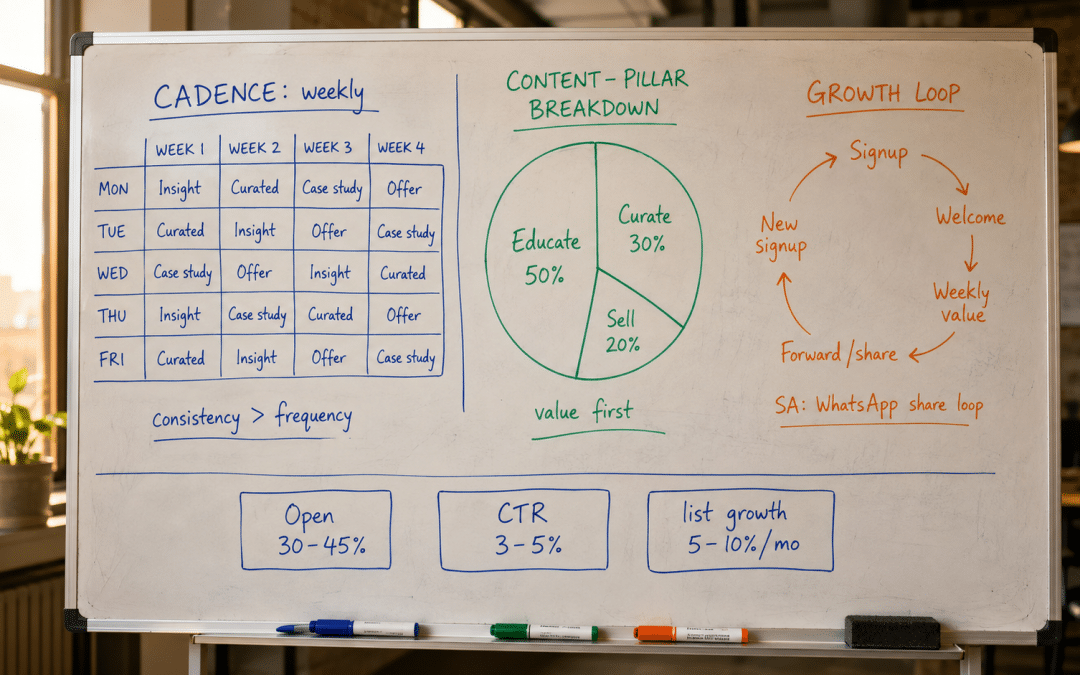
Newsletter strategy South Africa is the discipline of turning a recurring email into a compounding business asset — consistent cadence, a value-first content mix, and a growth loop — not the sporadic "company update" most SA businesses abandon by month three. Built well it is the most durable owned channel in our email marketing South Africa guide. Below: cadence, content pillars, list growth, and how it differs from the broader SA channel strategy.
Quick Answer
Newsletter strategy South Africa works on three pillars: consistent cadence (weekly or fortnightly, never sporadic), a value-first mix of roughly 50% educate, 30% curate, 20% sell, and a growth loop where every issue earns new subscribers. Aim for 30-45% opens and 5-10% monthly list growth. The mistake is treating it as a sales channel — a send that only sells gets unsubscribed, while one that consistently gives builds trust that eventually sells for you.
Thinking of launching a newsletter but not sure it'll survive past issue three? Let's pressure-test the idea.
Get a Free Newsletter Concept SessionNewsletter Strategy South Africa: The Three Pillars
A durable recurring publication rests on cadence, content mix, and a growth loop — get all three right and it compounds, miss one and it stalls. The table sets out what each pillar demands of an SA business before the first issue goes out.
| Pillar | The Standard | Why It Matters |
|---|---|---|
| Cadence | Weekly or fortnightly, fixed day | Consistency beats frequency; monthly is forgettable |
| Content mix | ~50% educate, 30% curate, 20% sell | Value-first earns the right to sell later |
| Growth loop | Sign-up capture + shareable value | Every issue should recruit new readers |
| One primary CTA | One dominant action per issue | Multiple competing links dilute every click |
| Owned list | Your database, not a rented feed | No algorithm can throttle your reach |
The pillars are not local invention — they are the consensus of publishing research. According to HubSpot's newsletter research, a strong cross-industry benchmark sits around a 40-45% open rate, a regular schedule builds the trust that occasional brilliance cannot, and the single most important structural decision is committing to one dominant call-to-action per issue. What changes for SA senders is the growth loop, where local sharing behaviour gives a specific edge.
Why a Recurring Publication Beats Sporadic Sends
A newsletter earns its keep precisely because it is recurring — the rhythm builds a habit in the reader that no one-off campaign can. Sporadic "we have news" emails train subscribers to ignore you; a dependable weekly slot trains them to expect you.
The trust compound
Every issue that delivers genuine value makes the next one more likely to be opened. Over months this compounds into a relationship where the reader trusts the sender's judgement — and trust is what converts when the occasional sell arrives. A business that shows up helpfully every week for six months has earned a hearing that no cold campaign can buy.
The owned-audience advantage
Social platforms rent you reach and can throttle it overnight; a subscriber list is yours. For SA businesses wary of algorithm changes and rising ad costs, a recurring publication is the one channel where reach cannot be taken away. This is the same owned-audience logic behind our SA benchmark guide — the list is the asset, the send is how you keep it warm.
The top-of-mind effect
In long SA B2B sales cycles, the business the buyer remembers when they are finally ready is usually the one that stayed visible. A fortnightly insights send keeps a firm present through months of consideration at a fraction of the cost of staying visible through paid channels — which is why professional-services firms in particular find the format pays back.
The Consistency Insight
Consistency matters more than frequency, and more than any single brilliant issue. A dependable fortnightly send that always arrives beats a weekly one that skips whenever things get busy, because the reader's habit is built on reliability. Pick a cadence you can sustain through your busiest month, not your calmest — the send that survives is the one whose schedule was set honestly at the start.
Want a content mix and cadence mapped to what your team can realistically sustain?
Get a Free Editorial PlanThe Content Mix: Value First, Sell Last
The content ratio is what separates a publication people keep from one they mute. Lead with value, curate generously, and reserve selling for a small, honest slice. The mix below is the durable default for SA businesses.
Educate (about 50%): the core. Practical how-to, industry analysis, answers to the questions your customers actually ask. This is the value that earns the open and builds the authority — the reader should get something useful even if they never click through or buy.
Curate (about 30%): the underrated pillar. Rounding up the best of what is happening in your sector — with a line of your own perspective on each — positions you as the trusted filter. Curation is cheaper to produce than original content and often more valuable to a busy reader, and it keeps the cadence sustainable.
Sell (about 20%): the earned slice. Offers, launches, and direct calls-to-action belong here, framed as relevant to the value already given. Because you have spent 80% of the issue giving, the 20% that asks lands as a natural next step rather than an intrusion. Our automation guide covers turning these into evergreen flows.
The mute-button trap: A send that is 80% selling and 20% value gets unsubscribed or muted within a few issues, taking the list's deliverability down with it. Selling every issue feels efficient and quietly destroys the asset — the more you sell, the less the selling works, because the trust that made it work is gone.
The Growth Loop: Every Issue Should Recruit
A newsletter strategy South Africa that only serves the existing list slowly shrinks, because every list decays. The fix is a growth loop — a system where each issue actively brings in new readers rather than waiting for them to arrive.
Capture everywhere. A prominent sign-up on the website, at checkout, in email signatures, and in social bios. Treat the sign-up page as a first impression, not an afterthought — a clear promise of what the reader will get and how often lifts conversion sharply.
Make it shareable. Every issue should contain at least one thing worth forwarding. For SA businesses specifically, the WhatsApp forward is a powerful and underused loop — a genuinely useful issue gets passed into group chats, reaching readers no ad ever would. Add a simple "forward this to someone who needs it" line and a one-tap share.
Reward referrals. Even a light incentive for subscribers who bring a friend turns the list into an acquisition engine. The mechanics need not be elaborate; the ask, made consistently, is what compounds. For high-value segments, a second channel touch keeps the loop turning.
The Growth-Loop Insight
The newsletters that grow without an ad budget are the ones where distribution is designed into every issue, not bolted on afterwards. Sign-up capture in five places, one genuinely shareable item per send, and a standing invitation to forward — that combination turns readers into recruiters. A publication without a loop is a slowly draining bucket; one with a loop is a flywheel that spins faster the longer it runs.
Before and After: What a Real Strategy Changes
The table below reflects the typical trajectory for an SA business moving from sporadic "company update" emails to a structured, value-first publication over six months. Figures are indicative composites from SA benchmark ranges.
| Metric | Before (sporadic updates) | After (structured strategy) |
|---|---|---|
| Open rate | 12-18% | 30-45% |
| Cadence | Irregular, skipped often | Weekly or fortnightly, reliable |
| List growth | Static or shrinking | 5-10% per month |
| Content ratio | Mostly selling | 50/30/20 value-first |
| Revenue influence (R250k store) | Negligible, hard to attribute | R20,000-R38,000 / month influenced |
Launch Mistakes That Kill Momentum Early
Most SA businesses that abandon the format do so for predictable reasons, and each is avoidable if you know it is coming. Knowing the failure modes before you start is far cheaper than learning them at issue five.
Over-promising the cadence. Committing to weekly when the team can barely sustain fortnightly is the classic opening error. The first few issues arrive on time, then a busy month hits, a send is skipped, and the habit breaks. Set the rhythm against your busiest season, not your keenest week — you can always increase frequency later once the engine runs itself.
Perfectionism paralysis. Waiting for the flawless template, the perfect design, and a month of banked content before launching means most never launch at all. A plain, useful, reliably-sent issue beats a beautiful one that ships once and dies. Start lean, ship consistently, and improve in public — readers reward reliability over polish.
No single owner. When responsibility is shared across a team, it belongs to nobody, and the send quietly stops. Assign one accountable owner with the time protected in their calendar. A recurring publication is a habit before it is a marketing channel, and habits need a person, not a committee.
Chasing subscriber count over engagement. A vanity race for raw numbers pulls in readers who never open, dragging deliverability down and flattering the dashboard. A smaller, engaged audience outperforms a large, indifferent one every time. Measure the right thing from issue one and the growth that matters follows.
Measurement and Reporting Discipline
Strong newsletter strategy South Africa programmes report on engagement and growth, not send count. Track open rate, click rate, list growth net of churn, forward and share rate, and revenue influenced — never issues published as if activity were the outcome. Forward rate especially is the truest signal of whether the content earns its place, because a forwarded issue is a reader vouching for you.
Watch the leading indicators, not just the lagging ones. A slow slide in open rate over several issues warns of content fatigue long before the unsubscribe rate spikes; catching it early means adjusting the mix while the list is still healthy. Segment engagement too — your most engaged readers are the seed of your best customers, and they deserve different treatment from the passive majority.
On tooling, disciplined use of the platform's native analytics beats an elaborate stack used badly. Every issue needs a primary goal defined before it is written, and every quarter deserves a review of what the most-opened and most-forwarded issues had in common. That pattern is your editorial compass — build the next quarter's calendar around what already works. The SA strategy guide covers how this feeds the wider channel plan.
The Growth Pulse Media Difference
Growth Pulse Media is run by an operator, not an account team. Before founding the agency, Dirk built and scaled a large SA ecommerce business — running recurring sends on Klaviyo and Omnisend that kept an owned audience warm through slow seasons — so this playbook comes from sustaining a real cadence to a real list, not from a template.
All work is done in-house with a deliberately limited client load. No offshore outsourcing, no junior hand-offs, and reporting built on engagement, list growth, and revenue influenced — never issues shipped as if volume were the result.
If you would rather have this built for you, our managed inbox revenue service includes a full newsletter programme — cadence design, the value-first content mix, growth-loop capture, and POPIA-compliant list building, reported against engagement and rand influenced.
Who This Is NOT For
An honest disqualifier list saves both sides time. A recurring newsletter is the wrong priority right now if any of the following describes you:
You cannot commit to a cadence. A send that skips whenever things get busy trains readers to ignore it. If a reliable weekly or fortnightly slot is not realistic, fix capacity first — an unreliable publication is worse than none.
You only want to sell. If every issue must push a product, the format will fail — subscribers mute a channel that only asks. The value-first ratio is not optional; it is the mechanism that makes the eventual selling work.
You expect fast results. The trust compound takes months to build and the payoff arrives quietly. If the next 90 days must show direct revenue, run paid acquisition alongside and let it mature in the background.
Not sure whether a newsletter or a flow-first approach fits your business? We'll give you a straight answer.
Request a Free Channel Fit ReviewFrequently Asked Questions
How often should a business newsletter go out?
Weekly or fortnightly, on a fixed day, is the durable default — consistency matters more than frequency. Monthly sends are easily forgotten and lose the habit-building rhythm that makes the format work. Choose the cadence you can sustain through your busiest month rather than your calmest, because reliability is what builds the reader's habit and protects your open rates over time.
What should a newsletter actually contain?
Roughly 50% educational value, 30% curated industry content with your perspective, and 20% direct selling. Leading with genuine value earns the trust that makes the occasional sell land as a natural next step rather than an intrusion. A send that is mostly promotion gets muted or unsubscribed within a few issues, taking your deliverability down with it.
How do I grow a newsletter list in South Africa?
Build a growth loop: prominent sign-up capture on your site, at checkout, in email signatures and social bios, plus at least one genuinely shareable item per issue. For SA audiences the WhatsApp forward is a powerful, underused channel — a useful issue passed into group chats reaches readers no ad would. A light referral incentive turns engaged subscribers into recruiters.
How is a newsletter different from email marketing?
Email marketing broadly includes automated flows, promotional campaigns, and transactional messages, each with a narrow immediate goal. It is a specific recurring publication whose value is self-contained and whose purpose is building an ongoing relationship. They complement each other — the publication keeps the list warm and trusting, while flows and campaigns convert that trust into revenue at the right moments.
What open rate should an SA newsletter target?
A strong cross-industry benchmark sits around 30-45%, with rates above 50% exceptional for niche or highly engaged audiences. Opens are directional rather than definitive, though — track click rate, forward rate, and list growth alongside them for the fuller picture. A steady slide in opens over several issues is an early warning of content fatigue worth acting on before unsubscribes climb.
Do I need a special platform to run a newsletter?
No — the same platforms that run your broader email programme handle recurring sends well. Klaviyo suits ecommerce senders, Omnisend offers similar capability at a leaner price, and both manage SA senders and POPIA compliance cleanly. The platform matters far less than the cadence and content discipline; a well-run publication on a basic tool beats a neglected one on a premium platform every time.
Worried a newsletter is just more work with no clear payoff? Bring us your business and we'll tell you honestly whether the format fits — some businesses are better served by flows alone.
Get Your Free Newsletter Strategy for Your SA Business
Growth Pulse Media builds newsletter programmes for South African businesses — sustainable cadence design, a value-first content mix, growth-loop capture built for local sharing behaviour including WhatsApp, and POPIA-compliant list building on Klaviyo or Omnisend. Built by an operator who kept a real owned audience warm through slow seasons while scaling an SA online store, and measured it on engagement and rand influenced.
No obligation — we will get back to you within 24 hours.
Request Your Free Strategy →