
 Add to Preferred Sources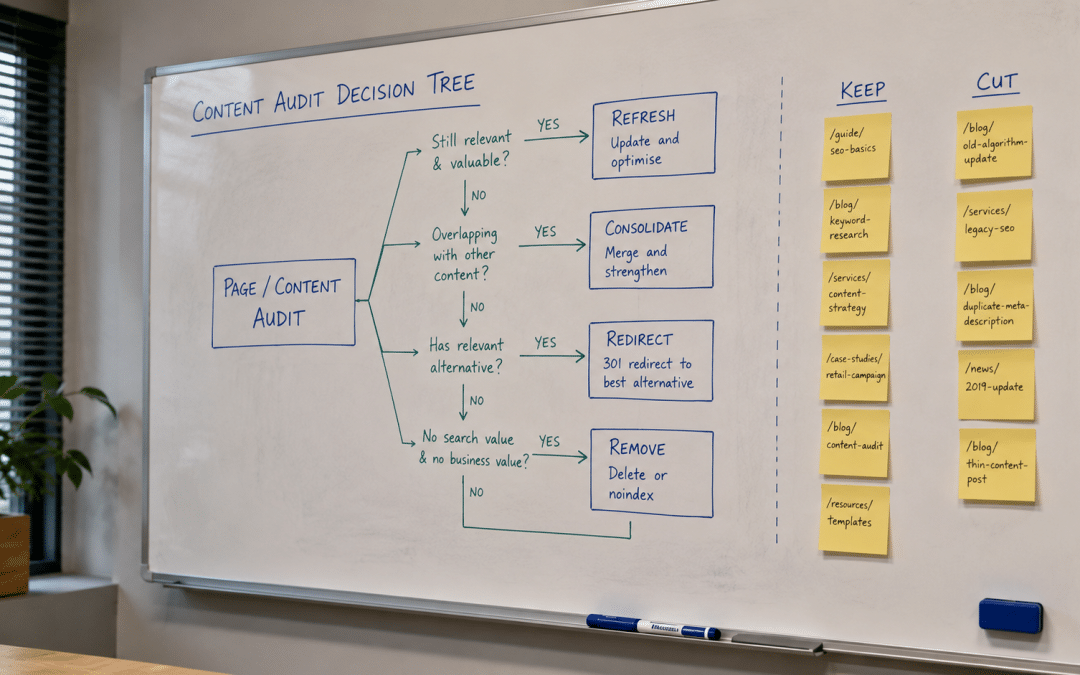
Content pruning seo south africa is the disciplined process of auditing an existing page library and deciding, page by page, whether to refresh, consolidate, redirect, or remove each post — to lift the whole site's quality signal rather than just adding pages.
The single biggest lever it unlocks: Google's Helpful Content system is site-wide, so a library carrying many thin or stale pages can drag down even the strong ones. Removing the dead weight often lifts rankings on pages you never touched.
This guide breaks down the four prune decisions (refresh, consolidate, redirect, remove), the SA-specific audit criteria, the decision tree for each page, and the operator framework for running the audit without nuking pages that quietly earn revenue. For broader cluster context, see the South African search pillar; for the planning counterpart, see our SA content strategy guide.
Quick Answer
A library audit sorts every existing page into one of four actions: (1) Refresh — the page has ranking potential but stale data, thin depth, or weak E-E-A-T; rewrite and re-date it. (2) Consolidate — multiple thin pages target the same query; merge into one comprehensive resource and redirect the rest. (3) Redirect — the page has backlinks or residual traffic but no standalone value; 301 it to a stronger relevant page.
The fourth action: (4) Remove — the page has no traffic, no backlinks, no strategic value, and no realistic ranking path; delete and let it 410 or 301 to the parent. The decision rule: refresh pages with upside, consolidate cannibalising clusters, redirect equity-carrying dead pages, and remove pure dead weight. Per Google's people-first content guidance, the site-wide quality signal means trimming weak pages can lift the entire domain.
Want a quick read on how many of your existing SA pages are quietly dragging down the strong ones — and which action each needs?
Get a Free Content Audit SnapshotWhy Trimming Pages Lifts Rankings on Pages You Never Touched
The core mechanic behind content pruning seo south africa is the site-wide quality signal: Google's Helpful Content system, now part of the core ranking algorithm, evaluates the whole domain — not just individual pages. A site holding a high proportion of thin, stale, or purpose-less pages gets a depressed site-wide signal that suppresses even its strong pages. Trimming the dead weight raises the average, which lifts the pages that were already good.
This is counterintuitive for most SA operators, who instinctively add pages to grow traffic. The instinct is right at the start; it becomes wrong once the library accumulates enough low-quality pages to depress the site-wide signal. The crossover point typically arrives around 40-60 published pages, when the proportion of thin or stale pages reaches a level Google's classifier registers as a site-wide pattern rather than isolated weak pages.
The Site-Wide Signal Operators Miss
Google's quality classifier is site-wide, not page-by-page. A library where 30%+ of pages are thin, outdated, or built purely for rankings depresses the quality signal applied to every page on the domain — including the strong revenue pages. Removing or improving the weak pages can lift rankings on untouched strong pages within 2-6 months, because the site-wide average rises.
Industry data shows refreshed pages generate on average 106% more traffic than publishing new articles on the same topic. The implication for SA operators with 40+ page libraries: a disciplined audit that refreshes the salvageable pages and removes the dead weight typically produces better ROI than writing more new pages. The portfolio's weakest pages are a more valuable lever than its missing pages.
The Four Prune Decisions and When to Use Each
Every page in an existing portfolio sorts into exactly one of four audit actions. The decision for each page depends on three inputs: current traffic, backlink profile, and realistic ranking potential. Getting the action right per page matters because the wrong action destroys value — removing a page with backlinks loses equity; refreshing a page with no ranking path wastes effort.
Decision 1: Refresh (Page Has Upside)
Refresh applies to pages with genuine ranking potential held back by fixable problems: stale data, thin depth, weak E-E-A-T, outdated examples, or missing recent developments. The refresh action rewrites the page to current quality standard, adds original SA data, strengthens the named-author E-E-A-T signal, updates the published date, and re-submits to Google.
In content pruning seo south africa work, operators should prioritise refresh on pages ranking position 8-25 for valuable queries — the pages closest to page-one breakthrough with the least work required.
Decision 2: Consolidate (Multiple Thin Pages, Same Query)
Consolidation applies when several thin pages target the same or near-identical query — the classic cannibalisation pattern. The consolidate action merges the strongest elements of each into one comprehensive resource, then 301-redirects the others to the merged page.
This concentrates ranking signals on one authoritative URL instead of splitting them across competitors. SA operators frequently discover 3-5 page cannibalisation clusters during audits — old blog posts, a service page, and a landing page all targeting the same head term.
Decision 3: Redirect (Equity Without Standalone Value)
Redirect applies to pages that carry backlinks or residual traffic but no longer justify standing as separate pages. The redirect action 301s the page to the most relevant stronger page, preserving the link equity and guiding any residual traffic to useful content.
The key distinction from removal: redirect when there's equity worth preserving; remove when there's nothing of value. SA operators should always check the backlink profile before removing any page — an unexpected media mention or partner link makes redirect the correct action.
Decision 4: Remove (Pure Dead Weight)
Removal applies to pages with no traffic, no backlinks, no strategic value, and no realistic path to ranking. The remove action deletes the page and lets it return 410 (gone) or 301s to the parent category.
This is the hardest action for SA operators emotionally — sunk-cost attachment to pages that took effort to produce. But the site-wide signal mechanic means keeping dead pages actively harms the strong pages; removal is a net positive for the domain even though it feels like loss.
Trying to work out which of your SA pages need refresh versus consolidate versus a clean removal?
Get a Free Prune Decision MapThe SA-Specific Audit Criteria Most Generic Guides Miss
An audit run on SA-specific criteria surfaces different priorities than a generic global audit. SA operators auditing against global checklists routinely keep pages that don't serve the SA market and remove pages that quietly earn SA-local visibility. The criteria below reflect the actual conditions of the SA search market rather than generic global advice.
| SA Audit Criterion | Why It Changes the Decision |
|---|---|
| SA geographic qualifier present | Pages with "south africa" / city modifiers face less global competition and rank more reliably — keep and refresh even at low current traffic |
| Local-pack / GBP relevance | Pages supporting Google Business Profile and local-pack visibility carry value beyond their organic traffic — rarely remove |
| SA regulatory content (POPIA, B-BBEE, NCR) | SA-specific compliance pages earn AI citation that global content cannot — high keep priority even at modest traffic |
| Rand-denominated pricing or local data | First-party SA data points are scarce and citation-valuable — refresh rather than remove, update the figures |
| Old WhatsApp / load-shedding / SA-event content | Time-bound SA content can be evergreen-refreshed (update the year, the context) rather than removed |
| Thin global explainer with no SA angle | Generic "what is X" pages with no SA context are the prime remove/consolidate candidates — they earn nothing and depress the signal |
The SA Page Most Operators Wrongly Remove
The single most common SA audit error is removing low-traffic pages that carry a geographic qualifier or support local-pack visibility. A page ranking position 15 for "service + city" with 12 monthly visitors looks like dead weight on a traffic-only audit — but it may be one refresh away from local-pack inclusion, where it would convert far above its organic traffic. SA-local pages should be assessed on conversion potential and local-pack relevance, not raw traffic.
The mirror error: keeping thin global explainer pages for their impressions. A "what is email marketing" page with 200 monthly impressions and zero clicks (fully summarised by AI Overview) is depressing the site-wide signal while earning nothing — a textbook remove or consolidate candidate. SA operators should weight the audit toward local value and away from vanity impression counts.
Real SA Before-and-After: An Operator Content Audit
The pattern below reflects a Johannesburg-based B2B services site, 84 published pages accumulated over 4 years, monthly organic sessions of 18,600 before the audit. The before-state reflects the pre-audit library; the after-state reflects 5 months after a disciplined audit that refreshed 22 pages, consolidated 18 pages into 6, redirected 9, and removed 14 — taking the library from 84 pages to 52 stronger pages.
| Metric | Before (84-page library) | After (52-page pruned library) |
|---|---|---|
| Total published pages | 84 | 52 |
| Monthly organic sessions | 18,600 | 27,400 |
| Pages ranking position 1-10 | 11 | 29 |
| Pages with zero clicks (90 days) | 38 | 4 |
| Average position (tracked commercial keywords) | 14.2 | 6.8 |
| Organic-sourced qualified leads / month | 29 | 71 |
| Crawl budget spent on zero-value pages | ~45% | ~8% |
What Drove the Lift
The library shrank 38% (84 to 52 pages), but organic sessions grew 47% and page-one rankings nearly tripled (11 to 29). The lift came mostly from pages that were never touched in the audit — strong pages that rose once the site-wide signal stopped being dragged down by 38 zero-click dead-weight pages. The refreshed pages contributed directly; the removed pages contributed indirectly by lifting everything else.
The crawl-budget shift (45% to 8% spent on zero-value pages) accelerated re-indexing of the strong pages. Qualified leads grew 145% as the audit concentrated ranking signals on the commercial pages that actually convert. The operator lesson: a smaller, stronger library outperforms a larger, diluted one. For the strategic frame on what to keep, see our SEO mistakes guide; for the AI Overview dimension, our AI SEO guide.
How Growth Pulse Media Approaches Content Audits
Most SA agencies avoid audit work entirely — it bills less than producing new pages and it requires admitting that some of the client's existing pages (sometimes the agency's own prior work) are dead weight.
That conflict of interest produces libraries that keep growing without ever being pruned, accumulating site-wide signal drag year after year. The right approach to content pruning seo south africa treats the audit as foundational, not optional — a stronger portfolio is worth more than a bigger one.
Dirk ran a real SA ecommerce business through the entire arc of the Helpful Content system rollout — direct experience watching a bloated library suppress strong product and category pages, then watching those same pages recover after a disciplined prune.
That operator seat applied to your SA audit produces decisions tuned to which pages quietly earn revenue versus which merely exist — the distinction that separates a safe prune from one that accidentally nukes a converting page.
SA businesses sitting on a 40+ page library that has stopped growing in rankings can use our search engine optimisation service, which covers the full audit, the per-page decision map, the consolidation and redirect execution, and the refresh production for salvageable pages. We pair audit work with the planning framework from SA content strategy and the diagnostic discipline from SA technical audit.
Who Content Pruning Is NOT For
A disciplined audit fits SA sites with substantial existing libraries that have plateaued or declined. It does not fit operations in specific situations where the audit assumptions break down. Here is who should look elsewhere first.
SA sites with under 20 published pages: The site-wide signal mechanic that makes pruning powerful only kicks in once a library is large enough to register a site-wide quality pattern. Sites under 20 pages rarely have enough dead weight to depress the signal meaningfully — the work for small libraries is building foundational depth and topical coverage, not pruning. Removing pages from an already-thin site usually hurts more than it helps.
Operations expecting instant ranking recovery: The site-wide signal re-evaluation after a prune takes 2-6 months to reflect in rankings, because Google's classifier reassesses the domain gradually rather than instantly. SA operators expecting next-month recovery from an audit consistently abandon the work at week 4, before the re-evaluation completes. The audit is a 3-6 month investment, not a quick fix.
Sites without analytics or Search Console history: The audit decision per page depends on traffic data, backlink profile, and ranking history. Sites with no GA4 history, no Search Console data, or recently migrated analytics cannot make informed prune decisions — removing pages blind risks deleting quiet earners. The prerequisite for an audit is at least 6 months of reliable performance data to assess each page against.
Operators unwilling to remove their own prior work: The hardest part of any audit is the emotional sunk-cost attachment to pages that took real effort to produce. SA operators who refuse to remove or consolidate underperforming pages — because they remember writing them — produce half-audits that leave the dead weight in place.
That forfeits most of the site-wide signal lift. The willingness to cut is the gating discipline; without it, the audit produces a list nobody acts on.
Wondering whether your SA library is actually large enough and data-rich enough for a content audit to move the needle?
Get a Free Audit Readiness CheckThe discipline carrying all of this is treating the library as a managed asset rather than an ever-growing archive. Every page either contributes to the site-wide quality signal or detracts from it; there is no neutral page.
SA operators who audit on a regular cadence — annually for stable sites, quarterly for fast-publishing ones — maintain a strong site-wide signal that compounds; operators who only ever add pages accumulate drag that eventually suppresses even their best work.
The 2026 SA market makes content pruning seo south africa more valuable than ever because the Helpful Content system is now continuous and site-wide, the AI Overview era rewards depth over volume, and crawl budget on bloated libraries is increasingly wasted on pages that will never rank.
The binding constraint remains operator discipline — running the audit honestly against real performance data, making the hard removal decisions, and committing to the 3-6 month re-evaluation window rather than abandoning when rankings don't move in week 4.
Frequently Asked Questions
What is content pruning in SEO for South African businesses?
Content pruning is the disciplined process of auditing an existing page library and deciding, page by page, whether to refresh, consolidate, redirect, or remove each post — to lift the site-wide quality signal rather than just adding pages. Because Google's Helpful Content system evaluates the whole domain, removing thin or stale pages can lift rankings on strong pages that were never touched. For SA sites, the audit weights local-pack relevance and geographic qualifiers heavily.
Does removing pages actually improve SEO rankings?
Yes, when done correctly. Google's quality classifier is site-wide, so a library where 30%+ of pages are thin or stale depresses the signal applied to every page. Removing or improving the weak pages can lift rankings on untouched strong pages within 2-6 months. The caveat: only remove pages with no traffic, no backlinks, and no strategic value — pages carrying equity should be redirected, not deleted.
How often should South African businesses audit their content?
Stable sites publishing slowly should run a full audit annually. Fast-publishing sites (2+ posts per week) should audit quarterly to prevent dead-weight accumulation. The trigger for an off-cycle audit is a plateau or decline in organic traffic despite continued publishing — a classic sign the site-wide signal is being dragged down by accumulated thin content. SA sites under 20 pages rarely need formal audits yet.
What's the difference between refreshing and removing content?
Refresh applies to pages with ranking potential held back by fixable problems — stale data, thin depth, weak E-E-A-T; you rewrite and re-date them. Remove applies to pages with no traffic, no backlinks, no strategic value, and no realistic ranking path; you delete them.
The decision hinges on upside: if the page can realistically rank with work, refresh it; if it cannot and carries no equity, remove it. Industry data shows refreshed pages generate 106% more traffic on average than new articles on the same topic.
Will pruning content hurt my existing South African search traffic?
Only if done carelessly. Removing pages with backlinks or residual traffic without redirecting loses equity and can dent traffic. The safe approach: always check the backlink profile and traffic history before any removal, 301-redirect any page carrying equity to a relevant stronger page, and never remove pages blind. SA-local pages with geographic qualifiers should be assessed on local-pack and conversion potential, not raw traffic, because they often earn far above their visitor count.
How many pages should I remove in a content audit?
There's no fixed percentage — it depends on how much dead weight the library carries. Typical SA audits on 4-year-old libraries remove or consolidate 30-45% of pages, but the right number is determined by the per-page decision (traffic, backlinks, ranking potential), not a target. A healthy, well-maintained library may need almost no removal; a bloated one accumulated without discipline may need substantial trimming. Let the data drive the count, not a quota.
Ready Auditing Your SA Content Library With Operator-Tested Prune Decisions?
Growth Pulse Media runs full content audits for SA businesses with plateaued libraries — per-page refresh/consolidate/redirect/remove decisions, backlink-equity protection, consolidation and 301 execution, and refresh production for salvageable pages. Real operator experience pruning a bloated SA library through the Helpful Content system rollout. In-house execution, limited client load, no outsourcing. No obligation — we reply within 24 hours.
Get Your Free Content Audit Strategy Call