A working paid social strategy south africa in 2026 splits along two completely different playbooks — B2B campaigns run primarily on LinkedIn with Meta retargeting layered underneath, while retail campaigns invert the mix (Meta primary, LinkedIn rarely used).
Trying to run one unified approach across both audience types is the most common SA mistake — and the reason most budgets underperform their realistic ceiling by 30-50%. For broader context, start with our social media marketing Johannesburg pillar guide.
This guide covers the B2B paid acquisition framework, the retail playbook, cross-platform budget allocation, creative approach by funnel stage, and the measurement realities that make or break a paid social strategy south africa rollout in 2026. Per IAB South Africa data, paid media on Meta and LinkedIn is the second-largest category in the SA digital advertising market — but most SA brands run it without a deliberate platform-by-platform plan.
Quick Answer
The right paid social strategy south africa depends almost entirely on whether your audience is B2B or retail.
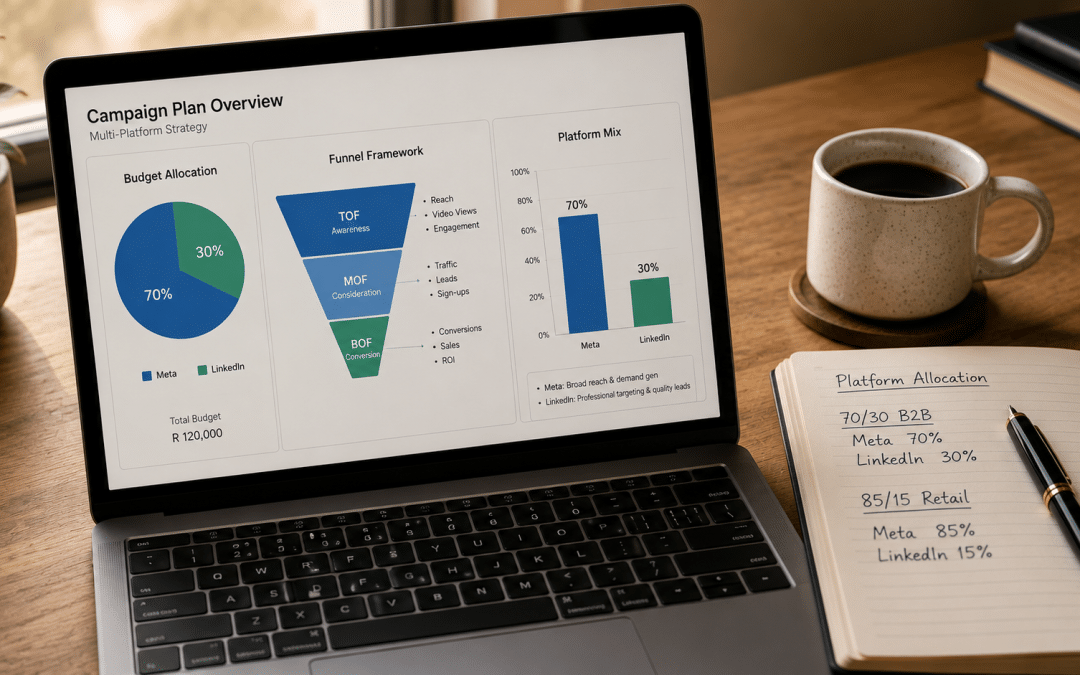
B2B campaigns (R 50,000+ deal sizes, decision-maker targeting) allocate roughly 70-80% of paid spend to LinkedIn, 20-30% to Meta (Facebook + Instagram) for retargeting. Retail campaigns (sub-R 5,000 AOV, consumer audiences) flip the ratio — 75-85% on Meta, 10-15% on Pinterest for category-specific discovery, almost zero on LinkedIn.
Three SA-specific realities reshape global paid playbooks: (1) SA professional LinkedIn audience is roughly 12-14 million members, smaller than US/EU equivalents, so B2B targeting layers shrink audiences fast, pushing CPC up 30-60% above EMEA averages.
The second: SA retail Meta audiences are 25M+ and competitively priced, with CPC averaging R 4-R 12 versus R 100-R 250 on LinkedIn. The third: cross-platform attribution is broken post-iOS 14.5, meaning the measurement framework matters as much as the channel mix.
Wondering whether your current spend split between platforms is matching the audience economics or fighting them?
Get a Free Platform Mix AuditThe B2B Stack — LinkedIn Primary, Meta Retargeting
The B2B paid social strategy south africa playbook leads with LinkedIn for one structural reason: targeting fidelity (job title, seniority, company size, industry) is the only consumer platform where B2B decision-maker identity is the native data layer.
Meta and other platforms infer professional context from behaviour; LinkedIn members declare it explicitly. For audiences where deal size justifies premium CPC, that targeting precision is worth the 4-6x cost premium.
| Layer | Platform | SA Cost Range |
|---|---|---|
| Top of funnel (awareness) | LinkedIn Sponsored Content + Thought Leader Ads | R 100-R 250 CPC |
| Middle (consideration) | LinkedIn Lead Gen Forms + Document Ads | R 1,400-R 4,500 CPL |
| Bottom (conversion) | Meta retargeting + LinkedIn Message Ads | R 4-R 12 Meta CPC / R 5-R 9 InMail send |
Most SA B2B teams attempt to run conversion-objective campaigns on LinkedIn directly — which produces R 4,500-R 12,000 cost per SQL because the optimisation model burns budget testing audience-creative combinations.
The smarter sequence runs LinkedIn for top-of-funnel awareness and middle-funnel lead capture, then uses Meta retargeting at R 4-R 12 CPC to close warm audiences who first engaged on LinkedIn. Combined cost per SQL routinely lands at R 1,800-R 4,500 — half the LinkedIn-only figure. For platform-specific cost detail, see our LinkedIn ads vs Google ads comparison.
The Retail Stack — Meta Primary, Pinterest Secondary
The retail playbook for SA inverts the B2B stack almost completely. Meta (Facebook + Instagram) is the primary platform for SA retail for three reasons: consumer audiences are 25M+ on Meta versus 12-14M on LinkedIn; visual-product ad formats (Catalogue, Reels, Collection) are purpose-built for sub-R 5,000 AOV impulse purchases.
The third reason: CPC sits at R 4-R 12 for retail audiences, making testing creative iterations economically viable across multiple weekly variations without the spend pressure that LinkedIn pricing creates.
Pinterest plays a smaller but distinctive role for SA retail brands selling fashion, beauty, home decor, and food — categories where the audience plans purchases over weeks rather than minutes.
The Pinterest audience is 80%+ female in SA, skews higher household income, and shows category-research intent that Meta's interest-based targeting cannot match. Allocating 10-15% of a retail budget to Pinterest is justified for the right vertical; for general retail and FMCG, Meta-only is the correct call. For the platform comparison, see Facebook ads vs Instagram ads.
The Cross-Platform Allocation Rule
For SA businesses with mixed B2B and retail revenue streams (uncommon but real — think SaaS-with-marketplace, B2B distributor with consumer arm), do NOT run one blended paid social strategy south africa across both. Split into two completely separate campaign structures with separate budgets, separate creative, separate measurement. The audience economics, optimisation signals, and creative formats are different enough that blended campaigns underperform both pure-play structures.
Practical split: separate Meta Business Manager ad accounts, separate LinkedIn Campaign Manager accounts where budget justifies, separate UTM taxonomies for backend reconciliation. The administrative overhead is real but small versus the 25-40% performance gap that blended structures create.
Cross-Platform Budget Allocation Framework
Beyond the B2B/retail split, the secondary allocation question is how much budget to assign to each funnel stage.
Most SA brands over-invest in conversion-objective campaigns and under-invest in top-of-funnel awareness — which strangles long-term audience expansion and creates dependence on increasingly tight retargeting pools that exhaust within 6-12 months.
| Funnel Stage | B2B Allocation | Retail Allocation |
|---|---|---|
| Top of funnel (awareness) | 40-50% | 30-40% |
| Middle (consideration) | 30-40% | 30-40% |
| Bottom (conversion / retargeting) | 15-25% | 25-35% |
SA retail brands typically over-weight bottom-funnel retargeting to 50%+ because it shows the best reported ROAS — but the inflated ROAS is largely attribution-stuffing of conversions that branded search or direct traffic would have produced anyway. The honest SA plan keeps retargeting under 35% and forces budget into upper funnel where actual new-customer acquisition happens. For the measurement side, see our social media ROI guide.
Creative Strategy by Funnel Stage
The most under-leveraged element of any paid social strategy south africa is creative variation across the funnel. SA brands routinely run the same creative across all three stages — typically a product-shot static image with discount copy — and wonder why awareness audiences disengage while retargeting converts. Different funnel stages need structurally different creative formats.
Top of funnel: video and storytelling formats that introduce brand and product context to cold audiences. SA Meta benchmarks suggest 15-second vertical video (Reels format) outperforms static images by 2-4x on engagement for cold audiences. Middle of funnel: educational content, lead magnets, proof, comparison content.
Bottom of funnel: explicit offer copy, urgency, proof from named customers. Refreshing creative every 14-21 days prevents fatigue, which kicks in around 3-4x frequency for cold audiences and 6-8x for retargeting.
Creative Refresh Cadence Rule
The most expensive creative mistake in any paid social strategy south africa is running the same hero asset until frequency caps tank CTR. Refresh top-of-funnel creative every 14 days, middle-funnel every 21 days, retargeting every 28 days. SA brands without a creative production cadence built into their monthly budget plan inevitably run stale ads at high frequency — paying premium CPC for audience fatigue.
Practical SA mitigation: budget 15-20% of monthly paid spend as production cost for new creative variations, treat the production line as part of the campaign infrastructure rather than a one-off setup, and pre-produce next month's variations before this month's start to avoid mid-month creative gaps.
Measurement Across Platforms — the Attribution Reality
According to IAB South Africa, this category represents the second-largest segment of the SA digital advertising market — yet the measurement infrastructure most SA brands run on is structurally incomplete in 2026. iOS 14.5 attribution gaps cost Meta-reported conversions 5-15% in SA (smaller than US 20-30% gap because SA iOS share is roughly 22-25%), and Meta's January 2026 removal of 7-day and 28-day view windows further dropped attributed conversions by 15-30% globally.
The practical mitigation for any SA plan: install Meta Conversions API (CAPI) for server-side tracking; reconcile platform-reported revenue against backend Shopify, WooCommerce, or CRM revenue weekly; use UTM tagging discipline across all paid channels so cross-platform journey analysis is possible in GA4 or your attribution tool. Without these three layers, platform-reported numbers will systematically misrepresent which campaigns deserve scaling versus cutting. For the deeper attribution view, see our B2B lead generation ROI guide.
Trying to figure out whether your paid social numbers reflect real performance or just what the platforms choose to report?
Get a Free Attribution PlanReal SA Before-and-After Paid Social Strategy in South Africa Rebuild
The pattern below reflects a JHB-based SA B2B SaaS company serving mid-market professional services firms, ACV around R 84,000 (annual subscription).
The before-state was: R 35,000/month split equally across Meta and LinkedIn, single blended campaign structure, conversion-objective campaigns on both platforms, no upper-funnel awareness investment. The after-state is six months after restructuring to the B2B playbook with separated upper/middle/bottom funnel allocation.
| Metric | Before (50/50 blended) | After (70/30 LinkedIn-led + funnel split) |
|---|---|---|
| Monthly spend | R 35,000 | R 38,000 |
| LinkedIn share | 50% | 70% |
| Top-of-funnel spend | ~0% (no TOF) | 40% |
| Average CPC (blended) | R 184 | R 126 |
| Monthly SQLs | 3 (avg) | 11 SQLs |
| Cost per SQL | R 11,667 | R 3,455 |
| Pipeline 90-day attribution | R 252,000 | R 924,000 |
What Drove the Result
Three changes produced most of the lift. First, separating the unified campaign into a proper funnel structure (40% top, 35% middle, 25% bottom) let upper-funnel LinkedIn awareness build the retargeting pool that bottom-funnel Meta then converted at R 4-R 12 CPC — a 15-30x cost-per-touch improvement on the same audience.
Second, shifting from 50/50 platform allocation to 70/30 LinkedIn-led matched the audience economics; the LinkedIn over-investment paid back because middle-funnel Lead Gen Forms qualified at 34% versus 12% for Meta in the B2B audience.
Third, weekly platform-vs-backend reconciliation surfaced approximately 20% of conversions that were happening but not attributed in either platform's dashboard. The combined effect: SQL volume tripled while spend rose only 8.6%, dropping cost per SQL by approximately 70% and lifting attributed pipeline by 267%.
How Growth Pulse Media Approaches Paid Social Strategy in South Africa Planning
Most SA agencies present a paid social strategy south africa proposal as a single budget split across platforms with generic creative recommendations. The B2B-versus-retail distinction is buried, the funnel-stage allocation is ignored, and the measurement layer is left as an afterthought. We build the strategic structure first — audience economics analysis, B2B/retail split, funnel allocation, platform mix, measurement plan — then execute campaigns into that structure with the right creative for each stage.
Dirk built and ran a real SA ecommerce business through full paid social maturity — the cheap-experimentation phase, the agency-mistakes phase, the iOS 14.5 measurement crisis, and the post-rebuild scaling phase. The framework we apply now reflects what real SA paid acquisition actually needs across both B2B and retail audiences, not generic agency proposals built on assumptions that ignore SA market specifics.
For SA businesses ready to take cross-platform paid media seriously, our digital marketing service covers the strategy structure, platform mix optimisation, creative production, and measurement build. We pair it with the broader organic context from social media strategy in SA.
Who This Paid Social Strategy in South Africa Guide Is NOT For
The framework above suits SA businesses with monthly budgets above R 25,000 and clear audience definition (either B2B with named ICP or retail with target buyer persona). Here is who should look elsewhere first.
Pre-PMF businesses still validating audience and offer: The B2B/retail split and funnel-stage allocation above assumes you know who you are selling to and what they are buying. SA businesses still iterating on which audience segment or which offer works should validate fit through direct outreach and small organic tests first. Running paid campaigns against a fuzzy ICP wastes budget at premium platform CPCs without producing actionable learning.
SA businesses spending under R 15,000/month on paid media total: The cross-platform allocation framework requires enough budget per platform to exit each platform's learning phase. Below R 15,000/month total, splitting across LinkedIn and Meta produces sub-threshold spend on both and no usable optimisation signal on either. Stay on one platform until total spend supports the cross-platform structure properly.
TikTok-first brands and influencer-led campaigns: The framework above explicitly excludes TikTok and influencer marketing. SA brands whose primary paid distribution is TikTok creator content or influencer partnerships operate in a different economic model where attribution, audience targeting, and creative iteration follow different rules. The B2B-LinkedIn and retail-Meta playbooks do not apply.
Operators expecting first-month results: Properly-built cross-platform paid acquisition takes 6-12 weeks to produce reliable cost-per-SQL or cost-per-customer figures. SA founders expecting first-month closed-won deals from a fresh structure are measuring before the campaigns have finished their learning cycle. Manage internal expectations or the channel gets cut before it has been given a fair window to prove itself.
Sitting on a budget that has produced some results but never had its platform mix or funnel allocation properly structured?
Get a Free Strategy ResetThe discipline carrying all of this is structural — match the platform mix to the audience economics, match the funnel-stage allocation to the buying cycle, and instrument measurement that survives the platform-attribution gap.
SA brands that build paid social strategy south africa around these three structural choices consistently produce 2-4x improvement in cost per acquisition over generic single-platform single-objective campaigns. SA brands that skip the structural work and run "boost the best-performing post" tactics consistently plateau at mediocre numbers with no path to scale.
The B2B versus retail distinction is the single most important call in 2026 SA paid acquisition planning. Get the platform mix right for your audience type and the budget allocation follows naturally.
Get the platform mix wrong and no amount of creative testing or budget increase rescues the structure. For most SA B2B businesses with deal sizes above R 50,000, the answer is LinkedIn-primary with Meta retargeting; for most SA retail brands with sub-R 5,000 AOV, the answer is Meta-primary with Pinterest where the vertical fits.
Frequently Asked Questions
What is the right paid social strategy in south africa for B2B?
For SA B2B campaigns with deal sizes above R 50,000, allocate roughly 70-80% of paid spend to LinkedIn (where decision-maker targeting works natively) and 20-30% to Meta for retargeting warm audiences first engaged on LinkedIn. LinkedIn's higher CPC (R 100-R 250 versus Meta's R 4-R 12) is offset by the deal-size premium and conversion-rate advantage on B2B audiences.
What is the right paid social strategy in south africa for retail?
For SA retail brands with sub-R 5,000 AOV, allocate roughly 75-85% of paid spend to Meta (Facebook + Instagram combined) and 10-15% to Pinterest where the category fits (fashion, beauty, home, food). LinkedIn is rarely worth the cost premium for consumer retail. Meta's visual-product ad formats (Catalogue, Reels, Collection) are purpose-built for impulse-purchase commerce.
How much should SA businesses spend on paid social strategy in south africa monthly?
Functional minimums vary by platform — R 15,000/month is the threshold for a single platform to exit the learning phase. Cross-platform plans need R 25,000+/month to operate properly. SA B2B mid-market typically runs R 30,000-R 80,000/month total paid spend; SA retail brands typically run R 20,000-R 100,000/month depending on AOV and growth stage.
How should SA businesses split budget across funnel stages?
SA B2B campaigns allocate roughly 40-50% to top of funnel (awareness), 30-40% to middle (consideration / lead capture), and 15-25% to bottom (conversion / retargeting). SA retail campaigns allocate 30-40% top, 30-40% middle, 25-35% bottom. The most common mistake is over-weighting bottom-funnel retargeting to 50%+ — which inflates reported ROAS through attribution-stuffing without actually growing new-customer acquisition.
How is cross-platform attribution handled in paid social strategy south africa?
Cross-platform attribution requires three layers: Meta Conversions API (CAPI) for server-side conversion tracking, weekly backend reconciliation against Shopify or CRM data, and consistent UTM tagging across all paid social channels for GA4 cross-platform journey analysis. Platform-reported numbers underreport conversions by 5-15% in SA (smaller gap than US's 20-30% because SA iOS share is roughly 22-25%) and need backend reconciliation to produce defensible figures.
How long until a new SA paid social strategy in south africa plan produces reliable results?
Properly-resourced cross-platform plans produce reliable cost-per-SQL or cost-per-customer data after 6-12 weeks. Weeks 1-4 are the learning phase where the algorithm collects audience signal. Weeks 5-8 produce the first defensible CPL figures. Weeks 9-12 are where audience targeting and creative get refined enough to drive cost-per-acquisition down. Measuring at week 2-4 produces noise, not signal.
Ready to Build a Paid Social Strategy in South Africa Matched to Your Real Audience Economics?
Growth Pulse Media builds cross-platform plans for SA B2B and retail businesses matching platform mix to audience, funnel allocation to buying cycle, and measurement to the platform-attribution gap. Real operator experience across both B2B SaaS and SA ecommerce. In-house execution, limited client load. No obligation — we will get back to you within 24 hours with a frank read on whether your current platform mix is matched to your audience economics.
Get Your Free Paid Social Strategy Plan