
 Add to Preferred Sources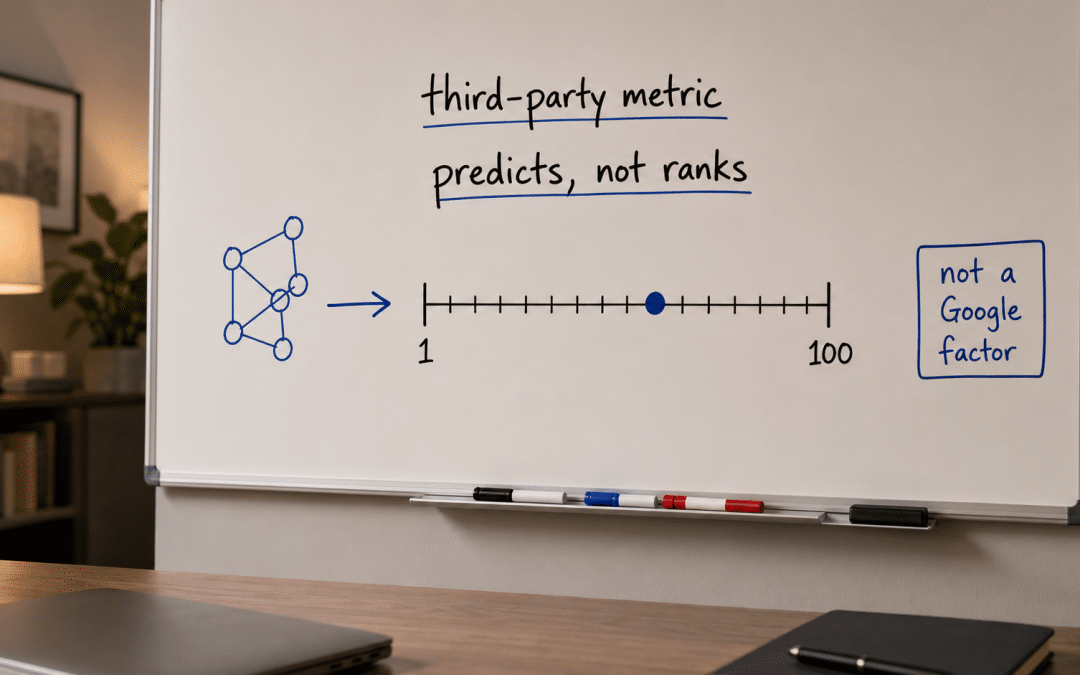
Domain authority south africa is a 1-to-100 score created by the SEO tool company Moz that predicts how likely a website is to rank. The single most important thing to understand is that it is not a Google ranking factor and Google does not use it at all.
For SA businesses this distinction matters concretely: chasing a higher Moz number is not the same as ranking better on Google, and confusing the two wastes effort on the wrong target. This guide explains what the metric actually is, what it is not, and how to use it sensibly, building on our complete SEO guide for South African businesses.
Quick Answer
Domain Authority (DA) is a third-party predictive metric from Moz, scored 1 to 100, that estimates how likely a site is to rank well based largely on its backlink profile. It is not a Google ranking signal — Google has stated repeatedly and explicitly that it does not use any "domain authority" score, and Moz itself says the same. What DA is genuinely useful for is comparison: judging your link strength relative to competitors and tracking the direction of an off-page campaign over time. What it is not useful for is being treated as a target, because optimising the Moz number directly does nothing for your Google rankings — the number moves as a side effect of real link and content work, not the other way round. The most expensive mistake SA businesses make with domain authority south africa is treating a third-party tool's estimate as the goal, then "optimising" for a number Google never looks at while the things that actually rank a site go unaddressed.
Confused about whether your "authority score" actually matters for ranking on Google? It is a common and costly mix-up.
Get a Free SEO Metrics ReviewWhat Domain Authority Actually Is
Domain authority south africa is best understood as a prediction, not a measurement — Moz's machine-learning estimate of ranking likelihood, not a verdict on it. It is calculated from a site's backlink profile and similar off-page signals, then expressed on a 1-to-100 scale where higher means a stronger estimated chance of ranking.
The word that matters in domain authority south africa is "estimate". Moz built DA to approximate how a strong site looks, by learning the patterns common to sites that do rank. It is a model of the outcome, produced by a third party, using its own index of the web — not a window into Google's algorithm. A higher score means Moz's model thinks you look more like sites that rank, nothing more.
According to Search Engine Journal's analysis of domain authority as a ranking factor, Moz's own documentation states the score has no effect on Google results, and Google representatives have confirmed repeatedly that Google uses no such metric. The metric exists; Google's awareness of it does not make it a Google signal.
Domain Authority South Africa: What It Is NOT
Domain authority south africa is not a Google ranking factor, not an official score, and not a number Google can see or act on — and almost every misuse of it traces back to forgetting one of those three things. Being precise about what it is not is more useful than another description of what it is.
| Common Belief | The Reality | Why It Matters |
|---|---|---|
| "Google uses DA to rank sites" | Google uses no domain-authority metric | Optimising DA directly does nothing |
| "Higher DA = higher rankings" | DA predicts, it does not cause | The number follows real work, not vice versa |
| "DA is an objective score" | It is one tool's model of the web | Other tools give different numbers |
| "A DA drop means a penalty" | It often means Moz changed its model | Score moves are not always your fault |
| "DA is the goal" | It is a proxy for the goal | Chasing the proxy misses the target |
The pattern is consistent: every misuse comes from treating a third-party prediction as if it were the thing being predicted. Moz's number is a useful mirror of your link strength; it is not the algorithm looking back at you, and a business that forgets that ends up optimising a reflection.
The "we boosted our DA so why aren't we ranking" trap is the most common domain authority south africa mistake. An SA business buys or chases links that lift its Moz number but adds nothing Google values, sees the score rise, and is then baffled that rankings did not move.
The DA went up because the model saw more links; Google ignored those links entirely. The number improved and the actual position did not, because they were never the same thing.
Want to know whether your link and authority work is moving Google rankings or just a third-party number?
Get a Free Off-Page SEO AuditDomain Authority South Africa: Why It Is Still Useful
Domain authority south africa is worth tracking despite not being a Google factor, because a good proxy still tells you something — just not the thing people assume.
Used correctly it answers comparative questions; used incorrectly it answers the wrong question confidently.
It is useful as a competitive comparison
The real value of domain authority south africa is relative, not absolute. A score of 30 means little alone, but knowing your competitors sit at 45 while you sit at 30 is a genuine signal that your off-page profile is weaker than the field you are competing in. The number is a benchmark against rivals, not a grade against an objective standard.
It is useful as a direction indicator over time
Tracked over months alongside real work, domain authority south africa shows whether an off-page campaign is moving the needle on link strength in the right direction. It will not tell you your Google position, but a steadily rising DA during a deliberate link-building effort is reasonable evidence the effort is building the kind of profile that tends to rank.
Use It as a Compass, Never as a Destination
The mental model that makes domain authority south africa safe to use is treating it as a compass, not a destination. A compass is useful because it points in a direction relative to other things; it becomes useless the moment you start walking toward the compass itself instead of the place it indicates. DA points: it tells you roughly where your link strength sits relative to competitors and whether it is trending up or down. It does not arrive: reaching a particular number is not reaching a ranking, because Google never reads the number. Every productive use of DA is comparative and directional; every destructive use treats the score as the goal and "optimises" it directly, which moves a third-party estimate while leaving the actual rankings — and the work that drives them — completely untouched.
Domain Authority South Africa: DA-as-Target vs DA-as-Proxy
Domain authority south africa produces opposite outcomes depending on whether it is used as a target or as a proxy — same metric, two completely different results. The before-state is the common target-chasing misuse; the after-state is the disciplined proxy use that actually helps.
| Dimension | DA as a Target (before) | DA as a Proxy (after) |
|---|---|---|
| What is optimised | The Moz number directly | Real links and content that the number reflects |
| Effect on Google rankings | None — Google ignores DA | Rankings move because the real work moved them |
| How the score is read | As an absolute grade to raise | As a competitive benchmark and trend line |
| Reaction to a score drop | Panic about a "penalty" | Checked against Moz model changes first |
| Budget outcome | Spent chasing a number Google ignores | Spent on work that ranks and moves DA as a side effect |
For the work that actually moves both rankings and DA in the right direction, our explainer on what link building is for SA businesses covers the off-page effort DA is a proxy for, and how SEO works in South Africa sets the broader context — domain authority is a gauge on the dashboard, not the engine.
Domain Authority South Africa: How It Is Actually Calculated
Understanding how domain authority south africa is built makes its limits obvious — once you see it is a model of links, you stop expecting it to behave like a Google verdict. Moz calculates the score using a machine-learning model trained on its own crawl of the web, not Google's.
The dominant input is the backlink profile: how many other sites link to yours, how many unique domains those links come from, and the estimated quality of those linking sites.
Moz feeds these signals into a model that has learned what the link profiles of ranking sites tend to look like, then expresses the result on the 1-to-100 scale. It is a similarity score — how much your link profile resembles those of sites that rank in Moz's index.
Two consequences follow directly. First, the scale is logarithmic: moving domain authority south africa from 20 to 30 is far easier than 70 to 80, because the model deliberately makes high scores rare. A flat score after real work is often normal, not failure. Second, the number can move when Moz retrains its model even if your site did not change at all — a score shift is not automatically a signal about your site.
This is also why different tools disagree. Ahrefs Domain Rating, Semrush Authority Score, and Moz DA are separate models built on separate indexes, so the same site scores differently in each. None is "correct" because none is Google — they are independent estimates, useful only within their own tool and compared like-for-like against competitors measured by that same tool.
It Is a Model of Links, Not a Verdict on You
The fact that collapses most domain authority south africa confusion is that the score is a third-party model's similarity estimate, not a judgement from Google about your site. Every odd behaviour follows from this: it moves when Moz retrains rather than when your rankings change; it is logarithmic so progress looks slow at the top; and it disagrees with Ahrefs and Semrush because each is a different model on a different index. None of that is a flaw to fix — it is simply what a predictive model is. The practical takeaway is to read any single tool's authority score only against competitors measured by that same tool, and never to treat a movement in it as if Google had spoken, because Google was never in the conversation.
How Growth Pulse Media Treats Authority Metrics
Most agencies report domain authority as a headline number because it looks like progress and is easy to move with low-quality links, which is exactly the wrong incentive. Growth Pulse Media's SEO work for South African businesses reports DA only as a comparative and directional indicator alongside the metrics that actually reflect revenue, because a rising third-party score next to flat rankings and flat leads is not progress, it is a vanity number.
The operator background behind GPM means authority metrics are read for what they genuinely indicate — competitive position and campaign direction — not dressed up as the outcome. Work is executed in-house and judged on rankings, traffic, and leads, so there is no incentive to inflate a Moz number that the people doing the work know Google never reads.
Who This Guide Is NOT For
Understanding domain authority correctly matters for anyone evaluating SEO, but this guide is not the right focus for several situations, and saying so prevents wasted attention.
Businesses with no SEO or link activity at all. Domain authority is a proxy for off-page work that does not yet exist for a business doing no SEO. For them the foundational question is whether to invest in organic search at all — a third-party authority metric is a refinement of an effort that has not started.
Operators who want a single number to report upward. Anyone looking for one tidy score to put in a board deck will misuse DA, because its only honest use is comparative and directional. A single absolute number presented as "our SEO health" is exactly the misreading this guide exists to prevent.
Businesses being sold "DA boosting" services. If a provider is offering to raise your domain authority as the deliverable, that is a signal to be cautious — the honest deliverable is rankings and leads, with DA moving as a by-product. Buying DA increase as a product usually buys low-value links Google ignores.
Those expecting DA to diagnose a ranking drop. If rankings fall, domain authority is not the diagnostic tool — it is a slow, third-party estimate, not a Google signal. The investigation belongs in Search Console and the actual SERP, not in a Moz score that may not have moved at all.
Ready to find out which of your SEO metrics actually predict revenue and which are just comfortable numbers?
Get Your Free SEO Metrics DiagnosisDomain Authority South Africa: Frequently Asked Questions
What is domain authority in simple terms?
Domain authority is a 1-to-100 score created by the SEO tool company Moz that predicts how likely a website is to rank, based largely on its backlink profile. Higher means Moz's model estimates a stronger chance of ranking.
The key word is "predicts". It is a third-party estimate of ranking potential, not a measurement of actual Google performance, and not something Google itself uses or sees.
Does Google use domain authority as a ranking factor?
No. Google has stated repeatedly and explicitly that it does not use any "domain authority" metric in its ranking algorithm, and Moz itself confirms DA has no effect on Google results. It is a third-party tool's score, not a Google signal.
This is the single most important fact about the metric. Treating it as something Google acts on leads directly to optimising a number that has no effect on your actual rankings.
If Google ignores it, why track domain authority at all?
Because a good proxy is still useful for comparison and direction. DA lets you benchmark your off-page strength against competitors and track whether a link-building campaign is trending the right way over time.
The value is relative, never absolute. "Our DA is 30" means little; "our DA is 30, our competitors are at 45, and ours is rising" is a genuinely useful read of competitive position and momentum.
What is a good domain authority score in South Africa?
There is no universal good score — it is entirely relative to your competitors in your specific market and industry. A score that is strong for a small local SA service business would be weak for a national publisher.
The right domain authority south africa question is never "is my number good" but "how does my number compare to the sites I actually compete with for the searches that matter to my business".
How do I increase my domain authority?
You do not increase DA directly — you do the real off-page and content work it is a proxy for, and the number follows. Earning quality, relevant backlinks and removing toxic ones is what moves both rankings and, as a side effect, the Moz score.
Anything that promises to raise DA as the deliverable itself is usually buying low-value links that move the number without moving Google. The score is an outcome of good work, not an input to it.
My domain authority dropped — was my site penalised?
Usually not. A DA drop frequently reflects Moz updating its own model rather than anything wrong with your site, and it is not a Google penalty because Google does not use the metric at all.
If rankings actually fell, that is investigated in Google Search Console and the live results — not in a third-party score, which may not even correlate with the change you are worried about.
Get an Honest Read on Your SEO Metrics
Growth Pulse Media will tell you which of your SEO numbers actually predict rankings and revenue and which are vanity metrics — including exactly how to read domain authority as the comparative proxy it is, not the goal it is often sold as, with the reasoning, not a "we'll boost your DA" pitch. Built by operators who report metrics for what they genuinely indicate, judged on rankings and leads. No obligation — we will get back to you within 24 hours.
Get Your Free SEO Metrics Review