
 Add to Preferred Sources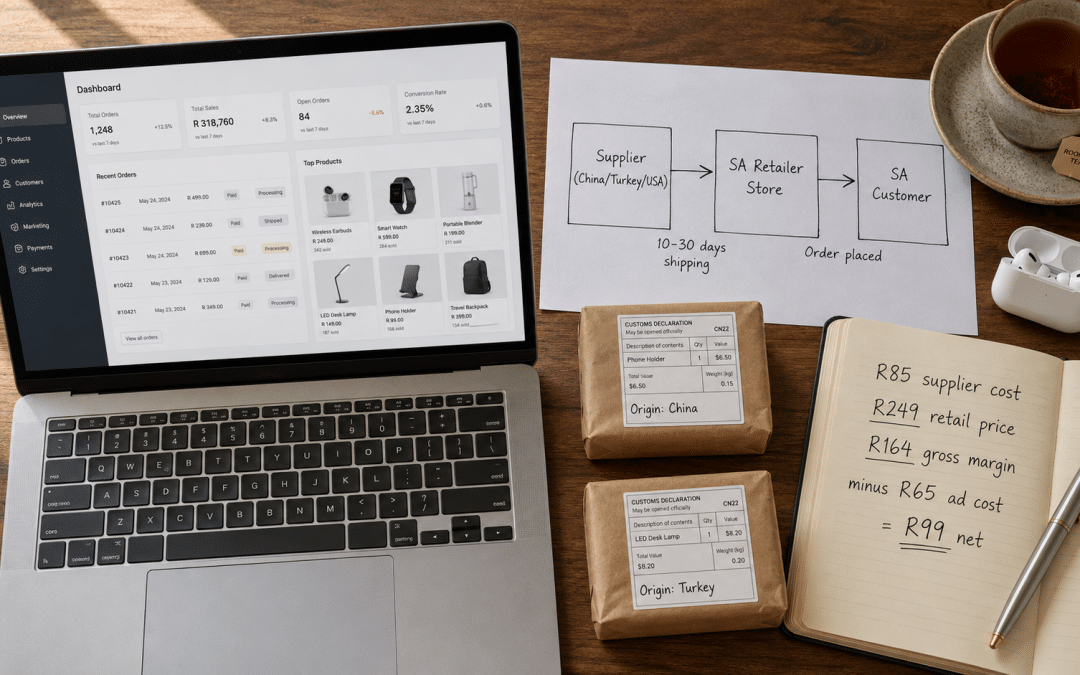
What is dropshipping in south africa? Dropshipping is an ecommerce business model where you sell products through your online store without holding physical inventory — when a customer orders, the product is shipped directly from a supplier (typically based overseas in China, Turkey, or the USA) to the SA customer, with you keeping the margin between supplier cost and retail price.
For South African entrepreneurs, dropshipping offers a low-startup-cost entry to ecommerce — typically requiring R1,500-R5,000 to launch versus R50,000+ for a traditional inventory-based store. This guide breaks down how dropshipping works in the SA market, realistic profitability expectations, supplier options accessible from South Africa, the regulatory considerations under the Consumer Protection Act, and the honest trade-offs SA dropshippers face. For the broader context, see our complete ecommerce marketing guide for South African businesses.
Quick Answer
Dropshipping in South Africa works the same way as anywhere else — you list products in your online store, the customer pays you, you pay the supplier, and the supplier ships directly to the SA customer. The practical reality is harder than most YouTube tutorials suggest. SA-specific challenges include international shipping times of 10-30 days that erode customer experience, customs duties and VAT obligations on imported goods, exchange rate volatility affecting margins, and the Consumer Protection Act giving customers strong return rights regardless of where the product shipped from. Successful SA dropshippers in 2026 typically focus on local SA suppliers via platforms like Bidorbuy, niche products with high perceived value, and Shopify or WooCommerce stores with strong brand presence — rather than the generic AliExpress dropship-everything model that dominated the 2018-2021 era.
Want to skip dropshipping and start a real SA ecommerce business with proper margins?
Get a Free Ecommerce Strategy SessionWhat Is Dropshipping in South Africa: The Mechanics Explained
The mechanics of what is dropshipping in south africa execution follow a consistent pattern regardless of which platform or supplier you use. Understanding the actual flow is critical because most failed SA dropshipping attempts come from misunderstanding one of the four core steps.
The four-step dropshipping flow
Step one in what is dropshipping in south africa execution: a SA customer visits your online store (typically Shopify, WooCommerce, or Wix) and places an order, paying you the retail price through a SA payment gateway like PayFast, Peach Payments, or Ozow. Step two: your store automatically (or manually) forwards the order details to your supplier with the customer's SA shipping address.
Step three: the supplier picks, packs, and ships the product directly to the SA customer — typically from an overseas warehouse in China, Turkey, the USA, or occasionally from local SA wholesalers. Step four: tracking information flows back to your store and to the customer via automated email or SMS notifications, and the supplier retains the wholesale price while you keep the margin.
The Hidden Cost Reality
The headline appeal of dropshipping — "sell without holding inventory" — masks several hidden costs that catch new SA dropshippers off-guard. The realistic per-order cost structure for what is dropshipping in south africa execution includes the supplier wholesale price, international shipping fees passed through to the merchant, customs duties (typically 20-45% depending on product category), 15% VAT on the customs value plus duties, payment gateway fees of 3-4% on each transaction, advertising cost to acquire the customer (often R40-R150 per converted sale), and approximately R10-R25 per order in apps, subscriptions, and platform fees. After all these costs, net margin on a typical R299 dropshipping product often lands at R30-R90, which is why volume and customer retention matter more than headline product mark-ups.
What Is Dropshipping in South Africa: Realistic Profitability
The profitability question for what is dropshipping in south africa execution depends substantially on product category, supplier relationships, marketing efficiency, and customer service capacity. The honest answer is that SA dropshipping is profitable for a minority of operators willing to invest 6-18 months in learning, testing, and iterating — and unprofitable for the majority who treat it as a get-rich-quick scheme based on social media content.
Typical SA dropshipping margin structure
| Cost Component | Typical % of Sale Price | SA-Specific Notes |
|---|---|---|
| Supplier wholesale cost | 25-40% | Lower for direct-from-manufacturer relationships in China and Turkey. |
| International shipping (passed through) | 15-25% | SA delivery from China typically 10-30 days standard, 7-15 days express. |
| Customs duties and VAT | 10-25% | Highly category-dependent; clothing, electronics, and beauty differ significantly. |
| Payment gateway fees | 3-4% | PayFast, Peach, Ozow typical SA rates. |
| Marketing cost per sale | 15-35% | Meta Ads typically R40-R150 cost per acquired customer for dropshipping. |
| Returns and refund overhead | 3-8% | Returns are operationally difficult with international suppliers. |
| Apps and platform fees | 2-5% | Shopify subscription, app subscriptions, accounting software. |
| Realistic net margin | 5-25% | Successful SA dropshippers operate at the upper end through brand and retention. |
What separates profitable from unprofitable SA dropshippers
The profitable minority of SA dropshippers share specific operational characteristics: they pick narrow niches rather than selling random trending products, they negotiate direct supplier relationships rather than relying on default AliExpress retail pricing, they invest in genuine brand building rather than treating their store as disposable, they prioritise customer retention through email marketing and post-purchase experience, and they treat customer service as a core function rather than an afterthought.
What Is Dropshipping in South Africa: Supplier Options
Supplier choice is the highest-leverage strategic decision in what is dropshipping in south africa execution because it determines product quality, shipping times, return logistics, and margin structure. SA dropshippers have three distinct supplier categories to evaluate, each with meaningful trade-offs.
International suppliers (AliExpress, Alibaba, CJ Dropshipping)
International Chinese-based suppliers are central to what is dropshipping in south africa execution for most operators — they offer the broadest product catalogue, lowest wholesale pricing, and the most mature dropshipping integration ecosystems (DSers, AutoDS, Spocket). The trade-off is 10-30 day shipping times to SA, customs and duty calculations every customer must absorb, and customer service complexity when products arrive damaged or incorrect.
According to Shopify's complete dropshipping guide, working with suppliers that store inventory near customer locations is one of the highest-impact factors in customer satisfaction.
Turkish and European suppliers
Turkish suppliers (via platforms like Trendsi for fashion) and European suppliers offer middle-ground options for SA dropshippers — shipping times typically run 12-22 days to SA, customs treatment is similar to Chinese suppliers, and product quality is often higher than budget Chinese alternatives. Turkish fashion suppliers in particular have grown popular with SA dropshippers selling apparel because the design aesthetic appeals to SA consumers and minimum order quantities are flexible.
Local South African suppliers
Local SA-based suppliers (sourced through Bidorbuy wholesale, Makro Business, or direct relationships with local wholesalers and small manufacturers) offer the strongest customer experience — 2-5 day delivery times via The Courier Guy or Aramex, no customs complications, no exchange rate volatility, and easier returns processing.
The trade-off is higher wholesale pricing (typically 40-60% of retail versus 25-35% for Chinese suppliers) and narrower product range. SA dropshippers building sustainable businesses increasingly favour local supplier networks despite the margin compression.
Need help deciding whether dropshipping or proper ecommerce is the right model for your SA business idea?
Get a Free Business Model RecommendationWhat Is Dropshipping in South Africa: The Consumer Protection Act Reality
SA's Consumer Protection Act creates legal obligations for dropshippers that international YouTube tutorials never address — and ignoring these obligations creates genuine business risk. The CPA gives SA consumers strong statutory rights regardless of whether the product shipped from a Johannesburg warehouse or a Chinese factory, and as the seller of record, the dropshipper bears legal responsibility.
Key CPA obligations for SA dropshippers
SA dropshippers in what is dropshipping in south africa execution must honour the statutory 7-day cooling-off period for online sales, meaning customers can return products for any reason within 7 days of receipt.
SA dropshippers must provide goods that match their description and are fit for purpose — supplier defects do not absolve the seller of legal responsibility. SA dropshippers must process refunds within reasonable timeframes (typically 7-15 business days) when consumers exercise return rights, even if the supplier has not refunded them yet.
The practical compliance challenge
The operational difficulty of CPA compliance creates the single biggest pain point for new SA dropshippers. A R299 product sold to a SA customer triggers full CPA liability — the customer can demand a refund, exchange, or repair within 6 months for defective goods, regardless of whether the dropshipper has recovered cost from the overseas supplier.
Profitable SA dropshippers build a returns reserve fund (typically 5-10% of revenue) specifically to honour CPA obligations even when supplier recovery fails.
What Is Dropshipping in South Africa: Platform Options
The platform you choose for what is dropshipping in south africa execution determines integration options, transaction fees, available themes, and the maturity of the dropshipping app ecosystem. The four practical platform options for SA dropshippers each have distinct characteristics.
| Platform | Monthly Cost (Approx) | Best For SA Dropshippers |
|---|---|---|
| Shopify Basic | R720/month | Most mature dropshipping app ecosystem (DSers, Spocket, AutoDS), strong SA payment gateway integration. |
| WooCommerce on WordPress | R200-R900/month | Lower base cost but more technical setup; better for dropshippers with existing WordPress experience. |
| Wix Ecommerce | R450/month | Beginner-friendly but more limited dropshipping integrations than Shopify or WooCommerce. |
| Local SA marketplaces | 10-15% fee per sale | Bidorbuy or Takealot Marketplace for testing dropshipping models without store infrastructure. |
The Shopify advantage for South African dropshippers
Shopify dominates SA dropshipping in 2026 for legitimate reasons — the dropshipping app ecosystem is more mature than any competitor, the integration with local payment gateways (PayFast, Peach Payments, Ozow) is straightforward, the local courier integrations (The Courier Guy, Aramex, PUDO) work natively, and the marketing app ecosystem (Klaviyo, Omnisend) handles South African email and SMS workflows.
The trade-off is the R720/month base cost, which becomes meaningful for stores in early testing phase but trivial at scale.
The Before-After Reality for SA Dropshippers
The operational difference between an SA dropshipper executing strategically versus following YouTube template advice crystallises into specific business outcomes over a 12-month execution period. Below is a realistic comparison for an SA dropshipper starting with R10,000 capital and R5,000 monthly marketing budget.
| Metric | Template Approach (Before) | Strategic Approach (After) |
|---|---|---|
| Months to first sale | 2-6 months of trial and error | 3-6 weeks with niche focus |
| Typical net margin per order | 5-12% on AliExpress products | 18-28% on niche or local SA products |
| Customer complaint rate | 15-30% of orders | 3-8% with local suppliers |
| Repeat purchase rate | 2-6% within 6 months | 15-28% within 6 months |
| Payment gateway approval status | Often suspended for chargebacks | Stable PayFast and Peach accounts |
| Months to R30,000 monthly revenue | 12-24 months if achieved at all | 4-9 months with proper execution |
| Realistic month-12 net profit | R0-R5,000 (most quit) | R12,000-R40,000 for committed operators |
| Probability of still trading at month 18 | 10-20% | 45-65% |
The table makes the strategic point clear — dropshipping is not impossible in SA, but the difference between profitable and unprofitable execution is enormous. The template-driven approach (sell trending AliExpress products with Meta Ads to broad audiences) has a roughly 10-20% probability of producing a viable business by month 18.
The strategic approach (niche focus, brand building, local supplier mix, customer retention) raises that probability to 45-65% — still not guaranteed, but reasonable for a business with real economics.
The Honest Trade-off
Dropshipping is genuinely a real business model with real successful SA operators behind it — but it requires the same commercial discipline as any other ecommerce business, not less. The "passive income through dropshipping" narrative dominant on social media is largely fiction; profitable SA dropshippers typically work 30-50 hours weekly on customer service, product testing, supplier negotiation, ad optimisation, and content creation. If the appeal of dropshipping is genuinely "lower startup cost than traditional ecommerce" rather than "easier than other businesses", the math can work. If the appeal is "passive income with no work", the probability of meaningful success is close to zero.
Why GPM Approaches Ecommerce Model Selection Differently
Most SA marketing agencies will happily run paid ads for any ecommerce model the client wants — what is dropshipping in south africa execution, traditional inventory, print-on-demand, subscription. That approach produces revenue for the agency but does not always serve the client's long-term commercial outcomes, because dropshipping at low margins requires fundamentally different marketing economics than inventory-based ecommerce at proper margins.
Growth Pulse Media builds ecommerce marketing programmes for South African businesses by starting with honest business model analysis before committing to marketing spend. We have run dropshipping and traditional ecommerce stores ourselves, watched both models succeed and fail across different SA niches, and seen the operator-level realities that template content creators never discuss. The model recommendation comes before the marketing recommendation.
Our typical engagement with SA dropshipping operators starts with a 7-day commercial audit — calculating true unit economics including all hidden costs, evaluating supplier relationships and shipping reliability, auditing CPA compliance and returns workflow, modelling the 12-month profit trajectory honestly, and providing the recommendation on whether to continue dropshipping, pivot to a hybrid model, or transition to traditional ecommerce before any marketing tactical work begins.
Who Dropshipping in South Africa Is NOT For
Being upfront about who should not pursue dropshipping saves time, capital, and disappointment. The SA dropshipping ecosystem has a high failure rate primarily because the model is pursued by people for whom it was never going to work.
Anyone expecting passive income from dropshipping. The "passive dropshipping income" narrative is the single most damaging myth in SA ecommerce. Profitable SA dropshippers spend 30-50 hours weekly on operations, customer service, ad testing, and supplier management. If your motivation for dropshipping is avoiding work rather than building a real business, the probability of meaningful success is close to zero regardless of capital invested.
SA businesses with capital and inventory storage capacity. If you have R50,000+ to invest and somewhere to store stock, traditional inventory-based ecommerce will produce 2-4x better unit economics than dropshipping. Dropshipping's only structural advantage is avoiding inventory cost and risk. Once you can absorb inventory cost and risk, the model becomes structurally inferior to holding stock, controlling shipping times, and managing returns directly.
Brands selling premium positioned products. Dropshipping's economics break for products with average order values above R1,500 because the trust deficit created by 14-day international shipping erodes the conversion rate disproportionately on considered purchases. Premium SA brands should use traditional ecommerce with local inventory and proper packaging to support the price positioning. Dropshipping works structurally better for impulse purchases under R600 than for considered purchases above R1,500.
SA operators unable to commit 12+ months to learning. Profitable dropshipping requires extensive product testing, ad iteration, supplier negotiation, and customer service development that takes 6-18 months to learn. SA operators seeking results within 60-90 days will quit before reaching the learning curve where the business becomes profitable. The capital cost is low; the time and patience cost is high.
Want help deciding whether dropshipping or traditional ecommerce fits your SA business situation?
Book a 20-Minute Ecommerce Model Fit CallFrequently Asked Questions
Questions on what is dropshipping in south africa execution that come up most often when SA entrepreneurs first start evaluating the model and trying to separate the marketing hype from operational reality.
How much money do I need to start dropshipping in South Africa?
Realistic minimum capital to start dropshipping in SA is R5,000-R15,000 covering the Shopify or WooCommerce subscription for the first 2-3 months, dropshipping app subscriptions, initial advertising budget for product testing, payment gateway setup fees, and a small reserve for refunds and chargebacks during early learning.
Starting with less than R5,000 is technically possible but practically very difficult because product testing requires meaningful ad spend before profitable products emerge. Most successful SA dropshippers report spending R10,000-R25,000 across the first 6 months before reaching consistent profitability.
Is dropshipping legal in South Africa?
Dropshipping is fully legal in South Africa. SA dropshippers must register as a sole proprietor or private company through CIPC, register for income tax with SARS, register for VAT once turnover exceeds R1 million annually, comply with the Consumer Protection Act for all SA customer sales, and pay customs duties and VAT on imported goods.
The legal obligations are no different from any other ecommerce business — dropshipping does not avoid SA business regulation simply because inventory is held overseas.
What are the best products to dropship in South Africa?
The best dropshipping products for the SA market typically share specific characteristics — average order values between R250-R800 (impulse purchase range), broad demographic appeal rather than narrow niche, easy to demonstrate visually for Meta Ads, low return rates (under 8%), and minimal sizing complexity. Categories that perform consistently include phone accessories, home gadgets, beauty tools, fitness accessories, pet supplies, and seasonal novelty items.
Categories with structural problems for SA dropshipping include fashion apparel (sizing returns), electronics (CPA warranty obligations), perishables (shipping incompatibility), and high-ticket items (trust deficit from shipping times).
How long does dropshipping delivery take to South Africa?
Standard international dropshipping delivery to SA typically runs 14-30 days from order placement, depending on the supplier's origin country and shipping method. Express shipping options through ePacket or DHL typically reduce this to 7-14 days but add R45-R120 to the shipping cost.
Local SA suppliers obviously deliver faster — 2-5 business days via The Courier Guy or Aramex. The shipping time gap between international and local suppliers is the single biggest customer experience factor for SA dropshippers and explains why local supplier networks are growing faster than international ones in 2026.
Can I dropship from Takealot or Amazon to South African customers?
Technically yes, but this is dropship arbitrage rather than traditional dropshipping, and both Takealot and Amazon prohibit it in their terms of service. Operators caught dropshipping from these platforms face account suspension, payment holds, and potential legal action. The model is also commercially weak because the margins after fees rarely justify the risk.
Legitimate SA dropshipping uses dedicated dropshipping suppliers (AliExpress sellers, Spocket suppliers, direct wholesale relationships, or local SA wholesale networks) rather than retail marketplace arbitrage.
What is the success rate of dropshipping in South Africa?
Honest data on SA dropshipping success rates is limited, but operator-level estimates suggest that 10-20% of SA dropshipping stores reach R10,000+ monthly profit by month 12, while 80-90% either fail to reach profitability or quit before the business matures. Strategic operators with niche focus, local supplier mixes, and customer retention discipline reach 45-65% probability of still trading profitably at month 18.
The success rate is significantly lower than traditional ecommerce primarily because dropshipping attracts operators expecting easier outcomes — the structural economics are tighter and unforgiving to inexperienced execution. Treating dropshipping as a serious business model rather than a side hustle dramatically improves the probability of success.
Get Your Custom Ecommerce Model Recommendation for Your SA Business Idea
Receive a custom evaluation of whether what is dropshipping in south africa execution makes sense for your specific business idea, capital position, time availability, and target audience — versus alternative ecommerce models that might produce stronger unit economics. Built by operators who have run both dropshipping and traditional ecommerce stores in the SA market. No obligation — we will get back to you within 24 hours.
Request Your Custom Model Recommendation