
 Add to Preferred Sources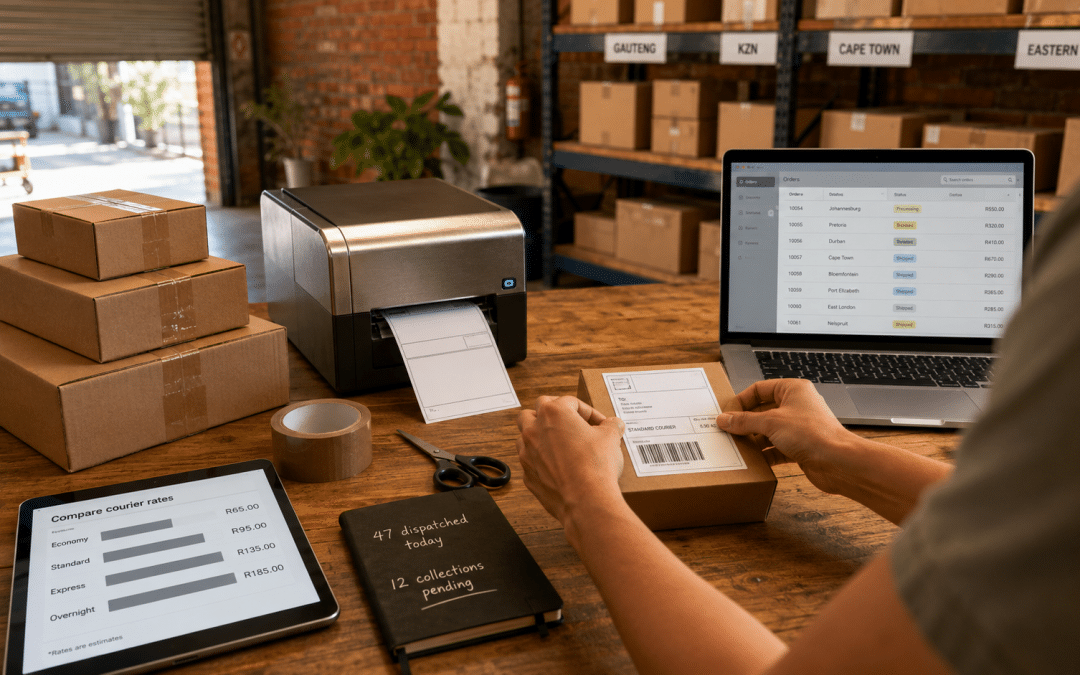
Ecommerce fulfilment south africa covers the operational infrastructure that takes a customer's online order from cart confirmation to delivered parcel — including inventory storage, order picking, packing, courier collection, last-mile delivery, returns processing, and the integration layer that connects your store platform to all of it. For most SA ecommerce businesses doing under 1,000 monthly orders, this means in-house packing combined with a courier partnership through The Courier Guy, Aramex, Fastway, or PUDO Locker-to-Locker.
Above that order volume, the decision shifts toward outsourced third-party logistics providers (3PLs) running dedicated SA warehouse capacity. This guide breaks down the realistic fulfilment options, costs, courier comparison, integration requirements, and the decision framework SA ecommerce operators use to scale fulfilment without breaking unit economics. For the broader context, see our complete ecommerce marketing guide for South African businesses.
Quick Answer
Effective ecommerce fulfilment south africa execution combines three operational layers — a primary courier partnership covering 90%+ of standard parcel deliveries, a secondary courier for failed deliveries or specific regions, and locker network coverage through PUDO or Pargo for cost-conscious customers in metro areas. Most SA ecommerce stores between 100-1,000 monthly orders use in-house packing with The Courier Guy or Aramex as the primary courier, typically achieving R55-R110 per parcel delivered fee depending on weight, destination, and volume commitments. Stores above 1,000 monthly orders should evaluate third-party logistics partners running dedicated SA warehouses — typical 3PL pricing in 2026 lands at R28-R55 per order for pick-and-pack plus separate courier fees. The single biggest fulfilment cost driver for SA ecommerce is failed first-attempt deliveries, which add R45-R85 per parcel in re-delivery costs and erode margins on lower-value orders disproportionately.
Want a fulfilment setup recommendation tailored to your specific SA ecommerce order volume and product mix?
Get a Free Fulfilment Strategy SessionEcommerce Fulfilment South Africa: The Operational Components
A working ecommerce fulfilment south africa programme consists of seven distinct operational components that must integrate seamlessly for cost-efficient execution. Most SA ecommerce stores underperform on fulfilment economics not because of courier rates, but because of weak integration between components — orders sit unpacked while operators manually copy addresses, parcels get dispatched to wrong couriers because rate cards are not consulted, and failed deliveries are not flagged for proactive re-collection arrangement.
The seven components
Component one of ecommerce fulfilment south africa execution is inventory storage and management — physical product held either in-house or at a 3PL warehouse, with accurate digital stock counts synchronised to the store platform. Component two is order receipt and routing — orders flowing from Shopify or WooCommerce to a centralised dispatch view where they can be batched and picked efficiently.
Component three is pick and pack — physically gathering products, packaging appropriately for the courier service, and producing accurate shipping labels. Component four is courier rate comparison and dispatch — selecting the right courier for each parcel based on weight, destination, and customer-selected service speed. Component five is collection and tracking — handing parcels to the courier with verified tracking numbers entered into the order system.
Component six is last-mile delivery and customer communication — proactive notifications to customers throughout the delivery journey, handling re-delivery attempts when first delivery fails. Component seven is returns processing — receiving returned parcels, inspecting condition, restocking sellable inventory, and processing customer refunds or exchanges.
Ecommerce Fulfilment South Africa: Courier Comparison and Pricing
The courier comparison for ecommerce fulfilment south africa execution is more nuanced than headline rate cards suggest — pricing depends substantially on parcel weight, dimensions, destination, volume commitments, and whether the courier is collected via integrated booking platforms versus walk-in retail counters. SA ecommerce operators committing to 100+ monthly parcels typically negotiate rates 20-35% below published retail courier pricing.
| Courier | Typical Rate (1kg, metro) | Best For |
|---|---|---|
| The Courier Guy (TCG) | R65-R95 | Door-to-door delivery, broadest network, strong Shopify and WooCommerce integration. |
| Aramex | R75-R110 | Express overnight delivery, premium positioning, strong international handling. |
| Fastway / PostNet | R55-R85 | Cost-conscious metro delivery, slower turnaround acceptable. |
| PUDO Locker-to-Locker | R45-R70 | Lowest-cost metro option, customer collects from locker network. |
| Pargo Pickup Points | R50-R75 | Click-and-collect at thousands of retail counter pickup points. |
| RAM Hand-to-Hand | R85-R130 | Heavier parcels (10kg+), B2B-style deliveries to business addresses. |
| SAPO Speed Services | R55-R90 | Outlying area delivery where private couriers do not service. |
| Skynet | R70-R105 | Strong rural and peri-urban coverage; alternative to TCG outside metro. |
The volume-discount reality
Published courier rates are designed for occasional senders — businesses dispatching 100+ monthly parcels with consistent volume should negotiate dedicated account pricing as part of their ecommerce fulfilment south africa cost strategy. Typical SMB ecommerce account pricing with The Courier Guy lands at R55-R80 per metro parcel for 100-500 monthly volumes, dropping further to R45-R65 per parcel at 500-1,500 monthly volumes. The same volume commitment with Aramex typically yields 15-25% discounts off published rates.
The Failed Delivery Cost Trap
The most expensive mistake in ecommerce fulfilment south africa execution is treating courier rates as the total delivery cost. The full cost per delivered parcel includes the headline courier rate plus an allocation for failed first-attempt deliveries — which run 8-18% in the SA market depending on customer demographic, neighbourhood, and order value. A R65 base courier rate with a 12% failed-delivery rate that costs R55 in re-delivery has a true unit cost closer to R72 per parcel. Smart SA ecommerce operators model the true unit cost and design checkout, address verification, and SMS notifications to minimise the failed-delivery rate rather than only chasing courier rate negotiations.
Ecommerce Fulfilment South Africa: In-House vs Third-Party Logistics
The most strategic ecommerce fulfilment south africa decision facing SA operators is whether to keep packing in-house or outsource to a third-party logistics provider running dedicated warehouse capacity. Both models work, but they suit different business stages — getting the transition timing wrong costs unit economics either way.
When in-house packing makes sense
In-house packing typically wins for SA ecommerce stores doing under 500 monthly orders, particularly when product margins exceed 50% and order volumes are seasonal rather than steady. At this scale, ecommerce fulfilment south africa execution stays under tight operator control without adding 3PL overhead.
The operational reality is that 100-300 daily parcels can be packed by 1-2 dedicated team members from a small warehouse or office storage space at fixed monthly cost of R12,000-R35,000 covering rent, packaging supplies, and labour. Below 500 monthly orders, the per-order cost of in-house packing typically lands at R15-R45 — competitive with or better than 3PL pricing.
When 3PL outsourcing makes sense
Third-party logistics outsourcing typically wins above 1,000 monthly orders, particularly when order volume is steady year-round or when the business operates from a location where retail rent is expensive. 3PLs aggregate volume across multiple ecommerce clients, achieving economies of scale on warehouse space, picking efficiency, and courier negotiation that single-tenant operations cannot match.
Typical SA 3PL pricing in 2026 runs R28-R55 per order for pick-and-pack with courier rates passed through at the 3PL's negotiated discount, plus monthly storage fees ranging from R450-R1,800 depending on SKU count and storage footprint.
Need help calculating whether in-house or 3PL is the right call for your current SA order volume?
Get a Free In-House vs 3PL AnalysisEcommerce Fulfilment South Africa: Platform Integration Requirements
Platform integration is the operational backbone of efficient ecommerce fulfilment south africa execution — manually copying customer addresses from Shopify into courier booking platforms is a guaranteed way to bleed margin through human error and labour cost. Native integrations between store platforms and courier APIs are now mature enough that SA ecommerce operators have no excuse for manual data entry beyond the smallest volume operations.
Shopify courier integrations available in SA
Shopify has the strongest courier integration ecosystem in SA, with native or app-based integrations available for The Courier Guy, Aramex, Fastway, PUDO, Pargo, and several others through marketplace apps. Setting up courier integration on Shopify typically takes 2-4 hours of configuration covering rate cards, default service speeds, address validation, and label printing workflow.
According to Statistics South Africa's analysis of the rise of e-commerce, courier services have grown significantly between 2019 and 2022 driven specifically by ecommerce demand, with same-day delivery, express, economy, and overnight delivery all expanding to meet rising parcel volumes.
WooCommerce courier integrations available in SA
WooCommerce has solid but less mature courier integration coverage compared to Shopify. The Courier Guy, Aramex, and PUDO all have official WooCommerce plugins, but configuration is typically more technical and requires WooCommerce Shipping extensions to function smoothly. SA ecommerce stores running WooCommerce typically need 4-8 hours of technical setup for clean courier integration versus the 2-4 hours typical of Shopify.
Ecommerce Fulfilment South Africa: The Returns Layer
Returns processing is the most underrated component of ecommerce fulfilment south africa operations — SA ecommerce stores with poor returns handling lose customers permanently after a single bad returns experience, while stores with smooth returns build repeat-customer rates 30-50% higher than category averages. The Consumer Protection Act gives SA online consumers a statutory right to return goods within 7 days of receipt, which means returns are not optional infrastructure.
The returns components
Effective SA returns operations as part of ecommerce fulfilment south africa execution need four working components: an obvious returns policy displayed prominently before checkout (not buried in footer), a self-service returns initiation portal where customers generate return labels without phoning support, a return collection mechanism using the same courier network (most SA couriers offer return waybills priced 50-70% of outbound rates), and inspection-and-restock workflow that resolves refunds within 5-10 business days of receipt.
Returns rate benchmarks
SA ecommerce returns rates vary substantially by category. Fashion and apparel typically run 15-25% returns rates, electronics 5-12%, beauty and skincare 3-8%, and home goods 8-15%. Returns cost typically adds R45-R95 per returned item to fulfilment cost — covering reverse courier, inspection labour, and restocking. Building this cost into product margin from day one is the difference between sustainable returns programmes and reactive cost-cutting that damages customer experience.
The Margin Recovery Opportunity
The single highest-leverage optimisation in ecommerce fulfilment south africa execution is reducing fulfilment cost as a percentage of revenue from a typical 14-22% range down to a well-run 7-12% range. That 7-10 percentage point gap is recovered through three operational changes: negotiating courier rates against committed monthly volume (typically 20-35% off published retail rates), reducing failed-delivery rates through address validation and proactive SMS notifications, and batching picking and packing workflows to compress labour cost per parcel. For an SA store doing R500,000 monthly revenue, this margin recovery typically translates to R35,000-R50,000 monthly profit recovered — usually more meaningful than equivalent investment in additional paid advertising.
The Before-After Reality for SA Ecommerce Stores
The operational difference between an SA ecommerce store running ecommerce fulfilment south africa strategically versus running it reactively crystallises into specific business outcomes over a 12-month execution period. Below is a realistic comparison for an SA ecommerce store growing from 200 to 600 monthly orders during the period.
| Metric | Reactive Fulfilment (Before) | Strategic Fulfilment (After) |
|---|---|---|
| Average courier cost per parcel | R85-R120 published rates | R55-R75 negotiated rates |
| Failed first-attempt delivery rate | 14-20% of all parcels | 4-8% with verified addresses |
| True cost per delivered parcel | R100-R145 including failures | R60-R85 with proactive flow |
| Order-to-dispatch time | 36-72 hours typical | 4-24 hours with batched picking |
| Returns processing time | 14-30 days to refund | 3-7 days with portal automation |
| Customer delivery satisfaction | 2.8-3.5 out of 5 | 4.3-4.7 out of 5 |
| Repeat customer rate | 12-18% within 6 months | 32-45% within 6 months |
| Fulfilment cost as % of revenue | 14-22% of GMV | 7-12% of GMV |
The table makes the strategic point clear — the difference between strategic and reactive fulfilment execution is roughly 8-10 percentage points of gross margin recovered, plus dramatically improved repeat customer rates. For an SA ecommerce store doing R500,000 monthly revenue, that 8-10 percentage point fulfilment cost difference translates to R40,000-R50,000 monthly margin recovered — typically more meaningful than equivalent investment in additional paid advertising.
Why GPM Approaches Fulfilment Strategy Differently
Most SA marketing agencies treat ecommerce fulfilment south africa as outside their scope — they optimise the funnel up to checkout completion and leave the post-purchase experience to the client to figure out. That approach produces strong top-of-funnel campaigns but fails on the post-purchase economics that actually determine ecommerce sustainability. Customer lifetime value is shaped by the delivery experience more than by any pre-purchase touchpoint.
Growth Pulse Media builds ecommerce marketing programmes for South African businesses from operator experience — we have run ecommerce fulfilment south africa execution for our own brand, negotiated courier rates with The Courier Guy and Aramex, integrated PUDO and Pargo into Shopify stores, processed returns through Klaviyo and Gorgias workflows, and tracked failed-delivery rates across customer demographics. The fulfilment recommendations are grounded in operational reality, not consultant theory.
Our typical fulfilment engagement starts with a 10-day operational audit — reviewing the current courier mix and rate cards, calculating true cost per delivered parcel including failed-delivery overhead, evaluating the integration layer between store platform and courier APIs, auditing the returns workflow against SA Consumer Protection Act requirements, and building the 6-month optimisation roadmap before tactical work begins.
Who This Fulfilment Approach Is NOT For
A serious approach to ecommerce fulfilment south africa optimisation is not the right fit for every SA ecommerce business. Being upfront about that saves wasted time on both sides and prevents misallocated operational investment.
SA ecommerce stores doing fewer than 50 monthly orders. At very low order volumes, fulfilment optimisation is not the highest-leverage investment — getting to product-market fit and consistent traffic is more urgent. SA ecommerce stores below this volume should use any reliable courier with retail walk-in service, optimise customer acquisition first, and revisit fulfilment strategy once order volume justifies the operational investment in optimisation.
SA businesses selling exclusively digital products. Software, courses, downloads, subscriptions, and digital services do not have physical fulfilment requirements — the operational components in this guide do not apply. Digital-only SA businesses should focus optimisation effort on email delivery, customer onboarding, and digital product experience rather than physical fulfilment infrastructure.
Ecommerce stores selling perishable or temperature-controlled products. SA fresh food delivery, frozen goods, pharmacy fulfilment, and similar temperature-sensitive categories require specialist cold-chain courier partnerships and packaging that standard ecommerce fulfilment guides do not cover. The standard courier comparison in this guide does not apply to these categories — specialist food and pharmaceutical logistics providers should be evaluated separately.
SA brands committed exclusively to one courier without comparison. Ecommerce stores already locked into single-courier exclusive arrangements (often for marketing partnership reasons) cannot benefit from the multi-courier strategic approach outlined in this guide. The 8-10 percentage point margin recovery typically requires courier comparison and rate negotiation across at least 2-3 providers — exclusive arrangements forfeit that optimisation lever.
Want help evaluating whether fulfilment optimisation is the right priority for your current ecommerce stage?
Book a 20-Minute Fulfilment Fit CallFrequently Asked Questions
Questions on ecommerce fulfilment south africa that come up most often when SA ecommerce operators start seriously evaluating their fulfilment infrastructure and looking for optimisation opportunities.
What is the cheapest courier for South African ecommerce?
PUDO Locker-to-Locker is typically the cheapest courier for SA ecommerce parcel delivery, with metro rates starting at R45-R70 per parcel. The trade-off is that customers must collect from a locker rather than receiving door-to-door delivery, which reduces convenience for some customer segments. PUDO works particularly well for younger urban customers in metros who prefer locker collection times to home delivery windows.
For door-to-door delivery, Fastway and PostNet typically offer the lowest rates at R55-R85 per metro parcel, with The Courier Guy slightly more expensive but offering significantly better integration coverage and tracking quality.
How does ecommerce fulfillment work in South Africa for small stores?
For SA ecommerce stores doing under 500 monthly orders, fulfilment typically works through in-house packing combined with a primary courier partnership. The workflow runs from order receipt in Shopify or WooCommerce, batched picking from in-house inventory at scheduled times each day, packing with branded packaging materials, label generation through the courier integration, and scheduled daily collection by the courier from the business address.
The full cost for an SA small ecommerce store typically runs R55-R110 per parcel depending on courier choice, weight, and destination. Stores adding R12,000-R35,000 monthly fixed cost for warehouse rent and labour need to factor those into per-order cost calculations as order volume grows.
Should SA ecommerce stores offer free shipping?
Free shipping is one of the strongest conversion levers in SA ecommerce, but it must be costed correctly into product margins to remain sustainable. SA ecommerce stores with average order values above R750 can typically absorb courier costs into product pricing while remaining competitive — typically improving conversion rates 15-30% versus charged shipping.
Below R500 average order values, free shipping often erodes margin unsustainably unless courier rates are aggressively negotiated and packing costs are minimised. A minimum-order-value threshold for free shipping (commonly R500-R800 in the SA market) is the typical compromise that captures conversion benefit while protecting margin on smaller orders.
How long does ecommerce delivery typically take in South Africa?
Metro-to-metro delivery in SA typically runs 1-3 business days for express courier services and 2-5 business days for economy services. Delivery to peri-urban and rural areas typically adds 2-5 additional business days depending on the courier's network coverage in those regions. The Courier Guy and Aramex have the broadest national networks; Fastway is faster in metro areas but slower for outlying regions.
SA ecommerce customers typically expect 2-3 day metro delivery as the baseline standard in 2026. Stores promising next-day or same-day delivery need to support that promise with specific service tier selection and dispatch cut-off times prominently displayed at checkout.
What happens with failed deliveries in SA ecommerce fulfilment?
Failed first-attempt deliveries in SA typically trigger a courier-managed re-delivery attempt within 1-2 business days, at no additional cost to the customer or merchant. If the second attempt also fails, parcels typically return to a nearby courier depot for collection, and a third home delivery attempt usually incurs additional cost (R45-R85 per re-delivery) that is charged back to the merchant.
Stores with high failed-delivery rates should investigate root causes — incomplete addresses captured at checkout, customer absence during delivery windows, or insufficient pre-delivery SMS notification. Address validation tools at checkout combined with proactive delivery SMS notifications can reduce failed-delivery rates from 14-20% down to 4-8% with minimal investment.
What does ecommerce fulfilment typically cost as a percentage of revenue?
Well-run SA ecommerce stores typically run fulfilment costs at 7-12% of gross merchandise value, covering courier fees, packing materials, fulfilment labour, and a reasonable allocation for failed deliveries and returns processing. Reactive or poorly-negotiated operations typically run 14-22% of GMV — the 7-10 percentage point gap usually comes from a combination of unnegotiated courier rates, high failed-delivery rates, and inefficient picking and packing workflows.
The fulfilment cost target varies by category — categories with high return rates like fashion typically run higher fulfilment cost percentages (10-15% of GMV is normal), while categories with low return rates like beauty typically run lower (6-9% of GMV is achievable).
Get Your Custom Fulfilment Optimisation Plan for Your SA Ecommerce Store
Receive a custom ecommerce fulfilment south africa optimisation plan covering your current courier mix analysis, true cost per delivered parcel calculation, in-house versus 3PL evaluation, platform integration audit, and returns workflow recommendations. Built by operators who run SA ecommerce fulfilment daily, not by consultants pretending to understand SA courier networks. No obligation — we will get back to you within 24 hours.
Request Your Custom Fulfilment Plan