
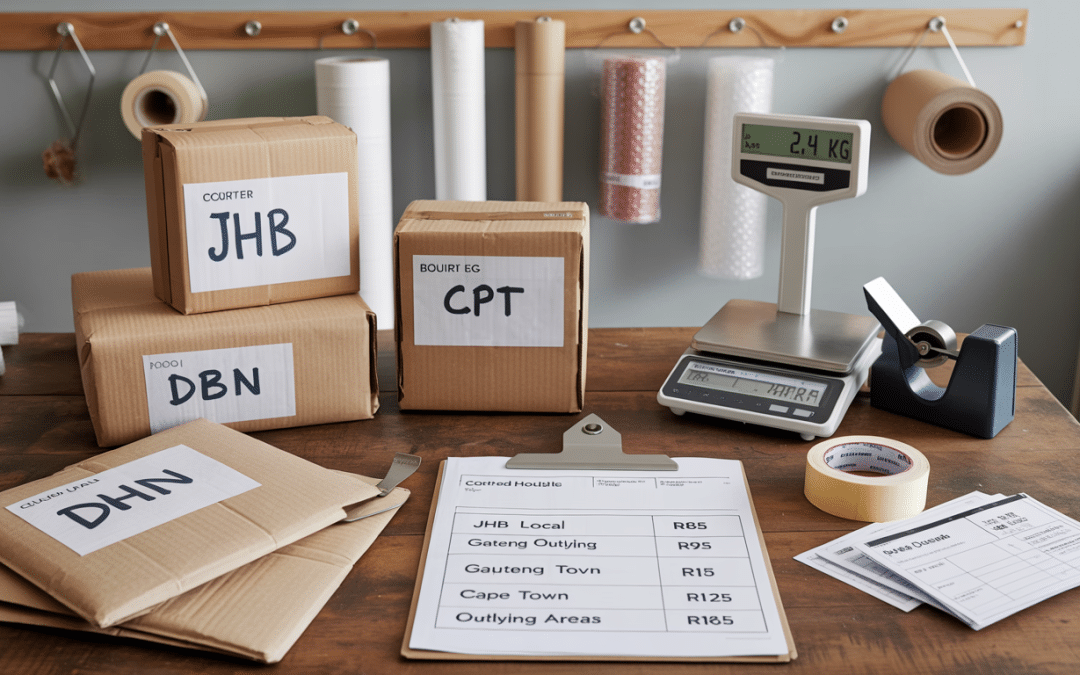
Shopify shipping south africa setup is more complicated than it should be because Shopify has zero native integration with any South African courier. The Courier Guy, Aramex SA, PostNet, RAM, and ShipLogic all require third-party apps or manual workarounds rather than the plug-and-play USPS/FedEx integration that international content assumes.
SA stores running on default Shopify shipping settings typically lose 8-15% of orders to checkout abandonment over incorrect shipping rate calculation, or overcharge customers by R30-R80 per order to compensate. Neither is sustainable.
This guide covers what actually works for shopify shipping south africa stores in 2026 — the three integration paths (app-based, flat-rate, hybrid), real Rand rate benchmarks per zone, and the operator-validated stack that survives high-volume operations. For the broader Shopify context, see our complete Shopify South Africa guide.
Quick Answer
Shopify shipping south africa stores have three viable integration paths in 2026 — app-based real-time rates via Bob Go (formerly uAfrica), Shiplogic, or Pargo Connect; manual flat-rate shipping zones configured directly in Shopify admin; or a hybrid model combining flat rates for predictable products with app-based rates for outsized items. App-based integration costs R299-R1,299/month plus per-shipment fees but eliminates rate-calculation errors. Manual flat rates cost zero but require careful zone configuration and lose 5-10% in margin over-collection or under-collection. Most established SA stores eventually adopt the hybrid model for the balance of accuracy and cost.
Need help choosing the right shipping setup for your specific product mix?
Request a Free Shopify Shipping Configuration ReviewWhy Shopify Shipping South Africa Setup Is Harder Than International Stores
The reason shopify shipping south africa setup is non-trivial comes down to a single structural fact — Shopify's native carrier-calculated shipping supports UPS, FedEx, USPS, Canada Post, and Australia Post out of the box, but has no native support for any SA courier. The Courier Guy, Aramex SA, RAM, PostNet, and ShipLogic all sit outside Shopify's built-in integration layer.
What this means practically
SA stores using default Shopify shipping settings have three problems. First, no real-time rate calculation means customers see flat rates that may not match actual courier costs. Second, no automatic label generation means orders require manual courier portal logins to create waybills. Third, no automatic tracking number sync means customers do not get tracking links unless manually emailed. All three problems compound as order volume grows.
The integration gap is real revenue impact
SA stores running default flat-rate shopify shipping south africa configurations typically experience one of two outcomes — either undercharging by R40-R120 per order when actual courier rates rise (margin destruction over hundreds of orders per month), or overcharging by R30-R80 per order to build a safety buffer (which causes 8-15% checkout abandonment compared to accurately-priced competitors). Neither is good. Both are avoidable with proper integration.
| Setup Type | Monthly Cost | Setup Complexity | Best For |
|---|---|---|---|
| Default flat-rate (no app) | R0 | Low — 1-2 hours | Stores under 50 orders/month with uniform products |
| App-based (Bob Go, Shiplogic, Pargo Connect) | R299-R1,299 | Medium — 4-8 hours | 50-500 orders/month, variable product weights |
| Hybrid (flat + app) | R299-R899 | Medium-High — 6-10 hours | 200+ orders/month, mixed product profile |
| Custom API integration | R0 (own dev) | High — 40-80 hours | 1,000+ orders/month with engineering capacity |
The Three Working Shopify Shipping South Africa Configurations
Most shopify shipping south africa stores eventually land on one of three working configurations after experimenting with the default approach. Each has different cost, complexity, and accuracy trade-offs. The right choice depends on order volume, product weight variation, and the operational cost of inaccurate shipping rates.
Configuration 1 — Flat-rate zone-based shipping (zero-cost path)
This is the default shopify shipping south africa approach configured properly. Set up shipping zones in Shopify admin (Major Metros, Outlying Areas, Outlying Outlying), assign flat rates per zone based on average courier cost plus a 10-15% margin buffer, and accept that some orders will over-collect while others under-collect. Works for stores with under 50 orders/month and products of similar weight (under 2kg variation).
Typical zone structure for SA: Major Metros (Johannesburg, Cape Town, Durban, Pretoria) at R85-R110, Gauteng/Western Cape outlying at R110-R145, KZN/Eastern Cape regional at R125-R175, all other SA at R165-R225. These ranges reflect Courier Guy, Aramex, and Pargo standard rates for sub-5kg parcels in 2026.
Configuration 2 — App-based real-time rates (mid-volume path)
The most common shopify shipping south africa setup for stores processing 50-500 orders/month uses one of three apps that bridge Shopify to SA courier APIs. Each app handles rate calculation, waybill generation, and tracking sync — eliminating the manual workflow gaps in the default setup.
Bob Go (formerly uAfrica): Integrates Courier Guy, Aramex, RAM, Skynet, PostNet. R299-R699/month base + R3-R8 per shipment. Strongest for multi-courier rate shopping.
Shiplogic: White-label courier aggregator with dynamic rate engine. R599-R1,299/month + R5-R12 per shipment. Strongest for high-volume single-courier accounts.
Pargo Connect: Pickup-point delivery network (Pep stores, Postnet, partner outlets). R0 base + per-shipment fees. Strongest for stores where customers prefer collect points over home delivery.
The App Choice Reality
For most shopify shipping south africa stores, Bob Go is the default starting point — it integrates the broadest mix of SA couriers (Courier Guy, Aramex, RAM, PostNet, Skynet) under one app and supports rate-shopping at checkout. Shiplogic becomes the right choice once volume exceeds 500 orders/month and direct courier account negotiations become the cost driver. Pargo Connect is the right addition (not replacement) for any store whose customers prefer collect points — adding pickup-point delivery typically lifts conversion 3-5% in metros where Pep and Postnet are dense.
Configuration 3 — Hybrid flat-rate plus app (operator-grade path)
The configuration most established SA Shopify stores eventually adopt combines flat-rate shipping for predictable-weight products (under 1.5kg, standard packaging) with app-based real-time rates for variable products (over 1.5kg, fragile, oversized). This delivers the cost predictability of flat rates for high-volume SKUs while preserving accurate pricing for outliers.
Implementation requires Shopify shipping profiles — separate profiles per product category, with flat rates assigned to high-volume SKUs and app-calculated rates assigned to variable SKUs. The Shopify official Shopify shipping rates documentation covers the profile mechanics; the SA-specific application is the assignment logic.
Want help mapping which configuration fits your specific product catalogue?
Get a Free Shipping Configuration RecommendationReal Rand Benchmarks for Shopify Shipping South Africa Stores
The honest shopify shipping south africa rate benchmarks for 2026 are not the marketing rates on courier websites — they are the actual blended rates SA stores pay across The Courier Guy, Aramex SA, RAM, and Pargo Connect for sub-5kg parcels. The blended rates are what should anchor your flat-rate zone pricing or your app-based rate-shopping logic.
| SA Zone | Sub-2kg Blended Rate | 2-5kg Blended Rate | Recommended Flat Rate |
|---|---|---|---|
| Johannesburg local | R75-R85 | R95-R115 | R85 (sub-2kg) / R110 (2-5kg) |
| Cape Town local | R75-R85 | R95-R115 | R85 (sub-2kg) / R110 (2-5kg) |
| Durban local | R85-R95 | R110-R135 | R95 (sub-2kg) / R125 (2-5kg) |
| Gauteng outlying (Pretoria, East Rand) | R85-R110 | R115-R145 | R105 (sub-2kg) / R135 (2-5kg) |
| Western Cape outlying | R85-R110 | R115-R145 | R105 (sub-2kg) / R135 (2-5kg) |
| Cross-country major metros | R95-R125 | R135-R175 | R115 (sub-2kg) / R155 (2-5kg) |
| Outlying areas (rural, farms) | R125-R175 | R165-R245 | R155 (sub-2kg) / R205 (2-5kg) |
These benchmarks reflect The Courier Guy economy and overnight rates, Aramex SA standard service, and Pargo Connect pickup-point pricing as of Q2 2026. Premium services (next-day, fragile, insured) add 30-50% to base rates. Heavyweight (over 5kg) requires per-kg pricing tiers rather than flat zones.
The Benchmark Review Cadence
Shopify shipping south africa rate benchmarks should be reviewed quarterly because SA courier pricing moves with fuel surcharges, route expansions, and seasonal capacity (especially November-January peak). Stores that set rates once and forget them typically drift 5-12% off accurate pricing within 6 months. The operator-grade habit is a R30-minute quarterly rate audit pulling the previous 90 days of courier invoices and comparing actuals against Shopify-collected fees per zone.
Why GPM Approaches Shopify Shipping Differently
Most SA agencies setting up shopify shipping south africa configurations install a single shipping app, configure default rates, and call it done. That approach works for stores under 50 orders/month but breaks at higher volume because the configuration cannot adapt to product weight variation, courier price changes, or seasonal demand shifts. The result is the over-collection or under-collection cycle that destroys margins or kills checkout conversion.
Growth Pulse Media builds Shopify stores for South African businesses from operator experience — we have configured shipping setups against Courier Guy, Aramex, RAM, and Pargo accounts at multiple volume tiers, debugged the app-based rate-calculation edge cases (oversized items, multi-location fulfilment, expansion stores), and rebuilt shipping configurations that were silently bleeding R5,000-R15,000/month in over-collection refunds or under-collection write-offs.
We work in-house with senior-level attention because we deliberately limit client load. Every engagement starts with a 7-day shipping audit — pulling 90 days of actual courier invoices, comparing them line-by-line against Shopify-collected shipping fees, and surfacing the over/under-collection patterns that need fixing before scale exposes them.
Who This Is NOT For
The configurations above are the wrong fit for several types of SA ecommerce operators, and it is more honest to say so up front than to take the engagement and disappoint everyone later.
Stores selling only digital products. If the catalogue is software, downloads, courses, or subscriptions with no physical fulfilment, none of this applies. Shopify's digital product delivery is handled separately from shipping configuration. Spending time on courier integration when there is no courier involvement is wasted effort.
Operators wanting to handle fulfilment manually with no integration. Some small stores deliberately operate with manual order processing — logging into courier portals, copying addresses, generating waybills one by one. This works under 20 orders/month but breaks fast above that volume. If the plan is to stay below 20 orders/month indefinitely, ignore everything above. If volume will grow, integration becomes mandatory and the sooner the better.
Brands expecting Shopify to negotiate courier rates for them. Shopify does not have rate-negotiation partnerships with SA couriers. The platform fee does not include any shipping discount programme. Negotiating better rates with Courier Guy, Aramex, or RAM is the merchant's responsibility — typically achievable above 200 shipments/month directly with the courier sales team.
Operators unwilling to maintain shipping configurations. Courier rates change quarterly. Fuel surcharges fluctuate. New zones get added when couriers expand routes. Shopify shipping configurations are not "set and forget" — they require quarterly review at minimum, monthly review at scale. If quarterly maintenance is not realistic, plan for the over-collection or under-collection drift that follows.
Not sure which shipping path fits your store's stage of growth?
Book a 20-Minute Shipping Strategy CallFrequently Asked Questions
Does Shopify integrate natively with The Courier Guy or Aramex in South Africa?
No — Shopify has no native integration with any South African courier. The Courier Guy, Aramex SA, RAM, PostNet, and Pargo Connect all require third-party apps (Bob Go, Shiplogic, Pargo Connect) or manual portal-based fulfilment workflows. Shopify's built-in carrier integrations are US, Canadian, and Australian only.
This is the biggest single gap SA stores face when setting up shopify shipping south africa configurations, and the reason third-party shipping apps are essentially mandatory above 50 orders/month.
How much does Shopify shipping setup cost per month in South Africa?
Zero if using default flat-rate shipping configured manually. R299-R1,299/month plus R3-R12 per shipment if using an app-based integration (Bob Go, Shiplogic, Pargo Connect). Higher-volume stores often negotiate per-shipment fees down to R2-R5 above 500 orders/month.
The hidden cost of "free" flat-rate shipping is the margin erosion from over-collection refunds (typically 5-10% of shipping revenue) or under-collection write-offs (typically 8-15% of shipping revenue when courier rates rise mid-quarter).
What is the best Shopify shipping app for South African stores?
Bob Go (formerly uAfrica) is the most common starting point because it integrates the broadest mix of SA couriers under a single app — Courier Guy, Aramex, RAM, PostNet, Skynet — and supports rate-shopping at checkout. Shiplogic becomes more cost-effective above 500 orders/month with direct courier account negotiations.
Pargo Connect is the right addition (not replacement) for any store whose customer base prefers pickup-point delivery over home delivery — particularly relevant for metros where Pep stores and PostNet outlets are dense.
Should I charge flat-rate shipping or real-time rates in South Africa?
Flat-rate shipping works for stores under 50 orders/month with uniform product weights (under 2kg variation). Real-time rates via app integration work for stores above 50 orders/month or with variable product weights. The hybrid configuration — flat rates for high-volume standard SKUs plus app-calculated rates for outliers — typically delivers the best balance above 200 orders/month.
The wrong answer is defaulting to flat-rate forever because "it is free" — the margin destruction or checkout abandonment at scale costs significantly more than the R299-R699/month a Bob Go subscription costs.
How do I handle returns and reverse logistics in Shopify shipping?
Shopify's built-in returns flow generates return labels through the same carrier integration that handles outbound shipping. In SA, this means returns are handled through whichever app or manual workflow generates the outbound waybill — Bob Go and Shiplogic both support reverse logistics via the same dashboard.
Manual return processing (no app) requires logging into the courier portal to book a collection, which is acceptable below 5 returns/month but breaks fast above that. Plan returns workflow alongside outbound configuration, not as an afterthought.
Can I offer free shipping in South Africa profitably?
Yes — but only with one of three configurations: free shipping above a minimum order value (typically R500-R750 to absorb the R75-R125 average shipping cost), free shipping built into product pricing (raising sticker prices by R75-R125 across the catalogue), or free shipping limited to specific zones (free local Johannesburg/Cape Town only, paid for outlying areas).
Universal free shipping with no order minimum typically destroys margins on small orders below R300 unit value. The maths only works at higher AOV or with high-margin products that can absorb the shipping cost without compressing unit economics.
If any of the above sounds different from what you have heard from generic Shopify content, that is the SA operator difference talking. International content optimises for US courier integrations that exist; SA-specific configurations have to work around integrations that don't.
Get a Custom Shopify Shipping South Africa Audit Before Volume Exposes Your Configuration Gaps
Receive a custom shopify shipping south africa setup review covering your current courier integration, flat-rate vs app-based rate analysis, over-collection and under-collection patterns from your last 90 days of orders, recommended courier mix for your product weight profile, and a Rand-by-Rand projection of margin impact across zones.
Built by operators who have configured SA shipping stacks at every volume tier — not by generic agency playbooks. No obligation — we will get back to you within 24 hours.
Request Your Custom Shopify Shipping Audit