
 Add to Preferred Sources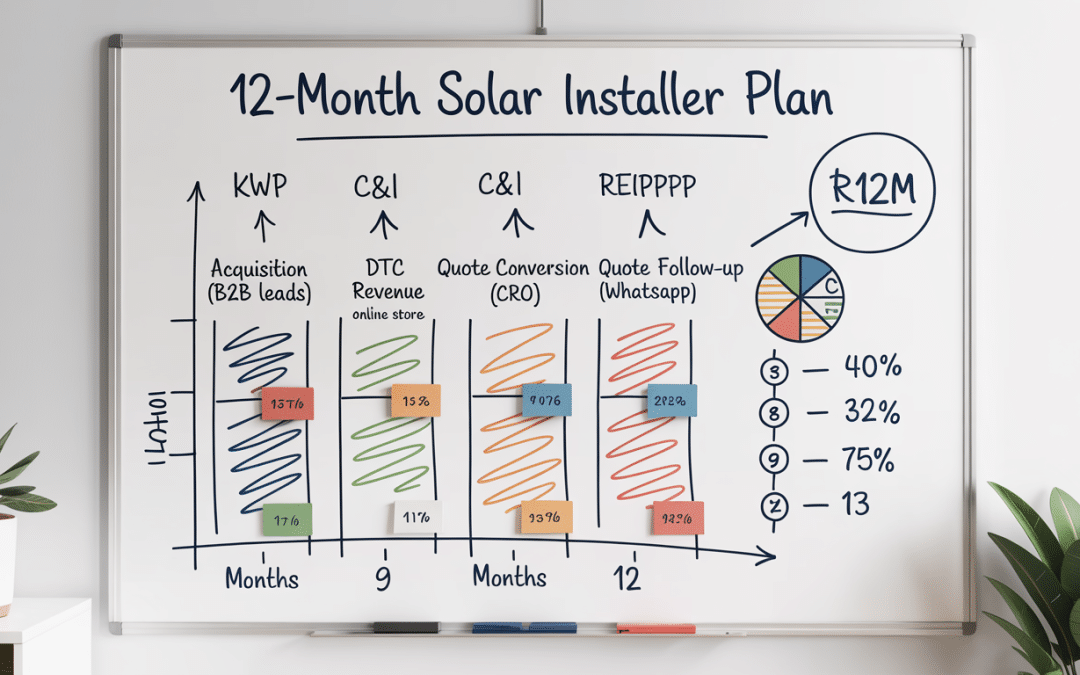
Digital strategy for solar installation businesses in South Africa is the 12-month integrated plan that sequences lead generation, online revenue, quote conversion, and customer follow-up into a coherent system. It is not a list of disconnected tactics borrowed from generic agency playbooks. For the broader strategic framework, see our complete digital strategy guide for South Africa.
This guide applies the Growth Pulse Matrix™ specifically to South African solar installers and renewable energy companies aiming to scale from sporadic enquiries to R12m+ in annual installation revenue. The digital strategy for solar builders we cover below works for both residential PV and commercial C&I installers serving SA metros.
Most South African solar installers run four disconnected workstreams — a website nobody updates, ad-hoc Facebook ads, a WhatsApp number on a personal phone, and quote requests that disappear into someone's inbox. The market opportunity is real and growing fast, but capturing it requires sequencing, not effort. The plan below is the integration apex that ties together the four operational channels each installer already touches.
Quick Answer
A working digital strategy for solar installers in South Africa allocates roughly 40% of marketing budget to lead acquisition, 25% to quote and site-survey conversion, 20% to customer follow-up and reorder, and 15% to brand visibility — sequenced over 12 months so each channel feeds the next. The R12m+ annual installation revenue target is achievable for a mid-sized SA installer running 8-12 commercial installs and 30-50 residential systems per year, but only when all four channels are integrated rather than run in isolation.
Want a custom 12-month digital strategy mapped to your solar business?
Request Your Free Solar Strategy SessionThe Four-Channel Reality of Solar Marketing
A working digital strategy for solar installers in South Africa always integrates four channels — acquisition, online revenue, quote conversion, and customer follow-up. Each channel serves a different stage of the buyer journey and a different segment of the installation market. Running any single channel in isolation leaves 50-70% of pipeline value on the table.
South African solar installation buyers fall into three distinct segments, and each segment uses different channels at different points in the buying journey. Residential PV buyers (R80,000-R250,000 systems) start on Google search comparing brands, then read reviews, then request quotes via WhatsApp.
Commercial and industrial buyers (R400,000-R2m C&I systems) start with LinkedIn or direct enquiry, then move through a 60-90 day procurement process with multiple stakeholders. Utility-scale and REIPPPP-adjacent buyers operate through formal tenders and relationship-driven business development that runs on a 6-18 month timeline.
An integrated digital strategy for solar covers all three segments by activating the four channels in sequence rather than competing for the same buyer with all four at once. The B2B lead generation channel captures commercial enquiry intent. The ecommerce channel captures component and accessory revenue between large installations. The CRO layer converts site visits into booked site surveys. The WhatsApp layer keeps deals moving through the long sales cycles SA solar buyers actually run.
| Channel | Buyer Stage | Primary Outcome | Budget Share |
|---|---|---|---|
| B2B lead acquisition | Awareness → Enquiry | Qualified quote requests | 40% |
| Quote conversion (CRO) | Enquiry → Site survey | Booked surveys, accepted quotes | 25% |
| WhatsApp follow-up | Quote → Signed contract | Closed installations | 20% |
| Ecommerce + brand | Component sales + visibility | Accessory revenue, top-of-funnel reach | 15% |
The split shifts by month as the strategy matures — early months over-index on acquisition because the pipeline is empty, while later months redistribute budget toward conversion and retention as quote volume rises. The fixed split above represents the steady-state allocation a mature digital strategy for solar uses once the system is fully built.
The 12-Month Sequencing Plan (Growth Pulse Matrix™ Applied to Solar)
A working 12-month plan sequences acquisition, conversion, and retention into three 4-month phases — Foundation, Activation, and Scale — with each phase building on the previous one. The mistake most South African installers make when building a digital strategy for solar is trying to launch all four channels simultaneously, which dilutes attention and ensures none get built properly.
Months 1-4 — Foundation
The Foundation phase builds the conversion infrastructure that every later phase depends on. Most South African solar installation businesses skip this phase because it doesn't generate immediate leads — which is exactly why their later acquisition spend underperforms.
Foundation work includes a properly built quote-request landing page with clean form mechanics, WhatsApp Business setup with approved message templates, a basic ecommerce store for accessories and portable power, and a CRM that tracks the journey from first touch to signed contract. Without these four assets, every Rand of acquisition budget spent in months 5+ leaks through the gaps in the system.
The Foundation phase also establishes baseline measurement. Without knowing your current quote-to-close ratio, your average installation value by segment, and your customer acquisition cost, optimisation in later months is guesswork. The first 4 months are deliberately slow on revenue and deliberately heavy on infrastructure — that is what makes months 5-12 work.
Months 5-8 — Activation
The Activation phase of a digital strategy for solar businesses brings acquisition channels online once the conversion infrastructure can actually handle inbound enquiry. Google Ads campaigns launch with proper landing pages behind them. SEO content publishes against high-intent commercial keywords like "solar installation Johannesburg" and "C&I solar quote South Africa". WhatsApp Business templates start moving quotes through the funnel automatically.
Activation is when most South African installers see the first meaningful pipeline growth — quote requests typically rise 2-3x compared to baseline, and quote-to-close ratios improve because the conversion layer is properly built. The key sequencing rule for any digital strategy for solar installation businesses: do not turn on acquisition spend until conversion infrastructure exists. Acquisition without conversion just buys traffic that doesn't convert.
Months 9-12 — Scale
The Scale phase optimises the system that activation built. CRO testing on quote-request pages compounds incremental improvements. WhatsApp sequences get tuned based on actual close-rate data. Ecommerce starts contributing meaningful revenue between large installations. The brand layer (case studies, project galleries, referral programmes) starts producing the inbound enquiries that lower customer acquisition cost over time.
By month 12, an installer running a properly sequenced digital strategy for solar should be running 30-50 residential installations per year at R150,000 average ticket plus 8-12 commercial installations at R800,000-R1.5m average ticket — putting total installation revenue in the R12m-R18m range. That outcome is what an integrated 12-month plan produces when the four channels are sequenced rather than run in parallel from day one.
Need help sequencing your solar marketing plan into a working 12-month roadmap?
Get a Custom Solar Strategy RoadmapBudget Allocation by Installer Size and Stage
Budget for a digital strategy for solar installers in South Africa scales with installation volume and revenue target — but the channel split in any working digital strategy for solar stays roughly proportional regardless of total budget. The mistake most installers make is allocating absolute budget by intuition rather than a percentage framework that scales with the business.
For an installer doing R3m-R6m annual installation revenue (typically 20-30 residential installs plus 3-5 commercial), a working monthly marketing budget sits between R25,000 and R45,000. For an installer at R8m-R15m revenue, the budget rises to R60,000-R100,000/month. Above R15m revenue, budget passes R120,000/month with proportionally more allocated to brand and retention as the pipeline matures.
| Annual Installation Revenue | Monthly Marketing Budget | Primary Focus | Expected New Installs/Yr |
|---|---|---|---|
| R3m-R6m | R25,000-R45,000 | Foundation + early acquisition | 20-35 residential + 3-5 commercial |
| R8m-R15m | R60,000-R100,000 | Full four-channel activation | 30-50 residential + 8-12 commercial |
| R15m-R30m | R120,000-R200,000 | Scale + brand + REIPPPP-adjacent BD | 50-80 residential + 15-25 commercial |
The South African solar PV market grew installed capacity past 8 GW by late 2025 according to SAPVIA — the South African Photovoltaic Industry Association, with residential and C&I SSEG segments expanding fastest. The budget framework above for a digital strategy for solar installers reflects what local businesses participating in that growth typically need to spend to capture share rather than be displaced by national chains entering local metros.
Budget Reality
A solar installer trying to scale from R5m to R12m annual revenue cannot do it on R10,000/month of marketing budget. The math doesn't work because at that spend level, you can run one channel half-heartedly and nothing else. Either commit to a R40,000+/month budget that funds all four channels properly, or accept that growth will stall at current revenue. Half-funding never produces full-growth outcomes.
The South African Solar Market Context That Changes the Plan
A digital strategy for solar in the South African market operates under conditions that don't apply to generic marketing playbooks — rolling load-shedding tail effects on buyer urgency, REIPPPP procurement cycles for utility-scale work, local tax incentives that swing residential demand, and POPIA implications for lead data handling. Ignoring these context factors is what makes imported global solar marketing strategies fail in South Africa.
Load-shedding tail effects
Even though Eskom has stabilised load-shedding through 2025-2026, the residential demand pattern remains shaped by the 2022-2024 outage memory. Buyers research solar systems during stable periods and convert during scarcity events. A working digital strategy for solar businesses keeps acquisition channels warm during stable periods so that conversion infrastructure is ready when the next scarcity event triggers buying urgency.
South African tax incentive timing
The Section 12B accelerated depreciation allowance and other South African solar tax incentives create predictable demand surges around financial year-end (February for South African businesses, varying for individuals). Acquisition spend should over-index on November-January to capture this annual surge, with conversion infrastructure built and tested before October.
POPIA and lead data
South African solar installers collect substantial personal data (property addresses, energy consumption, financial information) through quote requests. POPIA compliance is not optional — it shapes how quote-request forms are built, how WhatsApp Business sequences capture consent, and how customer data flows through the CRM. Every channel in a properly built digital strategy for solar installers must be designed with POPIA compliance from the start, not bolted on after launch.
REIPPPP-adjacent business development
For installers targeting utility-scale work, REIPPPP bid rounds and IPP procurement timelines drive the entire business development calendar. Digital marketing's job for this segment is not to generate quote requests — it is to position the installer as a credible bidder when formal procurement opens. This means content marketing, case study publication, and trade association visibility (SAPVIA membership, industry awards) rather than performance marketing.
Real-World Example — SA Solar Installer Going Integrated
The following before/after represents a typical outcome for a mid-sized South African solar installer that moves from disconnected channels to an integrated digital strategy for solar installation businesses. The numbers below are representative of what GPM has seen across similar South African solar businesses applying the Growth Pulse Matrix™ framework.
| Metric | Before (Disconnected) | After 12 Months (Integrated) | Improvement |
|---|---|---|---|
| Monthly quote requests | 22 | 78 | +255% |
| Quote-to-close ratio | 11% | 23% | +109% |
| Average installation value | R145,000 | R168,000 | +16% |
| Customer acquisition cost | R8,400 | R4,200 | -50% |
| Annual installation revenue | R4.6m | R12.8m | +178% |
| Monthly marketing spend | R18,000 | R72,000 | +300% |
| Marketing ROI | R1 : R21 | R1 : R15 | Slightly lower ROI, much higher absolute revenue |
The marketing ROI dropping from R1:R21 to R1:R15 looks negative on the surface — but the absolute revenue grew from R4.6m to R12.8m, which is the metric that matters operationally. Higher ROI on a tiny budget is a worse business outcome than slightly lower ROI on a properly scaled budget. This is the most common mistake SA solar installers make when evaluating their marketing.
The Real Lesson
A digital strategy for solar that produces R12m+ in annual installation revenue is not primarily about choosing the right channels — it is about sequencing the four channels you already touch into a working system and funding that system at a level the revenue target requires. South African solar installers don't fail at marketing because they pick the wrong tactics. They fail because they run four half-built channels instead of one fully built integrated plan.
Why GPM Builds Solar Digital Strategy Differently
A digital strategy for solar that actually works in South Africa cannot be built from generic agency playbooks — and most local agencies offering solar marketing have never installed a kWp, never managed a quote-to-close pipeline for a R1.5m commercial system, and never sat through a REIPPPP debrief. They optimise for impressions and clicks because those are the metrics that don't require operator knowledge to measure.
Growth Pulse Media builds digital strategy for South African businesses from a different starting point — actually scaling local businesses through long sales cycles, technical buyers, and the kind of multi-stakeholder procurement that defines commercial solar in this market.
We've worked with PayFast, Peach Payments, and local courier integrations for accessory ecommerce, built quote-request CRO mechanics tuned to South African buyer psychology, and operated WhatsApp Business sequences against actual consumer behaviour during load-shedding cycles. The framework underneath is the same Growth Pulse Matrix™ applied across all our solar engagements.
Every digital strategy for solar we build sequences acquisition, conversion, and retention as one integrated 12-month plan — not four parallel projects competing for the same budget. We work in-house, no offshore outsourcing, with senior-level attention because we deliberately limit client load to maintain quality. Our own domain ranks for "solar lead generation South Africa" and adjacent commercial queries — proof that the framework we apply for clients is the framework we apply to ourselves.
Who This Is NOT For
A 12-month digital strategy for solar installation businesses is the wrong fit for several types of South African solar operators, and it is more honest to say so up front than to take the engagement and disappoint everyone later.
Pure component distributors with no installation arm. If your business sells inverters and panels to other installers rather than installing systems end-to-end, the four-channel framework above does not map cleanly. Your buyer is an installer, not an end customer, and the channels you need are B2B distribution-focused (trade pricing, technical specs, fast shipping) rather than residential-conversion-focused.
Solar installers below R2m annual revenue. A 12-month integrated digital strategy assumes you have the operational capacity to handle a 2-3x rise in quote volume. If you're a one-person installer or a small two-installer team, the marketing plan will outrun your delivery capacity and create churn. Stabilise operations first, then build the digital strategy.
Installers wanting "just SEO" or "just Google Ads". Single-channel engagements don't deliver the outcomes the four-channel framework produces. We'll refer you to specialists who do single-channel work well if that's genuinely what you need — but it isn't a digital strategy, it's a tactical engagement, and we'll be honest about the difference.
REIPPPP-only utility-scale developers. If your business model is bidding for REIPPPP rounds and IPP contracts exclusively, digital marketing is not your primary growth lever — business development, technical credibility, and consortium-building are. Our framework helps installers reaching commercial and residential markets; it does not help utility-scale developers competing in formal procurement.
Not sure if your solar business fits the integrated digital strategy framework?
Book a 20-Minute Solar Strategy Fit CallFrequently Asked Questions
What does a digital strategy for solar installers in South Africa actually include?
A working plan integrates four channels — B2B lead acquisition (SEO, paid search, content marketing), quote-request conversion (CRO, landing page optimisation), WhatsApp follow-up (automated sequences and templates), and an ecommerce or brand layer for accessory revenue and visibility. The integration matters more than any individual channel — disconnected tactics fail regardless of how well any single one is executed.
How long does it take to see results from a solar digital strategy in South Africa?
Months 1-4 build conversion infrastructure with minimal revenue impact. Months 5-8 see quote volume rise 2-3x as acquisition channels activate. Months 9-12 produce the integrated revenue growth — typically reaching R12m+ annual installation revenue for a mid-sized installer that started in the R4m-R6m range. The full 12-month cycle is the minimum for a properly sequenced plan; trying to compress it produces worse outcomes than letting the sequencing play out.
How much should a SA solar installer spend on digital marketing each month?
Roughly 6-8% of revenue is the working range for solar installers in growth mode — so a R6m revenue installer spends R30,000-R40,000/month and a R15m installer spends R75,000-R100,000/month. Below 5% of revenue, the plan can't fund all four channels and growth stalls. Above 10% of revenue, marginal returns diminish unless the business is funding aggressive geographic or segment expansion.
Which channel should a SA solar installer prioritise first?
Conversion infrastructure before acquisition channels — always. Most installers want to start with Google Ads or SEO because those feel like the obvious lead-generation moves, but acquisition spend on a website that doesn't convert just wastes budget. Build the quote-request landing page, WhatsApp Business templates, and CRM tracking first. Then activate acquisition once the conversion layer can actually capture the inbound enquiry.
Can a small SA solar installer compete with national chains using digital marketing?
Yes — local market focus beats national spend in most SA metros. National chains optimise for broad reach and brand recognition; local installers can outrank them on specific city-level commercial queries ("solar installation Pretoria", "C&I solar Sandton") with focused local SEO and tightly targeted Google Ads. The trade-off is geography — you compete on depth in your metros rather than breadth across SA.
How does POPIA affect solar marketing in South Africa?
POPIA compliance shapes every channel in a digital strategy for solar installers operating in South Africa. Quote-request forms need explicit consent language, WhatsApp Business sequences need opt-in mechanics, CRM data flows need documented purpose limitations, and lead data sharing with third parties needs separate consent. Non-compliance is both a legal risk and a trust signal — South African buyers notice when forms ask for too much without explanation.
If any of the above sounds different from what you've heard from generic agencies, that's the operator difference talking. Generic agency advice optimises for what is easy to sell; operator-built strategy optimises for what actually moves installation revenue.
Build a 12-Month Solar Digital Strategy That Generates R12m+ in Installation Revenue
Receive a custom 4-channel digital strategy roadmap tailored to your solar installation business, your target revenue, your buyer segments, and the SA-specific market context — covering acquisition, conversion, retention, and brand sequencing across 12 months with budget allocation by phase and month-by-month milestone tracking. Built by operators who understand SA solar buyer psychology, not generic agency playbooks. No obligation — we will get back to you within 24 hours.
Request Your Custom Solar Strategy Roadmap