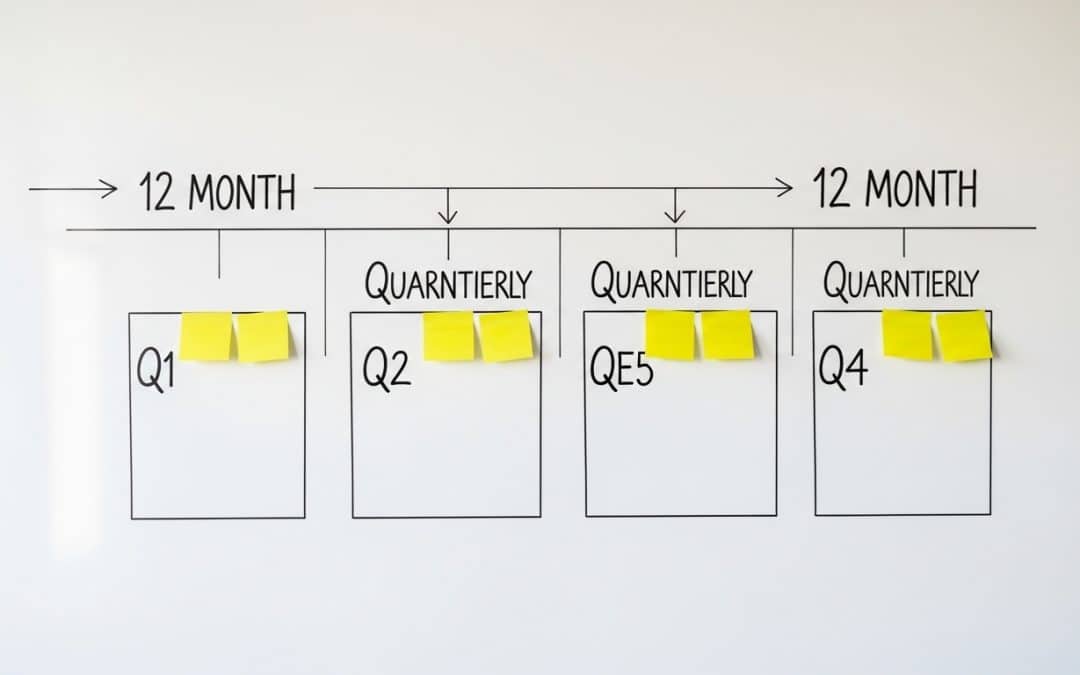
A B2B lead generation strategy in South Africa that actually scales is not a collection of tactics — it is a 12-month plan with defined milestones and a clear line between month-one foundation work and month-twelve pipeline maturity. Most South African B2B businesses have a list of tactics with no sequencing. This guide sets out a proven B2B lead generation strategy structured as a 12-month scaling plan for the South African market.
The plan is built around the 4-Stage Lead Engine™ — Attract, Capture, Nurture, Convert — with each quarter adding a layer of capability on top of the previous one, so that by month twelve the system is generating consistent, qualified pipeline with compounding returns from every component working together.
Quick Answer
A proven B2B lead generation strategy for South Africa follows a four-quarter structure: Q1 builds the foundation (ICP definition, conversion infrastructure, CRM setup), Q2 launches the first active channel, Q3 adds content compounding via SEO and LinkedIn, and Q4 optimises and scales. Businesses following this sequencing reach 10–20 qualified leads per month by month nine and 20–35 per month by month twelve — from a combined investment of R10,000–R18,000 per month.
Running a South African B2B business with no documented lead generation strategy — or one that has stalled after the first few months? Tell us where you are and we will map the next 90 days.
Get Your Free 90-Day Lead Generation RoadmapB2B Lead Generation Strategy South Africa: Why Sequencing Matters More Than Tactics
The most common reason South African B2B lead generation systems fail is not that the tactics are wrong — it is that they are launched in the wrong order. Starting LinkedIn Ads before defining the ICP wastes budget on the wrong audience. Launching cold email before building a CRM loses half the leads generated. Investing in SEO before fixing the website conversion rate drives organic traffic to a page that cannot convert it.
The 12-month sequencing plan solves this by treating lead generation as an infrastructure build — not a campaign launch. Each quarter installs a component that the next quarter depends on. Skip a quarter’s foundation work and the subsequent quarter underperforms. Follow the sequence and the system compounds.
Every South African B2B Lead Generation System Has a Sequencing Problem Before It Has a Channel Problem
When a South African B2B business says their Google Ads are not generating leads or their cold email is not converting — the problem is almost never the channel. The ICP is too broad, the landing page converts at 1% instead of 6%, or the nurture sequence was never built. Fix the sequence and the channels start working. Add more channels to a broken sequence and costs compound faster than leads do.
B2B Lead Generation Strategy South Africa: Q1 — Foundation (Months 1–3)
Quarter one is the most important quarter in the 12-month plan — and the one most South African B2B businesses skip because it produces no immediate leads. The Q1 work is entirely infrastructure: defining exactly who you are targeting, building the systems that will capture and follow up with leads, and establishing the baseline metrics that will allow you to measure everything that follows.
Month 1 — Define the Ideal Client Profile
The ideal client profile (ICP) is the single most important document in a South African B2B lead generation system. It defines the specific company size, industry, geography, revenue range, and decision-maker seniority that your offering is designed for — and it filters out every prospect who does not match before they enter the system.
South African B2B businesses that skip ICP definition generate leads — but they generate a mix of qualified and unqualified prospects that wastes sales time and inflates cost per acquired client. A tightly defined ICP reduces the pool of targets but dramatically increases the conversion rate of every subsequent stage.
Month 2 — Build the Capture Infrastructure
With the ICP defined, month two builds the capture infrastructure: a dedicated lead magnet (a checklist, calculator, or benchmark report specific to the South African market), a landing page with a conversion target of 5–8%, and a CRM with automated follow-up sequences configured. No active lead generation is launched until this infrastructure is live and tested.
South African B2B businesses frequently launch advertising before their CRM is configured. This means leads arrive, are manually tracked in a spreadsheet, and follow-up becomes inconsistent. A lead that enters a working CRM with automated day-1, day-3, day-5, day-10 follow-up sequences converts at 3–4x the rate of a lead that relies on manual tracking.
Month 3 — Establish Baselines and Launch First Outreach
Month three launches the first active channel — cold email outreach — while establishing baseline metrics. Cold email is the right first channel because it is the cheapest, fastest to launch, and most controllable. It allows you to test your ICP definition, your value proposition, and your call to action with real South African decision-makers before spending on paid channels.
A month-three cold email campaign sends 200–400 personalised emails per week to verified South African decision-makers matching the ICP. The reply rate and positive response rate from this campaign validates the ICP and messaging before any paid advertising spend is committed.
Want the exact Q1 foundation checklist — ICP template, landing page brief, CRM setup guide, and cold email sequence — tailored for your South African B2B business?
Get Your Free Q1 Foundation PackB2B Lead Generation Strategy South Africa: Q2 — First Active Channel (Months 4–6)
With the foundation in place and cold email validated, Q2 launches the first paid channel. For most South African B2B businesses with average contract values of R50,000–R200,000, this is Google Ads targeting high-intent search queries — prospects actively searching for a solution, an agency, or a vendor in your category.
Month 4 — Launch Google Ads
A South African Google Ads campaign for B2B lead generation starts with a tightly themed set of exact match and phrase match keywords targeting commercial intent — “B2B [service] South Africa”, “[service] company Johannesburg”, “[service] agency pricing”. Broad match is excluded in month four. Every ad drives to a dedicated landing page, not the homepage.
The month-four target is not volume — it is data. Run the campaigns at R5,000–R8,000 spend to identify which keywords, ad copy variations, and landing page versions generate the lowest cost per qualified lead before scaling spend.
Month 5 — Optimise and Scale Google Ads
Month five applies the data from month four: pause underperforming keywords, increase budget on the campaigns generating qualified leads, and test one new landing page variant. By month five, a well-structured South African Google Ads B2B campaign should be generating 5–10 qualified leads per month at R800–R1,800 per qualified lead.
Month 6 — Launch LinkedIn Presence (Organic)
Month six does not launch LinkedIn Ads yet — it establishes the organic LinkedIn presence that will make LinkedIn Ads significantly more efficient in Q3. A company page with consistent content, a founder or director profile with 3–4 posts per week, and the first LinkedIn connection campaign targeting South African decision-makers in the ICP. This builds the warm audience that Q3 LinkedIn Ads will retarget.
B2B Lead Generation Strategy South Africa: Q3 — Content Compounding (Months 7–9)
Quarter three adds the two channels that produce the lowest long-term cost per lead: content marketing with SEO, and LinkedIn Ads retargeting the warm audience built in Q2. According to HubSpot’s B2B lead generation research, approximately 90% of their monthly leads come from blog posts published months or years earlier — demonstrating the compounding nature of content that makes it the best long-term cost structure for any B2B system.
Month 7 — Launch SEO Content
Month seven publishes the first four cornerstone content pieces targeting the South African B2B search queries your ideal clients are using. These are 2,000–3,000 word guides targeting high-commercial-intent keywords: cost and pricing guides, comparison posts, and problem-specific how-to content for the South African market.
Content published in month seven will not rank until months 10–12. This is not a reason to delay — it is a reason to start in month seven rather than month ten. Every month of delay is a month of compounding returns foregone.
Month 8 — Launch LinkedIn Ads (Retargeting)
LinkedIn Ads launched in month eight retarget the warm audience built during Q2 organic activity — website visitors, LinkedIn profile visitors, and engaged content viewers. This retargeting audience converts at significantly lower cost per lead than cold LinkedIn Ads audiences, because the prospect has already encountered the brand.
Month 9 — Review and Rebalance
Month nine is the first full performance review across all four active channels: cold email, Google Ads, LinkedIn Ads, and organic content. The review identifies which channels are generating the lowest cost per qualified lead and which are underperforming relative to benchmark. Budget is rebalanced to the channels generating the best qualified-lead economics for the specific South African business and ICP.
B2B Lead Generation Strategy South Africa: Q4 — Scale and Systemise (Months 10–12)
Quarter four scales what is working and systemises what has been learned. By month ten, a South African B2B business following this plan has nine months of performance data across four channels, a CRM full of nurtured prospects, and content beginning to rank and generate inbound leads. Q4 is about acceleration — not addition of new channels.
Month 10 — Scale the Highest-Performing Channel
Identify the channel generating the best cost per qualified lead over months 7–9. Increase that channel’s budget by 50–100% while holding other channels steady. For most South African B2B businesses, this will be either Google Ads (fastest to scale) or cold email (lowest cost per lead). LinkedIn Ads and content SEO scale more slowly but will become the dominant volume sources by month 18–24.
Month 11 — Add the Sales Velocity Layer
Month eleven introduces sales velocity optimisation — not new lead generation, but improving the speed and conversion rate of the existing pipeline. This means reviewing the discovery call script, updating the proposal template, and testing a case study or social proof addition to the follow-up sequence. A 5% improvement in close rate at 20 qualified leads per month generates one additional client per month — at zero additional marketing spend.
Month 12 — Build the 13–24 Month Plan
Month twelve produces the next 12-month plan. By this point the system has enough data to project pipeline volume accurately, identify the content topics driving the most qualified inbound leads, and define the conditions for scaling LinkedIn Ads spend. The 13–24 month plan typically involves adding new content clusters, testing one new channel (events or partnerships), and building the referral activation system that converts satisfied clients into systematic referral sources.
B2B Lead Generation Strategy South Africa: Real Business Results Over 12 Months
A Johannesburg-based IT managed services company implemented this 12-month strategy starting from a referral-only baseline. They had no CRM, no documented ICP, no website lead capture, and averaged 1 new client per quarter from personal referrals. Monthly marketing spend across all 12 months was R12,000–R15,000.
| Metric | Month 1 (Baseline) | Month 6 | Month 12 |
|---|---|---|---|
| Monthly qualified leads | 0–1 (referral only) | 6–9 | 22–28 |
| Active lead generation channels | 0 | 2 | 4 |
| Cost per qualified lead | Incalculable | R1,650 | R620 |
| New clients per quarter | 1 | 3–4 | 7–9 |
| Average contract value | R85,000/yr | R85,000/yr | R85,000/yr |
| Annual new client revenue | R85,000 | R272,000 | R680,000 |
| Monthly marketing spend | R0 | R13,500 | R14,800 |
By month twelve, the business was generating 22–28 qualified leads per month at a cost per qualified lead of R620 — down from R1,650 in month six as the content and SEO channels matured. Annual new client revenue from the system reached R680,000 against a total 12-month marketing investment of approximately R164,000 — a +315% return on marketing investment in year one, with the compounding channels still building.
The 12-Month Plan Produces Compounding Returns — Not Linear Ones
The most important feature of the 12-month B2B lead generation strategy is that its returns are not linear. Month one produces almost nothing. Month twelve produces returns that reflect the compounding of every layer built since month one — content ranking in Google, warm LinkedIn audiences being retargeted, a CRM full of nurtured prospects. Every month of Q1 foundation work generates returns in month 24. Starting earlier matters more than starting with a larger budget.
How Growth Pulse Media Builds 12-Month B2B Lead Generation Strategies for South African Businesses
Growth Pulse Media builds complete B2B lead generation strategies for South African businesses — documented, sequenced, and executed in-house across all four channels of the 4-Stage Lead Engine™. Every engagement starts with an ICP definition workshop and a 12-month milestone plan before any channel is activated.
We do not manage channels in isolation. We manage the system — ensuring that the ICP defined in month one is reflected in the Google Ads targeting in month four, the LinkedIn content in month six, and the SEO content published in month seven. This integration is what produces the compounding returns that isolated channel management cannot deliver. All execution is in-house, all reporting is in Rand against qualified leads generated and pipeline value created.
Who This Is NOT For
The 12-month B2B lead generation strategy is not appropriate for every South African business right now.
You need leads in the next 30 days and have no existing pipeline. The 12-month strategy builds compounding returns — it is not a fast-start campaign. If your business has immediate cash flow pressure and needs signed clients within 30 days, direct outreach to warm contacts and reactivation of lapsed clients will generate faster results. Start the 12-month strategy once immediate revenue pressure is resolved — not as the solution to a cash flow crisis.
You want to outsource strategy but not execution. A 12-month lead generation strategy only works if the execution is integrated — the same team that defines the ICP runs the Google Ads, writes the content, and manages the CRM sequences. South African B2B businesses that outsource each channel to a different vendor end up with four disconnected activities producing inconsistent results and no compounding. The strategy requires integrated execution to produce integrated returns.
Your sales team will not engage with leads within 24 hours. The 12-month strategy generates qualified leads — but it cannot close them. A sales team taking 3–5 days to follow up loses a significant portion of pipeline. South African B2B buyers who do not receive a response within 24 hours frequently move to the next provider on their shortlist. The strategy requires a sales team that responds at the pace the system generates leads.
You want to run the strategy for 3 months and evaluate. A 3-month evaluation window on a 12-month strategy shows only Q1 foundation work — the quarter producing the fewest leads. The channels with the highest long-term output (content, SEO, LinkedIn) are still building at month 3. The correct evaluation window is 6 months for early indicators. Businesses unwilling to commit to 12 months should use short-cycle paid ads only.
Ready to build a documented 12-month B2B lead generation strategy for your South African business — with milestones, channel assignments, and monthly targets set before anything is activated?
Get Your Free 12-Month Strategy BriefB2B Lead Generation Strategy South Africa: Frequently Asked Questions
What is a B2B lead generation strategy in South Africa?
This is a documented, sequenced plan defining which channels to use, in what order, at what investment level, and with what measurable targets at each stage. It defines the dependencies between activities so each channel builds on the infrastructure of the previous one. The 12-month sequencing plan is the most effective structure for South African B2B businesses building from scratch or rebuilding a failing system.
How long does a B2B lead generation strategy take to produce results in South Africa?
The strategy produces initial results within 60–90 days of the first active channel launch. Meaningful qualified lead volume of 8–15 per month typically appears by months 5–6. Full system maturity occurs at months 10–12. The correct evaluation window is 6 months for early indicators — not 3 months, which only reflects Q1 foundation work.
What channels should a South African B2B lead generation strategy include?
A complete lead generation strategy for South African B2B businesses includes four channels in sequence: cold email outreach in month 3 (fastest to launch, cheapest per lead), Google Ads in month 4 (high intent, scalable), LinkedIn organic and Ads in months 6–8 (decision-maker access, compounding audience), and content marketing with SEO in month 7 (lowest long-term cost per lead). The correct sequencing is critical — launching channels out of order significantly reduces returns.
How much does a 12-month B2B lead generation strategy cost in South Africa?
A 12-month B2B lead generation strategy in South Africa typically costs R120,000–R216,000 in total — approximately R10,000–R18,000 per month including agency fees, ad spend, content creation, and tools. Investment is front-loaded in Q1 and Q2 (infrastructure and first channel) and back-loaded in returns. South African B2B businesses with average contract values of R80,000+ typically achieve positive ROI by month 8–10.
What is the biggest mistake South African B2B businesses make with lead generation strategy?
The biggest mistake is launching active channels before the foundation is in place — running paid ads before the ICP is tightly defined, the landing page is conversion-optimised, and the CRM has automated follow-up sequences configured. This generates qualified leads that are then lost to slow follow-up or wrong targeting. Fix the foundation in Q1 and every subsequent channel delivers significantly better results.
How do I measure the success of a B2B lead generation strategy in South Africa?
Measure success using five metrics: qualified leads per month, cost per qualified lead by channel, lead-to-opportunity conversion rate, opportunity-to-client conversion rate, and new client revenue generated per month. Pipeline value — the total potential contract value of active prospects — is the leading indicator that predicts next quarter’s revenue and signals whether the strategy is on track before the revenue appears.
Most South African B2B businesses will never build a 12-month lead generation strategy on their own — not because the plan is complicated, but because month one produces almost nothing and it takes discipline to invest in infrastructure before results. That discipline is exactly what separates businesses that break the referral ceiling from those that stay below it.
Ready to Build a Documented 12-Month B2B Lead Generation Strategy for Your South African Business — with Milestones, Channel Assignments, and Monthly Targets Before Anything Is Activated?
Growth Pulse Media builds complete B2B lead generation strategies for South African businesses — ICP definition, channel sequencing, milestone planning, and in-house execution across all four channels. We will deliver a one-page 12-month strategy brief specific to your business and ICP within 24 hours of your enquiry. No obligation — we will get back to you within 24 hours.
Get Your Free 12-Month Strategy Brief