A customer journey in South Africa is the complete sequence of interactions a consumer has with a business — from first discovering it exists, through researching and comparing options, to purchasing and returning as a repeat buyer. This guide covers what the customer journey means for South African businesses, how it differs from the sales funnel, and how mapping each stage generates more leads from the same marketing spend.
The customer journey connects every channel a South African business uses — SEO, Google Ads, email, social media, and the website itself — into a coordinated sequence that guides prospects from first awareness to first purchase and beyond.
Quick Answer
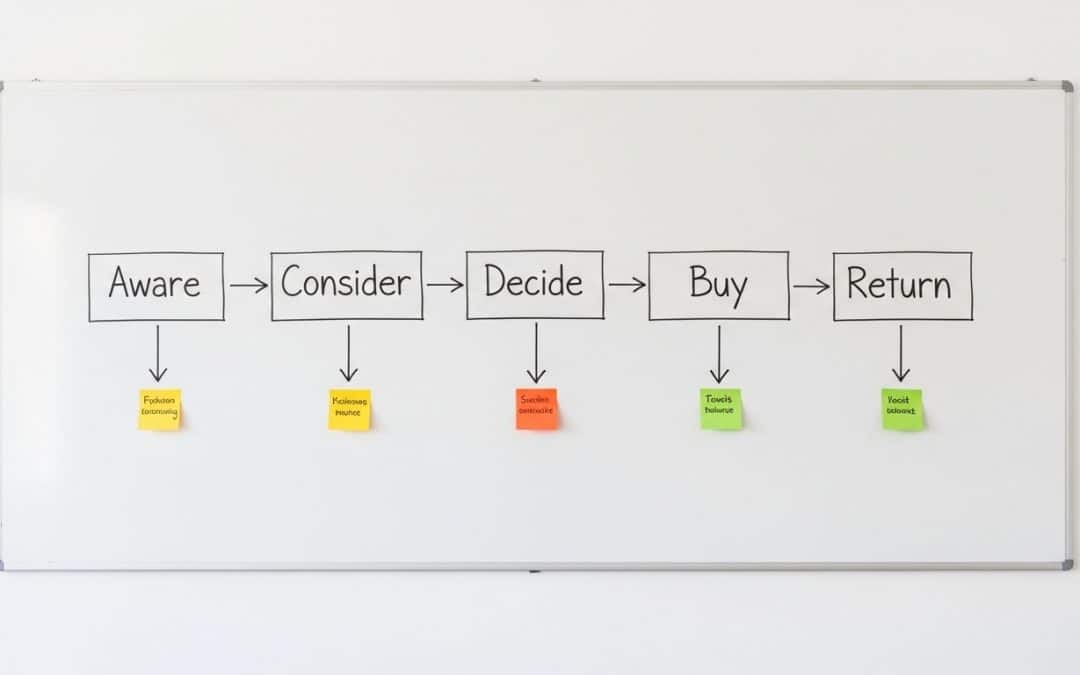
A customer journey in South Africa is the end-to-end experience a potential customer has across every touchpoint — Google results, your website, social media, email, word of mouth, and the purchase itself. It has five stages: Awareness, Consideration, Decision, Purchase, and Retention. South African businesses that map and optimise each stage generate more leads from the same spend than those focusing only on the purchase moment.
Not sure where your South African business is losing potential customers — and which stage of the customer journey is the biggest leak in your pipeline?
Get a Free Customer Journey AuditWhat Is a Customer Journey in South Africa: The Five Stages
The customer journey in South Africa follows five stages. Each stage requires a different type of marketing content and a different channel mix. Businesses that treat all five stages identically — running the same ad to a cold audience and a warm audience, for example — waste budget and confuse prospects who are at different points in their decision process.
Stage 1: Awareness
Awareness is the moment a South African consumer first discovers your business exists. The primary awareness channels in 2026 are Google Search (organic and paid), social media (Facebook, Instagram, TikTok), word of mouth, and local directory listings. The job at awareness stage is not to sell — it is to be found, make a strong first impression, and give the prospect a reason to take the next step.
Most South African businesses underinvest in awareness and then wonder why their conversion-focused ads are expensive. Without consistent awareness activity, the pool of prospects who already know your brand name — and therefore convert at lower cost — stays thin.
Stage 2: Consideration
Consideration is where the South African prospect researches their options. They are comparing your business to competitors, reading reviews, browsing your website, and forming an opinion about whether you are trustworthy and relevant. At this stage, the job of marketing is to provide the information needed to make a confident decision — detailed service pages, case studies, pricing transparency, and social proof in the form of reviews and testimonials from other South African customers.
Stage 3: Decision
Decision is the moment a prospect commits to choosing a provider. Friction is the enemy at this stage — slow websites, unclear pricing, and slow response times cause prospects already decided to use a business like yours to choose a competitor instead. South African businesses that reduce decision-stage friction — responding within 2 hours, displaying clear pricing, making it easy to book — consistently convert more visitors into paying customers.
Stage 4: Purchase
Purchase is the transaction itself — whether that is completing a checkout on a South African ecommerce store, signing a contract, or making a booking. The purchase stage is where payment friction matters: South African consumers have strong preferences for familiar local payment methods. Stores and service providers that display PayFast, Ozow, and SnapScan logos prominently at checkout consistently see higher completion rates than those showing only generic payment options.
Stage 5: Retention
Retention is where most South African businesses leave the most money on the table. Acquiring a new South African customer costs 5–7x more than retaining an existing one — yet most South African businesses invest almost nothing in systematic retention marketing. Post-purchase email sequences, loyalty incentives, referral programmes, and re-engagement campaigns for lapsed customers all work to extend the customer journey beyond the first purchase and increase lifetime value without additional acquisition cost.
The Journey vs The Funnel
The traditional sales funnel is one-directional: awareness at the top, purchase at the bottom. The customer journey is circular — a satisfied customer re-enters the awareness stage for their network when they refer others. McKinsey's research shows the post-purchase loyalty loop drives more revenue than the initial acquisition funnel, because retained customers buy more frequently, spend more, and refer others who arrive pre-sold. Businesses mapping only the funnel ignore everything after the first purchase.
What Is a Customer Journey in South Africa: The South African Context
The customer journey in South Africa has specific characteristics that differ from equivalent journeys in the UK or US — and South African businesses that apply generic international playbooks to their local market consistently underperform businesses that account for local buyer behaviour.
South African consumers rely heavily on word of mouth and personal referrals at the consideration stage — more so than buyers in more digitally mature markets. A South African prospect is more likely to ask a WhatsApp group for a recommendation than to rely solely on Google reviews. This gives the retention and referral stage an outsized awareness impact: a loyal customer who refers two friends generates higher-quality leads than most paid campaigns.
According to McKinsey's consumer decision journey research, the post-purchase experience and active loyalty loop drive more incremental revenue than the initial acquisition journey for most businesses — a finding that is amplified in the South African context where trust and personal referral carry significant weight.
Want to know exactly which stage of the customer journey is costing your South African business the most leads — and what to fix first to recover them?
Book Your Free Customer Journey Mapping SessionWhat Is a Customer Journey in South Africa: Real Business Results
A Johannesburg B2B services company was spending R25,000/month on Google Ads and generating 8 leads per month at R3,125 each. A customer journey audit revealed 74% of visitors dropped off at the consideration stage, and 60% of enquiry form completions went unresponded to within 24 hours. The business had a journey problem they believed was a traffic problem. After mapping and fixing each stage over 90 days, the results changed significantly.
| Journey Stage Fixed | Change Made | Before | After (90 days) |
|---|---|---|---|
| Consideration | Added case studies + pricing guide | 26% stayed past homepage | 51% stayed past homepage |
| Decision | Response SLA set to 2 hours | 60% unresponded within 24hrs | 100% responded within 2hrs |
| Purchase | Simplified proposal process | 14-day average to close | 6-day average to close |
| Retention | 90-day post-project email sequence | 0 referrals tracked | 4 referrals/month |
| Metric | Before Journey Mapping | After 90 Days |
|---|---|---|
| Google Ads spend | R25,000/month | R25,000/month (unchanged) |
| Leads generated | 8/month | 19/month |
| Cost per lead | R3,125 | R1,316 |
| Referral leads | 0/month | 4/month |
| Total leads (paid + referral) | 8/month | 23/month |
| Estimated monthly pipeline | R160,000 | R460,000 |
The marketing budget did not change. The same R25,000/month in Google Ads generated 23 total leads instead of 8 — a 187% increase — purely from fixing the stages of the customer journey that were leaking prospects before they reached the enquiry form.
Most South African Businesses Have a Journey Problem, Not a Traffic Problem
When a South African business says "we need more leads," the instinct is to spend more on ads. But most businesses are losing 50–70% of the leads their current traffic could generate — at consideration, decision, or purchase stage — before a prospect ever submits a form. Mapping the customer journey reveals where those losses occur and costs a fraction of what additional ad spend would to generate the same incremental leads.
How Growth Pulse Media Maps Customer Journeys for South African Businesses
Growth Pulse Media maps and optimises customer journeys for South African businesses — auditing each stage from awareness through retention, identifying where prospects are dropping off, and implementing the content, channel, and process fixes that recover those losses. We combine Google Analytics 4 data, Search Console performance data, and conversion rate analysis to diagnose exactly which stage is underperforming before recommending any change to marketing spend.
Our customer journey work is grounded in South African market experience — we understand the WhatsApp-driven referral loop that operates at consideration stage in the South African market, the local payment friction points that kill purchases at checkout, and the post-purchase touchpoints that South African customers respond to differently than the international playbook suggests. All work is executed in-house.
Who This Is NOT For
Customer journey mapping is not the right starting investment for every South African business right now.
Your business has fewer than 50 monthly website visitors. Customer journey mapping optimises the conversion of existing traffic — it does not generate traffic where none exists. A business with 40 monthly sessions cannot gather enough behavioural data to diagnose which journey stage is underperforming. Build organic or paid traffic to at least 300–500 sessions per month before investing in journey mapping. Fix traffic volume first, then fix the journey.
You want a customer journey map as a document, not an action plan. A map sitting in a Google Drive folder and never acted on generates zero business improvement. The value is in the implementation — fixing content gaps, response time failures, and checkout friction. If your business cannot implement findings within 60 days of the mapping exercise, the investment is premature.
You believe your only problem is awareness. Fewer than 30% of businesses with a lead volume problem actually have a traffic problem — the majority have a consideration or decision stage issue that more traffic will not fix. Before spending more on awareness, audit how well your site converts existing visitors. A 2% conversion rate improvement on existing traffic often generates more leads than doubling ad spend.
You sell a product or service with zero repeat purchase potential. Journey mapping is most valuable for businesses where retention and referral compound over time. If your business has a single-transaction model with no realistic path to repeat purchase or referral, focus only on the awareness through purchase stages. The retention stage investment is lower priority than for businesses with repeat purchase potential.
Ready to find out which stage of your South African customer journey is losing the most leads — and get a prioritised fix plan with projected revenue impact for each stage?
Get Your Free Customer Journey Audit ReportWhat Is a Customer Journey in South Africa: Frequently Asked Questions
What is a customer journey in South Africa?
A customer journey in South Africa is the complete sequence of interactions a consumer has with a business — from first becoming aware it exists through to purchasing and returning as a repeat buyer. It covers five stages: Awareness, Consideration, Decision, Purchase, and Retention. South African businesses that map and optimise each stage generate more leads and revenue from the same marketing spend than those running undifferentiated campaigns across all stages.
What are the five stages of the customer journey in South Africa?
The five stages are: Awareness (a prospect discovers your business through Google, social media, or word of mouth), Consideration (they research your business versus competitors and browse your website), Decision (they choose whether to enquire or buy), Purchase (they complete the transaction), and Retention (they return as a repeat customer and refer others). Each stage requires different marketing content and channels to move the prospect forward effectively.
Why is customer journey mapping important for South African businesses?
Most South African businesses lose 50–70% of the leads their existing traffic could generate — at consideration, decision, or purchase stage — before a prospect submits an enquiry. Mapping the customer journey reveals exactly where those losses occur. Fixing leaking stages costs a fraction of what additional ad spend would generate for the same incremental lead gain. It is the highest-ROI diagnostic available to a South African business with existing traffic but disappointing conversion rates.
How does the South African customer journey differ from other markets?
The South African customer journey places significantly more weight on personal referral at the consideration stage than more digitally mature markets. A prospect is more likely to ask a WhatsApp group for a recommendation than to rely solely on Google reviews. This gives the retention and referral stage an outsized awareness impact — a loyal customer who refers two friends generates higher-quality leads than most paid campaigns at a fraction of the cost.
How long does a customer journey take in South Africa?
Customer journey length varies significantly by product type. Low-consideration purchases — a R200 product from a South African ecommerce store — may complete in minutes. High-consideration purchases — a R50,000 business service, a vehicle, or a home improvement — may take weeks or months through research, comparison, and final decision. The longer the journey, the more touchpoints a South African business needs to maintain visibility and trust throughout the consideration and decision stages.
How do I map the customer journey for my South African business?
Map the customer journey in four steps: identify every touchpoint where a prospect encounters your business (Google results, website, social media, WhatsApp, in-person); audit each for friction and drop-off using Google Analytics 4; identify which stage has the highest abandonment rate; and prioritise fixes by estimated lead recovery impact. Start with decision and consideration stages — these are where most South African businesses lose the most qualified prospects.
Ready to Find Out Which Stage of Your Customer Journey Is Losing the Most Leads — and Fix It?
Growth Pulse Media maps customer journeys for South African businesses and delivers a prioritised stage-by-stage fix report — identifying exactly where your qualified prospects are dropping off, with projected lead recovery for each fix. All work executed in-house by South African digital marketing operators. No obligation — we will get back to you within 24 hours.
Get Your Free Customer Journey Audit Report