
What is digital marketing roi in south africa? It is the Rand return a South African business generates for every rand it puts into digital marketing — and measuring it correctly is what separates businesses that confidently scale marketing spend from those that guess their way through every budget decision.
Most South African businesses running Google Ads, Meta Ads, SEO, and email at the same time have no accurate picture of which channel actually produces the most revenue per rand. This guide explains the concept, how to calculate it across channels, realistic local benchmarks, and the measurement mistakes that quietly waste marketing budget. For the full strategic framework, see our complete digital strategy guide for South African businesses.
Quick Answer
What is digital marketing roi in south africa, in one line: it is (revenue generated by a channel minus the investment in that channel) divided by the investment, times 100, expressed as a percentage. A Google Ads campaign that turns R5,000 of monthly spend into R31,000 of attributable revenue has a return of 520%. Benchmarks vary sharply by channel — Google Search typically returns R3–R6 per R1 (300–500%), SEO returns R8–R15 per R1 once mature (800–1,500%) but takes 6–12 months to get there, and email marketing delivers the highest return of any digital channel at roughly R36 per R1 because it reaches people who already chose to hear from the business. The single biggest mistake South African businesses make is judging every channel on the same monthly timeline, which causes them to cut SEO before it has had time to work.
Not sure which digital marketing channel is generating your highest return — or whether your current marketing spend is working as hard as it should?
Get a Free Digital Marketing ROI AuditWhat Is Digital Marketing ROI in South Africa: The Core Definition
What is digital marketing roi in south africa, defined precisely: it is the revenue generated per rand invested in each digital channel, measured consistently, compared across channels, and used to guide budget allocation. It is not impressions, clicks, or followers — it is revenue produced relative to money spent.
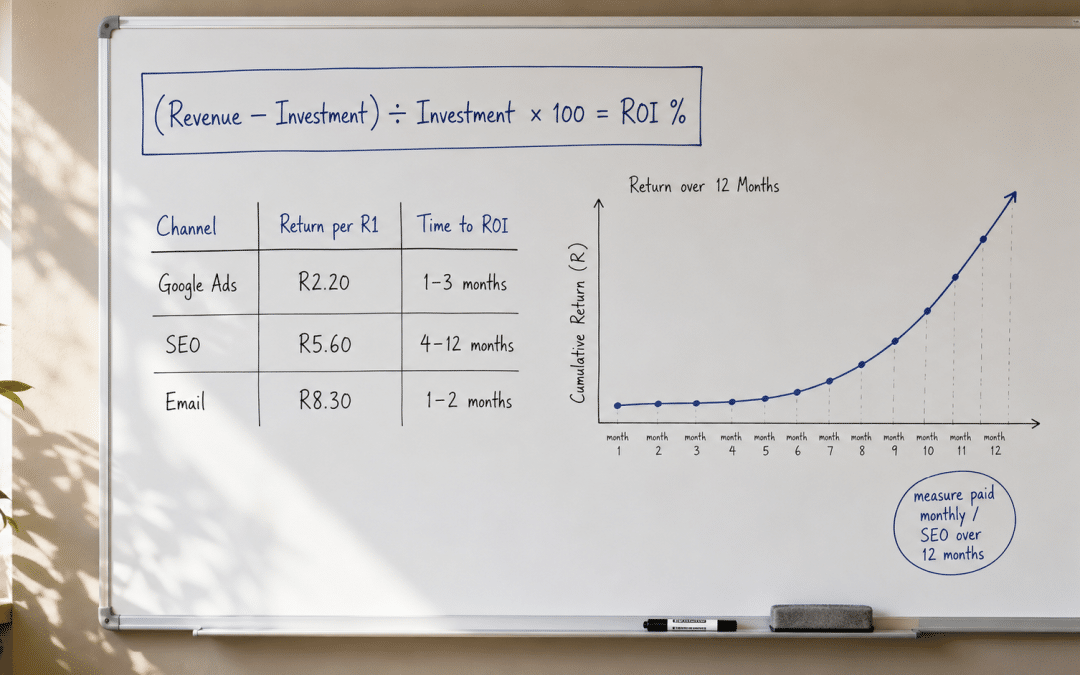
The formula is simple: (Revenue − Investment) ÷ Investment × 100 = ROI %. A South African business investing R10,000 a month in Google Ads and generating R45,000 in attributable revenue has a 350% return. The same business spending R8,000 a month on SEO and seeing only R12,000 in organic revenue at month six has a 50% return at that point.
By month twelve, that identical SEO investment may generate R60,000 in organic revenue, lifting the return to 650%. Channel return is not static — it evolves as channels mature, audiences grow, and campaign structures improve, which is why the measurement window matters as much as the formula.
A common failure looks like this: a business proudly reports that Google Ads produced 2,400 clicks, SEO produced 8,700 impressions, and email achieved a 24% open rate — without connecting any of it to revenue. That is activity reporting, not return reporting. Clicks, impressions, and open rates are inputs, not outcomes, and without revenue attribution every budget decision is being made on volume of activity rather than business return.
What Is Digital Marketing ROI in South Africa: Channel Benchmarks
Understanding what is digital marketing roi in south africa at the channel level means knowing realistic ranges, not best-case outliers. The figures below reflect correctly configured campaigns for South African businesses, not vendor headline numbers.
Google Ads return
Google Search typically delivers a 300–500% return for South African businesses with well-structured campaigns — roughly R3–R6 of revenue for every R1 of spend. Campaigns with poor Quality Scores, generic landing pages, and broad-match keywords consistently fall short of this.
According to Google's ROI and AI-powered measurement research, advertisers rate Google Search as the paid channel delivering the strongest return on ad spend more often than any other platform. Return improves as Quality Scores and landing-page conversion rates improve, which makes campaign structure as important as budget level.
SEO return
SEO produces the highest return of any digital channel at maturity, but it is also the most time-delayed. South African businesses typically see a return below 100% in months one to five (the investment phase), climbing to 300–600% by months six to nine as rankings establish.
By months twelve to eighteen the return reaches 800–1,500% or higher as organic traffic compounds on the same original investment. The calculation must include cumulative investment across all months, which is why SEO is best judged over a 12–18 month window rather than month by month like paid channels.
Email marketing return
Email consistently delivers the highest return of any digital channel — roughly R36 per R1 at industry average, often higher with well-built automation flows, because it reaches people who already opted in at near-zero marginal cost per send. This guide keeps email deliberately brief because it deserves its own analysis; for the full breakdown see our dedicated guide on email marketing ROI for South African businesses.
Meta Ads return
Meta Ads on Facebook and Instagram typically deliver a 150–300% return for South African businesses with well-targeted audiences and strong creative. Meta is an interruption channel — ads appear in feeds regardless of search intent — so conversion rates sit below Google Search, but audience targeting reaches people who do not yet know they need the product. Return is most predictable for ecommerce businesses with strong creative and retargeting audiences.
| Digital Channel | Typical Return Range | Time to Return | Best For |
|---|---|---|---|
| Google Ads (Search) | 300–500% | Days | Capturing buyers actively searching |
| SEO (organic) | 800–1,500%+ at maturity | 4–12 months | Lowest long-term cost per customer |
| Email marketing | ~3,600% (R36 per R1) | Immediate once live | Converting an existing subscriber base |
| Meta Ads | 150–300% | Days | Awareness and ecommerce retargeting |
| Google Ads (Display) | 100–200% | Days | Remarketing and brand awareness |
The Timeline Trap
Businesses that judge every channel on a monthly return and cut whatever looks weak in months one to three almost always make the same error — they kill SEO before it has reached its potential. SEO return at month two is negative by definition: money has gone in, organic revenue has not yet come out. SEO return at month twelve is routinely 600–1,200%. Cutting it at month three is a budget decision made on incomplete data. The discipline is simple: judge paid channels monthly, judge SEO on a 6–12 month rolling window, and never compare the two on the same clock.
Want to know which channels are actually driving your revenue — with accurate attribution across every touchpoint, not just last-click?
Get a Free Attribution AuditWhat Is Digital Marketing ROI in South Africa: Measuring It Correctly
Measuring what is digital marketing roi in south africa correctly requires conversion tracking that connects channel touchpoints to real business outcomes — leads, revenue, or customers acquired. Most South African businesses have incomplete tracking, which causes them to over-credit or under-credit the channels that actually influenced a purchase.
Google Analytics 4 setup
Google Analytics 4 with ecommerce or lead tracking is the foundation of measuring what is digital marketing roi in south africa accurately. It records which channels drive sessions that convert into goals — form submissions, purchases, calls, or WhatsApp initiations. Without GA4 conversion events configured correctly, comparing return across channels is impossible. The setup is a one-time technical task of a few hours that then enables measurement indefinitely.
Attribution models
Attribution decides how credit is split when a customer touches several channels before converting. A prospect who sees a Meta ad, then searches and clicks a Google ad, then receives an email and converts has touched three channels. Last-click credits only the email; first-click credits only the Meta ad; data-driven attribution, the GA4 default, distributes credit across all three based on actual contribution. Choosing the wrong model quietly distorts every budget decision that follows.
What Is Digital Marketing ROI in South Africa: A Real Reallocation
Seeing what is digital marketing roi in south africa play out in practice makes the concept concrete. A Pretoria professional services firm had run digital marketing for eighteen months with no conversion tracking, splitting R22,500 a month roughly evenly across Google Ads, Meta Ads, and SEO content. Once GA4 conversion tracking and a twelve-month return analysis were in place, the picture changed the budget entirely.
| Metric | Before (Even Split, No Tracking) | After (Return-Led Reallocation) |
|---|---|---|
| Google Ads monthly outcome | R7,500 in, return unknown | R12,000 in, 356% return |
| SEO content monthly outcome | R7,500 in, return unknown | R10,000 in, 548% return |
| Meta Ads monthly outcome | R7,500 in, return unknown | R2,500 in, retargeting only |
| Email marketing | Not running | R2,500 in, 676% return |
| Worst channel identified | None — no data | Meta Ads at 31% return |
| Additional monthly revenue | Baseline | R41,200 from same total spend |
| Total marketing spend | R22,500 | R27,000 (email added) |
| Decision basis | Self-reported channel metrics | Revenue attributed per channel |
By moving budget out of the 31%-return Meta Ads allocation and into Google Ads, SEO, and email, the firm generated roughly R41,200 a month in additional attributable revenue without materially increasing total spend. The insight only existed because tracking was finally measuring what each channel contributed to revenue rather than what each channel reported about itself.
The Channel Mix Reality
Almost every business that implements correct return measurement discovers the same shape: one or two channels generate the majority of marketing revenue, and one or two consume budget for very little. The 31% Meta Ads result above does not mean Meta is a weak channel universally — it means it was weak for that firm's specific audience and offer. Channel return is business-specific. Benchmarks are starting points for investigation, not verdicts to copy.
How Growth Pulse Media Measures Return for Clients
Growth Pulse Media measures and reports what is digital marketing roi in south africa for South African businesses across every active channel — Google Ads, SEO, email, and social. Every engagement includes GA4 conversion tracking from day one, so channel comparison is possible from the first month of data rather than a year later when budget has already been misallocated.
We do not report impressions, clicks, or domain authority as primary performance metrics. We report cost per lead, cost per customer acquired, revenue attributed per channel, and blended return — a monthly dashboard showing which marketing rands are working hardest and which channels need optimisation or reallocation.
The operator background behind GPM, running ecommerce, email automation, and Google Ads at scale before founding the agency, means the focus is on the business meaning of the numbers, not just the analytics configuration. All measurement and reporting work is executed in-house, never outsourced offshore.
Who This Is NOT For
Measuring what is digital marketing roi in south africa is not the right starting point for every business, and being honest about that prevents wasted effort.
Businesses running digital marketing for under 90 days. Meaningful return measurement needs enough data to be statistically reliable — typically 90 or more days of conversion tracking per channel. A return calculated from 30 days of Google Ads data is unreliable because of seasonal variation, campaign learning phases, and small sample sizes. Implement tracking from day one, but do not make reallocation decisions until there are 90-plus days of consistent data behind them.
Businesses wanting to optimise before fixing tracking. Optimising channel allocation on top of incomplete or inaccurate conversion tracking produces confident but wrong conclusions. Businesses that reallocate on last-click attribution consistently over-fund bottom-funnel channels and starve the upper-funnel channels that began the customer journey. Attribution has to be correct before budget optimisation means anything.
Businesses with a total marketing budget under R5,000 a month. Below roughly R5,000 a month, comparing return across several channels is impractical because there is not enough budget to run any single channel at meaningful scale, let alone several in parallel. At this level the better move is concentrating the full amount on the single highest-intent channel for the business type and adding channels as the budget grows.
Businesses seeking numbers to justify existing spend rather than improve it. Return measurement is most valuable precisely when it contradicts current habits. A business that tracks return but dismisses any result conflicting with its prior channel preferences — "we have always been on Meta so it must be working" — is not using the data to decide better. Measurement only creates value when the business is willing to act on what it shows.
Ready to find out exactly what return your business is generating per channel — and which reallocations would lift revenue from the same total spend?
Get Your Free Digital Marketing ROI AssessmentWhat Is Digital Marketing ROI in South Africa: Frequently Asked Questions
What is digital marketing ROI in South Africa?
Digital marketing ROI in South Africa is the Rand return a business generates from its digital marketing investment, calculated as revenue generated minus investment, divided by investment, times 100. A business spending R5,000 a month on Google Ads and generating R28,000 in attributable revenue has a 460% return.
It is the foundation of every sound marketing budget decision — without it, a business cannot identify which channels produce the most revenue per rand spent and ends up allocating budget on guesswork.
What is a good digital marketing return for South African businesses?
A good return varies by channel: Google Ads typically delivers 300–500% for well-structured Search campaigns, SEO delivers 800–1,500% or more at 12–18 month maturity, and email delivers the highest of any channel at roughly R36 per R1 invested. Meta Ads typically delivers 150–300% for ecommerce and consumer businesses.
Any channel returning under 100% — less than R1 back per R1 in — should be audited for structural problems before its budget is either increased or cut, because the issue is often configuration rather than the channel itself.
How do South African businesses measure digital marketing return?
They implement Google Analytics 4 with conversion tracking events — form submissions, purchases, calls, or WhatsApp initiations — and connect those events to the channels that drove them. GA4's data-driven attribution distributes conversion credit across all touchpoints in the customer journey.
Channel return is then calculated monthly by comparing revenue attributed to each channel against the investment in it. Without correctly configured GA4 events, cross-channel return comparison is not possible.
Why is email marketing return higher than paid advertising?
Email return is higher because it reaches people who already opted in — subscribers who chose to hear from the business — at near-zero marginal cost per send. Paid advertising reaches cold audiences at significant cost per click.
Automation flows such as abandoned-cart, welcome, and win-back generate revenue from existing relationships without additional ad spend, so the cost per email send is a small fraction of the cost per paid click, making the return structurally higher.
How long does it take for digital marketing to show return?
Paid channels such as Google Ads and Meta Ads generate measurable return within days of launch. Email generates return from the first send once automation flows are live. SEO generates measurable return between months four and six of consistent execution, peaking around months twelve to eighteen.
Organic social content generates the slowest and least measurable return of any channel — its brand-awareness contribution is real but difficult to attribute directly to revenue, so it should be judged on different metrics.
What is the most common return measurement mistake?
The most common mistake is using last-click attribution — giving all conversion credit to the final touchpoint before a customer converts. This consistently over-credits bottom-funnel channels like branded search and email and under-credits the upper-funnel channels that started the journey.
The result is budget shifting toward channels that close customers while starving the channels that create awareness in the first place. Configuring data-driven attribution in GA4 gives a far more accurate picture of each channel's true contribution.
Find Out Exactly Which Channels Generate Your Highest Digital Marketing ROI
Growth Pulse Media sets up digital marketing return tracking and reports monthly on cost per lead, cost per customer acquisition, and revenue attributed per channel for South African businesses. We report on Rand returns, not vanity metrics, so every budget decision is grounded in what actually drives revenue. No obligation — we will get back to you within 24 hours.
Get Your Free Digital Marketing ROI Consultation