
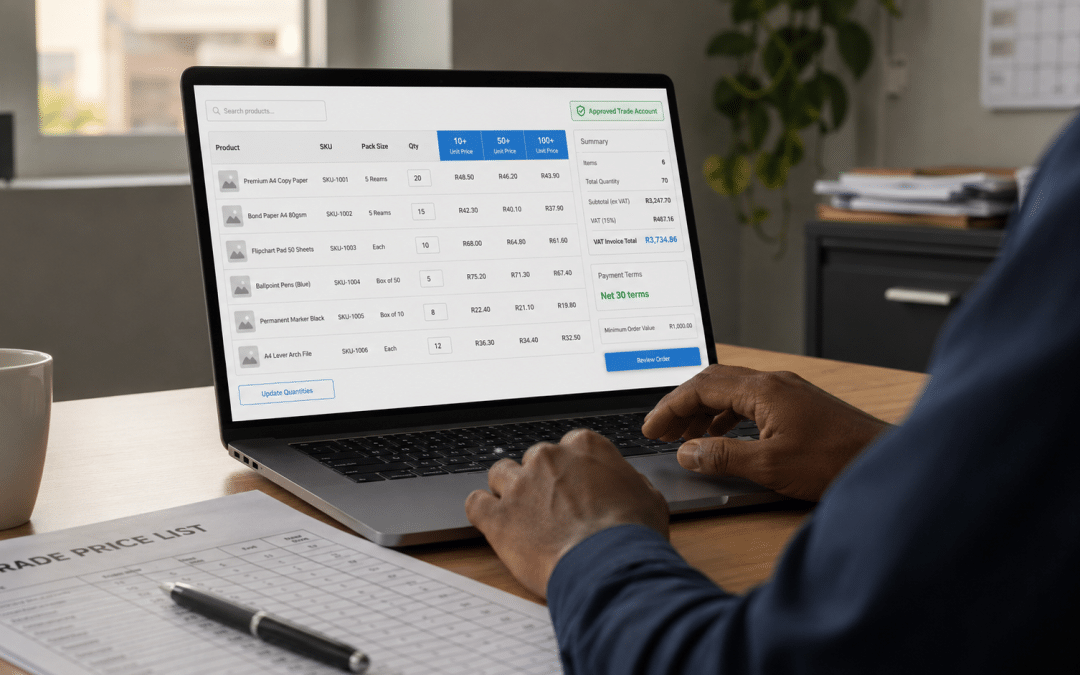
Running shopify b2b wholesale south africa operations alongside (or instead of) consumer ecommerce is one of the highest-leverage decisions an SA brand can make — trade orders tend to be 10–50× the value of consumer orders, repeat at predictable cadence, and respond to fundamentally different incentives than direct-to-consumer.
The platform handles this natively now that the company-account, price-list, and net-terms features have rolled out across all plans, but the SA-specific implementation requirements (VAT-exclusive pricing, Net 30/60 terms, SARS-compliant tax invoices, POPIA on business contact data) still trip up most setups. For the broader cluster context, read our Shopify South Africa pillar guide.
Quick Answer
The platform supports trade operations natively on all plans now (Basic to Plus), with company accounts, customer-specific price lists, gated catalogs, and Net 30/60 payment terms built in. Plus tier unlocks more advanced features (multi-currency, customer-specific catalogs per location, headless trade portals).
For SA operators, the real implementation work is not technical setup — it is getting VAT-exclusive pricing right, configuring Net 30/60 terms to match SARS invoicing requirements, and building a registration/approval workflow that screens out tyre-kickers before they enter your trade catalog.
Want a free review of your trade store setup against the seven SA-specific B2B checkpoints?
Get a Free Trade Store AuditShopify B2B Wholesale South Africa: Why Trade Is Different from Consumer
Selling to trade buyers on the same store you sell to consumers introduces eight operational differences that consumer ecommerce never has to handle. Understanding these differences is what separates platforms that work for trade from setups that work theoretically but break the moment a real wholesale account places a real order.
| Dimension | Consumer (DTC) | Trade (B2B) |
|---|---|---|
| Order value | R200 – R2,000 typical | R5,000 – R250,000+ typical |
| Order frequency | 1.2 orders/customer/year average | 6–24 orders/customer/year |
| Pricing | Single retail price, VAT-inclusive | Tiered, account-specific, usually VAT-exclusive |
| Payment | Card upfront at checkout | Net 30 / Net 60 / proforma deposit |
| Catalog visibility | Everyone sees everything | Gated; account-specific products only |
| Minimum order | Usually none | MOQ per SKU or per order common |
| Tax handling | VAT inclusive in displayed price | VAT-exclusive list price + 15% VAT line |
| Customer onboarding | Self-service signup | Application, approval, credit check, account setup |
Every one of these differences breaks an assumption built into a standard ecommerce store. A trade buyer arriving at a consumer-facing storefront will not see their negotiated pricing, cannot pay on terms, has no minimum-order enforcement, and sees VAT presentation that does not match how their accounting team processes invoices. The result: lost trade revenue every month the store is not configured properly.
The SA B2B Ecommerce Market Reality
The SA trade ecommerce opportunity is significantly larger than the consumer side — an inversion of what most operators expect. Shopify b2b wholesale south africa setups capture a meaningfully bigger market than retail equivalents.
While SA consumer ecommerce sits around R40–R60 billion in annual gross merchandise value, SA business-to-business commerce (the digital portion of trade transactions) is estimated at R200–R400+ billion, growing 18–25% year-on-year as more wholesalers, distributors, and manufacturers migrate from spreadsheet-and-email order processing to ecommerce-platform trade ordering.
Three SA-specific patterns shape what works on trade ecommerce setups in 2026. First, SA buyers expect Net 30 or Net 60 payment terms as standard — trade ecommerce that requires upfront card payment loses to suppliers offering credit terms, regardless of how good the platform experience is.
Second, VAT presentation must be exclusive on trade catalogs — SARS-registered trade buyers reclaim input VAT and need ex-VAT line pricing for their accounting workflows. Third, SA trade buyers are predominantly desktop and tablet users, not mobile — the buying process is researched, approved internally, and executed from an office workstation.
Key Takeaway
SA trade ecommerce is fundamentally bigger than SA consumer ecommerce — estimated 5–8× larger by transaction value — and growing faster. Most SA brands building consumer storefronts on the platform have a parallel trade opportunity that is larger, more predictable, and more profitable than the consumer side.
The reason most brands miss it is operational, not strategic: setting up trade ecommerce requires VAT/payment-terms/MOQ configuration that consumer setup never touches, and most generic ecommerce builds skip these requirements entirely.
Shopify B2B Wholesale South Africa: Platform Capabilities
The platform's native trade features now extend across all plans, not just Plus. Shopify's official B2B feature overview covers the full feature matrix; the practical reality for SA operators is that the trade capability you need depends on your account volume, pricing complexity, and integration requirements.
| Feature | Basic / Grow / Advanced | Plus |
|---|---|---|
| Company accounts | Available | Available + multi-location per company |
| Price lists | Up to 3 active catalogs | Unlimited, customer-specific |
| Net payment terms | Net 30/60/90 supported | Net terms + deposit + partial payment |
| PO numbers at checkout | Available | Available + admin editing |
| Catalog gating | Market-level assignment | Company-level assignment |
| Quick-order / CSV upload | Via apps (SparkLayer etc.) | Native + app-extended |
| Headless trade portal | Not natively supported | Hydrogen + B2B APIs |
| Multi-currency | Limited | Full multi-currency per market |
| Monthly cost | R750 – R7,500 plus apps | R45,000+/month |
For SA operators just starting trade ecommerce, the Advanced plan plus a trade-specific app like SparkLayer or Sami covers most operational needs at R5,000–R12,000/month total. Plus becomes the right answer once you exceed R750,000/month trade revenue, have customer-specific catalog requirements across more than 10–20 accounts, or need ERP-integrated pricing logic.
Not sure whether your trade volume justifies Shopify Plus or whether Advanced + apps would serve you better?
Book a Free Plan-Tier RecommendationSA VAT, Tax Invoices & Payment Terms Configuration
The single most common failure pattern in SA trade setups is tax and payment configuration. SARS requires specific elements on tax invoices for VAT vendors to claim input VAT, and trade buyers reclaim VAT routinely — meaning an invoice missing required elements creates accounting problems for your customers that they will absorb once and then move suppliers.
The SARS-required tax invoice elements for any trade transaction over R5,000 include: the words "tax invoice", "VAT invoice", or "invoice"; supplier name, address, and VAT registration number; recipient name, address, and (where the recipient is registered) their VAT number; invoice number and date.
Also required: description of goods or services; quantity; total price excluding VAT, VAT amount, and total including VAT shown separately. Standard ecommerce checkout receipts do not include all of these by default — a customisation pass or trade-specific invoicing app is required to produce SARS-compliant tax invoices automatically.
On payment terms: Net 30 is the SA trade-buyer default expectation, with Net 60 common for larger or longer-relationship accounts. Implementation requires backend reconciliation: orders are placed at trade prices with payment due 30 or 60 days later; finance must track outstanding invoices, follow up on overdue accounts, and reconcile payments when they arrive (often by EFT, not card). Without this reconciliation infrastructure, Net terms create accounts-receivable chaos rather than trade growth.
Company Accounts & Price Lists Setup
The structural unit of trade ecommerce on the platform is the company account — a parent profile representing a business buyer, with one or more contact users linked to it, an assigned catalog, an assigned price list, and payment terms attached at the location level. Getting the company-account structure right is what makes the rest of the configuration work; getting it wrong creates cascading data problems that surface weeks later.
The setup sequence: create a company profile for each trade buyer (with VAT number, billing address, and shipping locations); add contact users with permission roles (purchase, view-only, approval); create or assign a price list (percentage discount, fixed pricing, or tiered volume-based pricing).
Then assign a catalog (controls which products are visible to that account) and configure payment terms (Net 30 / Net 60 / immediate). Each of these decisions affects what the buyer sees at login and what they can do once logged in.
Pricing structure decisions specifically matter. Five common SA trade pricing models, in order of complexity:
| Pricing Model | How It Works | Best For |
|---|---|---|
| Flat percentage discount | 30% off retail across the catalog for all trade accounts | Single-tier wholesale (simple) |
| Tiered percentage discount | Bronze 20%, Silver 30%, Gold 40% based on annual volume | Stratified trade customer base |
| Volume-based tiered pricing | 1-9 units R100; 10-49 units R85; 50+ units R70 per item | Bulk-buying incentives within accounts |
| Customer-specific fixed pricing | Negotiated price per SKU per account (often ERP-driven) | Complex wholesale with negotiated contracts |
| Quantity-break + customer-specific | Negotiated base + automatic volume tiers | Large operations with hundreds of accounts |
Start with the simplest model that fits your business reality. Most SA trade operations under R1 million/month revenue work fine with flat percentage discounts or tiered customer segments; moving to customer-specific fixed pricing is operationally heavy and only justifies itself once account volume and negotiation diversity require it.
SA Trade Marketing Channels That Actually Work
Marketing for trade buyers in SA looks fundamentally different from consumer marketing — the buyer journey is longer, the decision involves more stakeholders, and the channels that work are largely outside Meta and Google's consumer-first ad inventory.
The realistic channel allocation for SA trade ecommerce: 35–45% direct outbound (LinkedIn outreach, email prospecting, trade-show follow-up, account-based marketing via Apollo or similar) — this is the highest-ROI channel for trade because the buyer pool is finite and addressable.
Then 20–30% email automation (welcome sequences for newly-approved trade accounts, reorder reminders, new-product alerts, account-management touchpoints); 15–25% SEO and content (long-form how-to-buy guides, technical product comparison content, supplier-evaluation resources); 10–15% paid LinkedIn ads (the only paid channel with reliable trade-buyer targeting in SA); and 5–10% Google Search ads (for brand-aware demand capture, NOT for cold trade prospecting).
Meta paid ads (Facebook/Instagram) play almost no role in trade acquisition. The targeting is too consumer-skewed, the audience pool of business buyers is small enough that LinkedIn dominates, and the creative formats are designed for consumer impulse rather than business research. Allocating budget to Meta for trade acquisition is a common but unproductive choice.
Shopify B2B Wholesale South Africa: Real-World Example
A representative SA distributor client (homeware and gift wholesale, R280,000/month consumer revenue baseline) launching a parallel trade channel on the platform over 120 days. The brand was already on Advanced plan, added a trade-specific app, configured company accounts, price lists, and Net 30 terms.
| Metric | Month 0 (Consumer Only) | Month 4 (Trade Channel Live) | Change |
|---|---|---|---|
| Monthly consumer revenue | R280,000 | R295,000 | +5% |
| Monthly trade revenue | R0 | R412,000 | New channel |
| Total monthly revenue | R280,000 | R707,000 | +153% |
| Approved trade accounts | 0 | 87 | New |
| Average trade order value | — | R8,640 | vs R720 consumer AOV |
| Trade reorder rate (90 days) | — | 62% | Predictable revenue |
| Net margin contribution | R56,000 | R195,000 | +248% |
The most important number is net margin contribution: total revenue grew 153% but net margin tripled because trade orders carry significantly higher absolute margin per transaction (lower discount as % but vastly larger basket size) and require less marketing spend per acquired buyer (LinkedIn outreach plus referrals dominate). Trade revenue compounds because reorder rates run 50–70% within 90 days — you are not re-acquiring the customer every month.
Key Takeaway
Adding a trade channel to an existing consumer store on the platform is one of the highest-leverage growth moves available to SA brands with trade potential. The technical setup is now native (no separate platform required), the operational economics are dramatically better than consumer ecommerce, and the channel compounds rather than churning.
The constraints are not technical — they are operational: getting VAT/Net-terms/MOQ configuration right, building a registration approval workflow, and shifting marketing investment from consumer ad channels to LinkedIn and direct outbound.
Why GPM Builds SA Trade Stores Differently
Our approach to shopify b2b wholesale south africa builds is rooted in operator experience scaling SA ecommerce stores across consumer and trade channels — not generic theme installation. We have personally configured Net 30/60 payment terms with EFT-reconciliation workflows, built tiered price lists for SA distributors with 200+ accounts, integrated company-account workflows with SARS-compliant tax invoice generation, and structured the registration-approval flow that screens trade applications before they consume account resources.
The Growth Pulse Media trade approach: VAT and tax-invoice compliance first (no SA trade operation works without SARS-correct invoicing), payment-terms infrastructure second (Net 30/60 backend reconciliation), pricing model third (start simple, evolve as account count grows), then catalog gating, customer onboarding workflow, and marketing channel buildout. Learn more about how we run SA ecommerce on the Shopify marketing agency page.
Who This Is NOT For
Honest scenarios where building shopify b2b wholesale south africa capability is not the right fit, or where another approach would serve better than direct trade ecommerce.
You have fewer than 5 active trade accounts and no pipeline: If your business does not yet have meaningful trade demand — or you are at the "we should probably do trade" stage rather than "we have buyers waiting" — the configuration overhead exceeds the immediate revenue. Validate trade demand manually (email order processing, custom proforma invoices) for the first 5–10 accounts before committing to platform setup.
Your products do not have enough margin to support wholesale discounting: Trade pricing typically runs 30–50% below retail. If your products are already priced thinly — or your trade demand is for products you sell at near-breakeven retail — the discount required to compete in trade will make orders unprofitable. Trade ecommerce works on volume × margin, both of which must be positive at the trade price.
You cannot fund 30–60 day accounts receivable: Net 30 and Net 60 payment terms mean your trade buyers receive products today and pay in 30–60 days. If your business cannot float the cost of inventory and operations during that window, trade ecommerce creates cashflow problems faster than it creates revenue. Solve the financing question (factoring, line of credit, supplier terms) before launching trade.
You expect "wholesale" to mean simple bulk discounts on your consumer store: If your trade strategy is "give them 20% off and let them order through the normal checkout", you are not running trade ecommerce. You are running a discount programme. Real trade ecommerce requires gated catalogs, account-specific pricing, payment terms, MOQs, and SARS-compliant invoicing — not a bulk discount code.
Ready to see exactly what your SA trade ecommerce setup needs to start generating predictable revenue?
Get a Free B2B Setup DiagnosticShopify B2B Wholesale South Africa: Frequently Asked Questions
What Shopify plan do I need for B2B and wholesale in SA?
Trade ecommerce features are now native across all plans from Basic (R750/month) upwards. Advanced plan (R7,500/month) gives most SA trade operations sufficient capability without needing Plus. Shopify Plus (R45,000+/month) becomes the right answer once you exceed R750,000/month trade revenue, need customer-specific catalogs across 20+ accounts, require ERP integration, or run multi-currency operations across SADC markets.
How do I handle SA VAT correctly on trade orders?
Trade catalogs should display prices VAT-exclusive (the trade-buyer norm in SA), with VAT calculated and added at checkout as a separate line. Tax invoices must include all SARS-required elements: invoice number, date, supplier and recipient VAT numbers, descriptions, quantities, ex-VAT subtotal, VAT amount, and inclusive total. Standard ecommerce checkout receipts often miss elements — verify SARS-compliance before launching or use a trade-specific invoicing app.
Can I sell to consumers and trade buyers from the same Shopify store?
Yes — the platform supports hybrid B2B+B2C from a single store without requiring separate storefronts or duplicate inventory. Consumer customers see retail pricing and the public catalog; logged-in trade accounts see their assigned catalog with account-specific pricing and Net terms at checkout. This is the recommended setup for most SA brands rather than running parallel stores.
What payment terms do SA trade buyers expect?
Net 30 is the SA default expectation for trade accounts; Net 60 is common for larger or established relationships. Some sectors (construction, government supply) require longer terms (Net 90+). Net terms require backend reconciliation infrastructure: invoice tracking, payment-due reminders, EFT payment matching, and overdue-account workflows. Trade ecommerce without functional Net-terms reconciliation creates accounts-receivable problems rather than revenue.
How do I approve trade buyer applications without slowing the funnel?
Build a structured registration form capturing VAT number, company registration number, expected order volume, payment terms requested, and category of business. Set automatic disqualification on missing critical fields (no VAT number for accounts requesting Net terms, for example). For approved applications, target 24–48-hour turnaround — SA trade buyers shop suppliers, and applications left in queue for 5+ days lose to competitors that respond faster.
What POPIA considerations apply to trade customer data in SA?
POPIA applies to personal information about individuals, including contact persons at business customers (the buyer at the company is a natural person whose data POPIA protects). You need a lawful basis for processing contact data (consent at registration is standard), must document the purpose of collection, and apply standard POPIA storage and access controls. Business-entity information (company name, VAT number, registration) is not personal information; the natural-person contact data attached to it is.
Not sure whether your SA brand has enough trade demand to justify the operational setup, or whether the configuration work is best done in-house or with a partner? A free initial review will look at your current consumer revenue, latent trade demand, margin profile, and operational capacity to recommend the path most likely to generate trade revenue within 90 days.
Want a Real Trade Store Setup Plan for Your SA Brand?
Growth Pulse Media will review your current platform setup, trade demand potential, margin profile, and operational readiness — and deliver a prioritised setup plan covering VAT/payment-terms configuration, company-account architecture, pricing strategy, and marketing channel allocation. No obligation — we will get back to you within 24 hours.
Get Your Free Trade Setup Plan