
 Add to Preferred Sources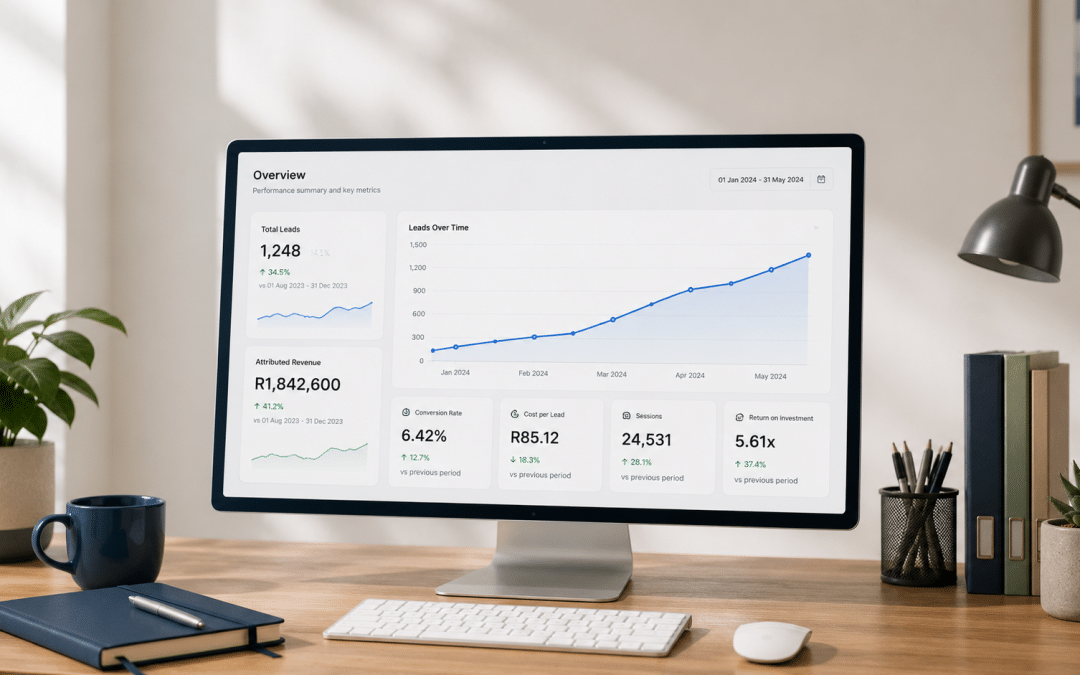
Getting SEO reporting KPIs South Africa right starts with one uncomfortable admission: most search reports measure the wrong things. They lead with rankings and raw traffic — numbers that move and look impressive — while saying nothing about whether organic search is producing leads, sales or rand.
A useful report does the opposite: it puts business outcomes first and treats traffic as a means, not the scorecard, the same discipline that runs through our SEO in South Africa work.
The distinction that matters is between vanity metrics and value metrics. Vanity metrics — impressions, sessions, keyword positions in isolation — feel like progress without proving any. Value metrics tie organic search to money: conversions, qualified leads, revenue. Effective SEO reporting KPIs South Africa work surfaces the second kind clearly enough that a decision-maker can act, which is also why the technical foundation has to be sound before the numbers mean anything.
This guide covers which indicators actually belong in a report, how to present them, and the local realities that shape what to track and how to show it to the people signing off the budget.
Quick Answer
The metrics that matter are the ones tied to business outcomes: organic conversions and leads, organic revenue, non-branded organic traffic, rankings for commercial terms, click-through rate, and indexing health. Rankings and raw traffic are leading indicators, not the scorecard. Done well, SEO reporting KPIs South Africa means reporting monthly, showing trends rather than single snapshots, isolating non-branded organic, and translate everything into the rand outcomes a decision-maker cares about.
A report that leads with sessions and positions is measuring effort; one that leads with leads and revenue is measuring results.
Vanity Metrics Versus Value Metrics
Every search report sits somewhere on a spectrum from vanity to value, and where it sits decides whether anyone can make a decision from it. The trap is that vanity metrics are easier to move and more flattering to show, so reports drift toward them unless someone holds the line.
Is your current SEO report actually telling you anything?
We'll review what you're being shown, flag the vanity metrics, and tell you which numbers actually reflect business results. No jargon, no obligation.
Get a Free Report ReviewA value metric answers a business question. Did organic search produce leads this month? Did those leads turn into revenue? Which commercial queries are we winning, and which are slipping? Strong SEO reporting KPIs South Africa reports are built backwards from those questions, then filled with the smallest set of numbers that answers them honestly — not the largest set that fills a slide deck.
According to Google's Search Console Performance report documentation, the core search metrics are clicks, impressions, click-through rate and average position — useful inputs, but inputs, not outcomes.
The leading indicators still belong in the report — they explain movement and flag problems early — but they sit below the outcomes, not above them. A good set of SEO reporting KPIs South Africa metrics is layered: business outcomes at the top, leading indicators beneath to explain them, and diagnostics at the bottom for when something needs investigating. Lead with the diagnostics and the report becomes noise.
Build the Report Backwards
Start from the business questions, not the available data. Outcomes go at the top — leads, revenue, conversions from organic search. Leading indicators like rankings, impressions and click-through rate sit beneath to explain why outcomes moved. Diagnostics like indexing and crawl health sit at the bottom for troubleshooting. A report assembled in that order answers "is this working" on the first line; one assembled from whatever the tools spit out buries the answer.
The KPIs That Actually Matter
A focused set of SEO reporting KPIs South Africa metrics tracks a handful of indicators that connect organic search to the business, plus a thin layer of leading indicators to explain them. More than that and the signal drowns; fewer and you cannot diagnose why a number moved.
The outcome layer is non-negotiable: organic conversions and qualified leads, organic revenue, and conversions from non-branded search specifically. The set of SEO reporting KPIs South Africa metrics worth tracking then adds the leading indicators — non-branded organic traffic, rankings for commercial terms, click-through rate, and indexing or Core Web Vitals health — each earning its place by explaining an outcome rather than decorating the report.
| Metric | What it tells you | The vanity trap |
|---|---|---|
| Organic conversions / leads | Whether search produces business | Counting all conversions, not organic |
| Organic revenue | The rand value search created | Ignoring it for traffic totals |
| Non-branded organic traffic | Demand the work actually created | Counting branded searches |
| Commercial-term rankings | Visibility on money queries | Tracking every keyword equally |
| Click-through rate | Whether listings earn the click | Chasing impressions alone |
| Indexing / CWV health | Whether pages can rank at all | Treating it as a headline number |
Notice what is missing from the top of that list: total sessions, total keywords ranked, and domain authority scores. They are not useless, but they are leading indicators at best and decoration at worst. Keeping SEO reporting KPIs South Africa metrics disciplined means resisting the urge to promote a flattering number into a headline it has not earned.
How to Report Them Properly
The metrics are only half the job; presentation is the other half, and it is where most reports fail. A set of SEO reporting KPIs South Africa metrics with no trend, no comparison and no business translation is data, not a report — and data does not drive decisions.
Three habits separate a report that gets acted on from one that gets filed. Show trends, not snapshots — a single month's figure means nothing without the line behind it. Isolate non-branded organic so the numbers reflect what the work created. And translate everything into business terms, because a sound set of SEO reporting KPIs South Africa metrics still fails if it is handed to an owner as raw analytics rather than rand and leads.
Want a dashboard that shows results, not just traffic?
We'll build a reporting view that puts leads and revenue first and connects organic search to the numbers your decision-makers care about. No jargon, no obligation.
Get a Free Dashboard SetupOn tooling, the practical stack is a dashboard pulling from Google Analytics 4 for conversions and revenue, Search Console for query and click data, and a layer like Looker Studio to combine them into one view.
The point of a dashboard is not more numbers but fewer, clearer ones — a single SEO reporting KPIs South Africa view that answers the business questions at a glance and lets anyone drill into the diagnostics only when a headline moves.
Cadence matters too: monthly is right for most businesses, since reporting too often turns normal weekly noise into false alarms.
Reporting for South African Decision-Makers
What you report, and how, shifts when the audience is a South African business owner rather than a marketing team. The owner does not want positions and sessions; they want to know whether the spend is producing rand, and that framing should drive the whole report.
That means translating organic search into the local outcomes that matter: leads and revenue in rand, not percentages and traffic curves. A report built on SEO reporting KPIs South Africa metrics earns its keep when it tells an owner "organic search produced 42 qualified leads worth roughly R310,000 in pipeline this month," not "sessions grew 18%." The first is a business statement; the second is a chart.
Local visibility deserves its own line where it applies. For businesses that depend on nearby customers, map-pack presence and Google Business Profile actions belong in the report alongside the national picture — and our local SEO work treats those as outcome metrics, not vanity ones. A national traffic total can hide whether you are winning the local searches that actually convert.
| Reporting line | Vanity version | Value version |
|---|---|---|
| Headline | Sessions up 18% | 42 organic leads, ~R310k pipeline |
| Rankings | 1,200 keywords ranked | Top 3 on 9 commercial terms |
| Local | Not reported | Map-pack on 6 "near me" queries |
| Format | Single-month snapshot | 12-month trend line |
Report to the Audience
A report for a South African owner leads with rand and leads, not sessions and positions. It translates organic search into pipeline value, reports local visibility as an outcome where nearby customers matter, and shows trends over months rather than a single snapshot. The numbers can be perfectly accurate and still fail if they are presented as analytics rather than business results — the translation is the part that gets the budget renewed.
Common Reporting Mistakes
The biggest SEO reporting KPIs South Africa mistake is leading with vanity metrics — opening on sessions, impressions or total keywords because they look good and move easily. It frames the entire report around effort rather than results, and trains the reader to judge success by the wrong numbers.
The rest follow a pattern of dishonest or careless presentation. Reporting a single-month snapshot with no trend, counting branded traffic as a search win, omitting the business-outcome translation, and reporting so often that normal noise reads as a crisis all corrupt the picture. Each turns a report that should drive a decision into one that misleads it.
What works: a monthly report opens with organic leads and pipeline value in rand, shows a twelve-month trend, isolates non-branded organic, and keeps rankings and impressions as a supporting layer that explains the outcomes. The owner reads the first line and knows whether to renew the budget.
What fails: a report leads with "sessions up 18% and 1,200 keywords ranked," shows only this month, counts branded searches, and never converts anything to rand. It looks busy and proves nothing — and the first time traffic dips for a normal reason, it triggers a panic that better framing would have avoided.
The One Discipline
Lead with outcomes, show trends, isolate non-branded organic, and translate to rand. The mistakes that wreck a report — vanity headlines, single-month snapshots, branded inflation, no business translation — are all failures of discipline rather than data. The tools give you everything; the skill is choosing the few numbers that answer the business question and presenting them so the answer is unmistakable on the first line.
Why Growth Pulse Media Reports This Way
Growth Pulse Media builds reports that lead with business outcomes, because treating SEO as a measurable channel means proving it in the terms a business actually runs on. We isolate non-branded organic, tie conversions to rand value, show trends across months rather than flattering snapshots, and keep the leading indicators as a supporting layer rather than the headline.
That approach sometimes means a less impressive-looking report. On every SEO reporting KPIs South Africa engagement we would rather show an owner four numbers that matter than forty that do not, and we would rather report an honest flat month with the reason behind it than dress it up with a vanity metric that happened to rise. The report exists to support a decision, and a decision needs signal, not volume.
It also connects to the surrounding strategy. A report framed in rand makes the pricing conversation rational and the channel-mix question — whether organic or paid search deserves the next rand — a numbers decision rather than a hunch. Clear reporting is what makes every other decision in the cluster defensible.
Who This Is NOT For
You want a report that always looks good. Honest reporting includes flat and down months with the reasons behind them. If the requirement is a perpetually green dashboard, vanity metrics will deliver that — and tell you nothing true when it matters.
You will not set up conversion tracking. Without GA4 tracking organic conversions and their values, the outcome layer is empty and the report falls back to traffic and rankings. Fix the tracking first, or accept that the numbers cannot speak to business results.
You judge success by rankings alone. Positions are a leading indicator, not a result. If the scorecard is keyword rankings rather than leads and revenue, this approach will frustrate you — it deliberately demotes the number you most want to celebrate.
You want a new report every week. Weekly reporting turns normal fluctuation into false alarms and drives reactive decisions. If the expectation is constant updates rather than a monthly view of the trend, the cadence itself will distort how the work is judged.
Want reporting that proves whether your SEO is working?
We'll build a monthly view that leads with leads and revenue, isolates non-branded organic, and shows the trend your decision-makers need. No jargon, no obligation.
Get a Free Reporting AuditSEO Reporting KPIs South Africa: Frequently Asked Questions
What SEO KPIs actually matter?
The ones tied to business outcomes: organic conversions and qualified leads, organic revenue, and conversions from non-branded search. Below those sit leading indicators — non-branded organic traffic, rankings for commercial terms, click-through rate and indexing health — which explain why outcomes moved. Rankings and total traffic on their own are leading indicators, not the scorecard.
What is the difference between a vanity metric and a value metric?
A vanity metric looks impressive but does not answer a business question — total sessions, impressions, or keyword counts in isolation. A value metric ties organic search to money: leads, revenue, conversions. A useful report leads with value metrics and keeps vanity metrics, if shown at all, as supporting context rather than headlines.
How often should I report on SEO?
Monthly suits most businesses. Organic search moves slowly, so weekly reporting turns normal fluctuation into false alarms and encourages reactive decisions. A monthly cadence with a rolling trend line shows the direction clearly without overreacting to noise, while still catching real problems early enough to act.
Which tools should I use for SEO reporting?
The practical stack is Google Analytics 4 for conversions and revenue, Google Search Console for query, click and position data, and a dashboard layer such as Looker Studio to combine them into one view. The goal is fewer, clearer numbers in a single place, not more dashboards to maintain.
Should rankings be a KPI?
Rankings are a leading indicator, not a primary KPI. They explain movement in traffic and conversions and flag opportunities — positions just off page one are often quick wins — but ranking high means little if it does not produce leads or revenue. Track rankings for commercial terms, and read them as a cause, not a result.
How do I report SEO to a business owner?
Translate everything into rand and leads. An owner wants to know whether the spend produced business, so lead with organic leads and pipeline value, show the trend over months, and keep analytics detail as backup. A statement like "organic search produced 42 leads worth roughly R310,000 in pipeline" lands where "sessions up 18%" does not.
Get reporting that answers the only question that matters
Growth Pulse Media builds SEO reporting for South African businesses that leads with leads and revenue, isolates non-branded organic, and shows the trend in terms your decision-makers actually use. No vanity dashboards, no filler metrics. No obligation — we will get back to you within 24 hours.
Get Your Free SEO Reporting ConsultationMost businesses do not need a longer report — they need a shorter, honest one that answers whether organic search is working in terms they can act on. That is the conversation we start with, and there is no cost or commitment to having it.
