
 Add to Preferred Sources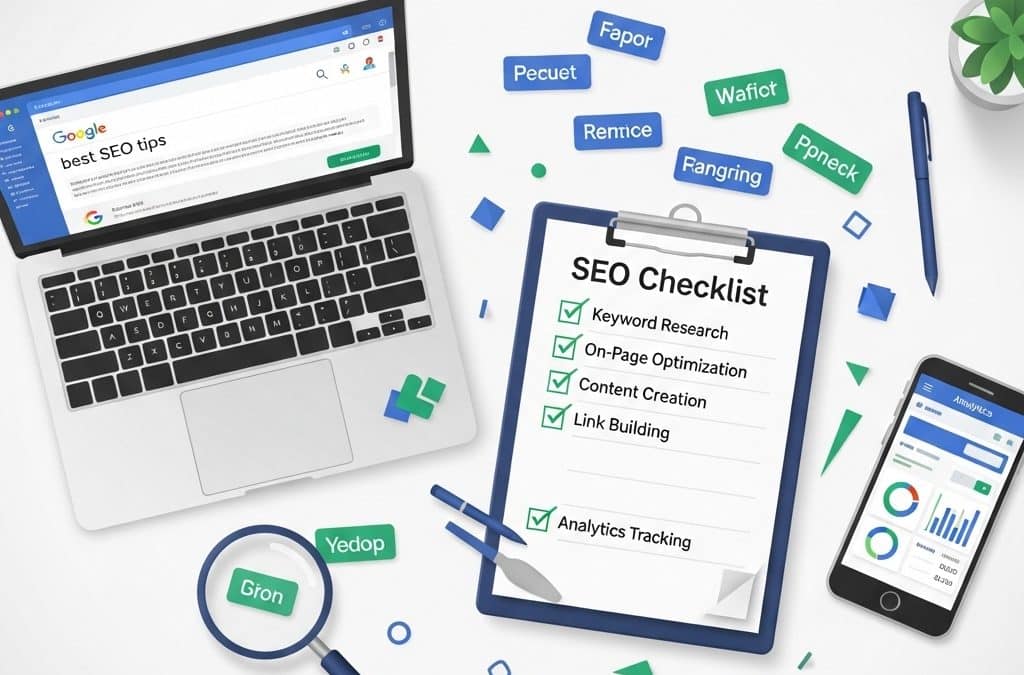
On-page SEO checklist South Africa — this 15-step guide covers every on-page optimisation your SA website needs to rank higher in Google, from title tags and heading structure through to schema markup, image optimisation, and featured snippet targeting.
On-page SEO is the foundation of all organic rankings — technical SEO helps Google find your site, backlinks help Google trust it, but on-page SEO is what helps Google understand each individual page and match it to the right search queries.
For a complete SEO strategy, read our SEO South Africa guide. For the technical side, read our technical SEO basics guide.
Want a free on-page SEO audit for your South African website?
Get a Free SEO AuditOn-Page SEO Checklist South Africa: The 15-Step Guide
On-page SEO checklist South Africa covers the elements on your website that you control directly — content, HTML, images, and internal links. Unlike off-page SEO (backlinks) or technical SEO (server and site structure), on-page SEO focuses on making individual pages as relevant and useful as possible for specific search queries.
1. Optimise Your Title Tag
Your title tag is the blue clickable link that appears in Google search results — one of the most important on-page SEO signals. Include your primary keyword near the beginning, keep it under 60 characters, make it compelling enough to earn clicks, and include your brand name at the end where space allows.
Good: Web Design Johannesburg | Professional Websites That Convert | Growth Pulse Media
Bad: Home | Growth Pulse Media | Web Design | Johannesburg | South Africa
2. Write a Compelling Meta Description
The meta description appears below your title in search results. It does not directly affect rankings but significantly influences click-through rate. Keep it 150–160 characters, include your primary keyword naturally, add a clear call-to-action, and make it unique for every page — Google generates generic ones automatically when yours is missing.
3. Create Clean URL Structures
Your URL should be short, descriptive, and include your target keyword.
Good: growthpulsemedia.co.za/web-design-johannesburg/
Bad: growthpulsemedia.co.za/p=12345&cat=services
Use hyphens to separate words, keep URLs lowercase, and avoid unnecessary parameters or numbers. Never change a live URL without setting up a 301 redirect — you will lose all accumulated ranking authority.
4. Use Proper Heading Structure (H1–H6)
Headings help both users and search engines understand content structure. Use exactly one H1 per page containing your main keyword. Use H2s for major sections. Use H3s for subsections within H2s. Include keywords in headings where they appear naturally — never skip heading levels.
5. Create High-Quality, Comprehensive Content
Google rewards content that thoroughly answers search queries. Thin content rarely ranks for competitive terms. Answer the search query completely, cover related subtopics users might want, aim for at least 1,500 words for pillar content, use original insights and SA-specific examples, and update content regularly to keep it fresh and accurate.
6. Strategic Keyword Placement
Include your target keyword in: the title tag, meta description, H1 heading, first 100 words of content, at least one H2 subheading, naturally throughout body content, image alt text, and URL slug. The key word is naturally — avoid keyword stuffing, which makes content unreadable and can trigger ranking penalties.
Key Takeaway
On-page SEO checklist South Africa rule one: write for humans first, then ensure your keyword appears naturally. If you have to force the keyword into a sentence, rewrite the sentence. Google's algorithms now understand context and synonyms — unnatural repetition does more harm than good.
7. Add Internal Links
Internal links connect pages, help Google understand site structure, and pass authority between pages. Link to relevant pages using descriptive anchor text — never "click here." Ensure every important page is linked from at least one other page. Three to five internal links per 1,000 words is a reasonable benchmark. Update old content to link to new pages as your site grows.
8. Optimise Images
Images affect both user experience and SEO rankings. Compress every image before uploading using TinyPNG or Squoosh. Use descriptive file names — `web-design-johannesburg.webp` not `IMG_1234.jpg`. Add alt text describing the image and including your keyword where it appears natural. Use WebP format for better compression. Specify image dimensions to prevent layout shift.
9. Ensure Mobile-Friendliness
Google uses mobile-first indexing — it primarily looks at the mobile version of your site for ranking, even for desktop searches. Over 70% of South African web traffic comes from mobile devices. Use responsive design, ensure text is readable without zooming, make buttons easy to tap, and test pages on actual mobile devices — not just a resized browser window.
Want to know exactly how your SA website scores on this on-page SEO checklist?
Get a Free On-Page SEO Review10. Improve Page Speed
Page speed and page experience affect both rankings and conversions. Every second beyond 3 seconds increases bounce rates significantly. Enable browser caching, minify CSS and JavaScript, use a CDN like Cloudflare, optimise images, and choose quality SA hosting. Use Google PageSpeed Insights to identify specific issues on each page.
11. Add Schema Markup
Schema markup is structured data that helps Google understand your content and can enable rich snippets in search results — FAQ dropdowns, star ratings, product prices. Common types for SA businesses include LocalBusiness, Organisation, Product, Service, Article, and FAQ. Most visitors never see schema code, but it can significantly improve click-through rates from search.
12. Include Relevant External Links
Linking to authoritative external sources signals credibility to Google. Link to reputable sources to support statistics or claims. Use `target="_blank" rel="noopener noreferrer"` to open external links in a new tab. Avoid linking to competitors or low-quality sites. Check external links regularly — broken links on your pages are a negative signal.
13. Improve Content Readability
High bounce rates caused by difficult-to-read content hurt rankings. Use short paragraphs of 2–3 sentences. Break up text with subheadings every 200–300 words. Use bullet points for lists. Write in plain English and avoid industry jargon. Aim for a Flesch reading score of 60–70 — readable by a broad audience without being simplistic.
14. Optimise for Featured Snippets
Featured snippets appear at the top of some search results, above all organic listings. To target them, answer questions directly and concisely using the question as a heading followed by a clear answer. Format content as lists or tables where appropriate. Keep paragraph snippet answers between 40–60 words. Structured content with clear H2 and H3 headings is the strongest signal for snippet eligibility.
15. Keep Content Fresh and Updated
Google favours updated content — pages that have not been touched in years lose rankings to newer, more relevant content. Update statistics and examples annually. Add new sections when relevant information emerges. Update the publication date when making significant changes. Refresh meta descriptions and titles periodically to maintain click-through rates.
On-Page SEO Checklist South Africa: Quick Reference
| Element | Requirement | Priority |
|---|---|---|
| Title Tag | Under 60 characters, keyword near start | 🔴 Essential |
| Meta Description | 150–160 characters, keyword + CTA | 🔴 Essential |
| URL Slug | Short, descriptive, hyphenated, includes keyword | 🔴 Essential |
| H1 | One per page, includes primary keyword | 🔴 Essential |
| Content Length | 1,500+ words for pillar content | 🔴 Essential |
| Keyword Placement | Title, H1, first 100 words, H2, alt text | 🔴 Essential |
| Internal Links | 3–5 per 1,000 words, descriptive anchors | 🟡 Important |
| Image Optimisation | Compressed, WebP, descriptive alt text | 🟡 Important |
| Page Speed | Under 3 seconds load time | 🔴 Essential |
| Mobile | Responsive, readable, tap-friendly | 🔴 Essential |
| Schema Markup | LocalBusiness, FAQ, Article as appropriate | 🟡 Important |
| External Links | At least one authoritative dofollow link | 🟡 Important |
| Content Freshness | Updated annually at minimum | 🟢 Recommended |
Key Takeaway
The businesses that rank well in South African Google searches are not necessarily the biggest — they are the ones that consistently apply on-page SEO best practices across every page. Work through this on-page SEO checklist for your homepage and main service pages first, then apply it systematically to every new page you publish.
On-Page SEO Checklist South Africa: Common Mistakes
Keyword stuffing: Forcing your keyword into every sentence makes content unreadable and can trigger ranking penalties. Write naturally — Google understands context.
Duplicate content: The same content on multiple pages confuses Google and dilutes rankings. Every page needs unique content targeting a specific query.
Missing meta descriptions: Google will generate one automatically, but it will not be optimised for click-through rate. Write one for every page.
Ignoring image alt text: Missing alt text loses both ranking opportunities and accessibility compliance. Every image needs a descriptive alt attribute.
No internal links: Isolated pages are harder for Google to discover and rank. Every important page should be linked from at least one other page on your site.
If you want specialist support implementing this on-page SEO checklist across your SA website, our SEO services South Africa team audits, optimises, and manages ongoing organic growth for SA businesses.
On-Page SEO Checklist South Africa: Frequently Asked Questions
What is on-page SEO and why does it matter for South African websites?
On-page SEO refers to optimising elements on your website that you control directly — title tags, headings, content, images, internal links, and schema markup.
It matters because it is how you tell Google what each page is about and which search queries it should appear for. Without on-page SEO fundamentals, even a technically perfect website with strong backlinks will underperform in South African search results.
How many keywords should I target per page?
Each page should target one primary keyword and two to four closely related secondary keywords. Trying to rank one page for too many unrelated keywords dilutes its relevance signal. A page targeting "web design Johannesburg" can also naturally cover "website design Johannesburg" and "web designer Johannesburg" — but should not also try to rank for "SEO Johannesburg" which needs its own dedicated page.
How long should a page be for good SEO in South Africa?
There is no universal minimum, but pages targeting competitive keywords in South Africa typically need 1,500 to 3,000 words to rank on page one. Thin pages of under 500 words often struggle for competitive terms because they cannot fully answer the search query. However, length should be driven by what the topic requires — do not pad content to hit a word count target.
Does page speed affect SEO for South African websites?
Yes — directly. Page speed and page experience are confirmed Google ranking factors through Core Web Vitals. For South African businesses specifically, this matters more than average because a significant portion of SA users browse on mobile data connections that are slower than fibre. A page that loads in 5 seconds on mobile loses the majority of visitors before they see any content.
How often should I update my website content for SEO?
At minimum, review and update your highest-traffic and highest-value pages annually — updating statistics, examples, and any outdated information. Pages covering fast-moving topics like pricing, regulations, or technology should be reviewed every 3–6 months. Google does not require constant updates, but pages that become outdated relative to newer competitor content gradually lose rankings over time.
Ready to implement this on-page SEO checklist across your South African website?
Get a Free SEO Strategy SessionGet a Free On-Page SEO Audit for Your SA Website
Growth Pulse Media audits South African websites against every item on this on-page SEO checklist — identifying exactly what is holding your pages back from ranking and what to fix first for the fastest results. No obligation — we will get back to you within 24 hours.
Get Your Free SEO Audit