
 Add to Preferred Sources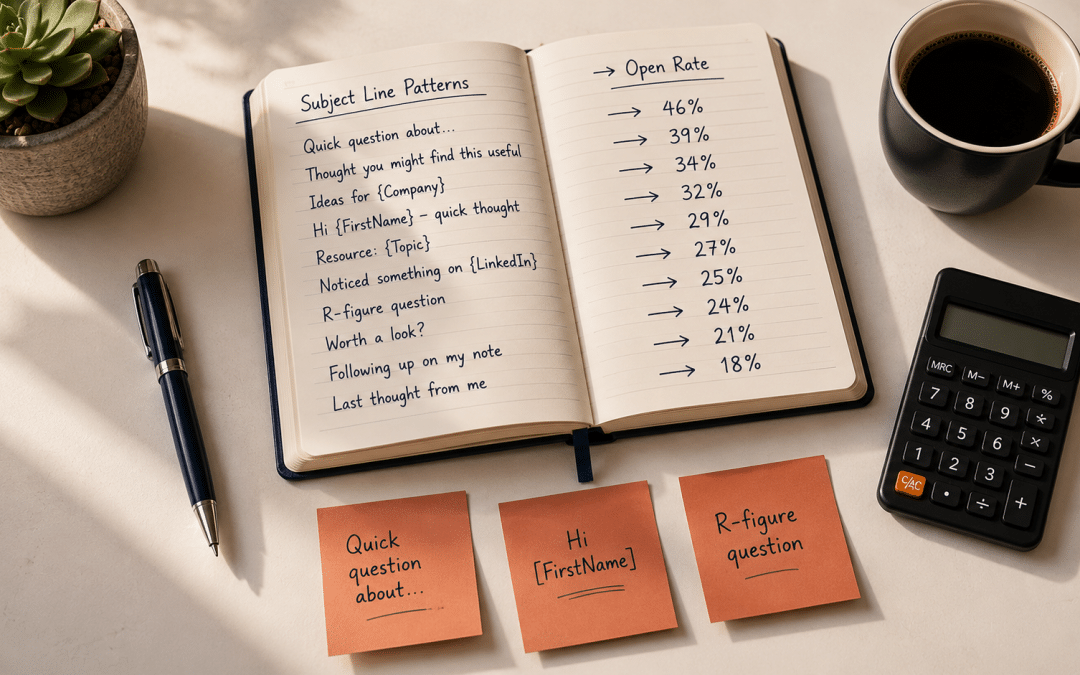
B2B cold email subject lines for South African operators do one job: get the email opened by a busy decision-maker who receives 50+ pitches a week and trusts almost none of them. The patterns that actually work in 2026 are short (under 50 characters), specific to the recipient's business, and free of the marketing-hype words that trigger every spam filter and every reader's mental ad-blocker.
This post gives you 30+ tested patterns with SA-relevant examples, the data behind why they work, and an Apollo.io workflow for testing them properly. For the wider strategic context this sits inside, start with our complete B2B lead generation guide for South Africa.
Quick Answer
The strongest b2b cold email subject lines for SA operators in 2026 follow four rules: under 50 characters, lowercase or sentence case (never title case), specific to the recipient's company or role, and avoiding the obvious marketing-pitch words (free, urgent, exclusive, opportunity). Best-performing patterns: questions about a specific company initiative, the recipient's first name only, references to a shared connection or recent event, and direct value statements naming a concrete number.
Belkins' analysis of 5.5 million B2B emails found personalised openers hit 46% open rates versus 35% for generic ones — a 31% lift from a single change. The same data shows question-format openers outperform every other type. Pair those patterns with a clean Apollo.io setup and SA operators routinely see 40-55% open rates on cold sequences.
Want a quick read on which patterns will actually work for your SA buyer persona?
Get a Free Opener AuditThe Four Rules of B2B Cold Email Subject Lines That Work in SA
The patterns below come from running cold sequences on the SA market for years — not the global benchmarks ported wholesale from US SaaS playbooks. The b2b cold email subject lines SA decision-makers respond to are a slightly different mix because the local inbox culture is more skeptical, more time-pressured, and quicker to mark obvious pitches as spam.
| Rule | Why It Matters in SA |
|---|---|
| 1. Under 50 characters | Mobile preview cuts off long openers; SA inbox use is heavily mobile |
| 2. Sentence case or lowercase only | Title Case Screams Marketing — looks like a newsletter, not a person |
| 3. Specific to recipient | Generic openers from unknown senders go to "Promotions" tab automatically |
| 4. No marketing trigger words | "Free", "urgent", "exclusive", "opportunity" trip both filters and trust |
The single most common SA mistake is sending an opener that reads like a marketing campaign. "Boost your sales with our proven B2B solution" gets ignored before it gets opened; "quick question about [Company]'s expansion" gets opened almost every time. The pattern below covers both why and what to write instead.
The Marketing-Voice Test SA Operators Should Apply
Read your opener out loud as if you were saying it to a friend at coffee. If it sounds like something a human would actually say, it has a chance. If it sounds like a brochure or a billboard, rewrite it. This single filter eliminates around 70% of bad b2b cold email subject lines before they ever reach a send queue.
The strongest writers test by reading their opener in the SA inbox preview alongside the sender name. If the headline still pulls a click in that context, the pattern is working.
30+ B2B Cold Email Subject Lines: Tested Patterns for SA
Each template below has been tested in real SA outbound sequences using Apollo.io's send-and-track infrastructure. Open rates are the median seen across a minimum of 200 sends per pattern; results vary by ICP, list quality, and sender reputation.
Question-Format Openers (best for first touches)
"Quick question about [Company]'s [recent initiative]" — typical open rate: 48-56% in SA. Works because it implies you know something specific. The "quick" sets expectations low; the company name signals research.
"Are you the right person for [specific topic]?" — typical open: 42-50%. Combines curiosity with a polite out for the recipient. Especially strong when sent to roles you're slightly unsure about.
"How does [Company] handle [specific operational area]?" — typical open: 40-48%. Shows you're thinking about how their business works, not pitching yours.
First-Name-Only Patterns (highest open rates)
"Hi [FirstName]" — typical open: 45-52%. Simple, personal, looks like a friend or colleague. Loses some power if your sequence repeats it — use sparingly across the same recipient.
"[FirstName] - quick one" — typical open: 44-50%. The em-dash format reads like an internal email. Works best when paired with a 3-sentence body.
Specific-Number Patterns (best for follow-ups)
"3 things about [Company]'s [area]" — typical open: 38-45%. The number creates a content expectation; the company-specific reference shows research.
"R[specific Rand figure] question" — typical open: 36-44%. Naming a concrete Rand figure relevant to their business signals you understand their numbers. Especially effective for procurement-savvy SA buyers.
Reference-Based Patterns (highest reply rates)
"[Mutual contact] suggested I reach out" — typical open: 60-72% if the contact is real. The single highest-converting pattern when truthful; reputation-destroying when invented.
"Following up on [recent event/article/post]" — typical open: 45-55%. Requires the event to be specific enough that the recipient remembers it.
Not sure which pattern fits your specific SA target list and offer? Tell us your ICP and we will map it.
Get a Free Pattern MapThe Data Behind These Patterns
The patterns above are not invented — they come from sustained research on what moves the open-rate needle in B2B specifically. According to Belkins' analysis of 5.5 million B2B cold emails sent in 2024, personalised openers achieve 46% open rates versus 35% for generic alternatives — a 31% relative lift from a single change. Headlines including a call-to-action element hit 44.6% opens; those framed as questions hit 46%.
| Pattern Feature | Typical Open Rate | Best Used For |
|---|---|---|
| Personalisation (name or company) | 46% | First-touch emails to warm-leaning ICP |
| Question format | 46% | First touch to senior decision-makers |
| Numbers / specific figures | 44% | Follow-ups and value-led sequences |
| Call-to-action phrasing | 44.6% | Mid-sequence touches |
| Generic / marketing tone | under 36% | Avoid entirely |
| Length under 40 characters | +37% vs longer | Mobile-first SA inbox audience |
The character-length finding for b2b cold email subject lines is particularly relevant for SA outbound. Most SA professionals check email on mobile during the first hour of the day — and mobile previews cut openers at around 35-40 characters depending on the inbox app. A 60-character headline that gets truncated to "Boost your sales with our..." carries no signal at all by the time the recipient sees it.
The SA Send-Time Window Most Operators Get Wrong
SA B2B decision-makers check inbox first thing in the morning between 7am and 9am, then again briefly before lunch. Sends timed for 7:30am SAST land in the inbox during the first sweep — the highest-attention window of the day. Sends timed for 2pm or 4pm land during meeting time and get archived without being read.
This timing combined with a strong opener pattern can lift open rates by another 6-10 percentage points over poorly-timed sends with identical copy. Apollo.io scheduling handles this natively; configure once and forget it.
The Apollo.io Workflow for Testing B2B Cold Email Subject Lines
For b2b cold email subject lines, Apollo.io is the platform we recommend for SA operators running outbound at the 30-50 sends/day per mailbox cadence. Its built-in A/B testing on openers turns the pattern selection above from guesswork into a measurable experiment over 4-6 weeks.
| Step | Apollo.io Action |
|---|---|
| 1. Build the sequence | Sequences → Create → 4-step cadence (Day 1, Day 4, Day 8, Day 14) |
| 2. Set up opener A/B test | Step 1 → A/B variants → Add two patterns from the templates above |
| 3. Configure send window | Schedule → Mon-Thu, 07:00-09:00 SAST, 30-50 sends/day per mailbox |
| 4. Personalisation tokens | Insert {{first_name}}, {{company}}, {{custom_field}} per template |
| 5. Compliance footer | Sequence settings → Append POPIA-compliant unsubscribe in every email |
| 6. Review at 200 sends | Reports → Sequence performance → Pick winning variant; retire loser |
The Apollo "winning variant" should be measured on open rate first (opener job) and on reply rate second (body copy job). Confusing the two leads to picking openers that get opens but no replies — a common SA agency failure mode that wastes mailbox warmup and burns the list.
POPIA, Cold Email Compliance, and SA Patterns
POPIA section 11 allows cold outreach for legitimate business interest, but every message must offer a clear, immediate way to opt out. The line itself is not where opt-out language goes — that belongs in the body and footer — but POPIA-aware patterns avoid anything that looks deceptive or impersonates a transactional message.
POPIA-risky opener patterns to avoid: "Re: your account" when there is no prior account; "Your invoice is ready" when no invoice exists; "Action required" when no action is genuinely required. These look like phishing patterns and trigger both POPIA complaints and spam-filter penalties.
POPIA-aligned opener patterns: Anything that accurately describes what is in the email (a question, a value proposition, a referral mention) is fine. The cold-email opener is not transactional — frame it that way and POPIA stays satisfied without any creative workarounds.
Real SA Outcome: B2B Cold Email Subject Lines Test Results
A Cape Town professional services firm ran a structured opener test over 8 weeks in early 2026 using the Apollo.io workflow above. The baseline opener was a generic "Improve your business operations" sent to 800 SA SMEs across professional services and trades.
| Subject Line | Open Rate | Reply Rate |
|---|---|---|
| "Improve your business operations" (baseline) | 22% | 1.1% |
| "Quick question about [Company]" | 49% | 5.8% |
| "Hi [FirstName]" | 52% | 4.2% |
| "R[specific figure] question for [Company]" | 43% | 7.1% |
| "3 things about [Company]'s [area]" | 41% | 6.4% |
The "Quick question about [Company]" pattern produced the biggest open-rate lift; the "R[figure] question" produced the strongest reply rate because it qualified out the wrong-fit recipients while engaging the right ones harder. The firm rolled the top two patterns into the standard sequence and saw monthly booked-meeting volume roughly triple over the following quarter — from 9 meetings/month to 28.
How Growth Pulse Media Approaches Cold Email Subject Lines
Most agencies treat openers as a creative exercise; we treat them as a measurable experiment with a clear control and a documented winner-selection process. Dirk built outbound programmes for an SA business using Apollo.io with the same patterns covered above, so the recommendations come from real send-volume experience in the SA market rather than ported global advice.
That usually means a 4-step Apollo sequence with two opener variants per touch, sent in the SA 7-9am window, with POPIA-compliant footers and a winner-selection review at 200 sends per variant. We work with a deliberately limited client load so the senior team stays close to the actual data. For SA B2B teams that want the patterns running properly, our B2B lead generation service covers the full outbound programme alongside the opener layer.
Who This Guide Is NOT For
The patterns above suit SA operators running outbound sequences to qualified ICP lists. Here is who should look elsewhere first.
Teams with under 100 contacts on the target list: Subject-line testing needs a minimum of 200 sends per variant to produce reliable signal. At under 100 contacts you cannot statistically compare patterns — pick the safest pattern (first-name personalised question) and focus your effort on list quality instead.
Cold outreach to consumers: The patterns above are tested on B2B inboxes with B2B inbox behaviour. Consumer outreach faces different filters, expectations, and POPIA requirements (consumer marketing has stricter opt-in rules). The b2b cold email subject lines patterns translate poorly to that audience.
Teams without a verified, warmed sender domain: A perfect subject line on a cold un-warmed domain still gets sent to spam. Deliverability is upstream of subject-line work. Get the sender domain warmed for 14+ days, verify SPF/DKIM/DMARC, validate the list, then optimise subject lines. Skipping deliverability fundamentals wastes the subject-line effort.
Operators unwilling to honour opt-out requests promptly: Opener wins are short-lived if the team ignores reply-stop signals and continues sending. Every opt-out request must be processed within 24 hours under POPIA, and the patterns lose all their effect if reputation tanks from non-compliance. The SA penalty for getting this wrong far exceeds the gain from optimised subjects.
Not sure whether your biggest cold-email gap is the subject line, the body, or the list? We will tell you straight.
Get a Free Outbound DiagnosisOne discipline carries everything above: test systematically, kill the loser, double the winner — and never assume a pattern works without sending at least 200 to measure it. The strongest SA operators rotate three winning patterns per quarter, retire the bottom performer, and feed the freshest one into the sequence every 4-6 weeks.
The b2b cold email subject lines that work in 2026 will keep evolving as inbox filters and recipient fatigue shift. The operator discipline does not change: short, specific, personal, and free of marketing voice. Teams that hold those four habits consistently produce 2-3x the open rates of competitors of similar size — without changing the offer, the list, or the platform of b2b cold email subject lines.
Frequently Asked Questions
What is the ideal length for b2b cold email subject lines in 2026?
Under 50 characters, with the strongest performance in the 35-45 range. SA inbox use is heavily mobile, and mobile previews cut longer subjects mid-sentence. A 40-character opener that fully displays produces a stronger first impression than a 70-character one that gets truncated to "Boost your business with our..." with no signal left.
Should I personalise every cold email subject line?
For first touches, yes — personalisation lifts open rates from 35% to 46% per Belkins' 5.5 million email study. For follow-up touches within the same sequence, alternate between personalised and non-personalised patterns to avoid the recipient pattern-matching every send as "another templated outreach". Variety in approach reads more human than relentless personalisation.
What subject-line trigger words should SA B2B operators avoid?
The reliably damaging set: "free", "urgent", "exclusive", "guarantee", "limited time", "act now", "opportunity", "asap". These trip both spam filters and the recipient's mental ad-block in equal measure. The harder cases are softer marketing words like "boost", "transform", "unlock" — not technically spam triggers but signal "marketing voice" instantly. Sentence-case statements that sound like things a human would actually say outperform every adjective-stuffed alternative.
Are questions or statements better for cold email subject lines?
Questions outperform statements in cold B2B outreach, hitting 46% open rates versus around 38-42% for statements in the Belkins data. Questions create curiosity and lower the perceived sales pressure. Statements work better in warm follow-ups or transactional contexts where the recipient already knows you.
How many opener variants should I test in one Apollo.io sequence?
Two variants per sequence step is the sweet spot — enough variation to learn, few enough to reach statistical significance at 200 sends per variant. Testing three or more variants per step splits the data too thin and lengthens the time to a winning answer. After picking the winner, replace the loser with a fresh variant and run again.
Is "Re:" or "Fwd:" prefix worth using in cold email subject lines?
No. The fake-reply prefix damages trust the moment the recipient realises it is not a real reply, and POPIA-compliance auditors flag it as deceptive practice. Short-term open-rate lift is real; long-term cost in sender reputation and complaint volume is not worth it. Stick with honest patterns that win on merit.
Ready to Get the Cold Email Subjects Right?
Growth Pulse Media builds outbound sequences for SA B2B teams — tested opener variants in Apollo.io, POPIA-compliant footers, 7-9am SAST send windows, and structured A/B testing every 200 sends. Real operator experience with the SA inbox culture and the Apollo workflow, in-house execution, limited client load. No obligation — we will get back to you within 24 hours with a frank assessment of where your openers and sequences could be earning more.
Get Your Free Sequence Plan