
 Add to Preferred Sources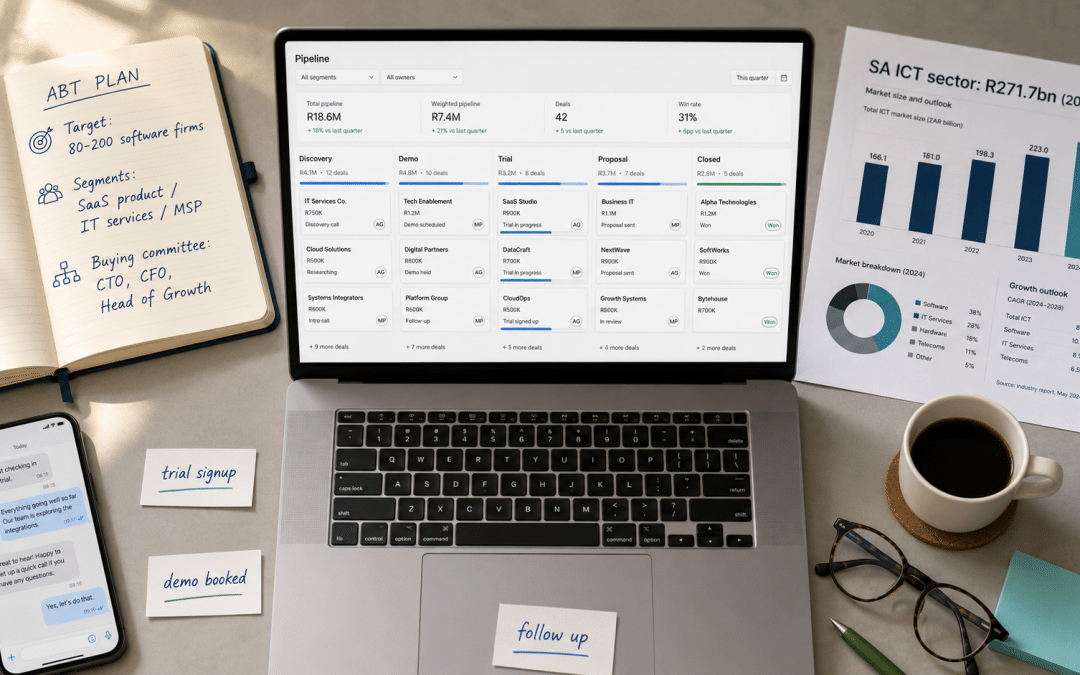
B2B lead generation for IT & SaaS in South Africa typically costs R30,000–R105,000 monthly for a properly scoped programme and delivers 8–25 qualified opportunities per quarter — but only when the programme is built around trial-and-demo pipeline mechanics, product-led signals, and multi-stakeholder sequencing tuned to how technology buyers actually evaluate software. This guide covers how to build pipeline programmes for SA software vendors and IT services firms, what to pay, and how to sequence outreach across the technical, financial, and executive stakeholders every technology purchase involves — with the same rigour we apply in our B2B lead generation South Africa guide and our professional services pipeline guide.
Quick Answer
B2B lead generation for IT & SaaS in South Africa works through account-based targeting of 80-200 named software and technology firms, product-led signals (trial signups, demo requests, usage triggers), and multi-stakeholder sequencing across CTO, Head of Growth, CFO, and end-user champions. Expect R30,000-R105,000 monthly cost, 1-6 month sales cycles depending on deal size, and 8-25 qualified opportunities per quarter. The mistake is treating software prospecting like any other outreach — technology buyers evaluate differently, expect product proof, and research independently before ever speaking to sales.
Want a free 60-minute strategy session focused specifically on your SA software or technology growth pipeline?
Get a Free Tech Pipeline StrategyB2B Lead Generation for IT & SaaS: What It Actually Costs
A software pipeline programme in South Africa is best understood as a scoped monthly engagement covering account research, product-led signal capture, multi-channel outreach, and pipeline management — not a per-lead purchase or a single campaign. Programmes run 6-12 months to reach steady-state output, though technology sales cycles vary widely: self-serve products close in weeks while enterprise platform deals run 3-9 months.
| Programme Type | Monthly Cost | Best For |
|---|---|---|
| Foundation programme | R30,000 – R45,000 | Early-stage SA software firms, single product |
| Growth programme | R45,000 – R72,000 | Scaling platforms, 2-3 target segments |
| Enterprise programme | R72,000 – R105,000+ | Established vendors, enterprise sales motion |
| Product-led add-on | +R14,000 – R26,000 | Trial-to-paid conversion, usage-signal automation |
According to Lula's analysis of the SA ICT sector, the ICASA-regulated technology sectors generated R271.7 billion in revenue in 2024 — a 9.01% year-on-year increase — signalling a large and growing addressable market for technology vendors selling into SA businesses. The challenge is not market size; it is that technology buyers research independently and reject vendors who lead with features instead of proof. For deeper cost context, see our pipeline cost guide.
Why Generic Outreach Fails for SA Technology Vendors
Generic prospecting methodology fails for SA software and technology firms because their buyers self-educate, expect product proof before sales conversations, and route decisions through technical evaluators most generic frameworks ignore. Applying standard outreach playbooks to the sector produces high enrolment metrics and near-zero closed revenue.
The Self-Educating Buyer Reality
Technology buyers complete a large share of their evaluation before ever contacting a vendor — reading documentation, comparing alternatives, and often starting a free trial independently. Outreach that ignores this and pushes a generic sales pitch feels tone-deaf to a buyer who already understands the category. Programmes that meet buyers with product proof, technical depth, and relevant comparisons consistently outperform pitch-led sequences.
The Product-Led Signal Reality
The strongest pipeline signal in software is behavioural: a trial signup, a demo request, a documentation visit, or a usage milestone. These product-led signals convert far higher than cold outreach because they indicate genuine intent. Programmes that capture and act on these signals — routing a trial signup to sales within minutes, not days — book meetings at materially higher rates than time-based follow-up sequences.
The Technical Evaluator Reality
Software purchases route through technical stakeholders (CTO, engineering lead, security reviewer) who evaluate integration, security, and architecture. A commercially strong pitch that cannot survive technical review stalls. Prospecting programmes for the sector must arm technical evaluators with documentation, security credentials, and integration detail early. See our pipeline mistakes guide for related failure patterns.
The Technology-Specific Insight
SA software buyers who arrive through a product-led signal — a trial or demo request — convert to qualified opportunity at 3-5x the rate of cold-sourced prospects. The single biggest lever in technology pipeline is speed of response to these signals: routing a trial signup to a human within the first hour lifts meeting-booking rates dramatically versus next-day follow-up. Signal capture plus fast response beats volume outreach every time. This is what effective B2B lead generation for IT & SaaS looks like in practice.
Want a product-led signal capture system built for your specific SA software segment?
Get a Free Signal Strategy RecommendationHow to Build the Technology Programme Step by Step
Building a software pipeline programme starts with segment definition, then signal infrastructure, then multi-stakeholder sequencing — in that order. Skipping steps or reordering produces activity without pipeline. The framework below reflects what actually works for SA technology firms.
Step 1 — Segment and Target List: Build 80-200 named accounts across the segments you sell into. Distinguish SaaS product buyers from IT services buyers — they evaluate differently. Filter by company size, tech stack (via tools like BuiltWith), funding stage, and growth signals. LinkedIn Sales Navigator plus Apollo.io is standard for technology prospecting.
Step 2 — Signal Infrastructure: Set up capture and routing for product-led signals — trial signups, demo requests, pricing-page visits, documentation engagement. The goal is to detect intent and route each signal to a human fast. This infrastructure is what separates technology pipeline from generic outreach.
Step 3 — Multi-Stakeholder Sequence: Deploy 6-10 touches across LinkedIn, email, and phone, varied by stakeholder. Arm the technical evaluator with documentation and security detail; give the CFO ROI and pricing clarity; give the executive champion strategic outcomes and peer references. A single generic message across the committee fails.
Common failure — feature-dump cold outreach: Programmes that blast identical feature-led messages to a broad unqualified list, ignore product-led signals, and target only one stakeholder generate response rates under 1% and stall at technical review. Signal-driven, multi-stakeholder sequencing outperforms feature-dump spray by 6-12x on pipeline generated per programme rand.
SA Technology Segment Considerations
Different SA technology segments require different demand generation approaches driven by sales motion, deal size, and buyer type. Applying self-serve SaaS methodology to enterprise IT services produces poor results and vice versa.
Software Product Companies
SA software product firms typically run product-led or hybrid motions where trial-to-paid conversion matters as much as outbound. Prospecting should emphasise signal capture, trial activation, and expansion within accounts. Sales cycles range from self-serve (days) to enterprise (3-6 months) depending on deal size and buyer seniority.
IT Services and Managed Service Providers
SA IT services firms and MSPs sell relationship-led, longer-cycle engagements where trust and track record dominate. Prospecting should emphasise case studies, certifications, and reference customers rather than product trials. These buyers value proven delivery capability and local support over feature lists. For IT and SaaS firms that want help building this kind of programme, our B2B lead generation service combines SEO, Google Ads, email and LinkedIn outreach, starting with a free audit.
Infrastructure and Enterprise Platforms
SA enterprise platform and infrastructure vendors face the longest cycles (6-12 months), heaviest technical evaluation, and largest buying committees. Prospecting should target multiple stakeholders early, arm technical evaluators comprehensively, and prepare for procurement and security review processes on larger deals.
The Segment Discipline Rule
The largest single factor separating technology prospecting programmes that produce pipeline from programmes that produce activity is segment discipline. Programmes targeting one clearly-defined SA technology segment (SaaS product, IT services, enterprise platform) consistently outperform generalist programmes by 4-7x on qualified opportunities per rand invested. The sales motion must match the buyer, and that only happens when the segment is tightly defined.
Measurement and Reporting Discipline
Strong programmes report on revenue-stage metrics, not activity metrics. Track qualified opportunities created, pipeline value by stage, meeting-to-opportunity conversion, and closed revenue by cohort — never message volume or connection counts. Activity dashboards feel productive while hiding the truth about whether the programme earns money.
Cohort tracking matters because deal cycles stretch across quarters. A prospect engaged in February may sign in August, so monthly snapshots systematically understate programme value. Group accounts by the month of first meaningful touch, then follow each cohort through to closed revenue. Within three or four cohorts, a clear conversion curve emerges — and that curve becomes the forecasting engine for the entire programme.
Weekly reviews should cover three questions. First, which accounts advanced a stage this week and why? Second, which accounts stalled, and what specific obstacle appeared — budget freeze, competing vendor, missing stakeholder? Third, which message angles earned replies and which fell flat? The answers feed directly back into targeting and sequencing decisions, turning the programme into a compounding system rather than a static campaign.
On tooling: a simple CRM discipline beats an elaborate stack used badly. Every account needs an owner, a next action, and a date. Deals without next actions rot silently. A Friday-afternoon pipeline scrub — thirty minutes, every open deal, next action confirmed — is the single cheapest habit that separates programmes producing consistent revenue from programmes producing occasional luck.
Want segment-specific prospecting strategy for your SA software or IT services operation?
Request a Free Segment AuditFrequently Asked Questions
How much does B2B lead generation for IT & SaaS cost in South Africa?
B2B lead generation for IT & SaaS programmes in South Africa cost R30,000-R105,000 monthly depending on segment count and sales motion. Foundation programmes covering a single product line run R30,000-R45,000. Growth programmes covering 2-3 segments run R45,000-R72,000. Enterprise programmes covering complex sales motions run R72,000-R105,000+. Product-led add-ons for trial-to-paid and usage-signal automation add R14,000-R26,000 monthly.
How long before a software pipeline programme shows results?
Technology sales cycles vary widely — self-serve products can close in weeks while enterprise platform deals run 3-9 months. First qualified opportunities from product-led signals often appear within the first month, while cold-sourced enterprise pipeline takes 2-4 months to build. Plan for 6-9 month evaluation minimum, longer for enterprise sales motions.
What is product-led lead generation?
Product-led pipeline building uses behavioural signals — trial signups, demo requests, documentation visits, usage milestones — as the primary source rather than cold outreach. These signals indicate genuine intent and convert at 3-5x the rate of cold prospects. The key is capturing signals and routing them to sales fast, ideally within the first hour, before buyer intent cools.
How does IT services prospecting differ from SaaS?
IT services and MSP prospecting is relationship-led and longer-cycle, emphasising case studies, certifications, and reference customers over product trials. Product-company prospecting leans on product-led signals and faster trial-to-paid motions. The buyer, sales cycle, and proof required all differ, so a single approach across both underperforms. Define which motion you are running before building the programme.
Which channels work best for reaching SA technology buyers?
Multi-channel sequencing outperforms single-channel approaches. Best-performing mix for SA technology firms: LinkedIn (senior and technical stakeholder outreach), email (product and evaluator contacts), phone (qualification), and product-led signal capture (trials and demos). For deeper nurture, see our email marketing resources. Programmes running fewer than three channels typically underperform.
How many stakeholders should we target per technology account?
Target 3-5 stakeholders per account minimum across technical, financial, and executive functions. Typical SA technology buying committee includes CTO or engineering lead, Head of Growth or product owner, CFO, and an end-user champion. Arming the technical evaluator early is critical because they can veto on integration or security grounds. Single-stakeholder programmes produce meeting rates below 2%.
Get a Free Pipeline Audit for Your SA Technology Business
Growth Pulse Media builds client-acquisition programmes specifically for South African software and technology firms — with account-based targeting via LinkedIn Sales Navigator and Apollo.io, product-led signal capture and fast routing, and multi-stakeholder sequencing across Technical, Financial, and Executive audiences. We understand how SA technology buyers evaluate because we have run these motions.
No obligation. No lock-in contracts. We will get back to you within 24 hours.
Request Your Free Pipeline Audit →