
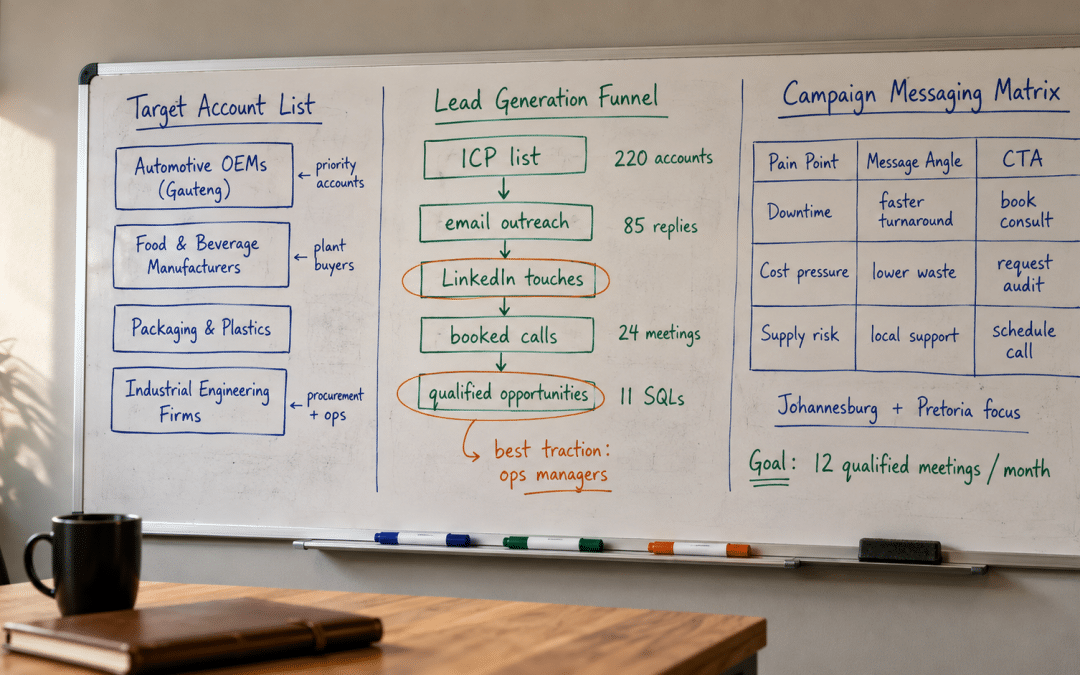
B2B lead generation for manufacturing in South Africa typically costs R28,000–R95,000 monthly for a properly scoped programme, generates 8–22 qualified opportunities per quarter, and delivers 12–35x pipeline ROI within 12–18 months — but only when the programme is built around account-based marketing methodology, procurement-cycle-aware sequencing, and buying-committee mapping specific to SA manufacturing sales cycles. This guide covers exactly how to build lead generation programmes for SA manufacturers, what to pay, and how to sequence outreach across the 5–8 stakeholders typical to every industrial purchase decision — with the same rigour we apply in our B2B lead generation South Africa guide and our professional services lead generation guide.
Quick Answer
B2B lead generation for manufacturing in South Africa works through account-based marketing targeting 80-250 named accounts, multi-stakeholder sequencing (Procurement Manager, Operations Director, Plant Manager, CFO, CEO), and 8-12 sales touches per meeting booked. Expect R28,000-R95,000 monthly cost, 6-14 month sales cycles, and 8-22 qualified opportunities per quarter for programmes running 12+ months. The mistake is applying B2C or SaaS methodology to industrial sellers — different buying committee, different cycle length, different qualification criteria.
Want a free 60-minute pipeline strategy session focused specifically on your SA industrial operation?
Get a Free Manufacturing Lead Gen StrategyB2B Lead Generation for Manufacturing: What It Actually Costs
A manufacturing pipeline programme in South Africa is best understood as a scoped monthly engagement covering account research, multi-channel outreach, content marketing, and pipeline management — not a per-lead purchase or a single campaign. Programmes typically run 12-18 months to reach steady-state pipeline output because SA industrial sales cycles average 6-14 months from first touch to signed order.
| Programme Type | Monthly Cost | Best For |
|---|---|---|
| Foundation programme | R28,000 – R42,000 | SA manufacturers under R80m revenue, single vertical focus |
| Growth programme | R42,000 – R68,000 | Mid-market manufacturers, 2-3 target verticals |
| Enterprise programme | R68,000 – R95,000+ | Large SA manufacturers, multi-region, complex buying committees |
| Vertical specialist add-on | +R12,000 – R25,000 | Automotive OEM, food & beverage, chemicals, mining supply |
According to MerSETA's sector research, the SA manufacturing sector employs over 1.7 million people across 30,000+ registered enterprises — providing a substantial addressable market for demand generation programmes targeting mid-market and enterprise manufacturers. The challenge is not addressable market size; it is buying committee complexity and sales cycle length that defeat generic outreach methodologies. For deeper cost context, see our B2B lead generation cost guide.
Why Generic Lead Gen Fails for SA Manufacturers
Generic B2B lead generation methodology fails for SA manufacturers because their purchase decisions involve 5-8 stakeholders on the buying committee, run 6-14 month sales cycles, and require specific technical qualification that SaaS or professional services frameworks do not address. Applying B2B SaaS playbooks to industrial sellers produces high enrolment metrics and near-zero closed revenue.
The Buying Committee Reality
Industrial purchase decisions rarely involve a single decision-maker. Typical committee: Procurement Manager (owns supplier evaluation), Operations Director (owns operational fit), Plant Manager (owns implementation), CFO (owns capex approval), and often CEO or Managing Director on larger deals. Each stakeholder has different concerns, different information needs, and different timing on the decision. Programmes that target only Procurement Manager or only CEO consistently underperform.
The Sales Cycle Reality
SA industrial sales cycles average 6-14 months from first meaningful touch to signed order, driven by capex approval cycles, technical evaluation timelines, and reference site visits. This makes lead attribution complex: a lead generated in January may close in September or later. Programmes evaluated on monthly closed-won metrics systematically underestimate pipeline impact. Correct evaluation requires 12-18 month cohort tracking.
The Technical Qualification Reality
Industrial prospects require technical qualification most generic frameworks miss: production volume specs, ISO certification requirements, quality tolerances, delivery capability against production schedule, and often site inspection before contract award. Programmes that generate high volume of unqualified enquiries create sales team burnout rather than pipeline. See our B2B lead generation mistakes guide for common pattern failures.
The Manufacturing-Specific Insight
SA manufacturers evaluating new suppliers require an average of 8-12 sales touches across at least 3 stakeholders on the buying committee before agreeing to a first meeting. Programmes running fewer touches or targeting only one stakeholder produce meeting book rates below 2%. Programmes running the full 8-12 touch sequence across procurement, operations, and executive stakeholders produce book rates of 6-11% — a 3-5x improvement driven purely by sequence discipline.
Want a custom multi-stakeholder outreach sequence built for your specific SA industrial vertical?
Get a Free Sequence RecommendationHow to Build the Programme Step by Step
Building such a programme starts with target account definition, then buying committee mapping, then multi-channel sequencing — in that order. Skipping steps or reordering produces programmes that generate activity without pipeline. The framework below reflects what actually works for SA manufacturers.
Step 1 — Target Account List: Build 80-250 named accounts using SA industrial sector databases, MerSETA registration data, and IPAP (Industrial Policy Action Plan) sector maps. Filter by revenue band (typically R80m-R2bn for mid-market), employee count (50-500), geographic concentration (Gauteng, KZN, Western Cape industrial hubs), and vertical fit (automotive OEM, food processing, chemicals, mining equipment, steel fabrication).
Step 2 — Buying Committee Mapping: For each target account, identify 3-5 stakeholders across procurement, operations, and executive functions. LinkedIn Sales Navigator combined with Apollo.io is standard for SA industrial prospecting. Verified contact data quality directly determines outreach conversion — invest in data hygiene before sequence execution.
Step 3 — Multi-Channel Sequence: Deploy 8-12 touches per stakeholder across LinkedIn InMail, direct email, phone, and LinkedIn video message. Vary message intent by stakeholder — efficiency benchmarks for Operations, ROI calculators for CFO, peer references for CEO, technical specs for Procurement. Sequence discipline determines outcome.
Common failure — single-channel spam: Programmes deploying 12 identical LinkedIn messages to 500 unqualified prospects generate response rates under 0.5% and consume months of team capacity for near-zero pipeline. Multi-channel sequencing across a smaller qualified target list consistently outperforms high-volume single-channel spray by 8-15x on pipeline generated per programme rand invested.
SA Vertical Considerations: Automotive, Food and Mining
Different SA industrial verticals require different prospecting approaches driven by regulatory environment, buying cycle differences, and stakeholder priorities. Applying automotive OEM methodology to food processing produces poor results and vice versa.
Automotive OEM Supply Chain
SA automotive OEM supply (Toyota, VW, Ford, BMW, Nissan, Mercedes) involves rigorous supplier qualification, PPAP submissions, quality audits, and typically 12-18 month cycles from first contact to first order. Outreach programmes must emphasise quality certification (ISO/TS 16949, IATF 16949), automotive-specific case studies, and executive relationships. Volume-focused programmes produce zero results in this vertical.
Food & Beverage Processing
SA food and beverage manufacturers (concentrated in Western Cape, KZN, and Gauteng) prioritise HACCP compliance, cold-chain logistics capability, and FSSC 22000 certification when evaluating suppliers. Programmes should emphasise food safety credentials, delivery reliability, and specific customer case studies from adjacent food categories.
Mining and Industrial Equipment
SA mining equipment suppliers (concentrated around Gauteng, Limpopo, Mpumalanga) face long capex cycles, extensive technical evaluation, and often multi-site pilot programmes before award. Outreach should target Chamber of Mines-affiliated buyers, emphasise safety credentials, and prepare for 12-24 month sales cycles on larger equipment sales.
The Vertical Discipline Rule
The largest single factor separating industrial pipeline programmes that produce results from programmes that produce activity is vertical discipline. Programmes targeting one clearly-defined SA industrial vertical (automotive OEM supply, food processing, mining equipment) consistently outperform generalist programmes by 4-8x on qualified opportunities per rand invested. Focus wins; breadth loses.
Want vertical-specific prospecting strategy for your SA industrial operation?
Request a Free Vertical AuditFrequently Asked Questions
How much does B2B lead generation for manufacturing cost in South Africa?
B2B lead generation for manufacturing programmes in South Africa cost R28,000-R95,000 monthly depending on target account count and vertical complexity. Foundation programmes covering single-vertical focus run R28,000-R42,000. Growth programmes covering 2-3 verticals run R42,000-R68,000. Enterprise programmes covering multi-region operations run R68,000-R95,000+. Vertical specialist add-ons (automotive, food & beverage, mining) add R12,000-R25,000 monthly.
How long before B2B lead generation for manufacturing shows pipeline results?
SA industrial sales cycles average 6-14 months, meaning first qualified opportunities typically appear at months 3-4 and first closed revenue at months 9-14. Programmes evaluated below 12 months systematically underestimate pipeline impact because the sales cycle is backweighted. Plan for 12-18 month evaluation minimum.
Which channels work best for reaching SA manufacturers?
Multi-channel sequencing consistently outperforms single-channel approaches. Best-performing channel mix for the sector: LinkedIn InMail (senior stakeholder outreach), direct email (operational and procurement contacts), phone (technical qualification), LinkedIn video message (executive engagement), and industry event presence (Africa Automation Fair, Propak Africa, Food & Hospitality Africa). Programmes running fewer than 3 channels typically underperform.
How many stakeholders should we target per account?
Target 3-5 stakeholders per account minimum across procurement, operations, and executive functions. Typical SA industrial buying committee includes Procurement Manager, Operations Director, Plant Manager, CFO, and often CEO or Managing Director. Programmes targeting only one stakeholder produce book rates below 2%. Multi-stakeholder programmes produce book rates of 6-11%.
Does content marketing work for reaching SA manufacturers?
Yes — content marketing focused on technical case studies, ROI benchmarks, and vertical-specific application notes consistently produces the highest-quality inbound enquiries in the sector. Generic thought leadership content underperforms; specific technical content targeting engineer and operations audiences drives real pipeline. Content programmes typically require 6-9 months before producing meaningful inbound volume.
How does this differ from SaaS or professional services lead gen?
Industrial sales involves longer cycles (6-14 months versus 1-3 months for SaaS), larger buying committees (5-8 stakeholders versus 2-3 for SaaS), technical qualification requirements (ISO certifications, quality audits, site inspections), and physical delivery constraints not present in SaaS. Applying SaaS methodology to industrial sellers produces high enrolment but near-zero closed revenue.
Get a Free Pipeline Audit for Your SA Manufacturing Operation
Growth Pulse Media builds lead generation programmes specifically for South African manufacturers — with account-based targeting via LinkedIn Sales Navigator and Apollo.io, multi-stakeholder sequencing across Procurement, Operations, and Executive audiences, and vertical-specific messaging for automotive OEM, food & beverage, chemicals, mining equipment, and steel fabrication. We understand these industrial sales cycles because we have worked them.
No obligation. No lock-in contracts. We will get back to you within 24 hours.
Request Your Free Pipeline Audit →