
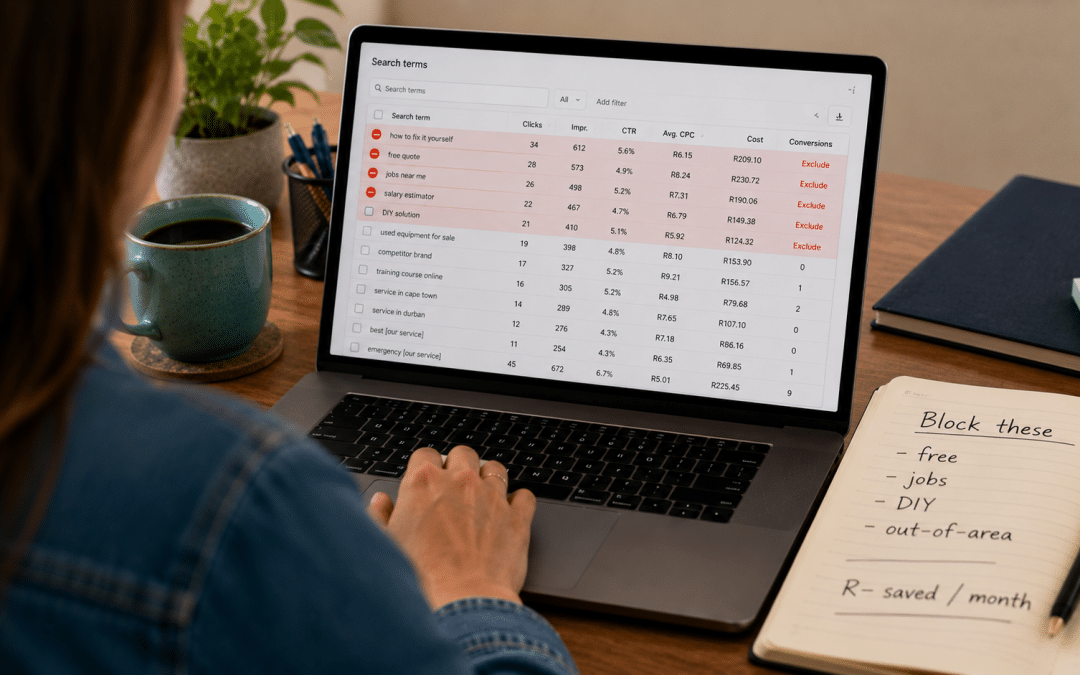
Negative keywords south africa campaigns rely on are the single highest-return lever for cutting wasted Google Ads spend — they tell Google which searches should never trigger your ad, so you stop paying for clicks that were never going to convert.
For an SA business, the difference between a campaign that bleeds budget and one that pays is often nothing more than a disciplined exclusion list built from the searches actually wasting your money. This guide shows where that waste hides locally and how to shut it off.
It sits within our Google Ads South Africa guide and tackles the wasted-spend problem head-on, which the broader cluster touches but does not isolate. Where keyword research decides what to target, exclusions decide what to refuse — and refusing the wrong searches is what protects your budget from quietly draining away. Here the focus is the refusal list and the Rand it saves.
Quick Answer
A negative keyword tells Google not to show your ad when a search contains that term. Add "free", and searches for "free quote template" stop triggering your ad. The point is to exclude irrelevant searches so your budget only buys clicks from people who might actually become customers — which directly lifts return on every Rand spent.
For an SA business, the waste is predictable: job and learnership searches, DIY and "how to" queries, "free" and "cheap" hunters, competitor brand names, and locations you don't serve. You find them in the Search Terms report — the list of what people actually typed before clicking your ad. Exclude the junk, keep refining, and a leaking campaign tightens into a profitable one without spending a cent more.
Suspect your Google Ads budget is leaking on searches that never convert? An exclusion audit usually finds it fast.
Get a Free Wasted-Spend AuditWhat Negative Keywords Actually Do
The negative keywords south africa advertisers need are simply terms you tell Google to exclude, so your ad will not show when a search contains them. If you sell premium accounting software and someone searches "free accounting app", a "free" exclusion stops your ad appearing — and stops you paying for a click from someone who will never buy. Each exclusion you add narrows your reach down to searches with genuine commercial intent.
Per Google's own documentation, these exclusions let you focus only on the searches that matter to your customers, which lifts return on investment. They work across match types — broad, phrase, and exact — though the rules differ slightly from ordinary targeting terms. The practical effect is the same regardless of the detail: every irrelevant search you block is budget redirected toward people who might actually convert.
Exclusions Are Where the Cheapest Wins Live
Most SA businesses pour effort into bids, ad copy, and landing pages while ignoring the one lever that costs nothing to pull: refusing the searches that waste money. A tight exclusion list does not require more budget, a new campaign, or clever creative — it simply stops the bleed. That makes it the highest-return hour you can spend in an account.
The mindset shift is treating "what not to show for" as seriously as "what to show for". An SA business that reviews its search terms regularly and blocks the junk keeps its spend concentrated on real prospects. Ignore the exclusion list, and even a well-built campaign quietly hands budget to job-seekers, bargain-hunters, and DIY searchers who were never going to buy.
Where Wasted Spend Hides in South Africa
The negative keywords south africa businesses most need follow predictable patterns, and the Search Terms report — the record of what people actually typed before clicking — is where you find them. Some categories of waste are near-universal locally: job and learnership searches, "free" and "cheap" hunters, DIY and "how to" researchers, competitor brand names, and searches from provinces or cities you do not serve. Each is a steady drain until excluded.
SA accounts have their own recurring offenders worth blocking early. Terms like "learnership", "vacancies", "tenders", and "salary" pull in job-seekers and researchers, not buyers, and burn through budget fast for service businesses. A Johannesburg-only plumber paying for "Cape Town" clicks, or a B2B firm paying for "wholesale" searches, is funding traffic that cannot convert. The table below maps the common SA waste categories to the exclusions that stop them.
| SA Waste Category | Exclude Terms Like |
|---|---|
| Job & learnership hunters | jobs, vacancies, learnership, salary, careers |
| Bargain & freebie seekers | free, cheap, DIY, how to, template |
| Out-of-area searches | cities and provinces you do not service |
| Wrong-fit intent | competitor brands, wholesale, second-hand, courses |
Want to know exactly which searches are wasting your budget right now, with the Rand figures attached?
Get a Free Search Terms ReviewThe Search Terms Report Is Your Money Map
Every exclusion worth adding is already visible in one place: the Search Terms report, which lists the exact queries people typed before clicking your ad. An SA business that reads it sees precisely where its budget went — including the job-seekers, freebie-hunters, and out-of-area clicks quietly draining the account. Nothing else in the platform shows waste this directly.
Treating that report as a weekly money map, rather than a screen you never open, is what separates a tightening account from a leaking one. Each irrelevant query you spot and block is a small, permanent saving. Skip the report and you are flying blind, paying for searches you would never have approved if you had simply looked at them.
How to Build Your Exclusion List
Building the negative keywords south africa campaigns need starts in the Search Terms report, where you review what people actually searched and flag anything irrelevant for exclusion. You can add terms at the ad-group level for precise control, at the campaign level to block across a whole campaign, or as a shared list applied to many campaigns at once. Most SA accounts benefit from a core shared list of universal junk plus campaign-specific blocks.
Match type matters when you exclude. A broad exclusion blocks searches containing all your terms in any order, phrase holds the word order, and exact blocks only the precise query. Phrase exclusions are usually the safest default — they catch variations without over-blocking. Build the list proactively from day one with the obvious offenders, then refine weekly from real search data as the campaign teaches you where the waste actually is.
The Over-Exclusion Trap
The negative keywords south africa accounts add can backfire when overdone — the opposite mistake is just as costly: blocking too aggressively and starving your campaign of the volume it needs to find buyers. Over-broad exclusions can quietly block valuable searches you did not mean to exclude — a generic term that occasionally converts, or a word that appears in legitimate buyer queries. More exclusions is not automatically better.
The discipline is to exclude what clearly wastes money and to test anything ambiguous before blocking it account-wide. When a term is borderline — generic but occasionally profitable — keep it in a separate list you can switch off easily, rather than permanently cutting it. An SA business that blocks junk ruthlessly but treats grey-area terms with caution gets the saving without choking off real demand.
What Cutting Wasted Spend Looks Like
The impact of a disciplined exclusion list shows up fast in the numbers, because every blocked junk search is budget that immediately moves to real prospects. An SA account spending R20,000 a month with a quarter of clicks going to job-seekers, freebie-hunters, and out-of-area searches is effectively burning R5,000 monthly on traffic that cannot convert. Shut that off and the same budget suddenly buys far more genuine leads.
The table below shows the typical shift for an SA account once exclusions are built and maintained properly, rather than set once and forgotten.
| Before (budget leaking) | After (exclusions maintained) |
|---|---|
| ~25% of clicks on junk searches | Junk searches blocked — budget on real buyers |
| R5,000/month wasted on bad clicks | Waste recovered — redirected to genuine prospects |
| Out-of-area clicks billed daily | Geography-tight — spend stays in your service area |
| Cost per real lead climbing | Same budget, more leads — cost per lead falls |
How Growth Pulse Media Approaches Wasted Spend
Most SA agencies set up a campaign, add a handful of obvious exclusions on day one, and never look at the Search Terms report again — so waste creeps back month after month. The honest approach treats exclusions as ongoing work: review the search terms regularly, block the junk as it appears, watch for over-blocking, and report the wasted spend recovered in Rand, not just impressions saved.
Dirk built and scaled an SA business on Google's channels, where the Search Terms report was a weekly habit and every wasted Rand cut was a Rand redirected to real prospects. That operator discipline means exclusions are never a one-off setup task here — they are a continuous tightening of the account, with the saving measured against the leads and revenue the surviving budget actually produces.
SA businesses wanting their Google Ads spend protected from leak, with exclusions maintained as an ongoing discipline rather than a forgotten setup step, can use our Google Ads management service, covering search-terms review, exclusion-list building, match-type discipline, and measurement that reports recovered spend. We run it as part of your wider Google Ads strategy so every Rand works on real prospects.
Who This Is NOT For
Disciplined exclusion work is not the right priority for every SA business. Here is who should think twice.
Businesses not yet running search campaigns: If you have no live Google Search ads yet, there is no Search Terms report to mine and no wasted spend to cut. An SA business at the planning stage should first get a well-structured campaign live; exclusions become valuable only once real search data starts flowing in. Building elaborate block lists before any traffic exists is effort spent on guesses.
Those who won't review search terms regularly: Exclusions are an ongoing discipline, not a one-time setup. An SA business unwilling to revisit the Search Terms report every week or two will see waste creep straight back as Google's matching surfaces new irrelevant queries. If nobody will own the weekly review, the list goes stale and the leak quietly reopens, undoing the early gains.
Accounts already starved of volume: An SA business whose campaigns barely get enough traffic to convert needs more qualified reach, not more blocking. Layering aggressive exclusions onto a low-volume account can choke off the little demand it has. The priority there is expanding reach and improving targeting first, with exclusions kept minimal until volume is healthy.
Those chasing exclusions instead of strategy: Cutting waste is powerful, but it cannot fix a fundamentally mistargeted campaign, weak landing pages, or the wrong offer. An SA business treating exclusions as a substitute for proper strategy will tidy the edges while the core problem remains. Block the junk, yes — but not in place of the bigger structural work the account actually needs.
Want an honest read on how much of your Google Ads budget is leaking, and exactly how to stop it?
Get a Free Budget Leak SessionThe discipline that ties this together is treating the refusal list as seriously as the target list, and maintaining it continuously rather than once. Per Google's own documentation on excluding search terms, this is how you focus a campaign on only the searches that matter to your customers and lift return on investment. Done weekly, it is the cheapest reliable improvement available to an SA advertiser.
For an SA business in 2026, the path is clear: mine the Search Terms report regularly, block the predictable local waste — jobs, learnerships, freebies, DIY, out-of-area, wrong-fit intent — use phrase exclusions as a safe default, and resist the urge to over-block. Run that way, your budget stays concentrated on real prospects and your cost per genuine lead falls without spending more. Ignore it, and even a strong campaign slowly funds the wrong searches.
Frequently Asked Questions
What are negative keywords in Google Ads?
They are terms you tell Google to exclude, so your ad will not show when a search contains them. If you add "free" as a negative, searches like "free template" stop triggering your ad. The purpose is to stop paying for clicks from searches that will never convert, concentrating your budget on people with genuine buying intent and lifting your return on every Rand.
How do negative keywords reduce wasted spend in South Africa?
Every irrelevant search you block is a click you no longer pay for. SA accounts predictably waste budget on job and learnership searches, "free" and "cheap" hunters, DIY queries, competitor brands, and out-of-area clicks. Excluding these stops Google charging you for traffic that cannot convert, so the same budget buys more genuine prospects and your cost per real lead drops.
Where do I find which terms to exclude?
In the Search Terms report, which shows the actual queries people typed before clicking your ad. Review it regularly, flag anything irrelevant — wrong intent, wrong location, job-seekers, freebie-hunters — and add those as exclusions. You can also block predictable junk proactively from day one, then refine continuously as real search data reveals where your specific account is leaking.
What match types do negative keywords use?
Broad, phrase, and exact, and they work differently from ordinary targeting terms. Broad blocks searches containing all your terms in any order, phrase holds the word order, and exact blocks only the precise query. Phrase exclusions are usually the safest default because they catch sensible variations without over-blocking. Choosing the right match type prevents both leaks and accidental over-exclusion.
Can you use too many negative keywords?
Yes. Over-aggressive exclusions can starve a campaign of the volume it needs to find buyers and quietly block valuable searches you did not intend to cut. The discipline is to block what clearly wastes money and to test borderline terms before excluding them account-wide. Keep grey-area terms in a separate list you can switch off, rather than cutting them permanently.
How often should I update my exclusion list?
Treat it as ongoing, not a one-time setup. Reviewing the Search Terms report every week or two keeps pace with the new irrelevant queries Google's matching surfaces over time. Waste creeps back the moment the review stops, so a regular habit is what keeps the saving in place. For most SA accounts, a short weekly review is enough to stay ahead of the leak.
Want Every Rand of Your Google Ads Budget Working on Real Prospects?
Growth Pulse Media protects SA advertising budgets from leak — weekly Search Terms reviews, disciplined exclusion lists, sensible match-type choices, and reporting that shows the wasted spend recovered in Rand, not vanity metrics.
Real operator experience treating the refusal list as seriously as the target list, inside one coherent Google Ads strategy. In-house, limited client load, no outsourcing. No obligation — we will get back to you within 24 hours with an honest read on how much of your budget is leaking and how to stop it.
Get Your Free Wasted-Spend Strategy Call