
 Add to Preferred Sources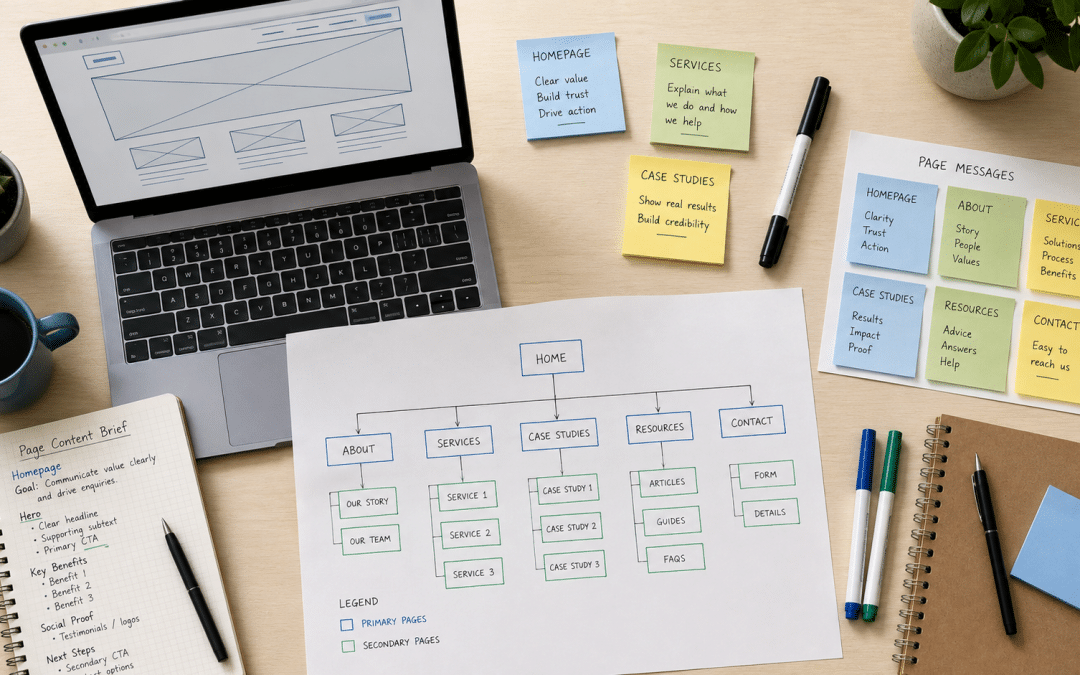
A website content strategy is the plan for what your site actually says — which pages it needs, what each must communicate, and how it guides a visitor toward enquiring. It is the difference between a site that looks good but converts nobody and one that converts. For the wider build context, see our web design guide; this page is about planning the site's own words and structure, not ongoing blogging.
Most sites fail on content, not design. The layout is fine, but the messaging is vague, the pages have no clear job, and visitors leave without understanding what the business does or why they should care. A deliberate plan for the site's content fixes that — and it costs far less to do upfront than to retrofit later.
Quick Answer
A website content strategy is a deliberate plan for the content on your site: which pages exist, what each says, how the messaging is structured, and where the calls to action sit. It starts with audience and goals, maps pages to user intent, gives every page one clear job, and writes for how people actually read online — scanning, not reading. Done well, it turns a good-looking site into one that converts.
Not sure what your site should actually say? Let us help you map it out.
Get a Free Content Plan SessionWhat a Website Content Strategy Means
A content strategy for your website is the plan that decides what every page communicates and how it is structured to move a visitor toward action. It covers the pages your site needs, the message each one carries, the order that message is delivered in, and the calls to action that turn interest into enquiries — the substance of the site, not its decoration.
This is distinct from ongoing blog or SEO content. Planning the content of your core pages — home, services, about, contact — is a build-time discipline about clarity and conversion, whereas SEO content strategy is the separate, ongoing work of publishing articles to win rankings. Both matter, but they answer different questions, and this guide is firmly about the first.
The guiding idea is simple: every page should have one job and say what it needs to say to do that job, clearly. A site built this way feels effortless to use because each page answers the question its visitor arrived with, rather than dumping every fact about the business onto every screen.
Plan the Site's Words, Not Just Its Look
A website content strategy plans what each page says and how it is structured to convert — the home, services, about, and contact pages that make up the site itself. It is separate from ongoing blogging or SEO articles, which chase rankings. Give every page one clear job, deliver its message in order of importance, and the site stops looking good while converting nobody.
Why It Matters: People Scan, They Don't Read
Content planning matters because of a hard truth about online behaviour: people do not read websites, they scan them. Research from the Nielsen Norman Group found that the vast majority of users scan any new page, reading at most around a quarter of the words — which means unstructured, wordy pages simply go unread.
That reality changes everything about how site content should be planned. If visitors only absorb a fraction of the words, the most important message has to come first, headings have to carry meaning on their own, and every page has to make its point fast. A vague, front-loaded-with-waffle page loses the visitor before the value ever lands.
The commercial cost of getting this wrong is real. A confused visitor does not enquire — they leave and try a competitor whose site told them, quickly, what they needed to know. Clear, well-planned content is therefore not a nicety but a direct driver of enquiries, which is why it deserves planning rather than being written page-by-page as an afterthought.
Wondering if your pages are losing visitors to waffle? Ask us for a quick read.
Get a Free Content ReviewHow to Build a Website Content Strategy
Building a website content strategy follows a clear sequence rather than guesswork. Start with the goal and the audience: what should this site achieve, and who is it for? Every later decision flows from that, because content that is not anchored to a goal and a real visitor is just words. Define the one or two actions you most want visitors to take before writing a single page.
Next, map the site. List every page the site needs and give each one a single, defined job — the home page orients and routes, a service page sells one service, the about page builds trust, the contact page removes friction. This page inventory is the backbone of the plan, and it is where most of the strategic thinking happens.
Then brief each page individually. For every page, decide the one message it must land, the order information should appear in (most important first), the proof that supports it, and the single call to action that follows. With that brief in hand, the actual writing becomes straightforward, because the hard decisions about purpose and priority are already made.
| Page | Its one job | Primary call to action |
|---|---|---|
| Home | Orient and route visitors | Point to the right next page |
| Service | Sell one specific service | Enquire / request a quote |
| About | Build trust and credibility | View services / get in touch |
| Contact | Remove friction to enquire | Submit the enquiry |
Finally, write for the web. Keep paragraphs short, front-load the point, use descriptive headings, and cut the word count hard — a page plan that respects how people scan will always outperform a wall of text. The plan sets the structure; disciplined writing fills it in.
Website Content vs SEO Content Strategy
It helps to be precise about where website content planning ends and SEO content begins, because the two are often confused. A website content strategy governs the fixed, core pages of your site and how they convert; an SEO content strategy governs the ongoing stream of articles published to attract search traffic over time. One is about the site's structure and message, the other about topical reach.
They work together, but in sequence. Get the core pages right first so that the traffic an SEO content strategy later attracts actually converts when it arrives — sending hard-won visitors to vague, unplanned pages wastes the ranking effort entirely. Plan the site's own content, then layer ongoing content on a foundation that is ready to convert.
Core Pages First, Articles Second
Website content strategy is the fixed, conversion-focused content of your core pages; SEO content strategy is the ongoing articles that chase rankings. They are complementary, not interchangeable. Build the core pages to convert first — otherwise the traffic your articles eventually win lands on pages that cannot turn it into enquiries, and the ranking effort is wasted on a foundation that was never ready.
Writing Website Content That Works in South Africa
For a South African audience, effective site content is plain, local, and mobile-first. Most SA visitors arrive on a phone, so content has to be scannable on a small screen, written in plain language rather than jargon, and specific about serving the local market — real Rand pricing where possible, local proof, and a tone that sounds like a person, not a brochure.
Credibility carries extra weight locally. Naming real local context — your city, your service area, genuine client results, recognisable local payment or delivery details — does more to build trust than generic claims of excellence. A content plan that bakes in this specificity reads as authentic, and authenticity is what turns a cautious SA visitor into an enquiry.
A Real-World Example: Before and After
The clearest illustration is a representative SA business whose site was rewritten around a proper content plan. Nothing about the design changed; the pages were simply restructured so each had one job, the key message came first, and every page ended with a clear next step. The result was a site that finally explained itself and converted the traffic it already had.
| Metric (monthly) | Before — unplanned page content | After — strategic content plan | Change |
|---|---|---|---|
| Bounce rate | High | Markedly lower | Improved |
| Avg. enquiries from site | 18 | 31 | +72% |
| Message clarity (user tests) | Confusing | Clear | Resolved |
| Pages with a clear CTA | Under half | 100% | +100% |
| Cost of the rewrite | — | Once-off, modest | Paid back fast |
The enquiries row is the one that matters. Restructuring existing content — with no new traffic and no redesign — lifted enquiries by nearly three-quarters, because the same visitors finally understood the offer and saw a clear next step. That is the leverage a content plan provides: it converts traffic you are already paying to attract.
The Same Traffic, More Enquiries
Rewriting a site around a clear content plan lifted enquiries sharply with no extra traffic and no redesign — purely by giving each page one job, leading with the key message, and adding a clear call to action. Confused visitors do not convert; oriented ones do. A content plan is the cheapest way to get more from the audience a site already has.
The GPM Differentiator
Most guidance on website content planning stops at "write good content," which helps nobody. We come at it from an operator's seat, having built South African sites where the words on the page were the difference between an enquiry and a bounce — so our web design services treat content planning as a first-class part of the build, not a box ticked after the design is done.
For clients that means a page-by-page plan tied to real business goals: every page with a defined job, a message that leads with what matters, local proof, and a clear call to action, written to be scanned. You get a site that explains itself and converts, documented so it stays coherent as you grow. For the ongoing ranking side, we point you to the separate SEO content work that builds on it.
Who This Is NOT For
This build-time view of content planning suits most businesses, but not everyone. Being clear about that upfront saves wasted effort — so here is who should read it differently.
Anyone looking purely for an SEO blogging plan. If your question is which articles to publish to win rankings over time, that is SEO content strategy, a separate discipline. This guide is about the fixed pages of your site and how they convert. The two connect, but starting here when you want a blogging calendar will point you in the wrong direction.
Businesses wanting volume over clarity. If the goal is simply to publish as many words and pages as possible, this approach will frustrate you, because it argues the opposite — that less, clearer content converts better than more. Padding a site to look substantial works against how visitors actually read and undermines the very conversions content is meant to drive.
Those unwilling to make hard choices about each page. A content plan forces decisions: one job per page, one main message, one primary call to action. If every stakeholder insists their priority goes on every page, the plan collapses into the unfocused mess it was meant to prevent. Without the discipline to choose, the strategy cannot do its work.
Anyone expecting content to fix a broken offer. Clear content communicates a strong offer well, but it cannot make a weak or confused business proposition compelling. If the underlying service or value is unclear, no amount of writing will rescue it — the offer has to be sound first, and then content can present it at its best.
Want a clear, page-by-page plan for your site's content? Start free.
Get a Free Content Plan SessionFrequently Asked Questions
What is a website content strategy?
It is a deliberate plan for the content on your website: which pages exist, what each one says, how the message is structured, and where the calls to action sit. It starts from your goals and audience, gives every page a single clear job, and writes for how people actually read online. The aim is a site that communicates clearly and converts visitors into enquiries.
How is it different from an SEO content strategy?
A website content strategy covers the fixed, core pages of your site — home, services, about, contact — and how they convert. An SEO content strategy is the separate, ongoing work of publishing articles to attract search traffic over time. They complement each other, but you should plan the core pages to convert first, so the traffic your SEO content later wins actually turns into enquiries.
How do I plan content for a new website?
Start with your goal and audience, then list every page the site needs and give each one a single job. For each page, decide the one message it must land, the order of information (most important first), the supporting proof, and the call to action. Write for scanning — short paragraphs, meaningful headings, front-loaded points — and you will have a clear, conversion-focused plan.
Why do people say visitors don't read websites?
Because research consistently shows they scan rather than read. Studies from the Nielsen Norman Group found most users scan any new page and absorb only a fraction of the words. That is why site content must lead with the key message, use descriptive headings, and stay concise — so the important points land even when a visitor only skims, which is the norm rather than the exception.
How long should website page content be?
Long enough to do the page's one job, and no longer. Because visitors scan, padding works against you — a focused service page that makes its point quickly will usually outperform a sprawling one. Let each page's job set its length: enough to communicate the message and proof clearly, with a strong call to action, then stop rather than filling space for its own sake.
Can I write my own website content?
Yes, if you follow a plan and write for how people read. Many business owners write strong content once they have a clear page-by-page brief — one job per page, key message first, plain language, a clear next step. The hardest part is usually the strategic planning and the discipline to cut, not the writing itself, which is where an outside view often helps most.
If you are unsure whether your current pages are working or quietly costing you enquiries, that is worth checking — many businesses have never tested whether visitors actually understand their site. A quick review against the one-job-per-page principle usually makes the gaps obvious, and the fixes are often a rewrite rather than a rebuild.
Get a Free Website Content Plan Session
Tell us about your business and we will map a page-by-page content plan — each page's job, its key message, the proof, and the call to action — built to be scanned and to convert, as a one-page plan you own outright with no pressure. No obligation — we will get back to you within 24 hours.
Get My Free Content Plan Session